

Alaska Airlines is quietly ushering travelers into a new phase of airport life, one that holds significant promise, where check-in and automated bag drop are designed to function without any human interaction. That is when all goes to plan.
The airline just announced the official launch of ID verification at automated bag drop units in Seattle and Portland, but when we went through it a few weeks ago during the trial period, it felt far from seamless.
The concept sounds futuristic and maybe even appealing: the Automated Bag Drop scans your baggage tag. Then you scan your ID. Following verification, you place your bag on the belt and wait for acceptance. But what looked smooth in Alaska’s press release was something different on the ground.
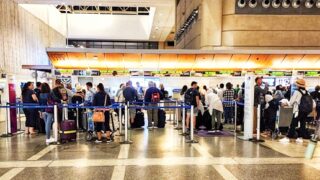
A lobby in transition at Sea-Tac.
In place of the familiar lines leading to staffed counters, there’s now a bank of strangely glowing machines, self-tagging kiosks, and automated bag drops that look like a mash-up between a security portal and a high-tech vending machine.
The day we went through, employees stood around trying to help, but many admitted they were just as confused as the passengers they were assisting.
Travelers lined up in front of the new units only to be turned away because they didn’t understand which documents to scan or how to place their luggage on the belt for the machine to work. One couple ahead of us fumbled with their driver’s licenses before an agent finally intervened, while another passenger gave up altogether and walked back to the old-style counter.
It wasn’t chaos exactly, but it was slow and awkward. Instead of speeding people through, the process jammed up lines.
Alaska’s official rollout of Automated Bag Drop.
Now, weeks later, Alaska has formally announced that its humanless bag drop experience is here to stay. Passengers at Seattle and Portland can now use ID verification to prove their identity without needing to hand over a document to an agent. The system scans an ID, takes a quick photo, and matches the two before allowing you to proceed.
Alaska states that images are deleted immediately after verification, a detail intended to address passenger privacy concerns. Still, some travelers are uneasy about where and how biometric data is handled. Even if deletion is promised, the idea of having your face scanned in the middle of a crowded lobby can feel like a big step toward an airport experience that is less personal and more about surveillance.
Ten new bag drop units and eight additional bag tag stations have been added at Sea-Tac. The airline states that this is part of a long-term lobby modernization initiative, which is expected to be completed by 2026. The admirable goal is to get passengers through check-in and into security in under five minutes.
That vision lines up with Alaska’s broader push toward self-service. Earlier this year, the airline integrated biometric verification into its mobile app through a partnership with Jumio. This digital identity company specializes in using AI to authenticate IDs and faces. It has also collaborated with TSA PreCheck’s Touchless ID pilot program, which enables travelers to pass through security without presenting a physical ID. All of this is about efficiency, cutting costs, and reducing reliance on front-line staff.
The gap between the press release and our experience.
For many travelers, especially those who don’t fly often, the idea of scanning IDs, having a photo taken, and trusting a machine with the process is intimidating. Even for very regular passengers, like us, it was odd. We overheard one passenger mutter, “I don’t like this.”
Our experience with the new system was not smooth, taking 45 minutes. We were unable to check in ahead of time because there was a prompt to see a gate agent. When we arrived at the Elite check-in area, there was no one from Alaska waiting to assist passengers. All agents were at the Automated Bag Drop or behind a counter.
That meant we could not obtain boarding passes or luggage tags and were unable to get help. We then waited in line with other passengers who did have their documents. When we reached the Automated Bag Drop, an agent had to assist with our check-in and left us standing for nearly 15 minutes while she retrieved our documents from another area. We stood to the side and watched others try to figure out how to place their luggage on the belt so that the machine could read the bag tag.
Once at TSA Pre-Check, Rob could go through, but Jeff’s boarding pass did not have the Pre-Check designation on it for no apparent reason. His Alaska number was in the record, and that is where PreCheck is stored, yet the designation vanished. What should have been quick turned into another 30-minute ordeal of tracking down three different employees to sort it out. In the end, the very human problem meant the humanless lobby saved no time at all.
That’s the real-world challenge. Alaska is hoping guests will accept new technology in a setting already filled with stress, and Seattle is definitely a stressful airport. Airport check-in is not where people always enjoy experimenting with learning curves; for loyal flyers used to human agents who can troubleshoot and reassure, being told to trust a kiosk feels abrupt.
On our visit, even with employees stationed nearby, help came very slowly because agents, supervisors, and trainers were juggling multiple confused passengers at once. The whole scene took longer than it would have at a staffed counter. Instead of being faster, at least for now, it was the opposite.
There’s no mystery why Alaska is doing this.
Airlines across the board are cutting costs by reducing staffing wherever possible. Technology enables the offloading of tasks once handled by people, and as travelers adapt, throughput can improve. Alaska is betting that its passengers will become accustomed to the machines, just as they have grown accustomed to printing their own bag tags and boarding passes over the years. They are undoubtedly correct.
This also fits with the broader shift toward biometric travel experiences. Delta has rolled out similar systems at its hubs, while United and American are experimenting with facial recognition technology at security checkpoints and during the boarding process. Airports and airlines want the same thing: more automation, fewer staff hours, and faster lines.
Still, the early rollout shows the risks of moving quickly. Without clear instructions, consistent reliability, and enough human support, passengers are left frustrated. That’s not the experience Alaska says it is aiming for, especially in Seattle, where the airline has long pitched itself as the hometown carrier.
Automated Bag Drop is a work in progress.
Looking back, our experience in the trial phase wasn’t a disaster. The bags were eventually dropped, and everyone moved along. But it was a reminder that the road to humanless travel will be bumpy and take some getting used to
The airline insists that privacy is respected, data is deleted, and agents remain available if needed. But the pressure is obvious. The long-term plan is for most people to bypass humans altogether. The staff in the lobby will be fewer, the machines will be far more numerous, and the expectation to adapt will be clear.
For travelers, especially those heading to Hawaii, where the journey already requires extra patience, this new layer could be welcome if it eventually does what Alaska promises. Getting through faster, avoiding lines, and skipping document checks might make sense if it works. But based on what we saw, that is still an aspirational work in process.
What’s next for Automated Bag Drop?
Alaska says the lobby modernization in Seattle will continue through 2026. More machines are being introduced, and the airline is continually refining the ID verification process. Eventually, this will likely spread beyond Seattle and Portland to other hubs. The question is how quickly passengers will adapt and whether the system will actually deliver the promised speed.
For now, what we saw and what Alaska has announced remain two different stories. The airline wants travelers to picture themselves gliding through the lobby in minutes. The reality today is lines, confusion, and passengers scratching their heads in front of uncooperative machines.
If history is any guide, though, the awkward start will not stop the change. Much like self-tagging bags or mobile boarding passes are handled with ease, what feels clunky now may become the norm in just a few years. The transition is underway, whether passengers like it or not.
Have you tried the Automated Bag Drop? Please share your comments with us.
Lead Photo Credit: Beat of Hawaii at Automated Bag Drop in Seattle.
Get Breaking Hawaii Travel News


I got the transition early as my flights that I booked on Hawaiian were changed to Alaska after we purchased them.
On the flight from PDX to OGG, it simply wouldn’t work, at all. Couldn’t find using ID, credit card nor booking code. Had to get in line and wait to have everything sorted out.
On the return, the baggage tags were messed up and the gate agent had to re-do two.
I have to say that mainland/Hawaii travel has gone to the dogs. From my early flights to / from in my college years on Pan through my visits home while in the military to today’s business trips to reunions and family travel, airline travel now sucks big time. From uncomfortable airline seats, to long waits for flight delays to dirty airline terminals, costly flights that charge for everything, etc. I hate traveling anymore and refuse to do it.
I used the automated bag drop at Sea-Tac. There is a bit of a learning curve the 1st time, but I think once passengers get used to it, the process will be faster. Overall, I was impressed. Put on luggage tags, scan your ID, then put a bag on the scanner conveyor belt with the tag clearly visible. After that, the bag gets whisked away! We’ll see if the process becomes more streamlined, but it was a fairly fast process for us.
It went smoothly at PDX in June.
IMO wait the airlines will use this as a way to streamline or make the system operate faster. Then they will state without it we would have to raise ticket prices. Then finally they will raise ticket prices stating the cost of this new process has to be paid for by raising ticket prices so profits will not be affected. With all this hassle wouldn’t it just be easier and more personal just to train Elon Musk’s Robots and have them be the baggage handlers that can detect weight by just picking up a suitcase or object? No paycheck or benefits required.
We have been using it in Portland for about a year now. The first trip was definitely a learning curve, now it goes pretty quickly. There still agents there helping people, but we’re about to drop and run on most trips.
Hawaiian has had this for Years. Flying them out of Honolulu is a nightmare unless you’re Gold or Platinum, because of how long the bag drop lines are.
And what happens when a bag is over weight (50lbs)? In Kona, they have semi-automatic bag tag and check-in. kiosk to get your bag tags but a human weighs every bag before it goes on the conveyor to make sure it meets weight requirements. The process runs fairly smoothly until there’s a bag issue. Then there is a hiccup and some delay depending on how much repacking is required.
QANTAS (Aussie airline) implemented the same thing decades ago[1]. It took a few months for the regular flyers to become proficient in it’s use – and from there you would claw that capability from their cold, dead hands.
Add to that the staff also became proficient and therefore could invest time to support those non-regular flyers with high-touch service.
Guess what happened? I’m certain you’re not surprised to hear trusty check in times sped up, customers didn’t have to deal with overworked gate agents and more time was spent in lounges 🙂
[1] After 12 years living in the US I’m still shocked at the lack of technical innovation in the airline industry – an extraordinary amount of time is wasted on check ins, security etc – and all the required goals can be met with tech that’s existed for decades….
Sad to hear the problems still exist. We tried Alaska’s automated checkin going through Portland last January. It was a complete mess. We had upgraded to First Class so we hoped there might be a little extra help but the few gate agents that were present were overwhelmed. It took far too long to check in.
I think you are right..the airlines are offloading traveling tasks to the travelers. They don’t really have to care that much if they waste our time.
Thankfully, the new Portland Airport is beautiful so that helped us regain some calm after the horrible checkin experience.
Instead of self checkout in a grocery store the airline just made it self check in. Next only a kiosk will be provided for self purchasing tickets without any agents or representatives. If this is the case let me serve me my own drinks and food just like a buffet style restaurant also.
It’s as if you two were our companion pass when you write about Alaska trips lately. We live in the NW so Alaska is kind of our default airline, and we have had no luck with the automated bag system at PDX. The first few days it was chaos, When we were there, only one of the eight or more automated stations was working. The rest were manned by agents hand entering information. The bag scanning was like a comedy routine (turn it this way, no that way). We’ve never been to PDX yet where the bag scanners are actually all working as they should. In Europe, however, they all seem to work great – so there’s hope we will get it right someday.
In reading others’ comments, it seems like there is some confusion about what is actually newly deployed technology and what is not. At SEA, I think that automated ID verification was deployed only this month, i.e., August, 2025. Several commenters stated they used this technology months ago but I don’t think that’s possible.
What has been deployed for a while is multiple machines for printing bag tags. One could scan a boarding pass and easily print bag tags for the reservation. The next step was to get in a line, which was often long but did move fast. However, a human verified passenger IDs. There was no need to have the bag tag read by placing the bag a certain way on the belt–a human scanned it. There was no need to scan your ID or have your photo taken. What the BOH editors describe in this article is a totally new and different system.
I am flying AS later this week. I may try to use a human-staffed elite check-in line!
Seatac is our “home” airport and we fly Alaska almost exclusively. The several times we have used the automated bag drop have all gone smoothly. When the airport is super busy is when this system really shines. Long lines moved quickly through the process with airline reps doing a good job controlling the flow.
As to TSA precheck, I can offer up my own experience. I got frustrated that I had to enter our KTN’s every time we checked in. Then awareness dawned (aha!) and I realized that I had to go into our Alaska customer profiles and enter them. No problems since then.
I see this as the future normal protocol. If you have to associate with an agent or front desk representative then wait sorry fee or up charge will be charged. If no human interaction is needed then where is my discount or whatever because the passenger is doing all the work.
Further reason to carry on whenever possible and have your boarding pass on your phone
I think the whole point people are missing about this automated self-serve check in and bag drop is that people are losing jobs. We basically have no human contact. Our lives are being run by computers and socialmedia. And, we are all becoming Walle’s. If you don’t know what that is, watch the movie! It’s not that I’m incapable of using it. I don’t want to use it! It, AI, and all this other automated garbage is ruining society. No one knows how to communicate in person any more. Customer Service is gone. Whose job is next on the chopping block while everyone is celebrating and embracing this nonhuman contact automation???
When I go to a grocery store, I prefer human cashier instead of self-checkout. Once I told the cashier that I hope it adds to their job security. To my surprise, she told me that those employees overseeing and assisting self-checkout actually get a higher hourly wage!
Luddites had a problem with advancing technology more than 200 years ago. Resisting it never worked. It’s unstoppable and and inevitable step in the evolution of any civilization. Whether we like it or not, doesn’t matter. It is going to take its course, no matter what.
We absolutely hated the non-human contact bag drop and check in! We might as well fly the plane as well at this point! Cost savings for who? Certainly not the traveler!
The incompetence of Alaska while doing this (agents unprepared to help, systems not functioning, check-in not working) made me and my wife to miss a flight. Arrived hours before at PDX and the staff was still unable to process our check-in in time. No one able to assist, call passengers, scan documents. Absolute disaster.
This system has been in test mode at SEA for several months. we experienced this nightmare in late April; it was an abject disaster. All the issues you experienced, we experienced: lack of knowledgeable staff, confused flyers, problems placing the luggage on the belt to assure proper sscanning, etc. Just what has Alaska been doing to improve all these months? Apparently, nothing.
I have used the new bag drop
many times without any issue,.
Last week the lines were long but moving smoothly in SEA.
As for not having PRETSA on your boarding pass my understanding is that you are not always guaranteed to get it.
This is the first time I hear you’re not guaranteed to get it. Once your TSA number is entered into your Hawaiian or Alaska account, it’s there for as long as it’s valid and TSApre should automatically show on your boarding pass.
Incorrect, TSA Pre is not automatic nor guaranteed even if entered
It is true that TSA doesn’t guarantee you will be allowed to use the Pre-Check lane every time, even if there are no issues with your enrollment. I have had this happen once or twice over more than 10 years of enrollment. Think of it the same way you are occasionally randomly selected to be patted down or go through the scanner, i.e., the metal detector beeps not because you are carrying metal.
Returning from London Heathrow airport recently, automated bag drop was the standard there. It was a little intimidating for us. They had an agent there to help, but they were a bit impatient with us. It didn’t take that long and it would seem that one you got used to the process it would be easier. I recall that positioning your ID correctly (passports for us)was the most difficult part.
@Ellen–Standard check-in at LHR has always been a pain in the a$$, irrespective of which airline I was flying. This includes PanAm, United, and BA, going back a few decades. It seems like automation would be a good idea there. I remember standing in horribly long lines with agents just standing there, seemingly doing nothing, and then finally calling for the next passenger. It was terribly frustrating. The only positive experiences I have ever had at LHR were when I was able to use the Virgin Atlantic Upper Class entrance–but I am betting that Virgin’s standard check-in is just as bad as the others. Glad to read your report–it gives me hope!
Got to try their automated bag drop at PDX and Loved It! It was our first time flying Alaska so we didn’t know it was something new. So easy and so quick! There were a couple of Alaska agents nearby to assist if needed, but we didn’t see anyone have any issues.