

For years, we had heard the back road to Hana described as rough, risky, and not worth the trouble. It was something people suggested you tolerate rather than enjoy. Residents discouraged it, too. Our recent visit completely shattered that impression. This became one of the most beautiful and memorable drives we have taken anywhere, not just on Maui, and it reshaped what we thought we knew about getting to Hana.
We began the drive from Upcountry Maui.
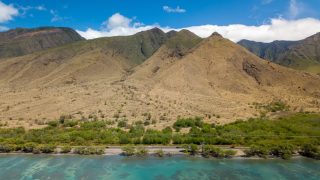
The transformation starts quickly once you leave Upcountry and head toward Kaupo. The landscape opens into wide, rolling hills that feel nothing like the dense rainforest environment most visitors associate with the traditional Hana Highway. Then the terrain shifts into something almost desert-like. The colors wash into browns and muted greens. The air becomes warm and still. It felt like crossing into a different ecosystem entirely.
What surprised us most was a distinct line on the mountainside where the moisture begins. One side is pale and sun-bleached. The other suddenly turns emerald green. Driving through that climate boundary felt like watching Maui change in real time.

Road conditions may surprise you.
For years, this road carried a reputation that no longer fits. It is mostly paved now, the unpaved sections are short, and the narrow parts feel similar to what you find on the traditional Hana Highway. The biggest difference is the lack of traffic. We encountered fewer than a dozen vehicles over more than an hour, which gave the drive a calm and relaxed pace.
Dry weather shaped our experience, but people over the years have described seeing the road in very different conditions, especially after rain, when puddles or soft spots can appear on the unpaved sections. On the day we drove it, everything felt smooth and well-maintained, which made the old reputation seem out of step with what we saw.
What “our” rental agreement actually said.
One other detail we checked carefully before taking this route was the car rental agreement language, because that is where many visitors rightfully get nervous. Every company and contract can be different, so this is not a blanket statement and you need to do your homework. In our case, the Alamo terms we accepted referenced permitted use “on a paved public highway or a suitable graded public or private road, except in an emergency.”
We mention that only because the back road we drove was almost entirely paved, with just one very brief graded section, which helped explain why the drive felt straightforward in the dry conditions we experienced. Anyone considering this route should look at the exact wording in their own rental agreement, since that is what governs them, not this article nor what was in our contract.
For this trip, we rented a four-wheel drive vehicle. The only time we needed that was when we drove down to Huialoha Church, which is also visible from the highway.

The coastline opens up.
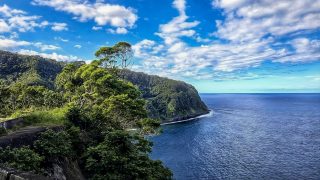
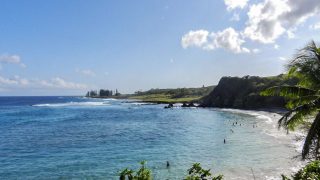
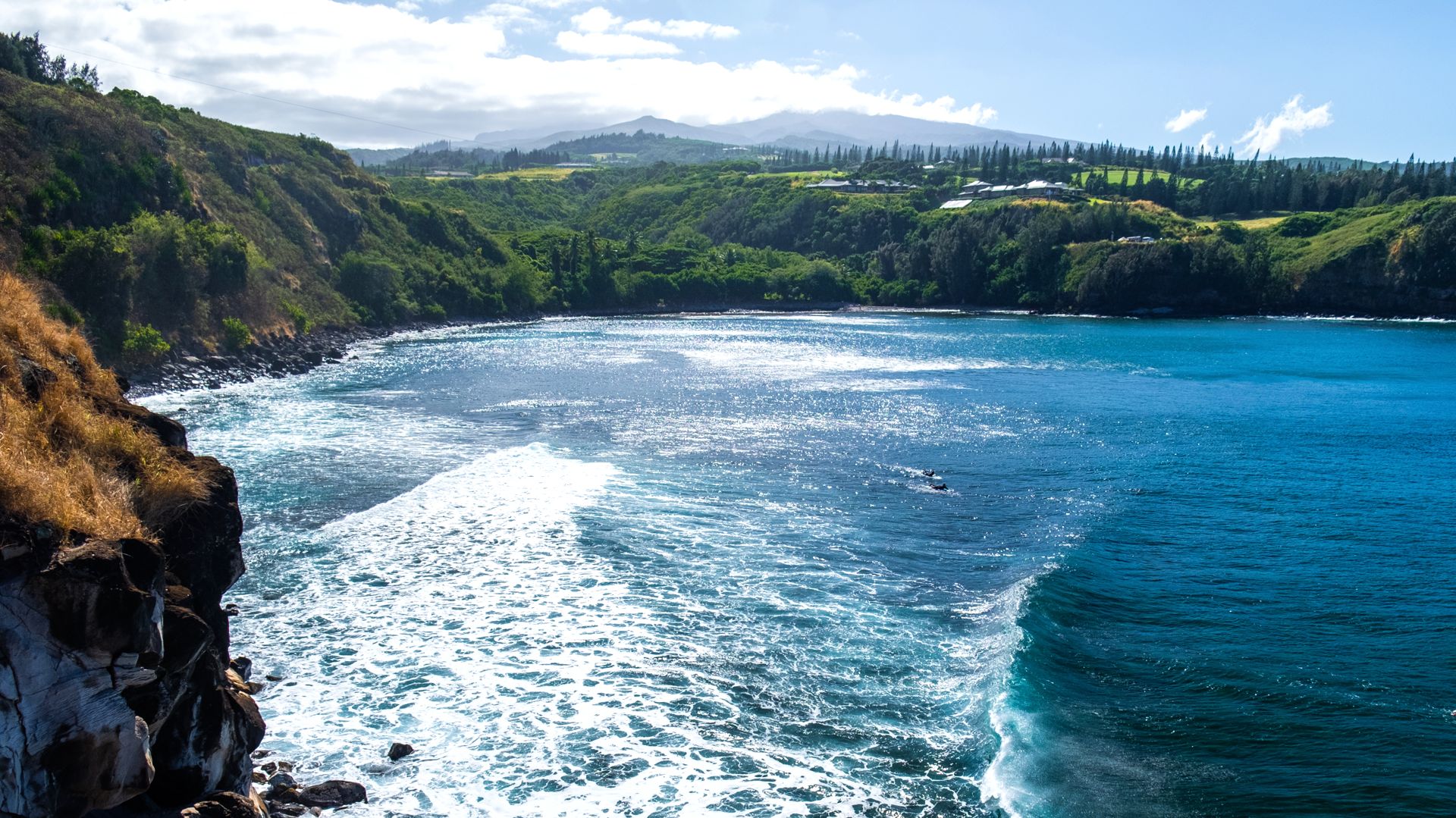
Along the coastline, the road becomes dramatic. Cliffs fall away to the ocean, and long views stretch out in every direction. The light shifts constantly, creating moments that seem to reset the landscape each time you round a turn. We stopped many times to take photographs and will include some of those in the article because the pullouts along this route were as good as anything we have seen in Hawaii.
The rural communities along this stretch add to the feeling of another time. Small churches like Saint Joseph and Huialoha, clusters of homes, and long empty spaces between them show a quieter Maui that still exists out here. It feels far removed from the busier parts of the island, yet completely connected to its history.

Approaching Haleakala National Park’s Kipahulu District.
As the vegetation becomes denser near Kipahulu, the sense of moving back toward Hana grows stronger. The solitude of the back road gives way to signs of activity. Near the turnoff to Charles Lindbergh’s grave at Palapala Ho’omau Church, sits a well-known fruit stand run by a local family called Laulima Farm. It had unusual varieties of fruit and a small crowd when we arrived. Colin, who works with us, recognized it instantly when we mentioned it later. It felt like the place where the quiet of the back road finally intersected with the rhythm of Hana.

Kipahulu is next, part of Haleakala National Park, with the visitor center, cultural programs, and the Pipiwai Trail that leads to Waimoku Falls. We did not stop on this trip, but for many visitors it remains a familiar marker on the way into town. The Pools of Oheo are here too, although they have not been open for swimming for years. Even without stopping, the transition into this greener part of Maui signals that Hana is getting close.
A short drive further is Wailua Falls, 80 feet high, right off the road, with a plunge pool at the base.

Our time in Hana.
We had to skip Hamoa Beach because of time, and stopped at a beach park we have enjoyed for years, and brought a picnic lunch. Sitting there reminded us of how charming Hana still is, even with the changes on the island. Because we did the full loop in one day, during shorter days in December, we did not have enough time to explore as much as we wanted.
The drive in along the back road with stops took close to 3.5 hours. The drive out later along the traditional highway took another 2.5 hours. Staying in Hana for several days is now high on our list because the town rewards visitors who slow down and stay a while.
Another thing stood out. Everything felt welcoming. We have heard comments from visitors in recent years about changes in sentiment on Maui, but we did not experience anything negative at all. The only visible regulations were cones placed along certain areas of the Hana Highway to prevent unsafe parking, which makes sense for emergency access. Beyond that, the atmosphere throughout Hana was calm and friendly.
The traditional Hana Highway still matters.
Leaving Hana in mid-afternoon gave us a very different perspective on the drive out. The highway is often crowded in the morning with people trying to get an early start, but at this hour, it was quiet. There were no long lines of cars and no backups at the narrow sections. It made the drive peaceful and efficient.
What surprised us was how drought has reshaped parts of the traditional route. The lushness most people expect from the Hana Highway was noticeably muted. The waterfalls were less dramatic than we remembered. The drive remains beautiful, with the same magic that made it famous, but the contrast with the back road was striking.
The back road to Hana is not about a list of attractions.
It is about the experience of moving through landscapes that shift dramatically in short distances. It is about quiet roads, unexpected scenery, and a sense of discovery that is becoming harder to find on Maui. For us, this drive became one of our favorites in years.
If you have driven both routes, which one stayed with you longer and why?
Photo Credits – Beat of Hawaii
Get Breaking Hawaii Travel News


We recently did the backroad. We went down a mile past those huge gulches, then I insisted we turn around. My husband loves to drive and was angry with me for being so nervous. It was wonderful that the road was paved since our last trip 8 years ago. We’ve done this road for years from 70s until now but this year, it was paved, now
my sense of adventurer is non existent. So,if you are an edgy driver or passenger, do not attempt.
I hope this road does not become popular, as it can not and will not hold up to,heavy tourism. It is meant for slow, intentional nature loving individuals , not those that want a social media like. I have no idea where the paved road ends but I remember even back in 2016, the road was scary and gravelly but doable for us at 65 years. Now we are older, the road is in better shape, but I am fearful.
Interesting, as a “local” the only thing we suggest to family, friends or tourists we run into Is to do the back roads. lol
I did the regular route many, many years ago as a tourist and said never again, even after driving around cliffs in Romania/Switzerland!
So yeah, back way is The way, imho.
I drove that road/loop the same way you did probably 15 years ago. It’s exactly like you say, beautiful and I them we say 6 cars and three were county vehicles. It’s slow driving due to patchy roads but it was paved most of the way. But that’s part of what made it enjoyable. Great drive and I would definitely do it again.
No! The back road is deadly now. Head-on collisions are much more likely now because the newly paved sections encourage much faster speeds over blind hills that are one-lane wide. Last time I went that way I was going slowly and still came within inches of two different head-ons. That road should be one-way from Hana to Kula except for Kipahulu and Kaupo residents.
Has that road been re paved? We drove it several years ago, could not go over 20 mph due to crazy mounds of oiled gravel most of the way to Kipahulu., not really a paved road. Gorgeous scenery though.
Traveling there in 2026. Hearing disturbing news when it comes to tourism. Hawaii making cost to visit more. Surprised due to fact that it is so important to the state.
I traveled opposite, driving towards Kula from Hāna. What stunned me the most was the beauty of Kaupō! Though I have to admit as a passenger, it was nerve wracking for me as a few times we’d come around a cliff and have to reverse. Maybe next time I’ll rent a motorcycle!
Still, be careful. I knew a resident who left Hana to go back toward Kaupo on a rainy night and got swept off the road, vehicle never recovered. And the drive can be tricky, not for the faint of heart (or the seriously safety-minded).
It’s good to hear it’s more paved now, because 5 years ago when driving it there was very little until almost all the way to the winery.
The road was narrow back then and only one car wide at times, and as all experienced people in hawaii know, just like the one lane dirt thru the west maui mountains its only one way (clockwise) travel that’s expected.
The back road as you identified is far less scene as has way less roadside waterfalls, but i think people should try it once when leaving hana and heading back.
And don’t forget to stop at the church and see the site where Charles Lindbergh was buried (because he loved maui so much).
Much less stress than the North route and no car-sick passengers!
The coastline is wild and no small waves come off the ocean.
When it’s rained, there will be muddy ruts, so be careful
We did the back road to Hana in July. Our experience was the same, it was a very peaceful drive. I will comment that it probably isn’t the right road for many though. Where I live, there are lots of roads like this, long stretches of one lane paved with pull outs. For those that are not used to it, the road can be a challenge. One needs to know that you will have to be aware at every corner, and be ready to make a lengthy back up to let traffic by. If you’re not comfortable with both, don’t go there.
Just wish we could still visit Nahiku landing off the traditional road to Hana.
Why the heck would you tell folks about this. The same thing happened with the bamboo forest on the other side. That closed for a few yrs . Please for the love of Buddha. Keep our secrets secret
It is not only the state of the road to consider (paved, curvy, etc..) when thinking about safety, but the accessibility and response time of emergency services if needed. The back road is not as frequently traveled nor monitored like the main road to Hana, and there is spotty cell connectivity. That is the main reason I do not recommend it to visitors.
Aloha Guys, Glad you were over here to enjoy yourselves. I admit I am sorry you wrote about the back road, as now more people will come. everyday we lost a little bit more of Maui to tourism and development. Hard to watch, as I know it is for you on Kauai. Anyway – the real reason I wrote is the back road is not as benign as you paint it. sure it is beautiful and can be stress free…and then…! I cant count the times it has been flooded, rocks falling on the really tight cliffside curves, very precarious and even closed. If they have not mowed the grass on either side there can be no visibility. It can be a white knuckle drive for sure. always check to see if the road is open. I would say if you like adventure and are willing to be courteous as a lot of it is one way, ok. if not the other way in is beautiful and not life threatening (except during big storms that have washed cars to the ocean) tho it is often really crowded. Either way Hana is special.
Aloha! As much as I’m confident your experience was memorable and heartfelt, this article and the attention it brings saddens me. So little is left of “old Hawaii.” Perhaps it’s not all meant to be shared—or at least overrun-by visitors. Just a thought.
I’m surprised you didn’t mention the spectacular views of Big Island, especially from Charles Lindbergh’s grave (which deserves a separate article). IMHO the views of Big Island from there are better than from the Haleakala summit.
The view from the summit is more consistent though. The day we visited Linbergh’s grave was cloudy and we couldn’t see the BI. We did from the top, and we did on the day we drove the back road and visited the churches.
It was a nice full circle for us. We visited the BI in ’23. I had an incredible view of Haleakala out the right side on the way into Kona, and then again when going from Kona to Lihue. We went out to the Northern tip of the BI and looked across to Maui. The same for visiting the top of Mauna Kea. Visiting Maui and being able to look the other way across the channel was cool.
Yes, but it’s not uncommon to have the Haleakala summit in the clouds or above the clouds which can significantly limit the views of both Maui and Big Island. You need to plan according to the weather, just like so many other things on almost every Hawaiian island.
And yes, both Maui and Big Island offer terrific views of one another. Hard to say which is my favorite, but there is something special about that South side of Maui which makes that trip a much deeper experience.
I drove that route the opposite way (clockwise) from the editors. Because I was spending the night in Hana I drove the traditional route slowly, making stops along the way. The next day, because it hadn’t rained in several days, I drove the back way out. I stopped at Charles Lindbergh grave (the driveway is very, one car, narrow), and The Pools of Oheo (you could swim in them then). The unpaved portion was an 11 mile graded stretch that I drove at about 15 mph since it wasn’t really smooth enough to go much faster in a car. The only encounter with another vehicle was with a large pickup truck, and we each moved as far to the sides as we could and squeezed by each other. It was a memorable drive, with so much relatively untouched land and broad vistas, it is a different Hawaii. One can only hope it stays that way.
Aloha
Well, 2 years ago, a trip to Hana on the back road ended up being a day and night of danger and terror for the couple in the story for which I’ve provided the link. I still can’t get this story out of my head.
Aloha Gloria!
That story from June 2024 still haunts me too.
Imagine running up the side of the volcano for 24 hours after being car-jacked by a gun-toting thug.
Way too isolated for me.
we have driven the round trip many times over the past 20 years . When there were several strips of unpaved roads i would have to drive very slow and stop every so often to move a rock so i would not damage the rental, it added to the adventurer we would get to the winery close to sundown and knew we were going to get home safely. I have pictures of cows next to the road . Today i wish we had stayed a few days in Hanna. The more times you make the trip the slower you go and the more you see . Going to Hanna first gives you better sunset pictures but more traffic in the morning.
Around 2015, while wasting time before we had to leave, we drove that same road ending at Manawainui Gulch, because that’s where the dirt road started. The site at Manawainui was beautiful. From where we stood, looking down towards the shoreline, I was able to make out the site of an old fishing village.
Back road to Hana:
Love this trip
Highlights
Charles Lindbergh grave, Church and park
Haleakala State park with bamboo forest trail and spectacular water falls
No traffic going there, and you beat the return traffic crowd by returning from Hana earlier
Kudos to the writers of BOT for sharing this with all the readers! It’s a secret that’s out now, but it’s much better route for all. I’ve been telling everyone to take the back road to Hana for years! Aloha.
My husband and I drove the back road to Hana after coming in on the main road and spending the night in Hana. I couldn’t agree with this article more! We had no idea. It was so quiet and peaceful and we took our time and stopped along the way. There cows and rolling hills and little churches and this was 10 years ago so there was a fair amount of dirt road and never once were we even remotely worried about not making it around the island or running into hostile locals. It was one of the highlights of our trip. Now when we go we always stay in Hana for a couple of days-brought our adult kids to enjoy too. It’s so worth doing. Magical.
Great article and certainly worth a try, depending on your car rental agreement as you clearly described. Might actually be worth calling other agencies than the one you rented from to see what their policies are for a couple day extra rental to allow this pleasurable sounding drive.
My heart just skips a beat hearing you talk about this drive. One of my favorite places on the planet. Actually it feels like you’re not on our planet. We just adore this drive and could do it every couple of years when we get to go to Maui. About 10 years ago, we stayed at an Airbnb right next to the Charles Lindbergh gravesite. In the 60s/70s it was a yoga/hippie commune we were told. But now it was small cabins as well as yurts. Perched up on the cliff overlooking the ocean towards the Big Island. Unbelievable. An experience we will never forget.
Thanks for this story. I drove the back road many years ago although going clockwise after leaving Hana and my impressions were similar to yours. It was a unique experience and worth the effort.
Dear Rob and Jeff,
Wonderful article that brought back memories. We too decided to “drive the south loop. Some highlights include waterfalls, banana bread and the peaceful atmosphere in Hana. We had the adventure of the rescue of a young couple that had broken down. There was no cell service for most of the drive.