
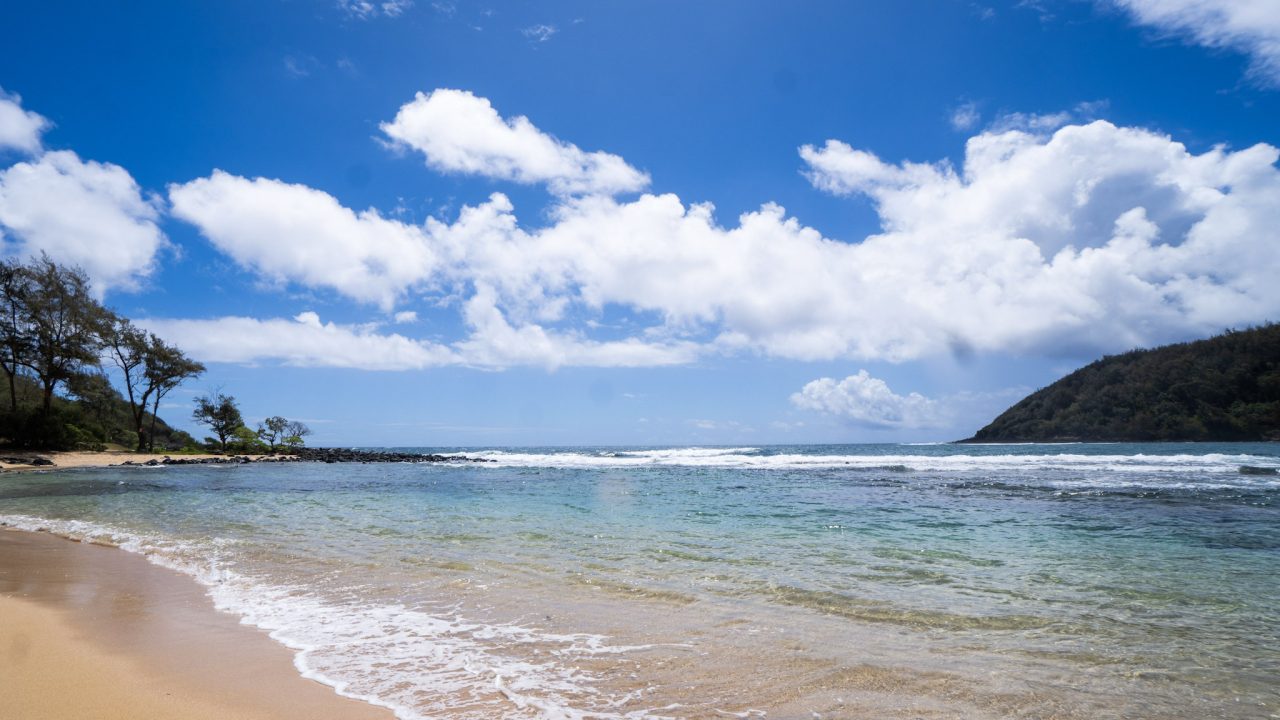
A 30-year-old visitor from Oklahoma drowned on Kauai’s north shore this week at Moloaa Beach, the latest in a pattern Kauai residents have watched repeat for decades. The beach looks calmer than many of Kauai’s better-known north shore beaches, but the shape of the bay is exactly what makes it dangerous.
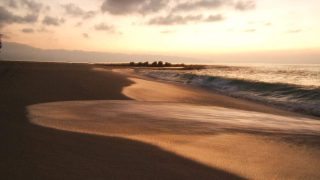
Moloaa has specific conditions that longtime residents know to read carefully. Visitors arrive expecting a sheltered north shore bay that looks gentler than Hanalei, Tunnels, or Lumahai. The beach photographs beautifully. The horseshoe shape looks protected. The center of the bay often appears calmer than the edges. Visitors may see that as safety, while Kauai residents read it as potential danger.
Moloaa sits about 22 miles north of Lihue, past Anahola and just beyond mile marker 16 off Kuhio Highway. Visitors reach it by turning onto Koolau Road and then Moloaa Road, dropping into a quiet valley with little sign that the beach at the bottom carries a reputation longtime residents know well. There are no lifeguards. No facilities. No restrooms. Parking is limited and can fill quickly on weekends, especially when conditions look inviting from shore.
The beach is also famous for something completely unrelated to ocean safety. The pilot episode of Gilligan’s Island was filmed there, and to this day, some visitors still occasionally arrive because of that connection. But the beach locals describe to each other is not the television version. It is a place where the ocean geometry tricks people into entering exactly where they should not.
Why Moloaa looks safe and is not.
Moloaa Bay is shaped like a broad horseshoe, with the reef protecting both sides of the beach. When swell wraps into the bay, the reef breaks much of the wave energy along the two sides. From shore, that can look reassuring. The sides appear rougher, while the center of the bay often appears smoother and calmer. Visitors naturally drift toward the middle because it appears to be the protected part of the beach.
The calmer-looking center is frequently where the water collected inside the bay funnels back out through the reef opening. The reef absorbs energy on the sides, but the water still has to escape somewhere. That outward-moving current forms the rip channel that visitors often enter without realizing what they are looking at. The rougher-looking sides near the reef are often where experienced residents stay because the current flow there is generally weaker and more predictable near the shore.
The bay also changes quickly when the surf rises even moderately. Residents have long described Moloaa as manageable only under genuinely calm conditions and dangerous once the ocean starts to build. Unlike some famous Kauai danger zones, the threat at Moloaa does not announce itself dramatically from the sand. There may be no huge shore break. No giant visible surf. No obvious visual signal telling a visitor to stay out. The danger lies in the current structure beneath the calmer surface.
The other problem is runoff. Moloaa Stream empties directly into the bay near the north end of the beach, and the valley receives more than 60 inches of rain annually. After rainfall, runoff flows directly into the ocean carrying sediment, bacteria, and debris. The Hawaii Department of Health advises staying out of ocean water for 48 to 72 hours after significant rainfall, especially near stream mouths and runoff zones. The same runoff pattern affects Hanalei and other Kauai beaches after heavy rain, but Moloaa is remote enough that most visitors never see monitoring warnings or updated advisories before entering the water.
What locals know that visitors never learn.
Longtime residents have repeated the same Moloaa swim guidance for decades. Swim only near the south side of the bay. Stay close to shore. Never go beyond the reef line. Never swim out through the center. If conditions are not genuinely calm, stay out entirely. That knowledge circulates resident-to-resident on Kauai, but most visitors never encounter it before arriving.
The pattern when something goes wrong at Moloaa tends to look similar. Visitors see calm-looking water in the middle of the bay, swim outward, get caught in the outbound current, and suddenly realize they are moving away from shore faster than expected. Rescues at Moloaa have been described by surfers, fishermen, nearby beachgoers, and strangers who happened to be present when swimmers got pulled out. The details vary from incident to incident, but the basic story is consistent.
Part of what makes Moloaa deceptive is that it does not carry the same warning reputation as places like Queen’s Bath or Hanakapiai Beach. Visitors often arrive at those locations already expecting danger because guidebooks, social media, and travel warnings have conditioned them to be cautious. Moloaa rarely appears on those lists. It is usually framed as a quiet local beach, a scenic north shore stop, or an uncrowded bay away from Kauai’s better-known destinations.
That disconnect is part of why we have never swum there ourselves despite living on Kauai for years. Residents here tend to develop mental maps of beaches that look inviting but are not trustworthy for casual swimming. Moloaa sits on that list. The issue is not that nobody ever enters the water there. It is that the ocean at Moloaa demands local reading skills many visitors understandably do not have.
The other Kauai beaches that share this pattern.
Moloaa is not unique on Kauai. Lumahai, Kalihiwai, Larsen’s Beach, and other smaller north and east shore beaches share the same visible-versus-actual gap visitors face at Hanalei and elsewhere on the island. The danger often has little to do with giant surf and everything to do with currents, runoff, steep drop-offs, shifting sandbars, or the complete absence of lifeguards.
Many of Kauai’s most beautiful beaches are also the least forgiving because they appear calmer and less intimidating than they really are. The famous beaches at least tend to have infrastructure, lifeguards, warning systems, or enough people nearby that trouble gets noticed quickly. The smaller beaches often have none of that. Visitors arrive with guidebook expectations, but the ocean is operating under local rules instead.
What Kauai visitors should actually do.
Visitors who want the safest swimming conditions on Kauai should stick primarily to lifeguarded beaches like Poipu Beach, Kalapaki Beach, Lydgate Beach Park, Hanalei Bay, when conditions allow, and Salt Pond Beach Park on the west side. At unlifeguarded beaches like Moloaa, the safest assumption is that the ocean is more dangerous than it appears. Do not swim alone. Do not enter the center of a horseshoe-shaped bay where the water looks unusually calm compared with the surrounding areas.
Do not swim after rainfall because both runoff contamination and current strength increase quickly. Do not assume surfers in the water mean swimming conditions are safe, because surfers are reading waves and current structure differently than casual swimmers do. And if longtime residents are staying close to shore or avoiding the water altogether, visitors should pay attention to that signal.
What this week tells Kauai visitors.
The Oklahoma visitor who drowned Wednesday became another visitor caught by conditions Kauai residents have learned to check carefully. What often goes wrong at Moloaa was familiar long before this week. The beaches that catch visitors off guard are often not the famously dangerous ones. They are the beaches that look calmer, quieter, and more approachable than they really are.
That contradiction is what most drowning coverage fails to explain. A news report can tell readers where and when someone died. It usually cannot explain why one specific beach keeps producing the same kind of issues across generations. At Moloaa, the answer begins with the geography, includes the absence of lifeguards, and ends with a piece of resident knowledge most visitors don’t receive before entering the water.
If you have swum at Moloaa Beach or another unlifeguarded Kauai beach, what did you wish you had known before you entered the water? Please tell us in the comments.
Get Breaking Hawaii Travel News


Good article. Moloa’a Bay is amazingly safe to swim at when calm on the north and south side. It is one of the few beaches that inside the protected zone on the north or south side, there is Zero waves and Zero current. So safe that even babies can swim there with mother and father and often is a daily occurrence on calm days with local families. Have been local to Moloa’a Bay for years. Unfortunate the situation with this visitor and we wish his family the absolute best. However the incident is not indicative of Moloa’a Bay on a regular occurrence, simply when it is stormy (we have had heavy rains the past week) and heavy current. Not a day to swim. Rest in peace.
Signs have been used forever to warn people about dangerous conditions, but this article makes it sound like they have not been discovered yet on Kauai. I know that places like Barking Sand are loaded with warnings about conditions, and Kauai has been famous for dangerous beaches for years, so DUH.
Hi, your comment is extremely insensitive to the family who is currently grieving the loss of their, spouse, son, brother, nephew, cousin, and friend. As read in the article he was a visitor and was not aware of the ocean conditions. This comment is distasteful and unnecessary. I really hope you can find some compassion because it pains me to see this comment. It costs nothing to keep things comments this to yourself.
In the Spring of 1970 while swimming at Ke’e beach, I was suddenly being swept out to open seas. I was new to the Pacific Ocean in Kauai and unaware of danger.
A young local man saw my dilemma and he quickly swam out beside me, calmly explaining that I was caught in a rip current. He advised me to swim parallel to the shore beside him and follow him to safety.
He saved my life. I learned from his wisdom about how to read the ocean.
Many years have passed and I still recall his bravery and his kindness.
I have talked story about this to my children and my Grandchildren, sharing the wisdom for my generations.
I often wonder where he is and wish I could say Mahalo, honoring the kindness of a stranger.
Early on (years ago) we spent several vacations (first 3 trips to Kaua’i) in Moloa’a (unfortunately in illegal rentals, we didn’t know until later). I watched the water, watched the locals and from that knew to swim over on the left/south, near side of the reef. I didn’t know … just observed … before we ever ventured into the water. Loved the shade under the big tree, laying and listening to the water. That’s my Happy Place.
So unfortunate for someone to lose their life in such a beautiful location.
Love Moloa’a. Just can’t stay there any more now that we found out about legal and illegal. We’ll drop into Moloa’a and enjoy and remember whenever we are on island. The lagoon and the nightly return of the birds is magical.
Love Moloa’a. Glad we were able to enjoy it as many times as we did (through our own ignorance). Glad the locals get to enjoy it. We saw many a night diver go out to the north side … I marveled at their courage.
We love Moloaa beach to just sit or stroll along the shore and watch the waves, usually for a picnic lunch that we often purchased at Moloaa’s fruit stand (when they were open). We have been there so many times and never thought it would be a safe beach to swim at, and we have only occasionally seen a few on the south side venture into the water.
Moloa’a fruit stand isn’t open any more??? We’re going in Oct, we always stop there.
Why can’t we put up warning signs? Tourist need to be informed somehow before entering the water. I wonder why this hasn’t happened yet.
Where does the current take you on the North shore? I’m presuming that this is a local current out the bay, but once you’re out there, where is the general ocean current going?
I’m assuming that the swimmer either doesn’t have the endurance to keep going, or makes the mistake of trying to fight the current and exhausts themselves fighting it.
Most visitors are unaware there is a channel in the middle of that reef. There is also a channel at Anini Beach and also at Larsen’s Beach. Those channels mean you can’t rely on the reef to protect you from strong currents and outward pull to the open ocean. I was shocked at the number of drownings in Hawaii this week.
Excellent point.
There is one at either end of Tunnels beach too. I noted them when I visited the first time in person. They’re easy to read if you know what to look for.
I’m reminded by an incident years ago on the Southern Oregon coast. I could clearly read a side rip with a turn out to the open ocean. It was formed by a sand spit. Many playing in the shallow water were wading out there in the rising tide. As people came in, I warned them about the risk they were taking and showed them the clearly visible currents that would have swept them away if they lost footing. Some where appreciative and some were dismissive.