
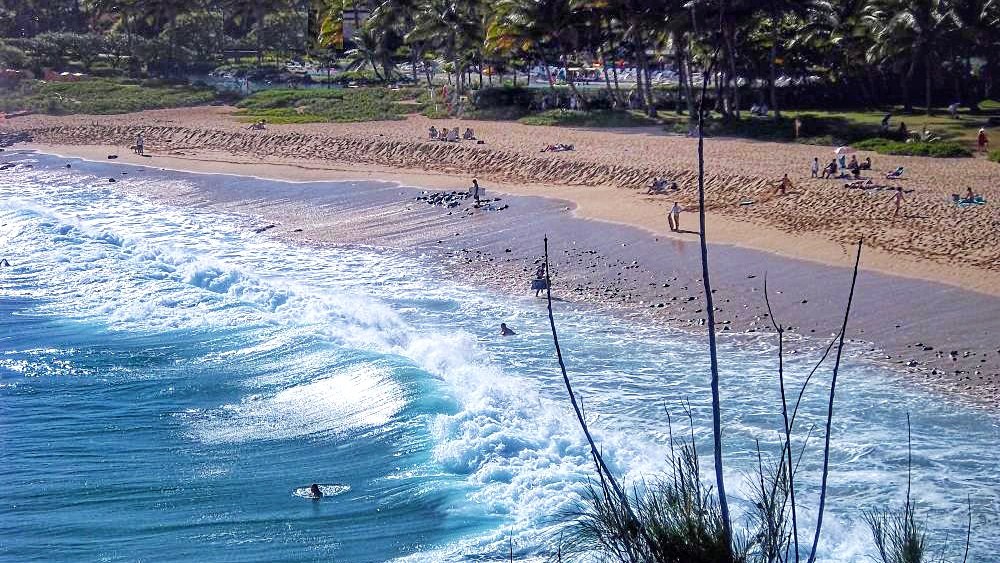
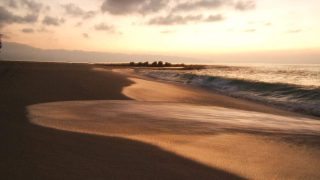
Shipwreck Beach on Kauai, also known as Keoneloa Bay, is one of those places that sells the dream of Hawaii in a single glance. The cliffs are dramatic, the sunrises unforgettable, and the waves pound against the shore in a way that feels alive.
But here’s the truth: for many of us who live here, Shipwreck means something else entirely. It means sirens. It means another family is about to have their vacation turn into the worst day of their lives. Last week, when the ambulance tore down Poipu Road, we knew right away where it was headed. Another life lost at Shipwreck.
The Shipwreck problem.
The cliff jump at Shipwreck has been glamorized for years. It shows up in guidebooks and on Instagram feeds as if it’s some rite of passage. The setup looks easy: a jump into blue water and a swim back to the sand. What you don’t see from the top is the chaos waiting below. The surf slams you hard, currents push you sideways or out, and rocks shift underneath. That’s where the real test begins, and too often it’s a fight that visitors can’t win.
People still write about it online with a mix of bravado and luck. One said, “The jump was awesome. The last 50 feet to swim was tricky because of the big waves and strong current. But I didn’t die. Overall 10/10.”
Locals reply in plain language: don’t do it. One reader told us, “There are rocks that move and you don’t know where they may be. Also, it doesn’t matter how strong you are, currents can take you out at any time.”
Another said he left Shipwreck with a concussion after being slammed into the ocean floor. These aren’t rare stories. They’re part of the running commentary of this beach.
We’ve also heard about long-term consequences. One physical therapist wrote that he treated a client who still suffers from a back injury after a Shipwreck jump. There is even a man on island left in a wheelchair. None of this gets advertised when people line up for their turn at the cliff.
A repeating cycle on Hawaii beaches.
Shipwreck isn’t alone. The pattern repeats across Hawaii, especially on Kauai. Queen’s Bath has warning fences, crosses, and decades of news stories. Still, visitors climb down to the lava pool for a photo and some never come back. Lumahai looks like a Hollywood postcard, but its rip currents are deadly. Hanakapiai, at the end of a two-mile hike on the Kalalau Trail, is beautiful and has claimed dozens of lives.
The Hawaii Department of Health says about 60 people drown in Hawaii’s waters each year. Visitors make up more than half of those deaths, and on Kauai, the ratio is even worse. The state once put it bluntly: the visitor drowning rate is about ten times that of residents.
What makes this especially painful is how predictable it all is: the same beaches, the same mistakes, the same outcomes. Families on vacation who just wanted a memory are left devastated. Locals hear the sirens again. First responders put themselves at risk in an effort to help. And the cycle continues.
Why warnings fail.
You can’t say there aren’t warnings. Beaches like Shipwreck and Queen’s Bath are covered with signs. Hotels hand out brochures. Lifeguards spend their days blowing whistles and yelling over bullhorns. In Lihue, safety videos are played on a loop at the baggage claim. Airlines have experimented with showing them on board.
Still, visitors ignore the warnings. Part of it is the vacation mindset. You land in Hawaii and everything feels calm, safe, and welcoming. The water is warm, the sun is shining, and the ocean doesn’t look intimidating.
But Hawaii’s waters are different from almost anywhere else. With no continental shelf to break swells, the Pacific hits the islands at full power. Rip currents are like invisible rivers flowing out to sea. Even the strongest swimmer can be swept out before they realize what is happening. Panic sets in fast, energy burns out, and tragedy follows.
One of our readers once put it in words that stay with us: “Flotation, flotation, flotation. Just take a small, inexpensive bodyboard. Who cares if you look goofy? You will be alive.”
Another cut to the heart of the problem: “People treat it like Disneyland sometimes, and it is so much more dangerous than anything Disney parks have ever produced.” Those voices carry a weight that signs alone never will.
The human toll.
Every time there’s a drowning, it isn’t just about one visitor. First responders leave their families and risk their own lives in dangerous surf. The community mourns, even when we never knew the person’s name. And for those who live nearby, hearing sirens race down Poipu Road has become a routine occurrence. It is heartbreaking because everyone knows it will happen again.
A call for respect of the ocean.
So what now? Some say Hawaii should require every airline to show an ocean safety video before landing, just as they show seatbelt instructions. Others call for more lifeguards or more substantial penalties for ignoring posted warnings. Australia, which has its own deadly beaches, has used graphic public campaigns to change behavior. Hawaii has tried softer versions of that, but it may not be enough.
Ultimately, this comes down to respect. Respect for the ocean, which doesn’t care how strong you are. Respect for the locals who have seen these tragedies unfold too many times. And respect for your own life, and the loved ones standing on the sand.
As one longtime Kauai resident told us, “Don’t be stupid in Kauai. Don’t be anything but extremely cautious.”
Hawaii’s beaches are among the most beautiful in the world, but they are not theme parks. They don’t come with guardrails or safety nets. The same waves that make Shipwreck unforgettable also make it deadly. Until visitors change the way they approach Hawaii’s waters, the sirens will keep sounding, and families will keep leaving these islands broken.
We invite your comments on ocean safety. What works for you? Mahalo!
Lead Photo Credit: Beat of Hawaii at Shipwreck Beach on Kauai.
Get Breaking Hawaii Travel News


I don’t know if this is a stupid conception but wouldn’t one think all the beaches are dangerous on the windward side of the islands, Example North Shore, Sunset beach, Ewa beach etc. Every island has their own windward side so wouldn’t that spell out use extreme caution. IMO if you don’t see many people at a beach location it might be for an obvious reason. No people might mean too dangerous and another hint. No people available to assist you if you are yelling out for any help.
The last time my wife and I were on Kauai we adopted a dog from the Humane Society for a few hour walk. One of the recommended beaches was Ship Wrek.
We climbed up to the jump area and couldn’t believe people would jump from there, but they did. We took pics from the beach of them. A lot braver than me.
Is it braver or just crazier, young with no fear of anything or just plain stupidity? I experienced a rock close to sunset beach where it looked 20 feet above the water and you had to time your jump for when the wave passes by. A local informed me these kids jump from the rock as young as 6 or 7 years old and has done it for years. No fear They just do it because the local did it in front of them first. IMO island residents look at these things as no big deal. Nobody wants to be known for being a chicken as this is why you see this happen.
As a teenager I worked S and R as a certified scuba diver on the north shore. There was 2 types of people we knew that we were going to have to look for those that ran past high tide mark and those that wanted to stand in the water waist deep and argue how good of a swimmer they were. Do you know what it’s like to tell someone that their spouse can’t be found, or finding parts of a skeleton,especially the skull in some coral hole. One of the causes of ptsd today.
I was sitting on a Kihei/Maui beach eight or so years ago and saw a man enjoying the waves as they came in while he was close to the shore. A giant wave came in, picked the man up and tossed him hard into the sand below the water. After others saw what happened to him they carried him to the shore. He died right there from a broken neck…just a matter of a minute or two and he was dead from a wave coming in and pounding the shore…this can potentially happen anytime on some beaches in Hawaii.
While I do not want anything bad to happen to people who disregard safety advice, and I say this as someone who has disregarded safety advice, we need to accept that there are people who are going to do what they want to do. No one is at fault except for those who take the risks. That’s life.
By Lumahai, do you mean Kahalahala, or the beach further up the road towards Ke’e? Mahalo for the clarification.
Is there any 100% safe beach in Hawaii where I can swim oblivious of waves, surfers, sharks and rip currents ?
There is no place on the entire planet where you can swim and be truly oblivious. However, yes, there are several beaches where you at least don’t have to feel like you’re actively risking your life and can just make sure you’re generally aware of your surroundings.
I am born and raised Maui girl, now living in Texas. I go home every year for family and every year I leave with with feelings loss and sadness when I see how much development has over taken and over run our community. I am not against progression and development, however when progress is breaks down and takes away from the community then how this change positive. Since the missionary times Hawaii has been in a constant struggle to hold on our precious culture, beliefs and love for each other .
I like just lie on the beach, go in the water to cool off, come out, repeat.
Sure it’s sad and unfortunate but per HDoH “about 60 drown each year, more than half are visitors” so allot of locals also.
Drownings happen everywhere, doesn’t even need to be like shipwreck, happens in calm lake waters…
Born and raised in Hawaii I say if you don’t respect the ocean then it is your life at risk, don’t blame Hawaii for your tragedy. Treasure the beauty in memories and not your lost life. ❤️ Go home and come back again to enjoy. Mahalo Nui.
Excellent article. I will be visiting Kauai in three weeks, and my family is always overly cautious about the beaches. It’s a great idea for the airlines to play a beach safety video before landing. Some people will still be stupid and careless, but maybe a video will make others think twice.
I lived in Hawaii for 5 years. The dangers are prevelant. I lived on Oahu. I snuck into Sacred Falls. I did Haiku stairs. I knew the risks, and did it anyway. One thing though, the ocean was a different story. For instance, there were many beaches where I wouldnt even stick my toe in the water, like Sandy’s for instance. Many visitors treat Hawaii like its Disneyland, where nothing bad can happen. Many have no idea the power of the ocean and have no respect for it or a lot of other things. This is where education and respect of Hawaii not only makes people better guests, but potentially saves lives too. The Pacific Ocean is not like some pool, lake, stream, whatever. It is fierce and if you dont know that and respect that, you can be severly injured or killed so fast you wont see it coming. The fact that half of the people in these tragedies are residents shows that even with the knowledge and respect, the ocean is a mighty force.
It must break your hearts when you hear about these drownings because you guys’ report on this at least 3 or 4 times a year. I wish your columns on water safety were required reading for all tourists who come to Hawaii. Unfortunately, when I snorkel, I inevitably see folks who are obviously not in the physical shape needed to be out in those dangerous waters.