
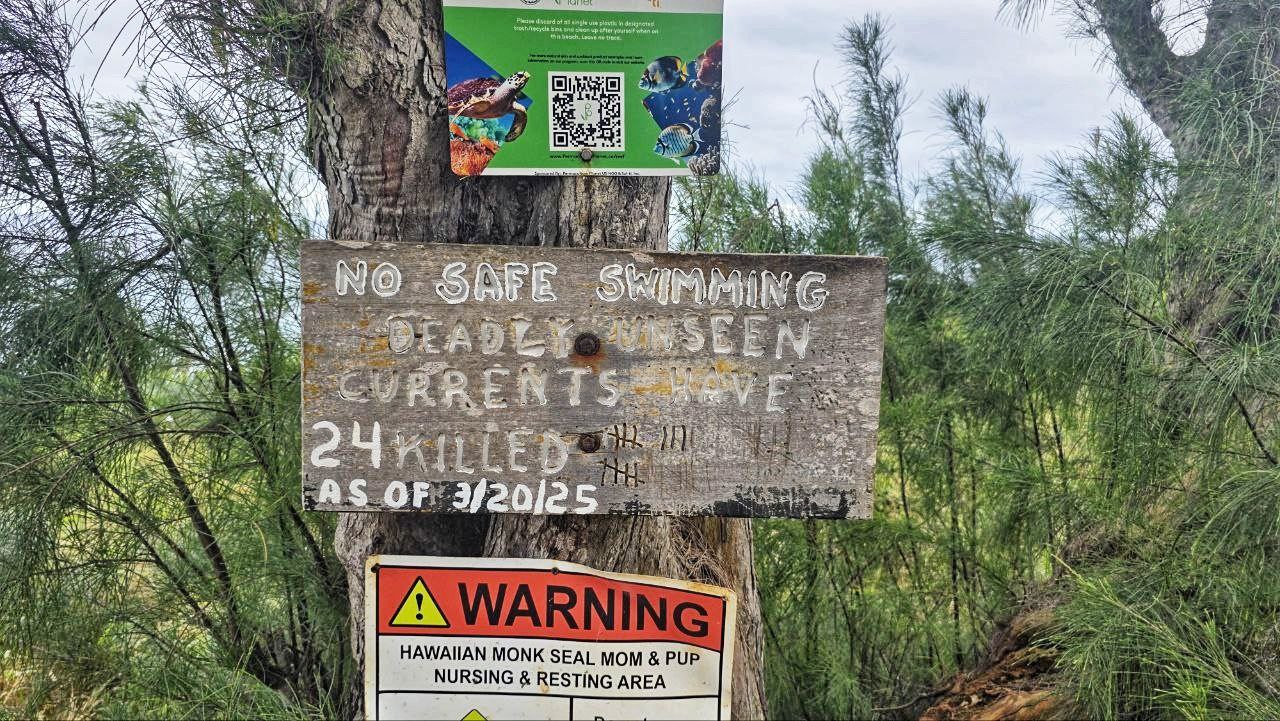
The sign is right there at the top of the trail, before you even start down. You cannot miss it, and it does not try to be gentle about what it says. It is hand-painted, dated, weathered, and blunt in a way you do not usually see in official warnings in Hawaii.
Someone carved tally marks into the surface over time, one by one, yielding two dozen deaths as of March 2025, and turning the warning into a kind of morbid record. There is nothing abstract about it, and there is no advice. It is a statement of fact.
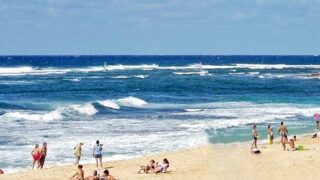
By the time you finish the hike down to Larsen’s Beach, the message already feels largely out of context. The water can look calm and inviting depending on the season. Yesterday, while there were large waves further offshore, the beach yielded the impression that I could certainly wade into the water. But could I? The beach is beautiful. The big waves tend to break well offshore, which makes the shoreline feel more protected than threatening. And from the beach, it can look like the sign may have exaggerated or been referring to someone else.
That is the moment when things can go so wrong. People trust what they see more than what they were told ten minutes earlier. They read the old sign we’ve seen for years, then glance at the shallow water at least, and decide it does not apply to them today. At least two dozen people have died here over recent years, and that gap between the warnings and behavior has never really made sense.
The beach’s shape doesn’t help. It curves in a way that hides trouble, and someone in distress can be very hard to spot from shore. There is no lifeguard, no quick backup, our cell phones did not work, and there is no easy way out once conditions change. The ocean here can look safe right up until the moment when it turns. When that changes, which it does so quickly, there may be no margin for error left.
Larsen’s Beach is a virtual case study in why beach warnings in Hawaii fail.
The sign tells the clear truth, but the ocean contradicts it in ways that feel convincing, even to us, in the moment. We know, because we just went there ourselves yesterday.
Visitors trust what they can see, especially when the water looks clear and inviting. Some describe it as looking like a swimming pool (which it did not), while others point out that the waves break well before reaching shore (and that was true). The combination creates the illusion that conditions are at least manageable, even when they are absolutely not.
What the sign does not communicate is perhaps more important than what it does. There’s no detail about how quickly the bottom drops away, how the currents wrap around the curved shoreline, or how just one wave set can flip the entire situation in seconds. It does not teach ocean judgment in a few lines of faded paint that can seem irrelevant.
Kauai residents understand this intuitively, and we go there with a great deal of respect. That is because these lessons were learned the hard way and repeated over many years. Visitors often do not have the same sense of it, and even strong swimmers can misread the situation until it is too late. We have covered cases where experienced ocean users were swept out to sea in conditions that looked benign from shore, and we’ve gotten in trouble ourselves in years past, underscoring just how deceptive Hawaii water can be when experience, familiarity, and respect are missing.
That gap between what the sign says and what the ocean seems to be doing is where the warning breaks down most. By the time someone realizes the sign was right, the window of safety to get out can already be gone.

This pattern repeats across Hawaii.
Larsen’s is one extreme example, and a great place for Hawaii to learn from, but it is not unique. Variations of the same problem play out across the islands every day, often in places people think they understand.
At places like Sandy Beach on Oahu, the reputation is largely instant for residents and not so for visitors. Locals know when not to go in. Visitors see people on the sand, feel the energy of the place, and then underestimate what the shore break there can do in seconds.
The danger is real, but understanding it is challenging. Even experienced swimmers can misjudge conditions in moments that look manageable. Case in point: BOH editor Jeff has had close calls himself at both Sandy Beach and Brennecke on Kauai, despite years in the water and lifeguard training. The lesson was the same each time. Ocean conditions can turn faster than human judgment can catch up.
Visitors may step into those same waters confidently after passing warnings that hopefully won’t apply to them. The result is not always tragedy, but the pattern repeats often enough that it is not coincidental.
Part of the problem is simply where the warnings are found.
These mostly live back at the parking lot or at a trailhead, as in the picture above, way before anyone has actually decided to go into the water. The prominent sign isn’t a government installation but a grassroots effort by residents to reduce fatalities. That hand-painted sign at Larsen’s Beach has not changed, and its message is still the same after all these years. It still tells the truth, even as people continue to question it.
By the time people reach the beach, the sign is already largely lost. What’s in front of them is a gorgeous-looking ocean, a beautiful beach, and often other people standing around who seem perfectly fine. That can carry more weight than weathered signage already forgotten.
The warnings also assume a lot. They see icons, red lettering, and broad cautions, but nothing that clearly matches what the ocean feels like in that moment.
The state has recently acknowledged that Hawaii’s beach warning system isn’t working as intended. Larsen’s already has one of the most explicit warnings, and the deaths continued anyway.
Tips on visiting Larsen’s Beach.
The warning sign is about dangerous ocean conditions, but the beach can still be enjoyed and offers seclusion. To reach the beach, turn off the highway on Koolau Road. You’ll find the turn for Larsen’s Beach at the mailboxes marked 7200. The road from here is dirt and gravel and about a mile long.
Park your car at the end of the road and walk out to the bluff, where you’ll see the famous sign and three trails. We suggest the trail on the left, which is behind you as you stand at the sign. It’s an easy walk and a gentle slope down to the ocean. The center trail is faster but more challenging. If you take the trail on the right, it will abruptly end. Some hikers use the left trail down, and the center trail up to avoid backtracking on the beach.

While Kaʻakaʻaniu is the Hawaiian name for this beach, its English name recognizes David Larsen, who managed Kilauea Sugar Plantation from 1918 to 1930 and had a beach house nearby.
Which Hawaii beach do you think has the most misleading or ineffective warning, and did it actually influence what you chose to do when you got there?
Photo Credits: Beat of Hawaii at Larsen’s Beach Kauai.
Get Breaking Hawaii Travel News

On Hawai’i island, beware of Pebble Beach in South Kona (mile marker 96.5). On average, there is one drowning a year. Almost exclusively visitors who confuse beauty with safety. Because of the remote location, in ideal conditions it takes an ambulance 30+ minutes to get down the steep hill to the beach. We residents can hear people calling for help when they can’t get to shore. Don’t ignore the signs. When in doubt, don’t go out.
Only in Hawaii is a bussup hand-painted sign considered “official.” It’s a nice gesture, but Not Official. In fact, that signage makes it look less dangerous because who takes that seriously? It seems like nobody. But wait, a date was painted on it? Well then, it must be official. C’mon man.
95% of my high school class in Honolulu went to the beach 1 day a year on class skip day.
Now these same people are the politicians and bureaucrats who are in charge of public safety and deciding which beaches get lifeguards.
They aren’t concerned with what happens to visitors unless it results in bad PR, and could lead to a reduction in tax revenue.
They need to put signs listing the names and dates people have died as warnings.
Been traveling to Hawaii for 60 years, and even when I was much younger I always approached every Hawaiian beach as potentially very dangerous, even beaches like Waikiki or usually calm Poipu. Visitors need to understand that Hawaii is over 2500 miles from the nearest major land mass. You flew over the ocean from wherever to get here for at a minimum 6 hours. What were you thinking, that it was a shallow Kitty pool. Approach every beach in Hawaii with upmost respect and know your limits. Now at 77 the beaches in Hawaii for me are for wave watching from the shore, if I want to swim I go to the condo pool, not the beach! Be safe respect the ocean at all times!
Aloha.
The Hawaiian name for Larsen’s Beach is Lepeuli. Kaakaaniu Beach is the very small beach south of Lepeuli. As you face the ocean at the bluff you see it to the right. The beaches are named because of the ahupua’a they are in.
Great article BOH!
Thank you for reporting on the drowning deaths in Hawaii. Hawaiians need to demand modern lifeguard staffing and official signage like California beaches.
Secrets.
Dear Humans,
The ocean is extremely dangerous to those who are not strong swimmers and don’t understand local conditions.
If you don’t feel confident about your abilities and what you’re getting into, Stay Out Of The Water.
If you choose to go in anyway, you have voluntarily assumed all risk.
You have no right to force your fellow citizens to pay for lifeguards or to have your corpse recovered after you drown.
Dear Chris S,
What a sad, cynical way to live.
Your “humans” are sons, daughters, fathers, mothers; Souls!
If you could only save one, sounds like you would choose to save your drowning dog and let a “human” drown?
“S”hame.
Well it’s very ironic that after all your warnings and history of drownings at Larsen’s Beach, that you would give all the incoming tourists clear instructions of how to get there.
#1 these signs are what people would call old School. I just googled Larsens Beach and the first thing that listed was how dangerous it is.
#2 as an 18 year resident there are places that tourist or people who have little knowledge of the ocean should simply not go and this is one of them. No Lifeguard.
#3 why don’t you give directions to Queens bath while you’re at it? Over the years I’ve found your blog extremely useful and advise generally spot on but on this article I’m questioning your judgement. Mahalo
And another word to the wise…
Not everyone wears clothes there. 😉
Many moons ago, back in the late 80s(?), I stayed at a resort (I believe it is now closed) at the West end of Molokai for a few days. It was a quiet place and not very busy and had a long beach with almost no one on it (and no warning signs that I recall). What a great spot! (I thought). I decided to wade into the water as there wasn’t any real surf break near by, but there was a fair surge going on. Mistake! What I didn’t realize that, as at Larsen’s, the danger was not what you could see as much as what you couldn’t see. The surge was stronger than I realized, the bottom sloped very steeply and it was soft with large grained sand that your feet dug into. When I tried to get back up on the beach, I couldn’t get a footing and the surge kept pulling me out. I almost didn’t make it. And there was no one on the beach to help. I finally was able to use the surge to help me crawl back onto the beach.
I know exactly where you are talking about as it is near my house. It is very deceiving indeed. Quite honestly, the waters of many of the Hawaiian beaches are very different than the mainland’s beaches with the waves, currents and under water topography. They are not the Disneyland that many believe them to be.
Papohaku Beach Park. A wonderful long and semi-private (as in almost nobody around) beach, but, yeah don’t go on the water. I’m not sure about Larsen’s, but the other beaches mentioned don’t have fringing reefs to break the surf and they drop off quite fast.
PS
There is a mini timeshare and rentals on west Molokai.
That’s Papohaku Beach … it is one of most beautiful beaches in Hawaii but since visitors are really not welcome on the island (funny it’s called The Friendly Isle), not too many people know about it. The hotel was a beautiful property but had to close due to lack of interest by tourists and probably due to the unfriendly attitude towards tourists by a certain group of locals. I’m glad you were able to experience my home island … I grew up in Maunaloa. This beach was my Boy Scout’s favorite place to camp; wide open beach and no one else around. But it’s definitely dangerous to wade in the water if you don’t know what to look for.
After a long hot hike on the Kalalau Trail on a calm summer day a dip in the ocean at Hanakapiai Beach seems like a nice reward. But, knowing its reputation as one of the deadliest beaches anywhere I’ve avoided the ocean there like the plague.
Polihale is also quite dangerous! Our dear friend who lives in Kekaha warned his cousin many times about the waves when they were out in the water there and it ended up taking his cousin’s life……. Right in front of him! He almost drowned trying to save him. We’ve been to that beach a few times and after that long and bumpy drive, you go out on the sand and you better have your socks on! I’ve gotta think that there have been quite a few deaths out there also with no resources near….
As you pointed out, there is also no cell phone service in an emergency once you are down on the beach. For those that own an iPhone 14 or later, I believe you get 2 years of satellite phone service with it that you can use in an emergency. It is worth it to learn how to use that feature before an event takes places. I just upgraded my iPhone 13 to an iPhone 17 specifically for this feature as there are lots of remote locations on Kauai where cellular service is not an option. I have not learned yet what happens when that 2 years of satellite service runs out. What are the options? Do you subscribe? Cost? And who is the carrier and provider (as it is not Apple).
I was on Kee Beach recently and just for grins and giggles I wondered if there was cell service there. I have a Samsung, but anyhow, I tried it and Starlink came up as the provider. I sent a brief text with a picture to some relatives.
I recognized this sign instantly. I never swim at Larsen’s Beach – I do take the signage seriously. Also, the trail there can be terribly overgrown with tall Guinea grass that you have to part with your hands as you make your way down. It’s disorienting – kind of like being lost in a cornfield. No one seems to be maintaining the trail. I also find it difficult to find the trailhead back up when you’re down on the sand and I usually take a photo so I can recognize it. All the trees and vegetation look the same once you are on the beach.