
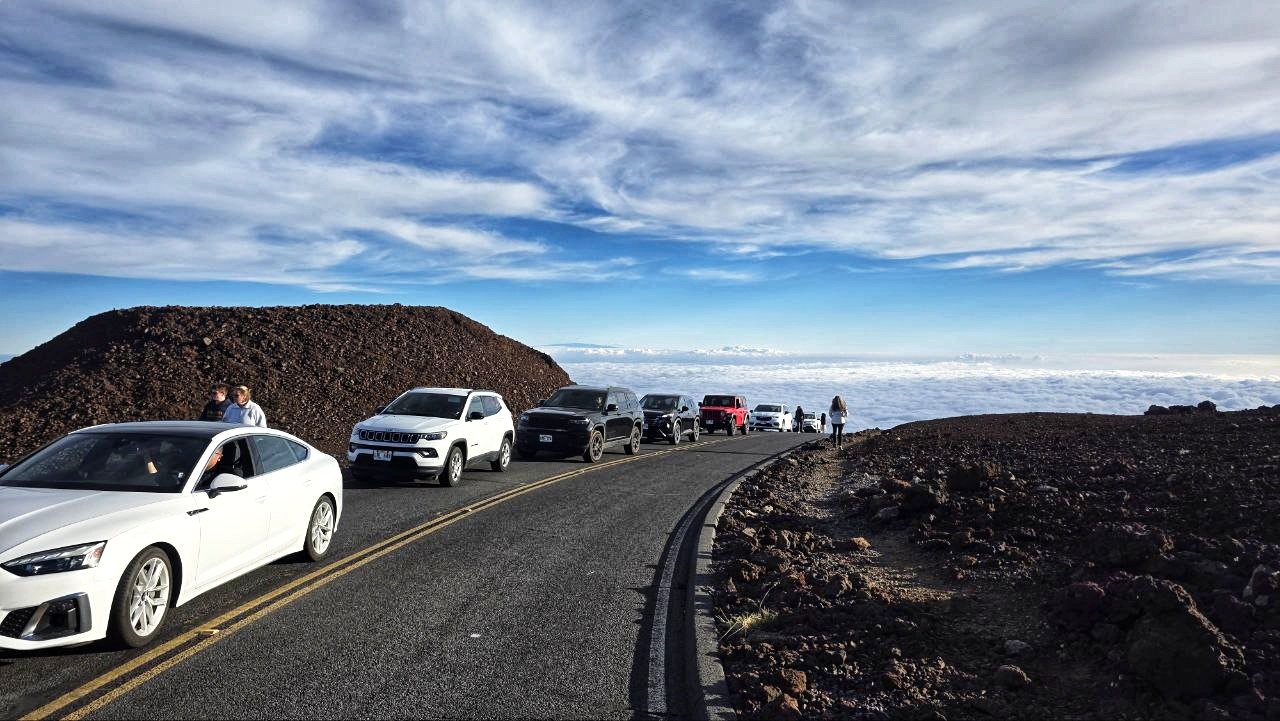
We first started going to Haleakala for sunset years ago when it was still a quiet secret. Sunrise had long since become the production everyone knew about for decades, but sunset was the exact opposite. We remembered having the summit nearly to ourselves, with only a few cars scattered around and a calm that matched the fading magic of the light.
The visit this week had none of that. When we reached the two parking lots, every space was already taken. Cars squeezed into the margins. Others simply abandoned along the steep approach road to the summit. Rangers we spoke with later told us that, after we arrived, they turned away well over 120 more vehicles. Those cars ended up lining the shoulders miles below the summit, and families stood in the wind on narrow pavement trying to catch the last minutes of color. It felt like something had shifted in a way we had not seen before or expected.
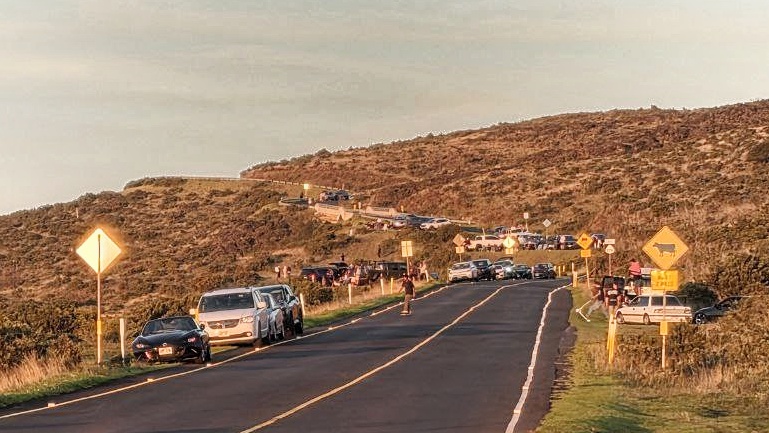
We arrived nearly two hours before sunset and were still among the last cars allowed through the gate. Visitors should plan to be at the summit more than two hours early if they hope to be admitted at all.
Haleakala National Park rises to 10,023 feet on Maui and spans more than 30,000 acres of fragile alpine terrain. The crater, the rare species that survive only at high elevation, and the small visitor centers perched along the summit road all depend on carefully managed access. The park learned that during the sunrise surge a decade ago. What is happening now at sunset feels like the same pressure building again, only much faster.
What sunset used to be.
For years, sunset was the easy part of Haleakala. People drove up in daylight, found a spot, and watched the crater shift through its evening colors. It had none of the tension or sleep disruption of the sunrise ritual. Even after sunrise became globally famous through social media, sunset long stayed in the background. That contrast made this visit’s crowding feel even more abrupt.
How sunset demand quietly tipped over.
When we asked the rangers what changed, they were direct. Sunrise reservations pushed demand into the only obvious window with no limits and no planning required. Social media accelerated that shift. Concierges began steering guests to sunset as the simpler option. Word traveled quickly, and visitors followed, arriving in numbers the summit infrastructure could not absorb.
Travelers online have started noticing the same trend. Some recent comments note that sunset is more crowded than sunrise because it has no restrictions at all. It is a familiar pattern across Hawaii, where a single viewpoint or moment can suddenly become global and overwhelm the capacity around it. Haleakala magnifies this because the road is narrow, the elevation extreme, and the summit fixed in size. The same may become true on the north shore of Kauai, if access to Tunnels Beach and Haena Beach Park come under state management.
What we saw on the summit.
Parking at the top of Haleakala is very limited and unforgiving once full. Car passengers waited nervously, looking for any sign that someone might leave. When it became obvious that wasn’t happening, they stopped wherever they were. The narrow road became a de facto parking lot. Visitors walked along the road as the temperature dropped, unaware of how quickly visibility fades in the thin air.
Driving back down the mountain revealed the rest. Long before reaching the entrance station, which remained closed to further access, the shoulders were lined with cars trying to salvage any view. Some angled into the road, others perched on sloping gravel that was never designed to hold vehicles. Families stood in clusters directly on the pavement, and the hazards compounded turn after turn.
Rangers said they do not have the staff to manage the surge. They described how people now treat the mountain road as a parking area when the summit fills. They acknowledged that discussions about sunset reservations have begun, though nothing formal has been announced yet.

Why this moment matters.
The issue is not inconvenience. It is how quickly the situation becomes unsafe. Parked cars on the shoulders create blind corners on a winding mountain road. People stepping into traffic for photos risk injury. You also had to be careful about cattle crossing the road below the park entrance. Emergency vehicles would be unable to reach the summit during a medical call. The road and the summit were not built for surges of this scale, especially at the time of day when ranger staffing is limited.
We saw similar circumstances during the peak sunrise years. Environmental damage, blocked access, and medical incidents eventually forced the park to introduce reservations. Without something comparable for sunset, the same pressures are now appearing in the afternoon hours and visitors can already expect many differences compared with how this worked previously.
Why sunset reservations may arrive sooner than expected.
When we asked the rangers about afternoon reservations, their response was careful but telling. Sunrise reservations were introduced only after the park had clearly reached its limit. Sunset appears to be approaching that point with even less buffer.
The ingredients are not complicated. Global visibility of a dramatic viewpoint. A narrow window when everyone wants the same photograph. A single road to the top with limited parking. No current restrictions. These conditions exist in many parts of Hawaii, but Haleakala amplifies every one of them.
Nothing will be expanded at the summit. The road cannot be widened, and the parking lot is unlikely to be enlarged. The only tool the park has is the one it used before: controlling timing and access.
What this means for future visits.
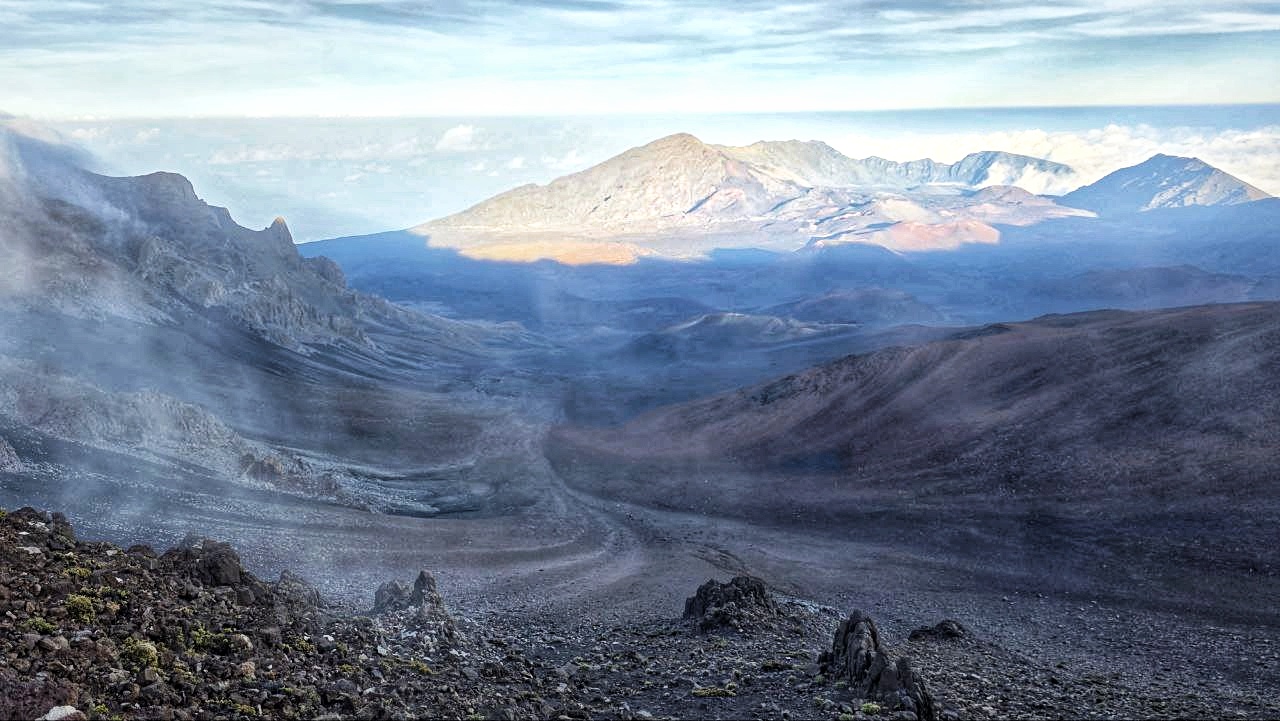
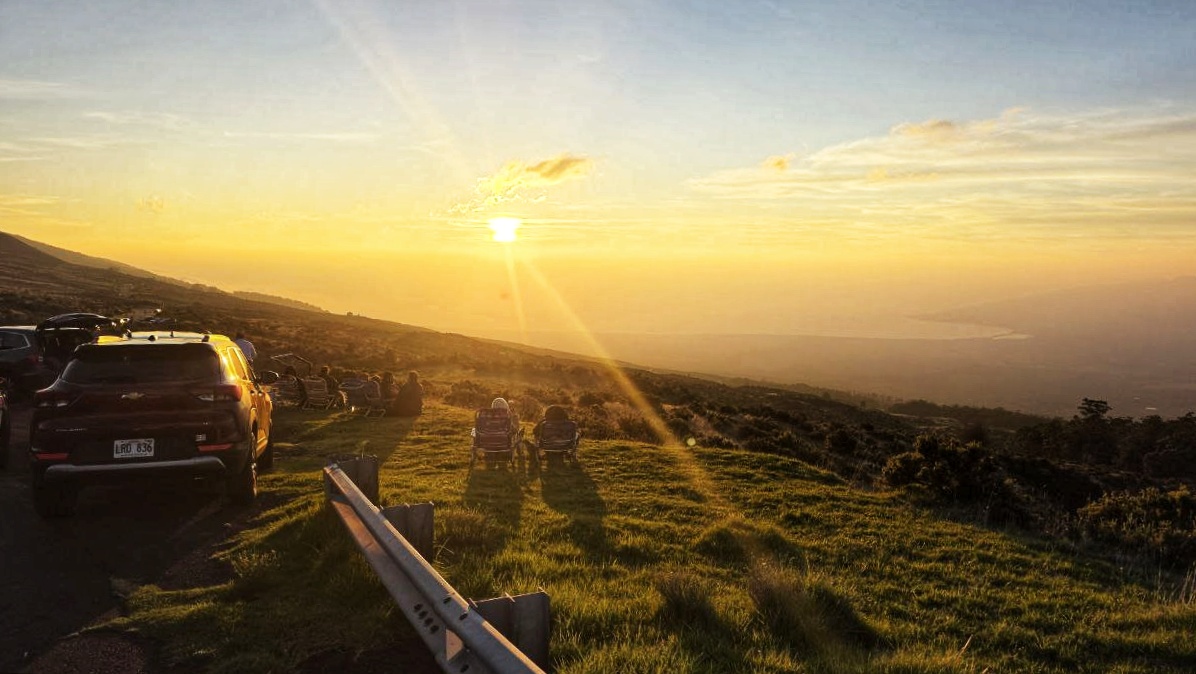
The sunset itself remained stunning. The crater glowed through soft layers of color, and people fell quiet for a few minutes in the cold air. That part has not changed. But the surrounding experience has. The serenity that once defined sunset at Haleakala now requires arriving early, finding a legal spot, and understanding that the system is under strain.
Visitors around us looked more confused than irritated. Most seemed unsure of what they had stepped into and surprised by the number of people around them. That confusion is often the first signal that a shift is underway.
Sunset at Haleakala is still extraordinary. But it has changed, and the change is accelerating. If this trend continues, sunset at Haleakala may follow sunrise into the reservation era. The only surprise now is how long the park can wait to make that call.
Photo Credits: All images under copyright by Beat of Hawaii.
Get Breaking Hawaii Travel News



Wow! Mahalo for this article. I was actually thinking of driving up there when my friend returns to Maui next month (from Germany). If we do, we will time it to a slower tourist week. I went to the beach today (Kaanapali) and was stunned how full it was, even though the weather and ocean conditions were bad. So much for less tourists ….(ha, ha!). I must say your pictures are stunning, especially with the cow ..but I can see how dangerous that can be with that many people on winding mountain roads they are not familiar with. It’s sad, but it looks like reservations will be needed in the near future.
Sunset at Mauna Kia is still a peaceful quiet experience. The requirements to go up there naturally limit it.
You must have a true four wheel drive with low range; all wheel drive does not cut it. Going up is a rental contract violation.
If you do stay for sunset you are committed to staying for sunrise too.
It was inevitable that sunset would be as popular as sunrise. Sunset is a lot easier to see; warmer till the sun goes down. Park had contemplated controlling summit traffic via some type of shuttle service from Hosmer area. That would require an EA minimally. Reservation system would be a lot easier. Your photo captioned “Many cars are abandoned leading down from the summit…” is somewhat misleading as the photo was taken from the 8.2 mile mark of Haleakala Hwy/Crater Road before the park boundary (10.25 mile mark). Mahalo for the article.
Update – a sunset reservation system would also require an EA but not as complicated as a shuttle EA/EIS which may require parking infrastructure of the shuttle system.
Maybe a fee to pay for security….large enuf to discourage large crowds, and a hawaii DL to make a reservation for residents.
Close road with barriers at certain time and limit number of cars. Barrier needs to be at beginning of access so people dont have to turn around after the long drive up to summit.
The fee would pay for top and bottom security personnel. Limit number of residents and number of visitors. Limited to parking spaces at the top.
Or
contract with a company with larger vehicles with a pick up point at the bottom .
Only way to top is in a larger van less, traffic larger amount of bodies having access. Bathroom facilities would still be a problem tho.
Test it out for options to it all.
Fee is the partial answer.
I am not surprised by this at all. Social media has changed so many things. I have seen sunrise and sunset up there several times in the past and it is spectacular. We camped up there and had snow too! Back then there were no more than 25-35 people.
I’ve not been up there since a bike tour some 50+ years ago and it was pretty barren, no buildings. Just the sound of the wind in the morning. Our bus with the trailer load of bikes had a loo on board. No problem.
There was no Park Entrance Gate or visitor building back then where such roadside facilities could be located. Anything change? Just curious, not planning.
Are there any kind of sanitary facilities up there (portalets or otherwise) to handle the huge numbers of folks congregating for hours on end? Kids and seniors would be the most interested!
Setting reservation quotas for Haleakala sunset is not the answer to the overcrowding problem. Setting tourist reservation quotas for the entire State is
Sadly, if Hawaii limits tourism, we also limit jobs without any alternative employment. Our kids just move and live on the mainland I guess. Is that what you want?
We live on an island. Islands have limits.
I think sunset reservations is a great idea. My son and I did a sunset tour to the summit last winter. Our tour bus arrived at the summit giving us plenty of time to explore and enjoy the experience. As it got closer to sunset the craziness began. Cars jam packed into the parking lot into spaces they were not suppose to be in. People rudely acted as though the sun literally rotated around them. I think the experience would be more enjoyable for all if it were less crowded.
“They called it Paradise
I don’t know why;
Call some place Paradise,
Kiss it goodbye”
– The Eagles
I hope they don’t take sunset away from the people who live here. Once reservations begin, it is only tourists that will plan a sunset months in advance.
I love that song! I didn’t even know it until my musician friend played it the other day. Hawaii surely was paradise when I first visited in December of 1989 and when the hype of 2000 started, there was no other place I wanted to be. Then came Covid and it was the 1st time I spent 9 months in my condo here on Maui. Well, it was paradise so I now live here permanently.
This goes back to BOH’s recent article about Hawaii being too complicated for visitors (as it is now for residents even if we don’t have to pay directly for an experience). Squeeze one end of the calendar, and demand comes out the other end. If they do reservations for sunset, soon people will be able to see neither. Terrible.
Maui is no longer……….”nō ka ʻoi”
Let’s not forget the traffic residents have to endure every evening on crater road. Not uncommon to see non stop cars for 20 or more minutes from a residents driveway and backing up at the intersection of Kekaulike. It is a daily evening parade of lights.