

You find a Hawaii airfare that looks reasonable, but you’re not quite ready to book. Maybe you check another website, compare a few dates, or return later that day. Suddenly, the price has changed. Sometimes it’s higher, sometimes the original fare has disappeared, and occasionally another website shows something different for what appears to be exactly the same flight.
It’s easy to wonder whether the airline noticed your interest and decided you were willing to pay more. We’ve reported on increasingly sophisticated airfare pricing for years, and new research published October 27 by aviation data company OAG reveals what airlines can learn before travelers ever purchase a ticket. We also ran our own Hawaii airfare comparison today, and what happened helps explain why the price you first see isn’t necessarily the price of the trip you thought you were buying.
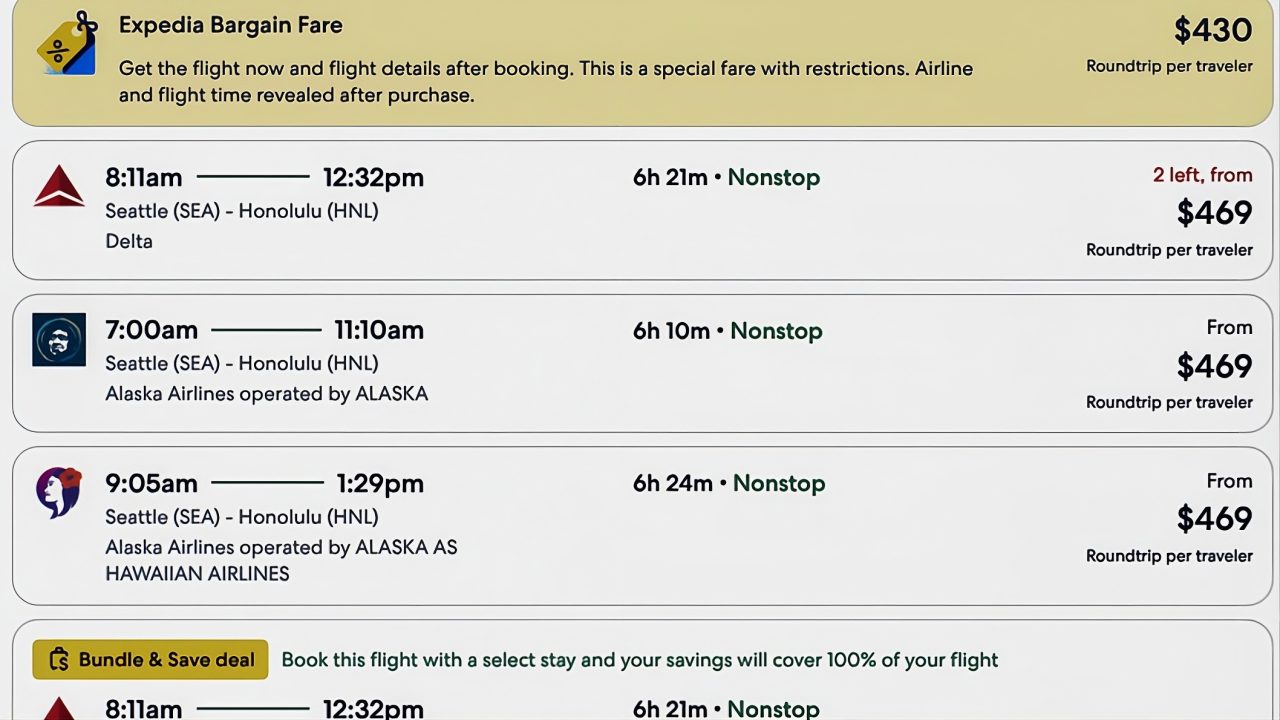
We tested the same Hawaii flight on three booking websites.
We searched for round-trip airfare between Seattle and Honolulu, departing November 11 and returning November 17. On Alaska’s website, the November 11 nonstop flight departing Seattle at 7 a.m. appeared at $477 round trip in Saver. Google Flights displayed the same $477 price for that departure.
Then we checked Expedia. The identical 7 a.m. Alaska departure appeared for $469 round trip, a mere $8 savings over both Alaska and Google Flights. It wasn’t a huge difference, but it raised the question of why one booking platform showed a lower price for the same flight.
We followed Expedia’s booking process to see what that $469 actually included. The lowest-priced return was on Southwest, departing Honolulu at 5:20 p.m., stopping in Lihue and Las Vegas, and arriving in Seattle the following afternoon. Total travel time was 17 hours and 40 minutes, however, with two stops and an overnight journey.
Choosing a nonstop return to Alaska instead added $8, bringing Expedia’s round-trip price to $477. The apparent savings disappeared when we selected a more comparable itinerary. We hadn’t reached final checkout or independently verified every fare condition, but this advertised difference had a straightforward explanation that wasn’t apparent in the initial results.
Expedia also offered a $430 Bargain Fare, with the airline and flight times withheld until after purchase. That’s a different kind of airfare offer, one that can’t be easily compared to a specific nonstop flight before the traveler knows what itinerary they’re buying.
Airlines are learning from searches before anyone buys.
The new OAG analysis examines how airline pricing is evolving beyond just published ticket prices. Airlines want to understand what travelers are shopping for beyond what they’ve already purchased, and search activity can help them anticipate demand for specific routes and travel dates before that interest becomes actual bookings.
OAG cites research by airline technology company PROS involving 27 airlines. The study found a 0.77 correlation between flight search initiation and subsequent purchases. That’s significant, and suggests that searches can help predict future ticket sales, although it doesn’t establish that searches cause purchases or that every Hawaii air route behaves the same way.
Consider a Hawaii flight that suddenly attracts more searches than expected. That information could give an airline an earlier indication of demand than waiting for reservations to accumulate. Pricing systems already consider booking patterns, remaining seats, competition, and departure dates, so search information adds another potential signal to decisions airlines have been making for decades.
Research doesn’t show that an airline identifies someone who repeatedly checks a Honolulu flight and raises that person’s price. Using shopping activity to predict demand across a market is different from charging a particular customer more because of their browsing history.
The same airfare may not be the same offer.
OAG’s October research also examines how airlines are moving away from distributing a fixed ticket price toward constructing offers when someone shops. Those offers can combine a fare with different conditions, seating options, baggage allowances, and flexibility. The airline’s website, an online travel agency, and a corporate booking system may not all show the same products or prices.
Airlines have developed this technology for years, but newer systems let more detailed shopping information reach them through outside booking channels. Previously, airlines generally had more detailed information about searches conducted on their own websites. The emerging systems can extend some of that visibility to travel agencies and other sellers, although adoption varies considerably.
OAG’s September analysis of competitive airfare pricing described how continuously changing prices and increasingly fragmented products are making comparisons more difficult even for airlines monitoring their competitors. More recent research continues to examine how complete offers, rather than published fares alone, are becoming the basis for comparison, and how search information can help airlines anticipate purchases.
Our Expedia experiment illustrated a more familiar version of the comparison problem, not proof that this newer technology produced the price difference. Expedia displayed an apparently cheaper round trip because the available return choices weren’t equivalent. As airline offers vary more across booking channels, understanding exactly what’s included becomes even more complicated.
Why private browsing isn’t a reliable airfare strategy.
Whatever happened to cookies? We’ve been writing about their possible role in Hawaii airfare pricing for years, including a 2023 article about travelers switching computers to find lower fares. The idea was simple: an airline or booking website remembers that you’ve searched for a Hawaii flight, recognizes your continued interest, and shows you a higher price. Clearing cookies or opening a private browser window was supposed to break that connection.
Cookies can still help websites recognize returning visitors, remember searches, and maintain login sessions. They haven’t disappeared, and newer pricing technology doesn’t make them entirely irrelevant. But there’s an important difference between a website recognizing you and an airline using that recognition to charge you more. OAG’s new research doesn’t say that individual cookie histories cause higher fares.
We’ve also found from our own experience that clearing cookies and using a VPN didn’t help us find cheaper Hawaii flights. Private browsing can limit some stored browser information, but it doesn’t change an airline’s inventory, competitive pricing, or broader demand forecasts. A fare that rises after repeated searches may change for reasons unrelated to your browsing, and the same price may appear on every device.
No reliable evidence shows that clearing cookies, switching devices, or searching privately consistently produces cheaper Hawaii airfares. That doesn’t rule out personalized offers based on customer accounts or other information, but it leaves the old cookie trick without any dependable benefit.
What our earlier reporting got right, and what needs another look.
In April 2025, we reported on shopping data and the changing way Hawaii airfares are priced. Three months later, we examined the growing use of predictive airline pricing technology, including systems designed to estimate demand and improve airline revenue. Those articles identified a genuine industry shift, but some of our earlier reporting suggested a more direct connection between individual searches and higher prices than the available evidence establishes.
There’s still plenty we don’t know about how individual airlines use customer information, especially when someone is logged into a loyalty program or shopping through a third-party platform.
Have you experienced different prices for the same Hawaii flight across booking websites, or watched an airfare rise after checking it repeatedly? We’d be interested to know whether you found an explanation, or whether the price simply changed without one.
By Rob and Jeff, Beat of Hawaii.
Some of Hawaii’s most meaningful parts are the ones visitors walk right past without knowing they are there. We’ve spent nearly 20 years finding them firsthand for BOH as full-time Hawaii residents reporting on travel, culture, and island life, and telling you what they mean for your trip. Join us →
Get Breaking Hawaii Travel News