
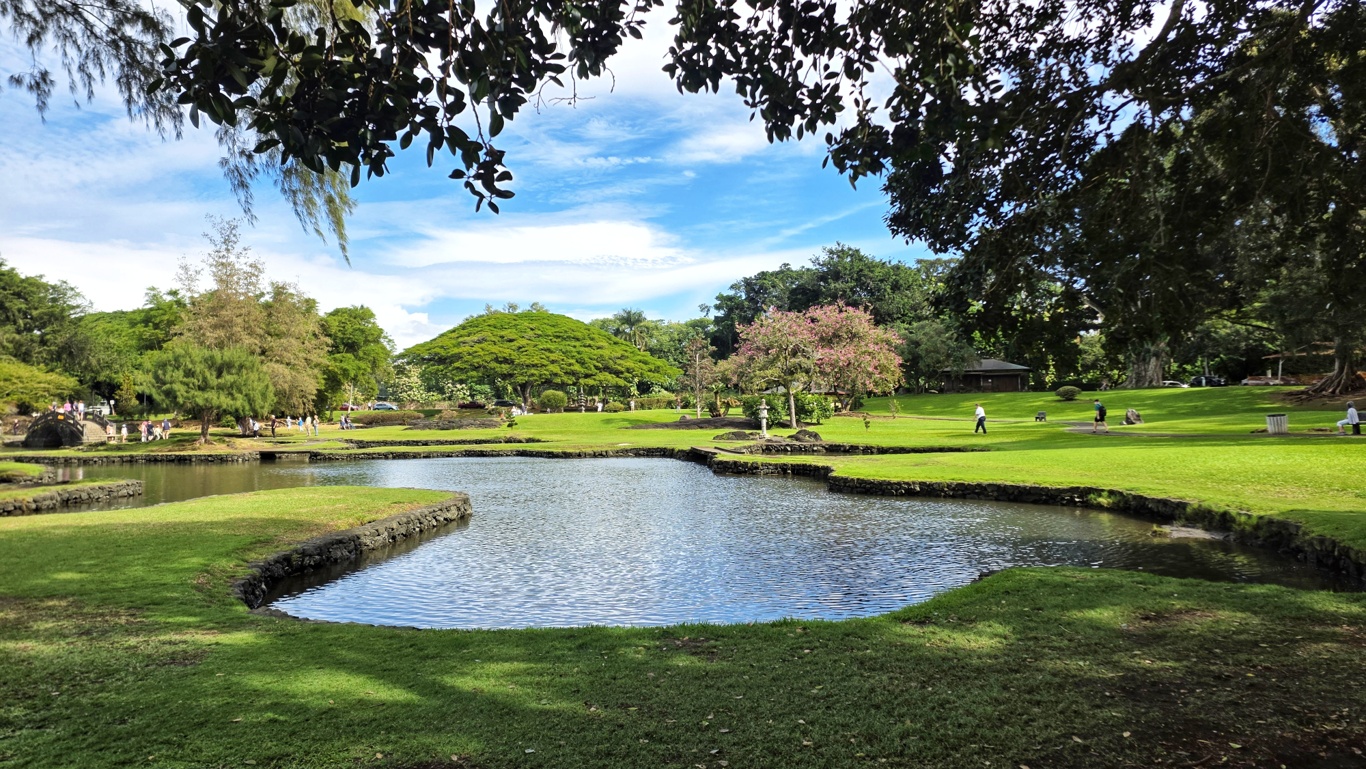
We were in Hilo for a story that had zero to do with the parks. Visiting Volcanoes National Park again, together with the coconut bridge problem, had sent us across the island from Kona, and the plan was straightforward enough: After our long-awaited volcano visit ended, we planned to do the remaining reporting, get something to eat, and head back out to Kauai via wonderful Hilo Airport. We had not flown through Hilo in years and wanted to check it out, too, and we were glad we did. And we were not expecting Hilo itself to change anything about the day. But it did.
Hilo gave us something we weren’t expecting.
What changed it was not a museum, any paid admission attraction, or some “must-see” visitor stop. It was a public park near the airport that we could have very easily passed by.
Liliuokalani Gardens does not look that impressive from the road. There was no gate, no fee, no reservation sign, and none of the now-familiar friction that can come with so many Hawaii stops. You did not have to plan for it, book it, or have any special reason for just being there. We just showed up. And almost immediately, we had the same thought that many other locals and visitors probably would: how is this still free?
Liliuokalani Gardens still feels generous and opulent.
Not free in the sense of being modest or “nice for what it is.” Free in the sense that if this were packaged somewhere else as a formal attraction, people would pay for it without much hesitation. The gardens are spacious, beautifully kept up, and full of details that only really register once you show up and slow down. The ponds, the bridges, the stonework, the open lawns, the beautiful trees, the way the paths keep opening up to new views. Nothing about it feels slapped together or reduced to the bare minimum.
What impressed us was just how easy it felt spending time there. People were wandering, stopping, sitting, talking, exercising, and taking their time. Some sat on benches and picnicked, as we did, while others strolled along the paths without any clear destination. Nobody seemed rushed. It was clearly Hilo at its best.
More often than not, the Hawaii experience starts before you even arrive. There is planning, the fee, the booking window, the parking issues, the time slot, the shuttle, the warning signs, the whole uncomfortable low-grade sense that you are entering something managed as tightly as Hawaii deems necessary. Some of that is understandable. Some of it is probably unavoidable. But it changes the feeling of a place in Hawaii. And it turns too many stops into logistics first and enjoyment second. But not here.
Liliuokalani Gardens felt like the opposite. We could hear planes not far off landing and taking off, and still see how close we were to the airport and town, but inside the gardens, all of that fell away. What took over instead was the sound of water, the stillness around the ponds, the nesting nenes, the bridges, and the rare feeling that nobody was trying to move us along.
After we left the park and before returning to Hilo Airport, we also stopped at Rainbow Falls. That stop turned out to be a whole different story. More on that soon.
Liliuokalani Gardens dates back to 1917.
The Territorial Legislature set aside land in Hilo for a public park dedicated to Queen Liliuokalani. The gardens’ own history says the park grew out of an early Hilo push to create a Japanese garden and tea house, influenced by Hawaii’s large Japanese immigrant community and by Laura Kennedy’s 1914 trip to Japan. That history helps explain why the place feels so substantial today: it now spans 24.67 acres, including the Japanese-style garden, Moku Ola, and other connected park areas.
What Hilo exposed about Hawaii.
These places are not good only because they are free. They are just good, period. The fact that they are free only sharpens the comparison. In a state where more visitor experiences now come wrapped in fees, reservations, restrictions, and various bottlenecks, Hilo can still find ways to offer places that feel open.
That does not mean every site in Hawaii can or should work this way. Some places are too fragile, too much in demand, or too small. But Hilo is a reminder that not everything meaningful in Hawaii has to be turned into a managed product. Not every worthwhile thing needs a layer of hassle between the visitor and Hawaii itself.
We did not go to Hilo looking for a parks story at all. We were nearby because of the coconut bridge problem.
Hawaii visitors are paying more, planning more, and dealing with infinitely more rules than they used to. Sometimes that is the price of preserving what visitors came for in the first place. Sometimes, however, it reflects a broader shift in how the state now handles access, demand, and public spaces.
Hilo offered exceptional beauty without a transaction attached and access without any conditions. We could just arrive spontaneously, stay as long as we wanted, look around, and then leave on our own terms. After so many Hawaii stops built around fees, timing, and control, this is one place where the welcome doesn’t come with a price tag.
For more information, visit the Friends of Lili’uokalani Gardens website or Facebook page.
Lead Photo: © Beat of Hawaii.
Get Breaking Hawaii Travel News


Historic Kona Low weather system affecting Hawaii for the next week! Massive rainfall!
Cancel your vacation plans if you can, and if not, stay away from areas, like this park, that are prone to flooding
Thanks BOH editors for this excellent article about Hilo. Even though we are Kauai-centered and have been for many years, we still enjoy the Big Island. Hilo is always thought of as the stepchild of the Big Island, but hopefully that is no more. The airport is great, the atmosphere is as close to “Old Hawaii’ as you can get nowdays, and you can experience true Hawaiian Hospitality without all the hype and crowds, and $500+ per night rooms. Sorry, I guess I shouldn’t have said anything about it, as the secret is out and that means more tourists and traffic. 🙂Aloha to all.
Not only is the wonderful park free, but you can even park on Banyan Drive overnight for $0.00! No need to pay the absurd valet charges if you’re staying at one of the big hotels there. Just mind the street-cleaning signs.
I see the change as well and am very disappointed in the direction things are going. This is why people come here. To leave those stressful things behind them. I have lived in Hawaii most of my life. I don’t want big city things and it’s why I love hawaii. During some travels to Europe I did see major overtourisim issues. Beaches covered in chairs and umbrellas and things you have to pay for with a small corner for the others. Too many cruze ships and oily waters. However I don’t feel added costs help. Where is the Aloha and love we are sharing to people who visit. If anything these extra costs should be passed on to non locally run bussiness and workers. Hotels that are not locally run, golf courses that use our water and others that own property that don’t live here.
Shhhhhh. Please no more articles about Hilo. We spend 90% + of our time in Hawaii in Hilo. I see the stories in Beat of Hawaii about tourism, etc. and it feels a world away from what Hilo is…