
Hawaii hotels are learning what airlines figured out a decade ago. The advertised rate is the base price, and not the whole product with upcharges. Everything that makes the trip actually comfortable gets sold separately on top.
The clearest current example is at Mauna Lani on the Big Island, where you can now book the same resort room two different ways. One option will run $829 per night this coming August. The second runs $1,179 for the same dates and the same room category, a $350 difference before tax or other fees.
The difference is not square footage, a larger lanai, a better bathroom, or any guaranteed view upgrade. Mauna Lani is selling resort access as its own product, and standard guests paying $829 a night just found out the room is no longer the whole offer.
The new Francis Brown Club at Mauna Lani, Auberge Resorts Collection, adds a paid upcharge to existing room categories. When we checked, the booking page showed standard rooms next to a ‘Francis Brown Club’ option, so the room is the base product, and the better version of the stay costs about $350 a night on top of it. The booking engine also flagged a $60 nightly resort fee, which brings the all-in standard rate to nearly $890 before taxes of nearly 20 percent.
Hawaii hotels model Hawaii flights by unbundling the experience.
Hawaii hotels have been heading this way for years. Unending resort fees taught travelers to pay separately for amenities once included in the rate, and paid cabanas, premium pool seating, upgraded and early/late check-in and check-out, and add-on lounge access kept dividing the same resort into more layers, with the standard guest sliding lower each time. If this reminds you of what’s happened to economy on Hawaii flights, it does us too!
What the extra $350 buys.
The $350 buys real things to be sure. Breakfast, all-day bites, a self-service bar from 11 a.m. to 9:30 p.m., reserved loungers, priority room placement, and a dedicated concierge team are all included. It also buys access to four private oceanview spaces over the Great Lawn that standard guests cannot enter.
That last part is fascinating for travelers. Mauna Lani is selling food and drink value, and the places where guests can spend their day while staying on the property, with standard guests now shut out of spaces that were open to everyone before.
The Club also has its own evening schedule, with Pau Hana gatherings and a late-night “Final Final” service standard guests don’t receive. Children under 18 must be accompanied and supervised within the Club, which keeps the space mostly adult inside a property that otherwise is family-friendly.
Reserved loungers are the interesting part of this.
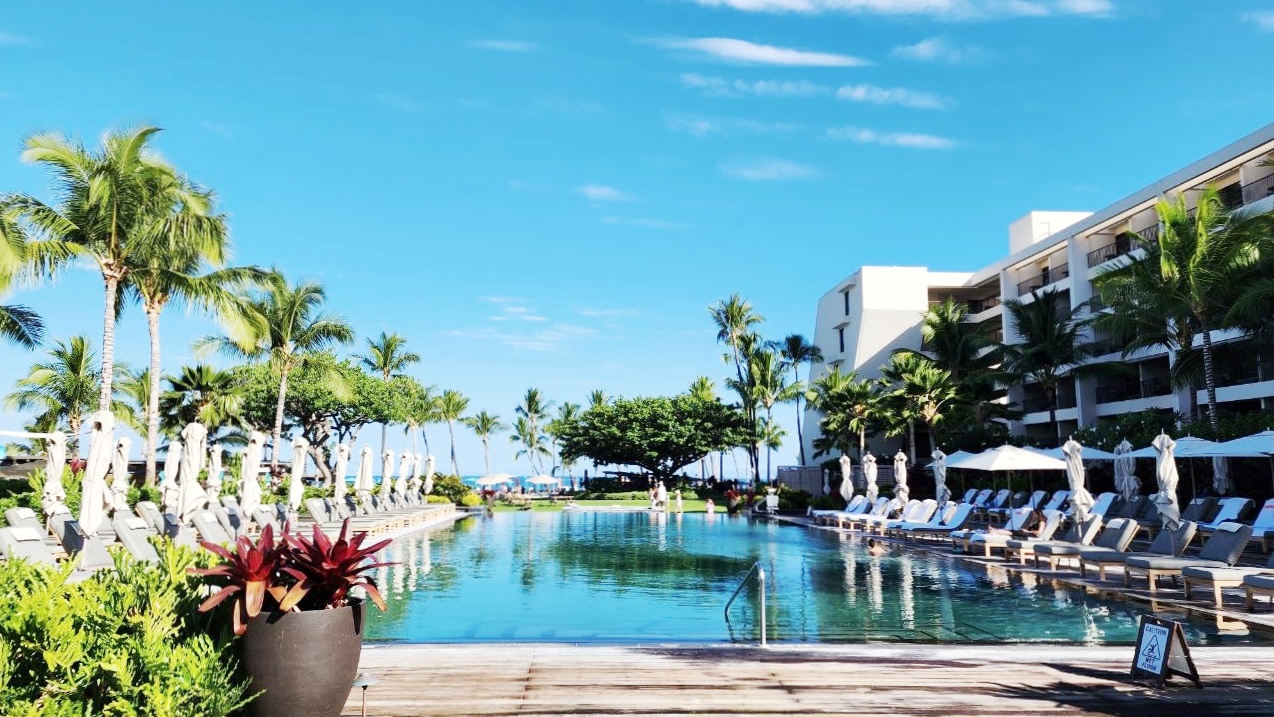
Club guests get them at the resort pool and at the Mauna Lani Beach Club, the resort’s prime water-access stretch. Anyone who, like us, has watched the morning chair scramble at a Hawaii resort knows how much a pool chair counts on a Hawaii resort vacation. At $829 a night, travelers do not expect to start every morning hunting for a chair at 7 am, and now they know why finding one feels harder or more expensive than before.
The Club has turned that issue into a viable product. Standard guests can fight for chairs the way that’s always true, while Club guests skip the issue because their chairs are already saved, and standard guests get the remainder.
What the extra $350 doesn’t buy.
The room itself stays the same. The booking doesn’t automatically guarantee moving guests into a larger category, a different building, an upgraded suite, or a better view.
That part’s interesting before anyone assumes this is just another upgrade to a club-level room. Mauna Lani is completely separating its club access from the room itself, which allows the resort to sell the upcharge against any room category a guest selects, rather than tying it to specific inventory.
At Hilton Hawaiian Village, guests paying more for the Ali’i Tower get a separate tower with its own pool, bar, and check-in tied to room inventory. At Prince Waikiki, club access connects to specific room categories and lounge-level inventory. At both of those, the room and the access move together, whereas at Mauna Lani, the room is the base product, and the better version of being at the resort is sold as a separate add-on on top of it.
Does priority access change the rest of the resort?
The Club also offers priority reservations at Auberge Spa, its Mercedes-Benz driving experience, Mauna Lani Golf, and the Sports Club and Tennis Garden. Those sound like concierge benefits and redistribute who gets what across the rest of the resort.
Priority means Club guests have the first opportunity. Standard guests still have access to the same resort, but the best spa times, the preferred tee times, and the easiest reservations now go to this new higher tier first.
The Francis Brown Club is not just a private lounge with snacks and drinks. It is a new layer of resort hierarchy, and the standard rate now buys what remains after club-level guests go first.
Hawaii hotels continue to break apart the stay.
Hawaii hotels have been heading this way for years. Resort fees were the first version and taught travelers to pay separately for amenities that had once been included in the rate. Paid cabanas, premium pool seating, upgraded and early/late check-in and check-out, and add-on lounge access kept dividing the same resorts into more layers, with the standard paying guest sliding lower each time. The Francis Brown Club is the next step, and it costs almost six times as much as most resort fees. If this reminds you of what’s happened to economy on Hawaii flights, it does us too!
Airlines have well-trained travelers to recognize this model. A fare gets you on the plane; everything else around the trip is priced separately, from bags, window seats, and legroom to meals, lounge access, Wi-Fi, early boarding, and flexibility. Hawaii resorts aren’t airlines, but the structure now looks very much the same, with the advertised room rate as the floor price and the comfortable version of the stay sold as a second purchase above it.
Some travelers will pay the $350 without thinking twice. The question is not whether the upcharge can be justified, but what happens to the rest of the resort once it exists and the standard guest gets repositioned around it.
Hawaii has already seen where this goes.
This fits a Hawaii hotel pricing pattern we have tracked for years, where every time a property is refreshed, repositioned, renamed, and reintroduced, the price moves with it. The Francis Brown Club is not just part of Mauna Lani’s story, it is part of every other Hawaii resort change where branding, access, and upgraded experiences move up to a new, higher price.
We recently wrote about how every time a Hawaii hotel rebrands, the price goes up, with Kapalua Bay next in line, and the underlying question was whether travelers keep getting less clarity about what their money actually buys. Mauna Lani has now put that question straight into the booking engine, with two prices for the same stay, and the higher one adds benefits around the room rather than changing the room itself.
Luxury experiments rarely stay luxury for long.
Hawaii hotel pricing rarely stays at the top of the market. Resort fees, parking charges, paid cabanas, and premium seating all started as luxury features and became standard charges across mid-tier and budget properties, and the Francis Brown Club is on the same path.
If this works at Mauna Lani, every Hawaii resort with a pool, a lounge, and a reservation system has reason to copy it. No new construction needed and no tower assigned, just a new line in the booking engine that drops every existing guest into a lower tier than they were in last year, with the standard rate still visible and the better version of the same property sold separately to anyone willing to pay for it.
The standard Hawaii resort stay is being unbundled piece by piece, even at properties where the base rate is already far from basic, and Mauna Lani is the sharpest version of the pattern yet. The open question is whether this becomes the next Hawaii resort pricing template, because once travelers accept paying extra for a position within a property, the rest of the industry has every reason to follow suit.
Have you stayed at a Hawaii resort with a club tier or paid lounge access? What did you pay, what did you get, and did it change how you felt about the rest of the property?
Lead Photo Credit: © Beat of Hawaii at Mauna Lani on Big Island.
Get Breaking Hawaii Travel News



Vegas is suffering from this arrogance and the revolt is real. Good luck. And, I’m routing all my friends and family to Fiji.
Easy to see why people are going elsewhere.
I love Hawaii and I would have loved to go back but many of the articles I read insinuate tourists are not welcome. Maybe some day they will learn that those who can afford the exorbitant prices are those that like to throw things at turtles, dolphins, and other protected sea life because they have money to buy themselves out of any consequences. Aloha and God Bless Hawaii!
BOH Bro’s In a couple of days we’ll be on BI staying at Manua Lani we’re not paying anywhere close to the numbers you’ve posted from their direct site. Several months ago I booked a stay through Costco that is about half of what you have posted, plus a ton of perks and rental car.
Plus the exclusive club stay has been around for years in both Vegas and on Hawaii. Outrigger has Club 47 and Grand Wailea has its own version. They never pencil out, so why bother.
IMO not only is Hawaii getting the golden goose eggs. It’s starting to pluck the golden goose’s feathers too.
This is why I opt for a rental condo. I can still do some food, drinks, and beach/pool access at my own cost/leisure, and I am also able to spend my money on local businesses!
Well said Teebs. If you visit every year and stay more than a week like I do, I can’t believe a resort experience would be affordable. And I consider myself to be fairly well off, but not rich by any means. Love the flexibility of a rental condo.
The only problem with that Hawaii especially Maui with Bill 9, Hawaii is trying to eliminate rental condos. I truly believe the big hotels and resorts are bribing Hawaii’s politicians.
Coming in 2027 to your favorite Hawaiian Resort Hotel — pay toilets!
Phillip please don’t give Hawaii any ideas like that. IMO they will take it to heart and make it a reality. I just wonder what are your Resort fee’s being charged for cover? Soap, toilet paper and tv. Previous articles have stated some resorts having a VIP pass to enter the pool lounge area that costs extra. Is this the same or different terminology? Access fee. IMO just another way to charge tourist’s to use various ammentities. I would think in the room or hotel description it would have to state whether certain ammentities have an extra charge or access fee to be a valid reason for payment. What’s next have to pay to talk to a front desk person to make a reservation. IMO just like Las Vegas with their pool regulations of chairs and unbrella’s etc.
And they wonder why we are being cut out of people’s travel destinations. Nickle and diming during high inflation and low tourism just tells visitors “let’s go somewhere cheaper.” And if they spend majority of their budget just on the flight and hotel, they got very little left to spend with local businesses. And “Kama’aina” who do stay cations need to be middle upper class income to afford it even with the discount. I’m all for making money off the tourist but resorts and airlines taking most of the pie and scaring off travelers doesn’t help.
Could this be one reason staff hours have been cut with many workers being put on “standby”?
Four Seasons in Wailea had something like this for years.
it very sad, hawaiian hotels find way to up sell, things not all of us want, however end up paying. just princing themselves out of the market of most travelers? people with the means to afford thse rediculouis price, pay because they can, however who knows how many will return? or just cut their time shorter? there are so many outher places in the world who arn’t tourist robbers
As I have stated several times in these types of escalating charge articles, it is simply cheaper and easier to just stay home.
Many agree. Or stay in other warm-winter destinations that have great pools, possibly even beautiful coastlines, and are literally 70% to 90% cheaper than these Hawaii ripoffs. We’ve posted before about these mainland and foreign destinations. They exist. They are great.
We paid lounge access at the old Sheraton Kona more than a few times. I don’t remember what the cost was exactly but we found it acceptable for the additional services and perks. It was our go to spot on the big island. I can guarantee that it wasn’t the exorbitant number listed in this article. We wouldn’t do it. We don’t travel to any of the islands anymore. Something that breaks our hearts. With all of the crap going on, we’d rather spend our $$$$ right here in our beautiful state of California and we know how to spend. It’s just not worth the hassle anymore.
Bring back Unkle Billy’s!
Unbelievable, but if enough tourists pay the price it’s going to continue. And you still probably have to pay big bucks for your supper. As for me, I’m going to stay at a condo with a kitchen.
Well, sounds like the separation between the ‘Haves’ and the ‘Have-Nots’ has ramped up in the Islands in a big way. Those of us who cannot drop thousands to experience the full resort amenities have to sit and watch from afar those who can. Too bad not all income levels, and locals too I imagine, can experience the high end vacation resorts who own all the best real estate. Exclusion and exploitation is alive and well.
The thing is, I don’t have a bit of envy for the people staying at those resorts. Those nickel-and-diming fake Disneylands aren’t all that they are cracked up to be. Not enough bang for the buck, not even close. Seems foolish to me, but to each his own, I guess. I guess the upside is that they can tell all of their friends they’ve stayed there.
That’s why we always book a condo instead of hotels. Kona Coast Vacations, on the Big Island, is our go to place to book our condo.
By the way, who in the heck is Francis Brown anyway? Another marketing blunder to name it that.
Hawaiian Golfer and Senator. He had a cottage there. Not saying it’s the best choice, but it’s not the worst.
If they were smart they’d turn it into more of a positive win-win, make it less of a haves vs have-nots and not look like elitists.
The people who stay there aren’t the type to quibble over price. Most are probably going to take the $350 deal. So why not just increase the regular rate and say “now we’re going to give you all of these benefits”. But then start a promotion for a lower rate that would be for people who want to “save” money by not having all of that and they want to try out the resort. Call it the “Taste Of Mauna Lani “ special. Day roughly a $1,000/$700 split. The proceeds end up the same. The difference is framing it in a more positive method rather than creating a have vs have not atmosphere.
The visitors who will spend that kind of money enjoy the have-vs-have-nots atmosphere. That’s almost the whole point of it. Look up the meaning of “exclusive”.
Hello, Pat….. I respectfully do not completely agree with that. In our world today it seems like “sensationalism” rules. You know, painting everything as extreme black and whites. I believe most people’s sentiments are more rational than that. And most of the “have’s” are in their own world and don’t give a rip about having or not having the “have-not’s” around them. If I were to paint an extreme picture I would actually say the “have’s” would be more inclined to stay at a place that is 100% “have’s”.
Hello, Deborah.
A large survey spelled out the most important priorities for groups at various income levels. For the lower income levels, it was food and shelter, job stability, and safety, For the wealthy, exclusivity was at the top of the list. Leaving a legacy also ranked highly.
Or book an all inclusive on Bonaire and get more for about half the cost of one night at that hotel.
Everytime I hear or see the wordb”resort”” I need to check and see if my wallet is still there. In the case of all islands in Hawaii, I have to additonally check my bank accounts to make sure the balances are still intact.
Jim, I agree. I feel it is ridiculous to call our condo hotel in Maui a “resort” but when I brought that up with other owners, no one else agreed with me. We have two small swimming pools and nothing else like a resort. No food service, no exercise room, no spa, no business center….