
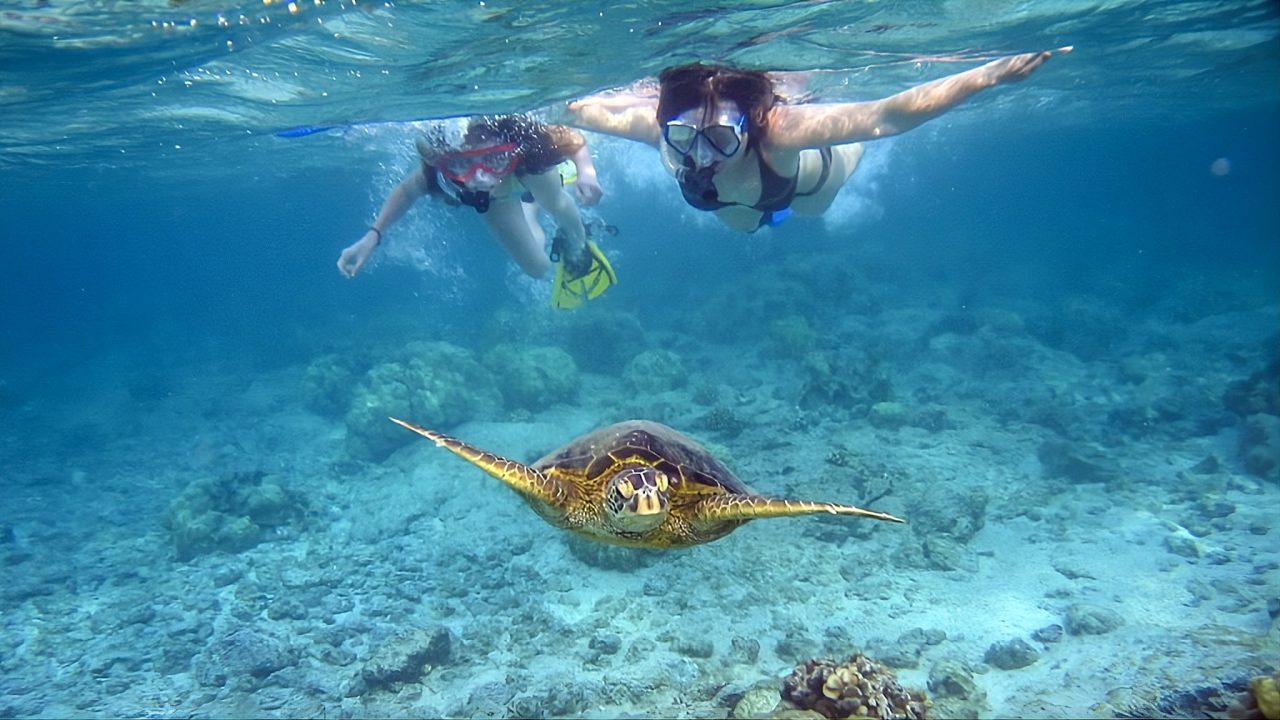
You can pay hundreds of dollars for a Molokini snorkeling trip and still get very different answers to a basic safety question depending on which company you book. One operator says people who cannot swim shouldn’t enter the water, even with flotation and crew assistance, while another says it accommodates non-swimmers every day. Hawaii’s ocean-safety guidance is stricter than some assurances given to prospective trip customers.
Maui operators disagree about who gets in the water.
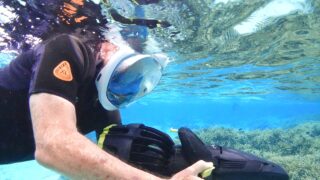
A Pride of Maui guide updated July 16 says it regularly takes people snorkeling at Molokini who cannot swim. Russell Hanson, the company’s videographer and photographer, says they fit those guests with a life vest, flotation belt, wetsuit, and two pool noodles. They hold a line behind the boat near the boarding steps, floating on the surface rather than swimming out on their own to explore the reef.
Maui Snorkeling, which also runs Molokini excursions, takes the opposite approach in guidance updated September 15. “A true non-swimmer shouldn’t enter the ocean to snorkel,” the company says, even with flotation, a buddy, or crew assistance. Guests must be able to swim independently in deep water, stay calm while breathing face-down through a snorkel, and follow instructions. Anyone uncertain about those requirements is told to contact the company before proceeding to checkout.
Alii Nui’s May 2026 snorkeling guide is much closer to Pride of Maui. It tells readers they don’t need to know how to swim if they have proper flotation and trained guides nearby, describing Molokini as a suitable destination for non-swimmers. The company recommends body-worn flotation belts or vests, with guides providing instruction and support in the water.
Both companies welcome non-swimmers and list qualifications elsewhere on their websites. Pride of Maui’s separate help-center page says guests should be able to float calmly with their faces in the water, breathe through a snorkel, move deliberately, and follow directions. Alii Nui’s FAQ strongly recommends comfort in the water and warns that there is nowhere to stand at its snorkeling sites. Neither page explains whether guests must demonstrate these abilities before entering the ocean.
A person who cannot propel themselves through deep water may still be comfortable floating with support, while someone else might panic the moment their face goes underwater. Both might describe themselves as non-swimmers when making their reservation, yet they could need very different levels of assistance. The companies’ published descriptions don’t necessarily make that distinction clear.
Hawaii’s safety advice is stricter than the sales pitch.
The Hawaii Department of Health’s snorkeling safety brochure tells people to stay out of the water if they cannot swim, explicitly including snorkeling with flotation devices. It says participants should be able to swim without equipment and notes that some responsible boat tour companies prevent non-swimmers from snorkeling. The Hawaii Ocean Safety guidance updated from June 2026 likewise says anyone intending to snorkel should be an experienced ocean swimmer.
The state’s ocean activity planning advice also suggests using a reputable tour or taking a snorkeling course, but not as a substitute for swimming proficiency. Its published safety guidance does not describe an exception for someone holding a line behind a charter boat or relying on flotation to remain at the surface. These recommendations are not, however, the same as a statewide law prohibiting commercial operators from accommodating non-swimmers, and the conflicting policies alone do not establish negligence or wrongdoing.
Flotation equipment isn’t all interchangeable, either. A snorkel belt, a wearable vest, and a pool noodle provide different kinds of support, and none teaches a person how to respond should their snorkel fill with water or breathing becomes difficult. As we explored in our reporting on full-face snorkeling masks, equipment can introduce concerns even for experienced swimmers, while our investigation into Hawaii’s visitor drowning toll also examined the wider circumstances surrounding ocean emergencies.
There is no evidence we’ve seen from those drowning figures to establish how many victims were non-swimmers participating in commercial excursions. Swimming ability is one of several risk factors, alongside medical conditions, equipment problems, and the ocean itself. None of the available information makes clear that an individual operator’s participation policy caused a snorkeling death.
The same disagreement appears beyond Maui.
On Kauai, Capt. Andy’s tells customers who cannot swim that they’re welcome aboard but cannot participate in snorkeling. Makana Charters says swimming ability is recommended but not required and that non-swimmers who want to enter the water can use flotation with crew nearby. Families considering similar Na Pali Coast excursions may face different eligibility requirements depending on the company they choose.
On the Big Island, Sea Quest Hawaii says it accommodates non-swimmers on many daytime Kona outings, provided they’re comfortable being in the ocean. But it draws a firm line at its nighttime manta ray tour, which requires strong swimming and snorkeling ability because of the conditions and dark night setting. The company also says a dedicated in-water crew member can join guests on some private charters for an additional charge, providing a more specific level of assistance than having crew members nearby.
Having crew available isn’t necessarily the same as having someone beside you throughout the snorkeling excursion. Pride of Maui says its assisted-floating arrangement is not a swim lesson and does not include one-on-one swimming instruction. A guided excursion may offer considerable assistance, but visitors need to understand what that assistance actually includes.
What a ticket does and doesn’t promise.
Alii Nui currently advertises its Molokini excursion starting at $249 per person, and its standard cancellation policy generally requires more than 48 hours’ notice for a full refund, although optional trip protection offers additional flexibility. We aren’t aware of customers being denied a refund because swimming ability prevented participation, but guests should confirm eligibility before committing to a paid reservation.
Someone considering a tour should tell the operator plainly whether they can swim independently in deep water rather than simply describing themselves as a beginner. They should ask whether they’ll actually be permitted to snorkel, what flotation and direct assistance will be available, whether staying aboard is an option, and how refunds are handled if the crew determines they shouldn’t enter the water. Those answers may be more useful than a general assurance that an excursion is beginner-friendly.
Each company website states what operators tell prospective customers, but it doesn’t show how every boat captain assesses individual swimming ability or handles changing conditions. We haven’t independently observed these procedures, and we still have unanswered questions about whether a crew member stays close to non-swimmers throughout their time in the water.
We’d especially like to hear from readers who’ve taken a Hawaii snorkel tour with someone who couldn’t swim. Did the company ask about their swimming ability before booking, and what happened when the boat reached the snorkeling stop?
By Rob and Jeff, Beat of Hawaii.
Some of Hawaii’s most meaningful parts are the ones visitors walk right past without knowing they are there. We’ve spent nearly 20 years finding them firsthand for BOH as full-time Hawaii residents reporting on travel, culture, and island life, and telling you what they mean for your trip. Join us →
Get Breaking Hawaii Travel News

Have friends whom have been running boat tours out of Kona and can tell you that tourists will lie and say they can swim when they can’t … putting businesses at risk because they don’t care … all they want is their selfie in the water. Whole families will come and say they can swim when they can’t. So a tour company has to then risk getting bad reviews from the folks that they won’t let go in the water. I have heard so many bad tourist stories combined my own experience working in the tourist industry here and a shocking large percent of tourists are horrible to work with. No respect for others or anything here. It’s all about me-me-me … the maturity of 2 year olds. Then they might wonder why the locals are not in aloha and don’t want them here.
Taking non-swimmers and putting them in the open ocean, even with various flotation devices, sounds like a serious event or death waiting to happen. A stupid practice that will likely self-correct once serious injury occurs, and that tour operator is out of business.
I’ve dove off of 6 of the Hawaiian islands with many different scuba diving operations. These are highly regulated, as they should be. Based on this article, it appears that it’s high time for the state of Hawaii to step in to better regulate the inclusion of non-swimmers in snorkeling operations.
My impression is that most snorkeling deaths in Hawaii do not happen on such excursions but rather at beaches and especially beaches that do not have lifeguards. Is that accurate?
Honestly, we’ve done snorkeling trips in Hawai’i. I’m a decent ocean swimmer. My wife Needs additional floatation devices to feel safe. No one has suggested not to go into the water if you have any fear. So, for her, a vest and a noodle helped her feel confident the first time, and that’s what she uses. Otherwise she never would have went in.
The only safety precaution was instruction on how to clear the snorkel of water.
Please be aware that there are specific guidelines re restricting one from scuba diving very soon after flying (like into Hawai’i). I do not know the specific details because I alas cannot scuba, but I do know that it is unwise to scuba in close proximity in time to being in the air at 35,000 feet. Look it up. Humans are generally landlubbers. Respect the ocean.
I cannot believe any tour company thinks it is a good idea to take out nonswimmers on the same tour as swimmers, unless maybe they bring extra staff exclusively devoted to safeguarding nonswimmers. I have gone to Molokini on Pride of Maui long ago, and they are a responsible and well run tour. If there were non swimmers among us, I could not tell, but this Was 20+ years ago before we moved to Maui.
I tell every visitor who asks me about ocean conditions: Respect the ocean. It is so much more powerful than little you. Don’t turn your back to it. Even expert ocean swimmers will say this. Ideally there would be a tour catering to nonswimmers. Theydeserve to see below, too. But if they begin to panic, some other stuff hits the fan, disaster in a moment. Respect the ocean and its awesome power.
I have run snorkel and scuba charters for over 40 years. The situations have a lot of variables. If someone cannot swim, are they told to stay next to the boat? Is there someone constantly watching them? Can they be assisted within seconds? As mentioned, what kind of flotation device are they given? Some people call themselves non-swimmers but could swim 20 or 30 feet. I have had people want to sign up for scuba diving who did not know how to swim. I would not take them! With close supervision a non swimmer could stay near the boat, constantly watched Calm water. If someone is freaking out before they even get in, I would not let them in. My mother-in-law put her face in the water with a mask on holding on to afloat and having a flotation device and was watched the whole time. She enjoyed it a lot. But it does take constant, close supervision!
How safe is it to attempt scuba diving after taking a one day pool instruction at a hotel or resort?
IMO depends on the diver. My first dive involved splashing off a boat after a 5 minute briefing. I was a university level competitive swimmer and had snorkeled extensively, was very comfortable in the water, and I was fulfilling a childhood dream of scuba diving. On the other end of the spectrum I have witnessed an ‘intro diver’ screaming and clawing the air once her mask went under. I think she was ‘encouraged’ to try despite misgivings.
I have been on dozens of intro dives with no issues. Many times certified shore dives include a first time into diver. Typically groups of 3 or 4 with an instructor. Almost always awesome. All intro divers must be able to swim and be comfortable in the ocean.
Gary,
I can’t say with specifics, cuz I can’t scuba, but I do know it is unwise to scuba “soon” after fling at 35000 feet. Humans are landlubbers. Ask your scuba instructor or. Tour guide for the details. Stay safe, have fun, respect the ocean
The guidelines are not to go to altitude, i.e. flying driving up a mountain after diving. Nothing above 1000 feet.
I would choose the company that is honest and protects everyone rather than their bottom line. Personally, I can see how someone would get panicked when something unexpected happens and they cannot swim. I would 100% recommend that you know how to swim, breathe correctly and be able to stay calm. It’s not worth the risk, but hey, it’s never too late to learn how to swim! It will help you in soo many ways ….Stay safe, everyone. Aloha from Maui
IMO it sounds like it’s about the money. How many families with one or two people that couldn’t swim just back out and not go? IMO just another situation that operators in hind sight feel all is good until something goes wrong. IMO when it comes to the ocean be safe not sorry. Does the all mighty dollar outweigh Liability? It isn’t like Hawaii don’t make any money per person on snorkeling tours. Teather a raft with a clear bottom floor and let them view the stuff from around their feet or restrict them to the front boat netting areas.
Aloha Don,
This is the most I have ever posted on BoH, but I have lived on Maui for 20 years and I am a retired lawyer. There is liability everywhere here in hindsight. But Hawai’i is a special, magical place. Almost all tour companies want their guests to have aneye opening experience with nature and they also want to keep you safe. It is not only making a buck. The ocean has awesome power, can become angry in a heartbeat, and does not care if it kills you. That’s the simple truth. That is why we must respect its power and carefully consider what is best for us and our ohana, whether resident or visitor. People needlessly drown here every year while they are on vacation. It breaks my heart. It does not need to be that way.