
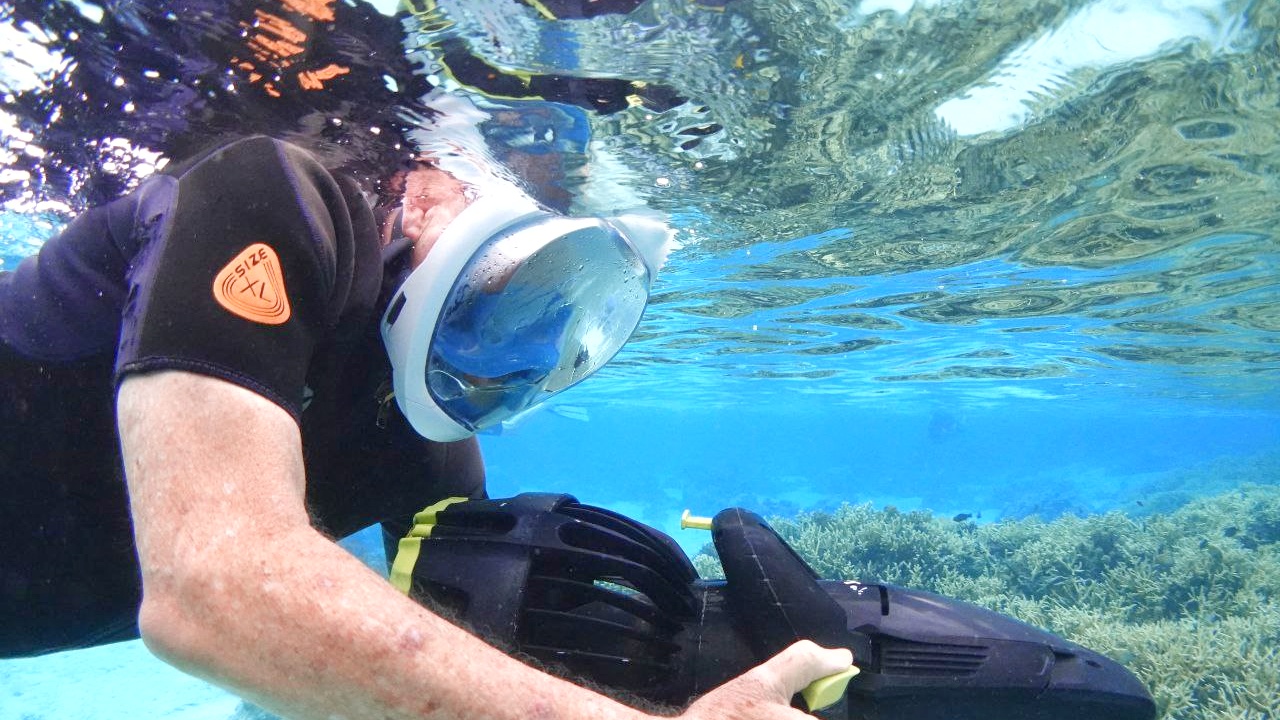
Five months after we last examined questions surrounding full-face snorkel masks in Hawaii, the story has not ended. Visitors are still trying to decide what to make of products that appear simple, widely available, and easy to use, while researchers, physicians, tour operators, and readers continue raising concerns.
A reader named Lydia just told us she and her husband bought a full-face snorkel mask at Costco on Maui this week, during their vacation. “My husband became exhausted after swimming for about 30 minutes and asked a surfer for help, it was really scary,” she wrote. “Mind you, my husband is extremely fit, avid swimmer and cyclist and we both think the mask was a factor…please be careful.”
We cannot know what caused that episode, and her account does not prove the mask contributed to it. But it also caused us to step back and consider what has changed since February. What makes her comment relevant is not that it proves anything happened. It is that visitors are still buying full-face snorkel masks in Hawaii, even as the broader safety debate remains unresolved.
The questions remain unresolved.
Full-face snorkel masks became popular because they appear easier than traditional snorkel gear. They allow users to breathe through the nose and mouth, offer a wide field of view, and seem less intimidating to those new to snorkeling.
These same features are also why some water safety professionals remain cautious. The concern is not that every full-face snorkel mask is unsafe or that every user is at risk. It is whether some designs, some users, or some ocean conditions may create breathing difficulties that a visitor does not recognize quickly enough.
Hawaii has spent years trying to better understand snorkeling fatalities, including research into rapid-onset pulmonary edema, often called ROPE. That does not mean ROPE explains every emergency, or that any one mask caused any specific incident. It does mean snorkeling risk is more complex than equipment alone, and that no single explanation accounts for every emergency.
A 2026 federal warning involved another mask.
Since our February article, the U.S. Consumer Product Safety Commission issued a March 2026 stop-use warning for OUSPT full-face snorkel masks. That warning cited drowning hazards and reports involving breathing difficulty, loss of consciousness, and fluid in the lungs.
That warning does not apply to Costco’s Oceanic full-face snorkel mask. We found no recall or CPSC warning involving Costco’s Oceanic mask, and we are not suggesting that Costco is selling a recalled product.
That distinction is critical because full-face snorkel masks can all look similar to shoppers who are not comparing brands, design, airflow systems, or warnings. A visitor may hear about general safety concerns, then see a legal product for sale in Hawaii and reasonably assume the broader questions have been settled. They have not.
The retail aisle sends its own message to Hawaii visitors.
Costco continues to show its Oceanic full-face snorkel mask online with product language emphasizing panoramic viewing and improved airflow. For a visitor shopping after arrival, that can feel like reassurance, especially when the product is sold by a familiar national retailer.
The harder question is what a visitor should do when faced with conflicting signals. A tour operator may discourage full-face masks, a researcher may raise unresolved questions about breathing, a federal warning may apply to a different brand, and a retailer may still sell a full-face mask as Hawaii vacation gear.
That is the Hawaii-specific consumer problem. Visitors are not choosing equipment in a vacuum. They are often buying it shortly before entering unfamiliar ocean conditions, sometimes after long flights, with varying and sometimes limited swimming ability, ocean experience, and awareness of Hawaii’s currents, reefs, and fatigue risks.
Our readers remain divided.
The public discussion on our February snorkeling mask article now includes many comments. Some readers said they had used full-face snorkel masks without trouble for years, while others described discomfort, dizziness, difficulty breathing, or being warned by guides against the masks.
That’s exactly why this topic remains difficult. The absence of a universal problem does not erase reader concerns, and reader concerns alone do not prove causation.
What the comments do show is that many Hawaii visitors are still trying to make an informed decision with incomplete information. Some see the masks as helpful and comfortable, while others say they would never use one again and want to warn other visitors to think carefully before buying one.
The decision should happen before the water.
The safest place to think through snorkeling equipment is before entering the ocean. Visitors should ask whether they are comfortable with traditional snorkel gear, whether a tour operator allows full-face masks, whether the mask fits properly, and whether they understand how to respond if breathing suddenly feels difficult.
Anyone who feels short of breath, dizzy, unusually fatigued, anxious, or unable to breathe normally should leave the water immediately. That advice applies no matter what equipment is being used.
For us, the issue is not whether every visitor should avoid every full-face snorkel mask. The issue is whether visitors understand that the debate is still active before they buy one in Hawaii and head straight for the ocean.
Have you used a full-face snorkel mask in Hawaii? Did it feel safer, harder to breathe through, or no different at all?
Lead Photo: © Beat of Hawaii. That’s editor Jeff wearing a full-face mask. It’s the first and last time for him.
By Rob and Jeff, Beat of Hawaii.
Some of the most meaningful parts of Hawaii are the ones visitors walk right past without knowing they are there. We’ve spent nearly 20 years finding them firsthand for BOH as full-time Hawaii residents reporting on travel, culture, and island life, and telling you what they mean for your trip. Join us →
Get Breaking Hawaii Travel News




I’ve used a cheap Temu face mask/snorkel set up for years and no issues. I usually do not snorkel the first 24 hours I arrive from mainland USA in the first place, and I have no clue if that’s a factor or not. And maybe I’m not understanding something, do people not know how to tread water and lift the mask to their forehead (and then breathe normally not into the mask) if they feel dizzy? If not, you shouldn’t be doing any kind of snorkeling imo.
I work in the emergency room at Maui’s only hospital. The high number of injured tourists coming for treatment is remarkable. The common thread: a combination of willful ignorance, arrogance or unwillingness to admit to physical limits. Ignoring safety advice at the beaches: quadriplegia. Riding down a volcano on a rented bike despite being 70 years old, obese and not having ridden for fifty years: pelvic and spine fractures. The list is endless. Full face mask: more of the same. God bless ’em, though-they help pay my salary.
First, thank you for your service in ER…Is there data Maui Memorial keeps on snorkel incidents? full-face vs. regular? etc….
the problem is relaxed breathing does not fully circulate new air into the face mask and the resulting carbon dioxide elevation is gradual, one a tipping point is reached breathing is not functional as normal, all the problems listed result from that design flaw.
In the debate about full-face snorkel masks, there is a key safety deficiency that never seems to be mentioned. That is the inability to verbally communicate with your snorkeling partner(s) while wearing a full-face mask.
Comments be like-
“I used the full face mask and didn’t die, so they are 200% safe” or ‘I don’t care if I die I will still use the mask because I like them”.
Ask yourself this if full face masks are that unsafe then why have they not been sued out of business?
Aloha-
I constantly warn parents at Ka’anapali Beach to be careful with their children and that we do not recommend them because of the Study out of New Zealand, which I would think BOH would refer to. Interesting enough Most parents tell me some version of “yeah, my kids say that don’t like it…”..I always notice they are completely fogged up…They also tell me they get them off Amazon or here at Maui Costco. …And there has been 3 three visitor drownings on the West-side in the last four months! All confirmed they were using a full-face snorkel mask-Ugh! Not worth the risk and Costco does not care
There has been a known risk with full face masks for many years. My question is why are they still being sold? I know that those who love them will not like this post, but it worries me that inexperienced people who have not snorkled much in the past will be caught off guard and could have a devastating experience. Those who are experienced will continue to take their chances if they use a full face mask. I truly hope that no one has a bad experience.
First time snorklers here, ages 40 and kids late teens. We bought the Seaview full face masks and have had an amazing experience with them at sharks cove and hamauma bay. The larger breathing tube made it easy for us to breath normally and the wide angle view was great for viewing fish but also maintaining a peripheral view of our kids. They are great for staying on the surface but we haven’t tried diving with them.
Been snorkeling in Hawaii the last 8 years. I invested in a full face to start, tested in my pool, was fine, and have used one since. I have used it in Bahamas and Caymans as well. I prefer them, find it easier to use with less potential for problems. My wife and kids have them as well, all tested in our pool at home prior to use in the ocean. The only complaint has been jaw being a little sore after because we do talk a lot when snorkeling (the part I love about the masks). The only issue I have ever had and I have warned my family and friends who use them is this: chin to chest, which can easily happen when looking at fun things under the water, can trick the ball in the mask to think you dove and will block the air. This can create panic because you literally can’t breathe. It has happened to me, but I realized the issue fast and just flung head back or to side. My son, his experience with it was enough to make him never want to try the mask again, so he went back to traditional.
Breathing through a little tube for a half hour is stressful. Try it on land sometime. Now try it doing a physically stressful exercise like swimming. Now try it when your over 50 and no longer in youthful fitness, and maybe haven’t done this in years. It’s a wonder more accidents aren’t happening.
Remember that Hawaii’s ocean deserves respect. Good equipment helps, but judgment, experience, and knowing when to get out of the water probably matter even more than what kind of mask.
The thing that surprised me wasn’t the reader’s comment. It was learning these masks are still being sold so prominently when there are obvious unanswered questions. I would also have assumed that the issues would have been settled one way or the other by now. Why not?
My wife and I both bought full-face masks a couple of years ago. She loves hers and still uses it. I never got comfortable with mine and just got rid of it. It’s interesting how different two people can react to the same equipment.
Every visitor should realize that Hawaii snorkeling isn’t the same as floating around in a resort pool somewhere. Conditions change quickly too and even really good swimmers can get into trouble.
I tried one of these in calm water off Oahu and found myself strangely breathing faster than normal. I took it off after about ten minutes later because it just didn’t feel safe. Maybe it was me, maybe it wasn’t, but I haven’t used one since that happened.
I’ve snorkeled in Hawaii for more than 30 years. Every time I see someone wearing one of these full-face masks, I wonder if they ever practiced with it say in a pool before getting into the ocean. New equipment and unfamiliar water don’t ever seem like a great combination.
The problem may not be just the mask alone. Visitors often arrive after a long flight, rent gear they’ve never used before, aren’t super strong and regular swimmers, and head straight into the ocean. That’s a lot of variables all at once so this is no wonder.
If there’s ongoing debate about these masks, why not have a simple notice encouraging people to read up before trying to use them safely? I saw nothing.
I had exactly the opposite experience. I can’t comfortably use a traditional snorkel no matter how hard I’ve tried, and the full-face mask let me enjoy snorkeling for the first time. Everyone’s experience seems different.
I think it’s important not to jump to conclusions as Hawaii’s ocean is demanding even for strong swimmers. That said, with so many people reporting similar concerns, it’s worth paying some attention.
Our snorkel guide on the BI asked before we even got on the boat whether anyone had brought a full-face mask. He politely suggested we leave ours behind and use the equipment they provided instead. That made an impression on me.
I’ve used both styles over the years. The full-face mask always felt just a little harder to breathe through, although I never had any scary experience. I eventually switched back to a regular snorkel because it just felt more comfortable.
We bought full-face masks for our first Maui trip because they looked so much easier than the traditional kind. After reading more about them, we left them in the condo and rented regular snorkel gear instead. Maybe we were overly cautious, but it seemed like the safer choice anyway.
Not unresolved for me. I had a similar experience the last time we were on Kauai. I rented full face and experienced fatigue both times I used it. Once was maybe … twice was confirmation. Not using a full face mask again … too scary.
These seem dangerous to me, and also pretty unnecessary.
I bought the Tribord full face mask back in August 2016. I’m unable to use the traditional snorkel mask, so this was a game-changer.
I love mine and have never had any issues.
I don’t get why anyone would consider the full face masks. I tried one on my face in a dive shop and noped out really fast.
I find ocean water in my eyes very unpleasant. I definitely wouldn’t like the inability to breathe freely unless I want my eyes exposed. As a regular lap swimmer, I find it easy to inhale a big breath rapidly and then rest my head in the water. I do quite a bit of my swimming into position or back to the shore without the snorkel. I also take a break from the snorkel regularly to keep myself well ventilated.
I grew up snorkeling. At the age of 3 under the tutor of my father an U of H graduate oceanographer he had me all over the islands with him. I now have snorkeled and dove all over the world. I thave tried 5 different full face mask/snorkels over the years and experienced shortness of breath with each one. The last time I had spent a good amount on one, thinking that maybe it was a problem with cheap ones. Nope shortness of breath after 30 mins, switched to my old school mask and snorkel, went back out and was fine for 3 hours. My thought is because CO2 is heavier than air it builds up in the bottom of the full mask and is not being blown out like with a traditional snorkel.
Found the study out of University of Auckland. It is a small sample size 20 people, experienced snorkelers.
pmc.ncbi.nlm.nih.gov/articles/PMC10735670/
The study concludes that full-face snorkel masks carry a meaningful risk of hypercapnia and hypoxia, primarily because their internal seals and one-way valves fail to maintain truly unidirectional airflow in practice. The resulting rebreathing enlarges the effective “dead space” — the volume of stale, CO₂-rich air re-inhaled before fresh air arrives. The authors call on manufacturers to improve mask design and urge prospective users to be aware of these risks, particularly children (who have smaller tidal volumes) and individuals whose facial anatomy does not match the standard mask sizing.
Swimming in the ocean for 30 minutes is likely to make anyone tired, whether they’re wearing a full face mask or nothing at all.
The moral of the story? Just because you’re fit and can swim in your local pool or lake doesn’t make you fit enough to swim in the Pacific Ocean.
There are drowning deaths by snorkelers every year in Hawaii. Some snorkelers use traditional snorkel gear while most recently others have opted for the newer design full-face masks. It seems to me the obvious question to ask here is how many snorkelers have drowned using traditional snorkel gear vs the number that have drowned in full face mask gear?