
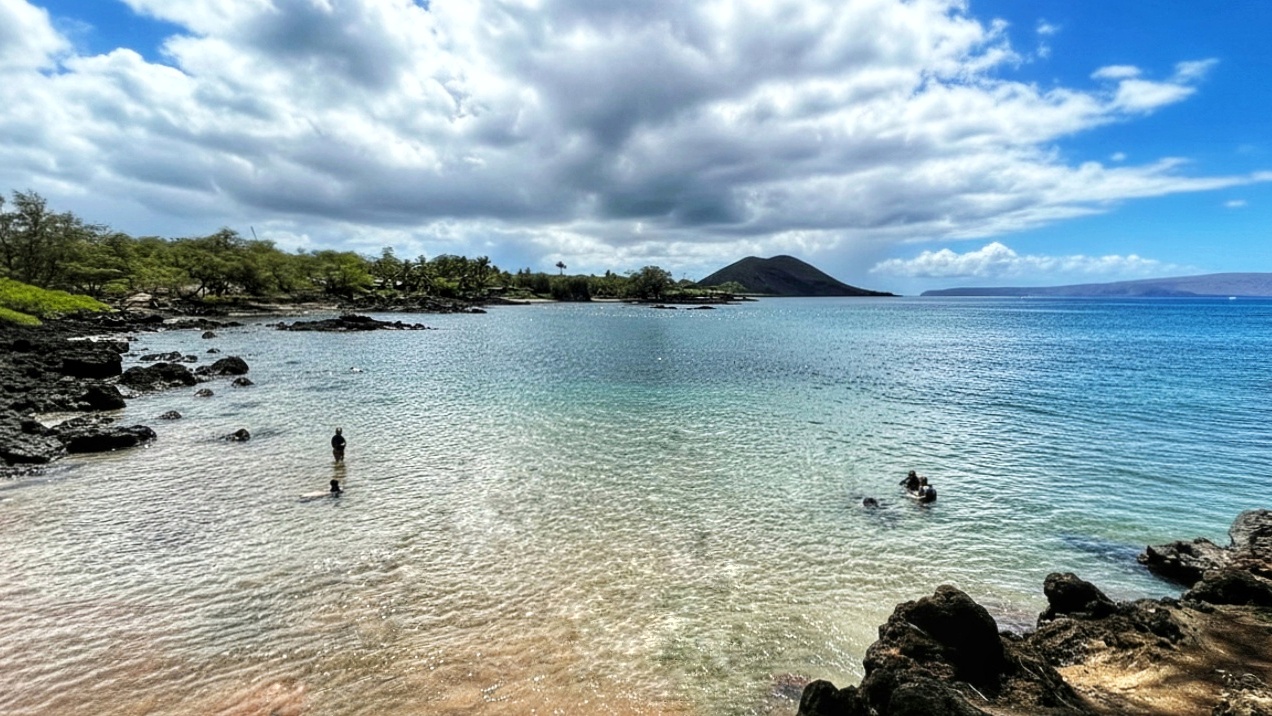
A 69-year-old visitor from Huntington Beach is dead after snorkeling at Makena Landing (Maui) on January 31. Frank Archuleta Jr. was pulled from the water around 11:45 a.m., CPR was attempted, and he was pronounced dead at the scene. Police classified it as a miscellaneous fatal accident, and an autopsy was scheduled. No foul play is suspected. No official report has said what kind of mask he was wearing.
We are not claiming he was using a full-face snorkel mask in this case. But within days of the news breaking, the same question landed in our inbox again: Was he wearing one of those full-face masks?
At the same time, a longtime reader on Maui’s west side wrote to say there had been another incident in early February in front of Royal Lahaina involving a male visitor using a full-face mask. That account is based solely on reader and social media reports. We have not found news coverage confirming it. What we do know is that in past Hawaii incidents where equipment was confirmed, full-face masks have been involved.
Full-face masks and the debate that won’t go away.
In Hawaii Snorkeling Unmasked After Recent Drownings we detailed the double drowning at Ahihi-Kinau (South Maui), where full-face masks were confirmed. We also wrote about BOH editor Jeff’s own experience with a full-face mask, which felt wrong fast once breathing picked up.
In 69% Of Hawaii Drownings Are Visitors As Maui Rate Doubles, we documented how Maui’s drowning rate has outpaced Oahu’s and how visitors account for the majority of deaths. This is not a new issue for Hawaii. It keeps resurfacing because the pattern continues.
Full-face mask study published in Diving and Hyperbaric Medicine.
The study, conducted in December 2023, was led by researchers at the University of Auckland. It compared full-face masks to conventional snorkels under simulated exercise. The full peer-reviewed paper is embedded below and is available through the NIH National Library of Medicine.
During light exercise, 45% of full-face mask trials were stopped after exceeding 7.0 kPa end-tidal CO2. With conventional snorkels, it was 20%. During moderate exercise, 41% of full-face mask trials were stopped due to excessive CO2, compared with 19% for conventional snorkels.
Five participants dropped below 90% oxygen saturation. Four of those drops occurred while wearing full-face masks. The researchers described how exhaled gas can mix with incoming air within the mask through communication between the eye pocket and the oronasal pocket. That creates rebreathing even when the mask is not fogging and not obviously leaking. They said manufacturers and snorkelers should be made aware of the risk. They also flagged that children, because of smaller tidal volumes, may be more vulnerable.
The study also found that females and participants of Chinese or South-East Asian ethnicity more frequently experienced inadequate internal seals on full-face masks, indicating that the internal seal did not perform equally well across different facial types.
Yes, the study was lab-based and involved 20 participants. In August 2025, a case series in the journal Children documented three kids under six hospitalized after incidents involving full-face masks, including one cardiac arrest. That is not theoretical. This is not theoretical. It reflects documented real-world medical cases.
Now step into Costco.
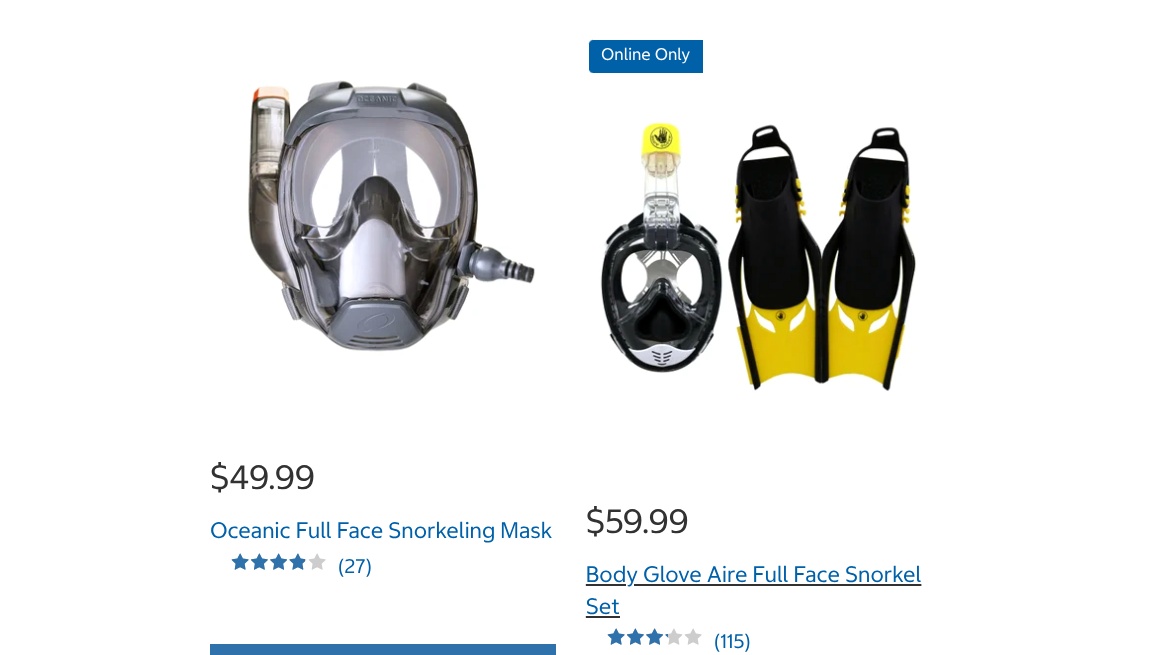
Costco.com still shows live product pages for two full-face snorkel masks, the Oceanic Full Face Snorkeling Mask at $49.99 and the Body Glove Aire Full Face Snorkel Set at $59.99. Both are currently showing as “Out of Stock” for online delivery. The pages remain up. The reviews remain visible. The Oceanic product copy highlights less CO2 volume as a feature.
“Less CO2 volume.” The marketing language acknowledges carbon dioxide buildup as a design consideration worth mentioning. At the same time, peer-reviewed research shows that CO2 levels rise and oxygen levels drop during exertion.
Reader Nita told us she recently saw full-face masks on the shelves at the Maui Costco. She reported that she spoke with a manager there, who told her they were hesitant to sell them. That is her account. We can’t independently confirm that conversation, and it is not an official Costco statement.
The product reviews on Costco’s own site are even harder to ignore. One reviewer, Joe F, described getting hypoxia from CO2 buildup inside the mask. He wrote that after one use, he fell onto rocks, and after another, he became dizzy, lay down, and his girlfriend noticed his feet and halfway up his calves were purple. He called the design flaws well-known and said he assumed Costco would know if a product was potentially dangerous or deadly before selling it.
Another verified purchaser wrote that she was not allowed to use the mask on snorkel trips in Hawaii because of safety concerns. She does not recommend it. Another review simply flags safety issues and urges buyers to research before purchasing. Those reviews sit on the same page as the add-to-cart button.
It is also worth noting that some of those safety warnings show vote ratios like 14 unhelpful to 3 helpful and 15 unhelpful to 4 helpful. We are not drawing conclusions about who is voting for those reviews. We are noting that warnings about hypoxia show more unhelpful than helpful votes in some cases.
Meanwhile, many Hawaii tour operators will not rent full-face masks and will not allow them on their boats. Visitors can arrive, buy one from a mainland retailer, and then be told by local operators that they cannot use it. That highlights how the risk line is being drawn in the water rather than in the warehouse aisle.
We are not saying a full-face mask caused the Makena death. But we are saying that peer-reviewed data documents increased CO2 retention, a published case series describes pediatric harm, customer reviews describe hypoxia symptoms, Maui’s drowning numbers remain high, and these masks continue to be marketed and sold into Hawaii’s visitor market, both at Costco.
The research is out, the warnings are visible, the reviews are public, another visitor is dead, and the masks are still in circulation.
If you are Costco, knowing what is published and what your own customers are writing, do you keep selling them in Hawaii? And if you are a visitor standing in that aisle in Kahului, what would you want someone to tell you before you carry that box from checkout straight into the ocean?
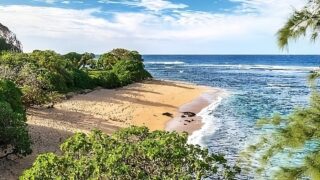
Lead Photo: Makena Landing on Maui.
Get Breaking Hawaii Travel News
Wow, yesterday in Maui we experienced something questionable with this mask. We are vactioning and saw the full mask at Maui Cosco and purchased it. My husband became exhausted after swimming for about 30 minutes and asked a surfer for help, it was really scary. Mind you, my husband is extremely fit, avid swimmer and cyclist and we both think the mask was a factor. Those trying to point to lack of respect of the ocean, we live on the florida coast and have snorkled everywhere from PR up the East and West Coast and something is just not right with this mask, please be careful.
If it weren’t for a full face mask, I would have never known the wonders of snorkling. I tried using a standard snorkle mask once and had a terrible experience. As someone who not only respects, but fears the ocean, a full face mask allowed me to relax and get my bearings. I can now snorkle with any mask and have learned to enjoy the ocean in a whole new way.
I agree with another poster that the mask isn’t the problem, it is a fundamental lack of respect for the ocean.
As I mentioned before I mentioned I felt like I couldn’t breathe with the full mask. The more I thought about it is I am claustrophobic too. Maybe that is what some of the snorkelers are feeling. Just a thought!
This is likely R.O.P.E. Rapid Onset Pulmonary Edema. Hawaii owes it to its visitors to warn about this. If snorkeling within 1 week of flying, many are at risk!! Its preventable. If incoming flights warned of dangers, people would stop dying. The fact it continues is unacceptable.
Yes! This what I was hoping would be added by our lovely BOH editors. When I saw the study a couple of years ago, it makes perfect sense. Also, it seems middle aged men are more prone to succumb?
It isn’t the masks that are getting tourists killed on Maui it’s their total disrespect of the ocean.
We’ve all seen them with their backs turned to the water to get that perfect selfie only to be smashed by a sleeper wave.
I’ll bet if they outlawed full faced masks there wouldn’t be any less drownings. Can’t stop stupid.
Just breathing thru a tube with any face mask is a disorientation experience for older adults who may not have snorkeled often or recently.
Safety recommendations should encourage the holding onto a floatation device such as a kickback, inner tube or boogie board to provide a place to rest and catch your breath with mask and snorkel off.
It would have helped me understand this issue if you pictured full mask and regular snorkels. Illustrations please.
I continue to use my full face mask….But I make sure that I come up every five minutes or so take it off for a bit.
Hello BOH editors,
Thank you raising the full-face mask snorkeling danger.
Because it’s heavily related, and may be a co-occuring danger, can you add information about snorkeling after air travel for new Hawaii travelers?
I’ve had a full face mask for over 2 years now….from Temu…around $10. It doesn’t get cheaper. Works just fine. It doesn’t allow me to breathe water in…ever (whether an errant wave splashes over the snorkel… and it never leaks around my face (I have facial hair)…so I consider this mask far superior for snorkeling on top of the water vs. traditional. Not a great mask if you want to dive below the surface due to its inherent buoancy. I have never felt panic or loss of breath..however due to these stories I read on places like here, I do take a break once in a blue moon, tread water, pull the mask away from my mouth and breathe in/out normally just to ever see if I ever notice a difference. I do not. Did people ever die from snorkeling Before full face masks existed? That might make a more interesting and balanced article.
You are making a flawed assumption, namely that everyone snorkels as well as you do and that they are: Not obese, without pulmonary health issues, not hyperventilating, not overexerting themselves, calm when in the water.
The full-face snorkels are sold to the exact nervous, inexperienced, and unathletic people who are likely to have a problem snorkeling.
Unfortunately, unlike a regular mask and snorkel, a full-face has large physical cavity for CO2 to build up during respiration which causes hypoxia, which causes tunnel vision, panic, then unconsciousness.
That is why traditionally the mask part is separate from the snorkel part. That’s every single experienced snorkeler and freediver uses a traditional mask and snorkel, often costing more than $10.
Also bring a float.
I was pulled from the water after a failure on a Costco sold full face mask. I let Costco know these are dangerous and should not be sold.
I said I was on the edge of death. Five emergency rescue personnel carried me to shore. Luckily a life guard station was nearby. I just couldn’t breathe trying repeatedly to clear the mask. I swam to the shore from about 500’ out when the failure happened. No energy when you’re fighting to breathe.
Costco management in Maui are aware of the complaints. At the time of my near life ending experience I took my six mask back. I didn’t want my family or death of my home on Maui killed by these things.
Apparently, my complaints were unheard by executives in Kirkland.
Now I understand why Costco sells caskets.
Thanks BOH for saving lives. Buy a $20 bodyboard at Costco: Velcro it to your wrist and no more worries.
Aloha
Aloha!
Mahalo nui for this article. it’s not a hypothesis…it’s real. You may be responsible for saving lives!!
Mahalo BOH for kindly reporting on the info I sent you. Once I can confirm all the details of the incident (February 13th, 2026) in front of the Royal Hawaiian, Ka’anapali, Maui with BOH readers I will…the word on the “coconut wireless” is that both incidents did indeed involve the full face snorkel mask, as was used in the couple that died snorkeling on their “baby moon” last year…all so sad and perhaps preventable
You are positing that full face masks were the cause of these incidents without proof. The outcomes may have been the same with a traditional mask and snorkel. There is no evidence for either theory.
Correlation is not causation.
Three years ago a good friend died snorkeling off Kihei. He wore a traditional mask and snorkel. In fact, he was part of a group snorkeling tour, so no full-face masks allowed. Breathing, even with traditional gear, is not normal, as it is full-mouth, not using your nose. Unless you force yourself to breathe more deeply it is easy to rebreathe CO2 trapped in the tube, and you can find yourself a bit oxygen starved. In my friend’s case, an older leisure swimmer with casual snorkel experience and an extended swim offshore, the deprivation and extra exertion with an undiagnosed heart issue likely triggered his heart attack. There are many different reasons that intersect when these accidents happen. It’s not always just a mask. At least he passed in a place he adored.
My friend and I both used the full face mask. The whole time I felt like I couldn’t breathe. Took it back the same day and got the old fashioned kind
AI says, “There are no lifeguards on duty at Makena Landing (also known as “Turtletown”) in Maui.” Even Blackrock with thousands of visitors has none.
If it is true there are No lifeguards at these tourist beaches, shame on all Hawaiians.
Shame on all Hawaiians for not babysitting every inch of coastline???? There are not an unlimited number of life guards living in Hawaii and it is not possible to police every beach. Common sense says that, if you go in the water at an unguarded beach, you are on your own. You want life guards, go to one of the many beaches that do have them.
Shame on all Hawaiians for not babysitting every inch of coastline????? There are not an unlimited number of lifeguards living in Hawaii and most shoreline access is unrestricted by law. It is common sense to acknowledge that, if you choose to go to an unguarded beach, you are responsible for your own safety. If you want life guards, go to one of the many beaches that have them during the hours that they are on duty.
I remain baffled by many of the hypoxia, CO2 and CO poisoning cases. I say that because I am very in tune with how my body feels, and I don’t ignore that feeling. In the cases of environments completely unsuitable to support life, loss of consciousness happens too fast to react. But not so in these cases of slow hypoxia or poisoning.
If your field of vision narrows, if you feel light headed, if you smell exhaust or combustion products, don’t ignore it. If you do, you may pass out feeling peaceful and never wake up again.
My wife and I have been using Full Face Masks for many years now. I have facial hair that makes using a traditional mask difficult.. I had to order them from Europe as they weren’t available in the US at the time. We’ve never experienced any issues with them. Ours are the originals (before knock-offs were available). My son rented a knockoff and had fogging issues immediately. It was poorly made and its use was immediately discontinued. All of these masks are *not* the same.
Its also important to understand that many people using traditional snorkel gear also die in Hawaii. I’d love to see some published statistics breaking down full face vs traditional mask and snorkel to see if there is any statistical difference between the two. As far as I know, that data has not been published. Until that empirical data is published, its just a guessing game.
My parents used the same argument about cigarettes in the 70’s.
How do you empirically explain that every single experienced snorkeler and freediver uses a traditional mask and snorkel?
I have had a bad & good experiences with full face masks (I’ve only used them 3 times). The first time I used a size L mask that was offered to me because the strap to my mask/snorkel set broke. I know I was breathing too rapidly with the full face mask as it was awkward, not a tight seal & I wasn’t familiar with how they work. Pretty quickly I started feeling dizzy & queasy. I removed the mask and began vomiting so that ended that. I’ll add I had heard conflicting reports about their safety. My husband bought me one in a small size and I have used it twice with no ill effects, but I am Very mindful that if I start feeling the least bit ‘odd’ to stop and remove it. I have to say they are much easier to use than the traditional mask & snorkel.
While I agree there have been a lot of reports about serious issues with full face masks, I doubt Costco is the only retailer selling them. I agree it would be wise for Costco to take a hard look at this product. The study you cited was an awfully small sampling: 20 people? Understand the hi am Not in any way defending on the full face masks, but playing devils’ advocate, it seems we need more & a bit larger studies to provide good data to get these masks entirely off market. I don’t snorkel, but if I did, I can tell you that due to reports o have read over the past few years, I would Never utilize a full face mask.
Thank you for the informative article, mine is going in the trash.
I’ve been an avid scuba diver and snorkeler for decades all over the world. Had my first experience a couple weeks ago on a private boat where they only had full face snorkel masks. It felt like a struggle to get air and I abandoned it very quickly. It’s an ill conceived newbie gadget that is trying to eliminate 5-10 minutes of basic snorkel & mask use training but causes more problems than it solves. Not worth it!
I tried one in shallow water at Poipu and felt like for whatever reason I couldn’t get a full breath once I started moving faster. Switched back to a standard snorkel and I felt normal.
The irony is that your article above that questions the safety of these masks has ads for full face snorkeling masks. The irony!
BOH is merely showing that Costco is still selling ful-face masks. It’s a screenshot. As proof, the links in the ad do not work.
We were turned away from a Maui snorkel tour because my son had a full-face mask. At the time I felt annoyed, but now I’m feeling grateful.
yes…all the locals here in Maui know the dangers of full-face masks and we know of No retailer or activity or business that uses them, rents them or sells them; except Costco. They are heavily marketed on Amazon with Amazon retailers paying dearly for their ad$….I can always tell a visitor because they will have the whole family in these contraptions and Every Mask is fogged up with breath and their faces are white from sunscreen goop- just the appearance looks horrific!
I’ve snorkeled Hawaii for 40 years with a regular mask and snorkel. Simple and it works. I don’t understand the need to reinvent this.
If the Costco reviews mention purple feet and hypoxia, that should be enough to cause pause. You don’t need any study. Use common sense.
My husband is a boat captain on Maui and they absolutely do not allow full-face masks. That alone tells you a lot. The water people here see things that tourists don’t.
This feels like an overreaction. Millions of people use these masks worldwide without dropping dead. At some point personal responsibility has to enter the conversation.
I can assure you this is Not an overreaction. The risk of hypoxia from full face masks is real and has been documented by both studies and actual drownings, not just anecdotal evidence. Snorkeling tours in Hawaii will not accept them due to increased risks and liability. The ban has since spread to other parts of the world, such as the Red Sea in Egypt as well as cruise lines operating in the Caribbean and Galapagos.
We bought one of these masks at Costco last year because it looked easier than the old ones. After about ten minutes I felt lightheaded and had to get out. I thought it was just my nerves. But was it?
Probably not.
Light headed, narrowing vision, or tingling lips are all signs of high CO2 and low oxygen.