
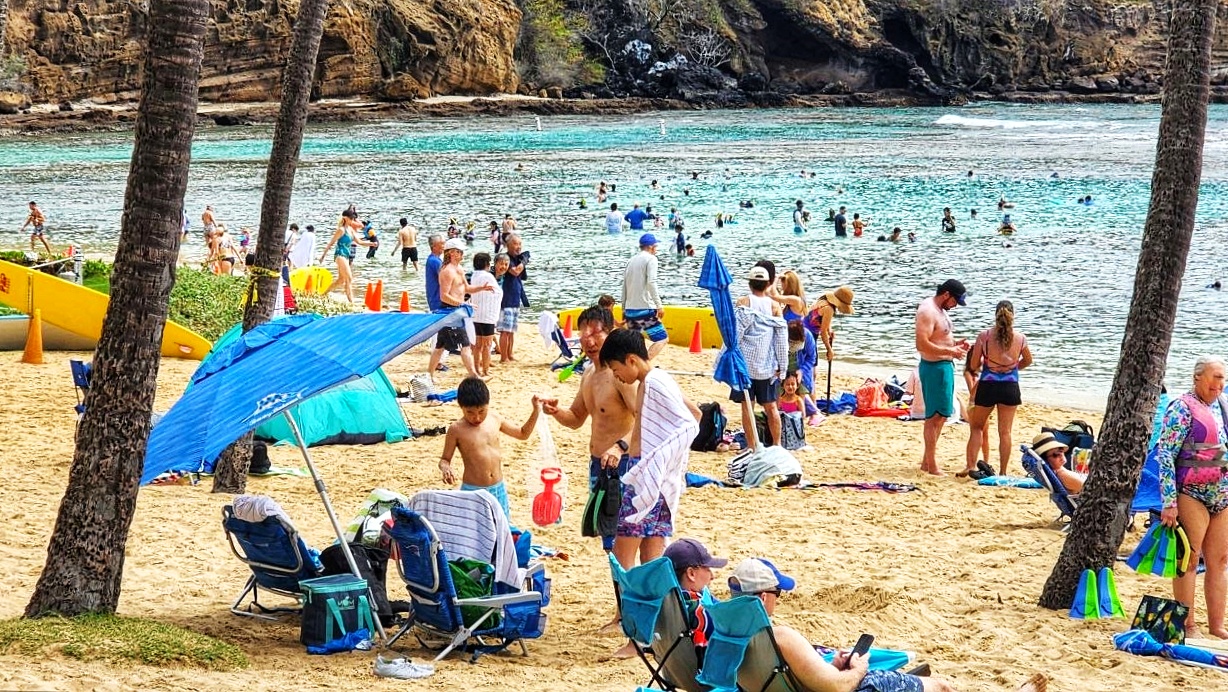
A 66-year-old woman was pulled unresponsive from Hanauma Bay on Sunday morning, about 10 feet offshore in front of lifeguard Tower 3C. This didn’t happen at a remote, unguarded Oahu beach where warning signs were missed, and help was far away. It happened at the Hawaii snorkel spot with reservations, visitor caps, a required orientation video, lifeguards on duty, and controlled entry. The so far unnamed woman was taken to the emergency room in critical condition after the 9:28 a.m.
What happened Sunday morning at Tower 3C.
The woman was found unresponsive while snorkeling in the middle section of Hanauma Bay. Ocean Safety personnel brought her to shore, CPR was started, and Honolulu EMS transported her in critical condition.
The location is worth noting as it was very close to shore and directly in front of a lifeguard tower. Visitors often think the biggest danger is being too far out, getting caught somewhere isolated or without lifeguards, or snorkeling where no one is watching. The woman was close enough to shore that most visitors would not have considered the spot risky at all.
Hanauma Bay is one of the few beaches in Hawaii where visitors are warned, counted, managed, and watched before they can enter the water. That helps, but it does not remove the basic problem with snorkeling here. Trouble can happen so fast, even in water that looks calm and controlled from land.
The safety layers Hanauma Bay actually has.
Hanauma Bay is not like pulling off the road at a random beach and walking into the water on your own. The daily visitor cap is 1,400, with time entry in groups of 40 every 10 minutes. Hanauma Bay reservations open two days in advance at 7 a.m., Hawaii time, and nonresidents pay $25 to enter. A required 9-minute orientation video is part of the process, and the city has added managed transportation options, including the Roberts Hawaii shuttle package, launched in November 2025, which can be reserved up to a month in advance.
We covered that access and management shift in Hanauma Bay Shake-Up | What Visitors Need To Know Now, in part because Hanauma has become one of the most structured visitor experiences in Hawaii. It is still a spectacular beach, but to many visitors it now feels like an over-managed attraction with rules, gates, time slots, and a safety video attached.
That system limits crowding, protects the reef better than the old free-for-all days, gives visitors basic information before they go in, and keeps lifeguards nearby when something goes wrong. Sunday morning showed that even then, the system has limits. None of those layers can make snorkeling risk disappear.
Why visitors believe Hanauma is the safe choice.
Many visitors choose Hanauma Bay specifically because it feels like the responsible choice. It is not only famous but also well-staffed, regulated, and widely regarded as a safe place to snorkel if someone wants fish, reef, and a little more structure and seemingly reduced risk than they would get at many other beaches.
That belief makes sense. A first-time visitor, an older traveler, a family, or a cautious snorkeler may look at Hanauma and assume it is the safer version of snorkeling in Hawaii. Compared with an unguarded beach, a more dangerous rough entry, or a spot found on social media, Hanauma does offer more systems and support.
The problem is that “safer” is not the same as “safe.” Hanauma can manage crowds, control access, educate visitors, and keep lifeguards present near the beach. It cannot control what happens inside someone’s body once they are face down in the water, breathing through a snorkel, adjusting to the ocean, and perhaps working harder than they realize.
That is the gap that is hard to explain well enough. Visitors can be warned about reef protection, standing on coral, touching marine life, and basic water safety guidelines. They are not given a blunt enough warning that snorkeling itself can be the issue, even when everything else looks easy.
What the ocean does that no system guardrails remove.
One mechanism is ROPE, or rapid onset pulmonary edema. We wrote about it in Hawaii Snorkeling Deaths May Start On Your Flight. Hawaii snorkel deaths are not always simple drowning stories caused by waves, panic, or poor swimming.
ROPE causes fluid to build in the lungs while someone is snorkeling. The person may not thrash around or call for help as people expect. They may become weak, confused, or unresponsive while still close to shore, while the water looks calm and ordinary to everyone else.
That is why Hanauma is worth focusing on here. When someone is found unresponsive 10 feet offshore in front of a lifeguard tower, it also points to a risk that no reservation system can remove. Lifeguards can respond quickly, and that can be the difference between life and death, but even they cannot prevent every event that begins in the water or in the body.
The required orientation video at Hanauma Bay covers reef protection and general fitness warnings, but at least when we were there recently, it did not warn visitors specifically about ROPE. That omission is significant. Hanauma is a beach where Hawaii has the best opportunity to reach snorkelers before they enter the water. A lawsuit filed in 2024 by Patti Johnson, whose husband died after snorkeling at Wailea Beach on Maui, alleges that the Hawaii Tourism Authority and the Hawaii Visitors and Convention Bureau failed to warn the public about ROPE.
The pattern Hanauma’s own history shows.
Sunday’s rescue was not the first serious snorkeling incident at Hanauma Bay. Previously reported incidents include a man in his 30s hospitalized in critical condition in July 2024, a 76-year-old woman rescued after going unresponsive in March 2023, and a man believed to be in his 50s taken to the hospital in critical condition previously.
That in no way makes Hanauma Bay the most dangerous snorkel spot in Hawaii. Serious incidents are more obvious because lifeguards are present, EMS is called, and the beach is closely monitored. Many other snorkeling incidents around Hawaii occur in places with less structure and perhaps even less public reporting.
Still, this could change how visitors think about Hanauma Bay. The rules and systems may reduce some risks, but they do not make snorkeling a risk-free activity. The guide-rails may also give some visitors more confidence than they should have, especially if they are older, tired, jet-lagged, not strong swimmers, or not used to breathing through a snorkel.
We have written before about the conflict between Hawaii’s safety messaging and Hawaii’s marketing. The state wants visitors in the ocean, but it has to be more direct about what can go wrong there, especially when the activity looks gentle from the beach.
What this means for visitors planning a snorkel outing.
The answer is clearly not that visitors should avoid Hanauma Bay. For many people, Hanauma is still a better choice than an unguarded snorkel spot with no briefing, no lifeguards, no entry control, and no one nearby who understands the conditions.
The answer may just be that visitors should stop treating Hanauma Bay as proof that snorkeling risk has been handled for them. The bay has more safety layers in place than almost anywhere else in Hawaii.
That should make visitors pause before grabbing rental gear and walking into the water anywhere in Hawaii. It should make people ask whether they are rested, whether they are comfortable in the ocean, whether they have health issues that make snorkeling riskier, whether they are using unfamiliar equipment, and whether someone is watching them.
If reservations, lifeguards, capacity limits, and a mandatory video cannot remove the risk at Hawaii’s most controlled snorkel beach, what do you suggest for visitors who snorkel here?
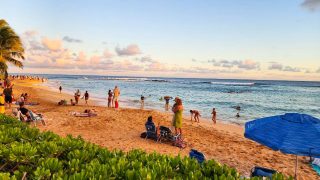
Lead Photo: © Beat of Hawaii at Hanauma Bay, Oahu.
Get Breaking Hawaii Travel News


After multiple 2018 incidents, I believe there was supposed to be an initiative to track snorkel drownings and identify what type of gear was used (traditional vs FFM). Not sure if anything came of it but I always advise friends and family use traditional gear to help reduce risk. While FFMs may not be the sole cause it could be a contributing factor based on the poor design.
People are assuming alot here.
Until we learn her health condition it is pure speculation to blame the mask or the bay or Hawaii waters in general.
Snorkeling is dangerous anywhere if you don’t know what you are doing.
So many don’thave a clue.
They panic when water gets inside their mask or they become disoriented or excited when the see a turtle etc and dislodge their mask etc
So Hanauma Bay has tried hard to control the crowds and train the inexperienced tourist.
Despite all that.
You can swallow water and not get enough air and drown quickly.
You can have a heart issue or have asthma etc and should not be out there.
So many things can be the cause.
Hope we learn how she died.
So sad.
I can’t believe Hawaii is still allowing the full face masks! My friend and I used them when they were first rentable & within 5-10 minutes we were both aware something with the oxygen was not right. We did’nt use them after that. The next day we heard someone drowned at that beach with the same gear. We tell everyone we see wearing them of our experience.
I was a scuba diver for about 20 years and have been diving in Moorea, Bora Bora, Australia, and Mexico. I have never heard the inherent risks of snorkeling among seasoned divers discussed. I have stayed in many over-the-water bungalows advertising excellent snorkeling right off the deck and never been warned (or educated) of the risks and the resorts did not know I was a seasoned diver.
In aviation, we have a saying: “Aviation is in itself not dangerous, but like the sea, it is terribly unforgiving of any carelessness or neglect.”
There is certainly a corollary here. Be careful folks, look out for each other. If somebody looks like they need a hand, offer it. Maybe you will help avoid a tragedy nobody saw coming.
Aloha BOH- Do we know if the woman was wearing the Full-Face Snorkel mask? Costco in Maui is still selling them; I have spoken to both the local managers and Corporate people….I have confirmed that the North Ka’anpali beach recent drowning victims were indeed wearing the Full-Face Snorkel masks…both fatalities.
While any loss of life is tragic, nothing is 100% safe. Signage and warnings only help so much. We know lots of people don’t read or heed signs and don’t absorb info in videos. And there are so many things new visitors need to know, like don’t touch the turtles, and when there are whales in the water, at least one person in every vehicle needs to keep their eyes on the road. How many people die on each cruise ship sailing? Do they show a video that explains the 24-hour dining options and warn that is an amenity, not a challenge? All of the victims mentioned in this article are adults, and people, adults, need to be responsible for their own actions and safety, which includes reading signs and paying attention to videos.
I wonder if every hotel, timeshare, and short-term rental could be required to provide a brochure that pulls no punches about drowning in Hawaii in general and specifically related to snorkeling – what the risks are, safe equipment, and safe practices? Also seems like every outlet that rents/sells snorkel equipment should be required to provide this information. Everyone should welcome the opportunity to help save lives in this way. BOH, thank you for keeping this important issue front and center.
The brochures would probably be ignored by 90% of the renters. It’s all about personal responsibility. I hope that the lawsuit filed against the Tourism Board gets thrown out of court. Entirely frivolous.
This is precisely why there should be a MANDATORY Training and Orientation Program before Anyone is allowed to enter Any body of water in Hawaii (including resort pools, spas and bathtubs).
This Training MUST include a Minimum of:
1) An 8-hour lecture on water safety and health conducted by a certified State of Hawaii lifeguard,
2) Passing a written test of 100 questions covering water safety, physiology and health medicine, with a minimum score of 98%,
3) A 4-hour one-on-one swimming lesson conducted by a certified Hawaii lifeguard with oversight by an attending Hawaii physician,
4) A complete medical/physical exam completed by a Hawaii licensed physician,
5) All of the above will be paid for by a mandatory 20% tax on airfares, hotel rooms, dine-in restaurants, and businesses that rent snorkeling gear.
“Won’t someone think of the children?!”
You can’t be serious. What do “the children” have to do with this. Most of the deaths are adults who didn’t know their limitations. What Hawaii doesn’t need is more onerous rules and regulations that pad the pocketbooks of government politicians.
Mandated safety videos help, but each swimmer also must be aware of their own condition and their own limits, and be accordingly cautious.
When we take risks, we risk not only our own lives but the lives of those who will need to save us if we get into trouble.
But in the end, we must be prepared to accept the risks we choose to take.
It is one of the reasons why, before every swim, I say a prayer, before entering the ocean.
Aloha 🏊🏼♂️🙏🏼🤙🏼
So what have we learned from this article, no matter what measures a state or county can take, including forcing you to watch a 9 minute video, there’s virtually no way of preventing drowning deaths on Hawaii.
I mean come on just look at the sheer numbers of clueless people we’ve all witnessed entering the ocean daily they have very little common sense and no respect for the water.
I’m surprised that the drowning deaths are not higher.
ROPE should be explained on the Hanauma Bay reservation site…added to the required on site video..added to the in flight videos. Tour companies should include ROPE in their packaged info. Warning posters (signs) should be added along the path ( inside and outside) the bay. Just like on the Volcano trails. ” Never swim alone” has a new reason.
Type of snorkel mask? Full face mask or traditional 2 piece?
My question exactly.
I would never trust the full face mask style.
Could easily be the silent culprit in this case.
Best wishes for her recovery.
My 55 year old husband, a strong, healthy, daily surfer drowned at “4’s” in front of the Hilton Waikiki. Unfortunately no lifeguard there. A lifeguard may have made the difference between life and death for him. Drowning is a real risk in Hawaii. The “turn around don’t drown” motto for floods should be stressed for recreational ocean use as well…we need to do more, we should do more for our residents and our visitors.
so sorry for your loss!…how did he drown; snorkeling, swimming…? does 4″s mean four feet of water?