
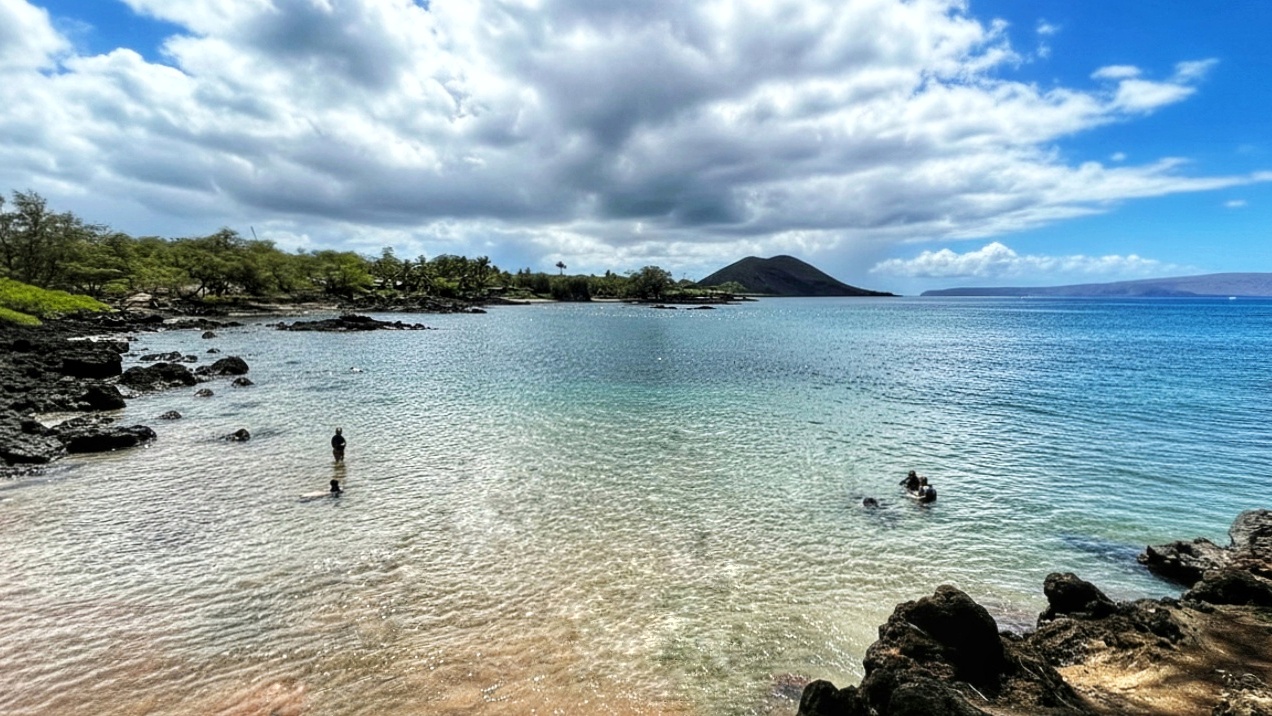
A 69-year-old visitor from Huntington Beach is dead after snorkeling at Makena Landing (Maui) on January 31. Frank Archuleta Jr. was pulled from the water around 11:45 a.m., CPR was attempted, and he was pronounced dead at the scene. Police classified it as a miscellaneous fatal accident, and an autopsy was scheduled. No foul play is suspected. No official report has said what kind of mask he was wearing.
We are not claiming he was using a full-face snorkel mask in this case. But within days of the news breaking, the same question landed in our inbox again: Was he wearing one of those full-face masks?
At the same time, a longtime reader on Maui’s west side wrote to say there had been another incident in early February in front of Royal Lahaina involving a male visitor using a full-face mask. That account is based solely on reader and social media reports. We have not found news coverage confirming it. What we do know is that in past Hawaii incidents where equipment was confirmed, full-face masks have been involved.
Full-face masks and the debate that won’t go away.
In Hawaii Snorkeling Unmasked After Recent Drownings we detailed the double drowning at Ahihi-Kinau (South Maui), where full-face masks were confirmed. We also wrote about BOH editor Jeff’s own experience with a full-face mask, which felt wrong fast once breathing picked up.
In 69% Of Hawaii Drownings Are Visitors As Maui Rate Doubles, we documented how Maui’s drowning rate has outpaced Oahu’s and how visitors account for the majority of deaths. This is not a new issue for Hawaii. It keeps resurfacing because the pattern continues.
Full-face mask study published in Diving and Hyperbaric Medicine.
The study, conducted in December 2023, was led by researchers at the University of Auckland. It compared full-face masks to conventional snorkels under simulated exercise. The full peer-reviewed paper is embedded below and is available through the NIH National Library of Medicine.
During light exercise, 45% of full-face mask trials were stopped after exceeding 7.0 kPa end-tidal CO2. With conventional snorkels, it was 20%. During moderate exercise, 41% of full-face mask trials were stopped due to excessive CO2, compared with 19% for conventional snorkels.
Five participants dropped below 90% oxygen saturation. Four of those drops occurred while wearing full-face masks. The researchers described how exhaled gas can mix with incoming air within the mask through communication between the eye pocket and the oronasal pocket. That creates rebreathing even when the mask is not fogging and not obviously leaking. They said manufacturers and snorkelers should be made aware of the risk. They also flagged that children, because of smaller tidal volumes, may be more vulnerable.
The study also found that females and participants of Chinese or South-East Asian ethnicity more frequently experienced inadequate internal seals on full-face masks, indicating that the internal seal did not perform equally well across different facial types.
Yes, the study was lab-based and involved 20 participants. In August 2025, a case series in the journal Children documented three kids under six hospitalized after incidents involving full-face masks, including one cardiac arrest. That is not theoretical. This is not theoretical. It reflects documented real-world medical cases.
Now step into Costco.
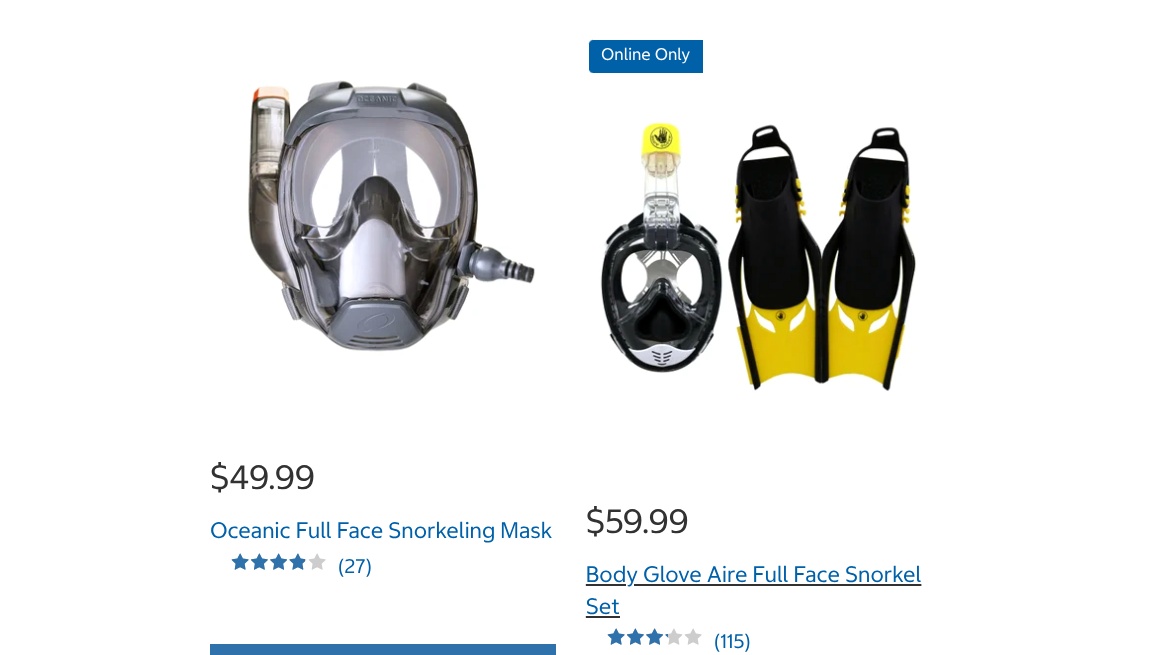
Costco.com still shows live product pages for two full-face snorkel masks, the Oceanic Full Face Snorkeling Mask at $49.99 and the Body Glove Aire Full Face Snorkel Set at $59.99. Both are currently showing as “Out of Stock” for online delivery. The pages remain up. The reviews remain visible. The Oceanic product copy highlights less CO2 volume as a feature.
“Less CO2 volume.” The marketing language acknowledges carbon dioxide buildup as a design consideration worth mentioning. At the same time, peer-reviewed research shows that CO2 levels rise and oxygen levels drop during exertion.
Reader Nita told us she recently saw full-face masks on the shelves at the Maui Costco. She reported that she spoke with a manager there, who told her they were hesitant to sell them. That is her account. We can’t independently confirm that conversation, and it is not an official Costco statement.
The product reviews on Costco’s own site are even harder to ignore. One reviewer, Joe F, described getting hypoxia from CO2 buildup inside the mask. He wrote that after one use, he fell onto rocks, and after another, he became dizzy, lay down, and his girlfriend noticed his feet and halfway up his calves were purple. He called the design flaws well-known and said he assumed Costco would know if a product was potentially dangerous or deadly before selling it.
Another verified purchaser wrote that she was not allowed to use the mask on snorkel trips in Hawaii because of safety concerns. She does not recommend it. Another review simply flags safety issues and urges buyers to research before purchasing. Those reviews sit on the same page as the add-to-cart button.
It is also worth noting that some of those safety warnings show vote ratios like 14 unhelpful to 3 helpful and 15 unhelpful to 4 helpful. We are not drawing conclusions about who is voting for those reviews. We are noting that warnings about hypoxia show more unhelpful than helpful votes in some cases.
Meanwhile, many Hawaii tour operators will not rent full-face masks and will not allow them on their boats. Visitors can arrive, buy one from a mainland retailer, and then be told by local operators that they cannot use it. That highlights how the risk line is being drawn in the water rather than in the warehouse aisle.
We are not saying a full-face mask caused the Makena death. But we are saying that peer-reviewed data documents increased CO2 retention, a published case series describes pediatric harm, customer reviews describe hypoxia symptoms, Maui’s drowning numbers remain high, and these masks continue to be marketed and sold into Hawaii’s visitor market, both at Costco.
The research is out, the warnings are visible, the reviews are public, another visitor is dead, and the masks are still in circulation.
If you are Costco, knowing what is published and what your own customers are writing, do you keep selling them in Hawaii? And if you are a visitor standing in that aisle in Kahului, what would you want someone to tell you before you carry that box from checkout straight into the ocean?
Lead Photo: Makena Landing on Maui.
DHM-53-313Get Breaking Hawaii Travel News




I have had a bad & good experiences with full face masks (I’ve only used them 3 times). The first time I used a size L mask that was offered to me because the strap to my mask/snorkel set broke. I know I was breathing too rapidly with the full face mask as it was awkward, not a tight seal & I wasn’t familiar with how they work. Pretty quickly I started feeling dizzy & queasy. I removed the mask and began vomiting so that ended that. I’ll add I had heard conflicting reports about their safety. My husband bought me one in a small size and I have used it twice with no ill effects, but I am Very mindful that if I start feeling the least bit ‘odd’ to stop and remove it. I have to say they are much easier to use than the traditional mask & snorkel.
While I agree there have been a lot of reports about serious issues with full face masks, I doubt Costco is the only retailer selling them. I agree it would be wise for Costco to take a hard look at this product. The study you cited was an awfully small sampling: 20 people? Understand the hi am Not in any way defending on the full face masks, but playing devils’ advocate, it seems we need more & a bit larger studies to provide good data to get these masks entirely off market. I don’t snorkel, but if I did, I can tell you that due to reports o have read over the past few years, I would Never utilize a full face mask.
Thank you for the informative article, mine is going in the trash.
I’ve been an avid scuba diver and snorkeler for decades all over the world. Had my first experience a couple weeks ago on a private boat where they only had full face snorkel masks. It felt like a struggle to get air and I abandoned it very quickly. It’s an ill conceived newbie gadget that is trying to eliminate 5-10 minutes of basic snorkel & mask use training but causes more problems than it solves. Not worth it!
I tried one in shallow water at Poipu and felt like for whatever reason I couldn’t get a full breath once I started moving faster. Switched back to a standard snorkel and I felt normal.
The irony is that your article above that questions the safety of these masks has ads for full face snorkeling masks. The irony!
BOH is merely showing that Costco is still selling ful-face masks. It’s a screenshot. As proof, the links in the ad do not work.
We were turned away from a Maui snorkel tour because my son had a full-face mask. At the time I felt annoyed, but now I’m feeling grateful.
I’ve snorkeled Hawaii for 40 years with a regular mask and snorkel. Simple and it works. I don’t understand the need to reinvent this.
If the Costco reviews mention purple feet and hypoxia, that should be enough to cause pause. You don’t need any study. Use common sense.
My husband is a boat captain on Maui and they absolutely do not allow full-face masks. That alone tells you a lot. The water people here see things that tourists don’t.
This feels like an overreaction. Millions of people use these masks worldwide without dropping dead. At some point personal responsibility has to enter the conversation.
I can assure you this is Not an overreaction. The risk of hypoxia from full face masks is real and has been documented by both studies and actual drownings, not just anecdotal evidence. Snorkeling tours in Hawaii will not accept them due to increased risks and liability. The ban has since spread to other parts of the world, such as the Red Sea in Egypt as well as cruise lines operating in the Caribbean and Galapagos.
We bought one of these masks at Costco last year because it looked easier than the old ones. After about ten minutes I felt lightheaded and had to get out. I thought it was just my nerves. But was it?