

How Kalalau Compares to the World’s Deadliest Hikes
When fifty hikers were stranded overnight on Kauai’s Kalalau Trail last month, it made international headlines—but for many who know the trail, it was no surprise. This rugged 11-mile path along the island’s remote Napali Coast is as dangerous as it is simply stunning, with sheer cliffs, flash-flooding streams, and often, little room for error.
One of the 50 stranded hikers last month shared this with us: “We were having a quick snack above Hanakapiai Beach and about to head back when a flash flood hit around 10 am. We wouldn’t have gone if we had been told it was unwise to head out that day with the rain forecast. We had been trapped for hours when firefighters arrived. They advised us, yelling from the other side of the raging stream, to wait it out, and then they left. No one rescued us. We hiked out on our own in the morning after the water was at a safe level.”
While Kalalau might not always top global deadliest hike lists, it belongs in the same conversation as some of the world’s most extreme and treacherous trails.
As one hiker put it after barely navigating a washed-out stretch: “Don’t be fooled by the views. This trail will kill you if you stop paying attention.”

The incident that sparked global comparisons.
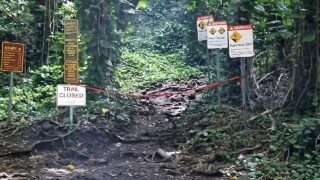
On April 6, 2025, heavy rains quickly swelled Hanakapiai Stream, a notorious crossing just two miles into the Kalalau Trail from Kee Beach. Around 50 hikers could not return and spent the night between the stream and the ocean. Most had only planned to hike a short distance before returning. Rescues like this happen often in Hawaii, but the scale and media attention this time revived a familiar question: Is Kalalau as dangerous as it looks—or is it worse?
One commenter recalled witnessing a death on the trail years earlier, saying simply: “Weather happened.” They had just made it out ahead of a flash flood that turned deadly minutes later. It was a stark reminder that timing and luck often separate a great day from a tragedy. BOH editor Jeff also witnessed a death following a hike at Hanakapi’ai Beach, which left him with an indelible image.

What makes Kalalau different?
Unlike many extreme trails in the world, Kalalau is also set in an epic, popular vacation destination—Kauai—and is one of the island’s top activities. The danger is subtle at first.
The trail begins near a paved road that ends at Kee Beach in Haena State Park. There, day hikers set out in shorts and sometimes even slippers (we’ve seen it), aiming to reach Hanakapiai Beach just a seemingly easy two miles in. But weather shifts fast on the Napali Coast, and flash floods, slippery conditions, rockfalls, and narrow ridgelines can rapidly escalate what felt like a casual hike into a survival situation.
Kalalau is also deceptive in its access. While hiking permits are required to go beyond Hanakapiai Valley, the early part of the trail is open to hikers with only park entry and parking or shuttle reservations. That makes it feel more like a visitor-friendly nature walk than a high-risk route. It’s not until you’re a ways in—when the cliffs narrow and the isolation sets in—that the trail shows its true nature.
As one hiker said, “We thought we were just going to the beach in sneakers. That red Kauai mud felt like ice, and I nearly slid off the edge more than once.”

Kalalau vs. Mount Huashan’s death-plank standard.
By contrast, China’s Mount Huashan is designed to look terrifying. The infamous plank walk features wooden boards bolted into a sheer cliff face, thousands of feet above ground. Hikers clip into a harness and inch along a narrow ledge with chains bolted into the rock as their only handhold.
It’s become a viral social media destination because it looks so dangerous. Unlike Kalalau, however, Huashan is tightly controlled and maintained, with some safety features in place, and most tourists don’t make it far.
So while Huashan trades on the spectacle of danger, Kalalau hides its risk under a lush canopy and a familiar Hawaiian backdrop. That makes it more insidious: hikers let their guard down, and the trail doesn’t forgive them.
As one visitor who completed the trail said, “Crawler’s Ledge isn’t the part people should fear. A few miles past that is where the real danger kicks in—muddy, narrow, and one bad step from gone.”
Other deadly trails that don’t disguise the risk.
South Africa’s Drakensberg Traverse is another extreme hike that is often compared to Kalalau. It lacks a formal trail for much of its 80 miles, requires real navigation skills, and involves chain ladders up vertical cliffs. Altitude, weather, and remoteness push it into serious mountaineering territory. Most who attempt it know exactly what they’re signing up for.
Switzerland’s Hardergrat Trail—which BOH editors recently visited near Interlaken—is equally infamous. It follows a knife-edge ridge above Lake Brienz with no margin for error. One wrong step could mean a thousand-foot fall, and parts of the trail are so narrow and exposed that even experienced hikers have turned back. There are no harnesses, no fences, and no bail-out points.
What these trails share with Kalalau is not the same kind of access, but a similar pattern of underestimation. Some hikers plan carefully. Others see a photo, or a friend’s post, and set out without fully understanding what’s ahead. One Reddit user bluntly said, “The people who think it’s easy are the ones who get into trouble.”
Hawaii’s rescue culture and what it costs.
In Hawaii, emergency airlifts for hikers are common at Kalalau. On Kauai alone, hundreds of rescue operations are conducted each year, many on or near the Kalalau Trail. But these rescues aren’t just risky for first responders. They’re also costly, raising long-standing debates over whether tourists should be billed when ignoring warnings or entering during bad weather.
Yet part of the problem is how accessible these hikes feel. Kalalau begins near a parking lot at the end of a road. It’s in a state park. There’s a shuttle. For many travelers, that implies safety and infrastructure, even when reality on Kauai says otherwise.
One Reddit commenter, after seeing a fellow hiker airlifted, said, “It’s a tough one. People show up thinking it’s a scenic walk. Then you see someone carted off by helicopter and realize how quickly it can flip.”
The Instagram problem.
Like Mount Huashan’s viral videos, Kalalau is heavily photographed and posted online. But the steep drop-offs, the washed-out sections, and the sheer isolation are often missing from those images.
Social media has glamorized hiking into Kalalau Valley with a tent and a drone, but little attention is paid to the logistics, physical toll, or environmental risks.
Some of the stranded hikers in the April incident said they had only planned to go a mile or two in. Others admitted they didn’t check weather conditions at all. These aren’t uncommon stories.
Should Kalalau be treated like an extreme hike?
The state of Hawaii promotes hiking as a key part of the visitor experience for good reason—it is iconic. But rarely is Kalalau marketed as dangerous. Small signs, permit limits, and shuttle rules exist, but no one checks gear or warns tourists about specific hazards beyond the general hike at your own risk. Kalalau’s management feels understated at best when compared to some of these other most dangerous trail requirements, like China’s full harness systems or South Africa’s mountaineering cautions.
It raises the question: Should Hawaii treat Kalalau like a true danger trail, with stricter controls and more explicit public warnings? Or is the balance between access and responsibility where it needs to be positioned?
Final thoughts on Kalalau Trail.
Kalalau might not have the plank walk of China’s Mount Huashan or the altitude of South Africa’s Drakensberg. Still, it offers its own very real form of danger—one that blends beauty with largely hidden unpredictability. It often doesn’t look deadly, and that’s precisely what makes it so. With another peak summer rescue season ahead, and more hikers arriving daily, the trail’s risks are again in our minds.
For those considering Kalalau: don’t be fooled by the views, the Instagram hashtags, or the distance. This is one of the world’s most dangerous hikes, whether the rankings say it or not.
After watching others misjudge the terrain, one hiker warned: “Kalalau isn’t hard because of one spot—it’s the thousand chances to slip when you’re tired, hungry, and thinking the hard part’s over.” We concur.
Your comments are welcome. Mahalo!
Get Breaking Hawaii Travel News
Why don’t they turn it into guided-only like in Waipi’o Valley on the Big Island? Or station parking attendants to “warn” people like they do at Pololū Valley?
Re: trail to Kalalau
I don’t know what the trail looks like these days. I can only imagine how dangerous it can be with the foot traffic’s erosion from the overtorism reported. It’s quite a shame for Hawaii. We’ve traded money for a way of life. I can now only experience the Hawaii I knew as a memory. It’s simply tragic. It’s simply sad.
All trails in Hawaii are potentially dangerous in bad weather. No matter what you tell people about the soils on Kauai, about 60% decide those providing information are not aware how experienced they are where they are from and that the sun is out today so what if it rained for a solid week. They only ask questions to validate their choices and continue to ask until someone agrees with them. I never want bad things to happen but with that attitude it happens. Ive lived and played on Kauai all my life. Every place has a period when you just don’t go. Visitors with their limited time insist on doing only the activity they planned on the day they planned it. When they insist after the warnings and ignore suggestions of a safer hike, I just remind them to wear good shoes as it is really slippery and take lots of water and snacks. Helicopters can’t land on ridges or look for you at night.
The people who run the government here don’t want hikers. Stay at your resort and drink Mai tais. Locals shouldn’t hike either. No signs or trail improvements will be done. It’s up to hiking clubs for any changes. Bicycling league and money got them to redo our roads for almost no bikers
Hikers got Manoa falls after millions of hikers. Koko crater?
DIY.
Stairway to Heaven? Your under arrest.
Yep. I would say from experience that 7 out of 10 “hikers” are inexperienced day hikers that are not prepared in Any way for this strenuous hike.
One museum assistant informed us that a lot of locals and especially visitors don’t realize or forget how these islands were formed. Volcanoes and lava rock. Trails have round small gravel over hard rock or powdered rock. Add this to hills and slopes and angles and slippery conditions. The scenery and landscape hide these dangers so ones guard is not always up. Really surprised the state don’t require gorilla shoes or strapped on spiked shoes for extra traction. Is it the hikers fault or the state not mandating certain foot wear? Too many stories about this and remember hikes are not the same as walking on a flat beach. How many of these hikes are done by visitors just to obtain that special selfie? Pretty soon most trails will be signed For Locals Only.
“We were having a quick snack above Hanakapiai Beach and about to head back when a flash flood hit around 10 am. We wouldn’t have gone if we had been told it was unwise to head out that day with the rain forecast. We had been trapped for hours when firefighters arrived. They advised us, yelling from the other side of the raging stream, to wait it out, and then they left. No one rescued us. We hiked out on our own in the morning after the water was at a safe level.”
Wait, what?? “…if we had been told…”?? And then kvetching about no one having rescued them??
1) I am in favor of the state passing a bill to reclaim funds from those who engaged in dangerous activities as you described in the article. 2) If the fees charged could be pro-rated so that kvetchers pay the highest fees, so much the better. (OK maybe #2 isn’t to be taken seriously.)
We have done this hike 2-3 times, just partially, and had no idea initially what we were getting into. I’m not sure what can be done other than to continually publish stories about the dangers so that people hopefully become increasingly aware of how challenging this hike is, and how deadly it can become. Not sure, tho, what can be done about people not knowing their own limits and skill level. I think sometimes us humans just don’t realize something is beyond our ability until it’s too late.
I agree that the trail should be graded as difficult and dangerous. To what degree that will help is questionable. It would probably be just like Queen’s Bath or Lumahai Beach. Post all the signage you want, some people just refuse to take them seriously.