
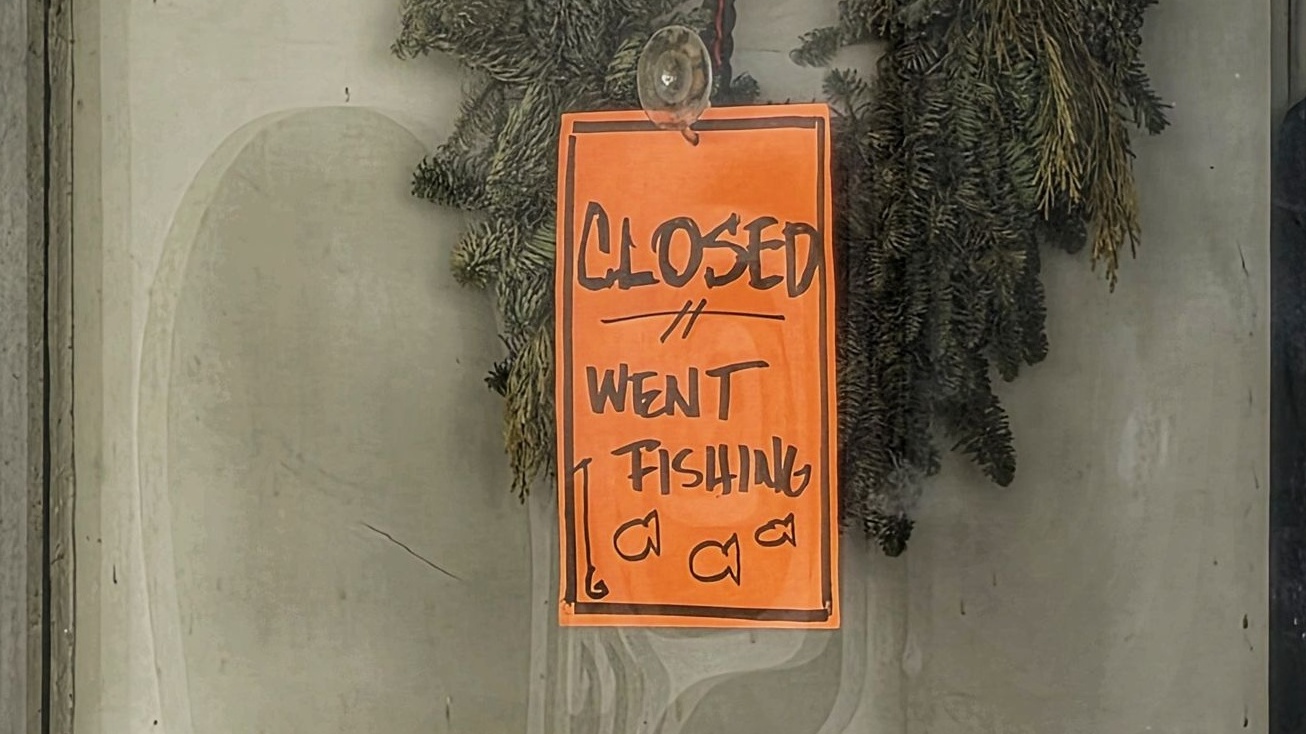
“Island time” used to mean something simple. Slow down. Stop staring at the clock. Talk to people. Let dinner run longer than normal. And in Hawaii, that still means something real to a lot of people. Take our lead photo, for example. We found this in Hilo at a clothing store we wanted to visit in December, but it was closed for fishing.
The phrase does a lot more work now than it used to, and not all of it is flattering exactly. It gets used for culture, for sarcasm, and for excuses. Today, it means something else, too. At 2:00 a.m. this morning, when most of the mainland moved its clocks ahead again, Hawaii stayed where it was, by intention. So the West Coast just went from 2 hours ahead of Hawaii to 3, and the rest of the country (except for Arizona) followed.
That is why this phrase is worth looking at again. Everybody thinks they know what “island time” means until they actually start using it. Then it turns into several different things depending on who is talking. For some people, it still means aloha, patience, and not living like every minute is a Zoom meeting. For others, it means that Hawaii just moves too slowly, repairs take too long, and nobody deals with anything, including basic infrastructure, until it is already a total mess. If then. And for plenty of mainland visitors, it is just a line, the kind they might utter when they think Hawaii is behind, inefficient, or not serious enough for them.
Readers have been laying this out in BOH’s comments for years. Recently, Keith pushed it right into the open. “I work for one of the largest employers on the Big Island,” he wrote. “The facility I work in is literally crumbling down around us with signs of band-aid patchwork everywhere. No problem is addressed until it becomes a nuisance or interferes with operations. Foresight is nonexistent. It is third-world mentality in a first-world reality.” He called it “island time applied across all aspects of life.” That line hit because it sounded too familiar.
One phrase, multiple meanings.
The first meaning is the one people still like. A longtime commenter named Jim once told us that if you really want to experience Hawaii, you should stay on one island, slow down, and let the trip unfold rather than trying to conquer it through experiences. That is island time, as people mean it when they say they love Hawaii. It is not sloppiness or laziness. It is not being proud of being late. It is making room for life instead of simply cramming more into a vacation schedule.
A lot of travelers do not get that at all. They land with rental car reservations, restaurant bookings, timed stops, backup plans, and a full day lined up even before breakfast. Then the line is longer than expected, the food comes out slower, somebody stops to talk story, and suddenly “island time” takes on a different meaning. It stops being appreciation and turns into a complaint. We have seen that version too. A Boston visitor working with a Hawaii company once told us, “I know you’re on Hawaiian time, but we need it ASAP.” That is not somebody admiring the culture. That is somebody saying Hawaii needs to hurry up and act more like the mainland.
Then there is yet another version, and this is where the phrase really starts to rot. It gets attached to delays that should not exist, repairs that clearly should have been done long ago, safety problems that sat too long unaddressed, and public systems that seem to run only when somebody finally gets shamed enough to act. At that point, nobody is talking about culture anymore. They are using a familiar phrase to soften something unattractive.
The cultural version Hawaii still defends.
One recent commenter put it in the plainest possible way: “Island time is the only time. The rest of the country needs to be on the same page. Life’s rough enough. Solve the easy problem. Then go ahead and tackle the big problems.”
A lot of people in Hawaii, both residents and longtime visitors, know exactly what he means. Life already comes with enough pressure, enough deadlines, enough text messages, calendar appointments, and all the rest. The appeal of Hawaii has always included the fact that not everything has to be rushed. And that’s a rare find nowadays.
For many in Hawaii, island time reflects a choice to value presence over punctuality. It means talking with neighbors, lingering over coffee, and measuring a day by experience rather than the calendar. It means you do not lean on your horn the second the light changes. And it means there is enough time to stop and talk. It means not treating every human interaction as something to get through as quickly as possible. That part is real, and it is worth defending.
That is also why people here in Hawaii get protective when outsiders mock it. They hear something real being reduced to a punchline. A phrase tied to patience and human connection gets turned into some proof that Hawaii is backward or unserious. Residents here know the difference. Visitors who spend enough time here usually learn it as well. The problem is that the same phrase is now doing a lot of work, and once it starts covering for things it should never cover, the original meaning gets dragged down.
When it turns into cover.
Keith’s comment about a crumbling facility on the Big Island is not some weird one-off. Readers have described the same pattern in many places. Beach and park bathrooms that seem to stay broken forever. Roads are patched, patched again, and then patched one more time instead of ever being properly repaired. Airport issues that somehow became normal decades ago. Temporary fixes everywhere in Hawaii that last so long people forget they were ever supposed to be temporary.
One reader joked that Maui TSA checkpoints seem to close on “island time,” not at any hour anybody can actually count on. Another reader described the way some public infrastructure feels like it is just being held together with chewing gum until the next failure. People laugh about it because sometimes that is easier than admitting how bad it looks. But when government agencies use the phrase to explain away delays, safety lapses, or endless studies that go nowhere, it stops being culture. It becomes something else.
That is a line that keeps getting crossed. No one is saying Hawaii has to run like LA or Seattle. That isn’t even the point. The point is that a failing runway, a crumbling public facility, or basic maintenance problems are not expressions of aloha or island time. It is not local style either. These are not slower, kinder ways of life. It is a failure to get the job done. Once “island time” gets used to blur that difference, the phrase starts protecting the wrong things.
Visitors split on Island Time.
Some visitors really do get it. They stay put longer, stop trying to see several islands in one week’s vacation, and quit acting like every day has to be optimized. Those travelers usually end up liking Hawaii more because they stop trying to win like it’s a game. They stop fighting how Hawaii works. They let it be what it is.
Others use “island time” the minute anything inconveniences them. The food is slow. The line is long. Someone did not respond to an email fast enough. A local business did not move at the speed they wanted. Out comes the phrase, and now it means “you people are behind.” We have seen comments like that more times than we can count. There is nothing warm in it. It is pressure dressed up as common sense.
Other readers push in the opposite direction. Buddy G. wrote, “It’s not necessarily island time, but more a reflection of Aloha and everyone being stretched thin.” Jenn F. said, “Just have to have patience and live on island time. No rush or hurry.” For one group, the phrase still means grace. For another, it can serve as either an insult or an excuse.
The economy has a problem here, too.
Amy E. made one of the sharper points we have seen on this subject. She argued that Hawaii likes the idea of island time, but that same mindset does not exactly help when the state says it wants more innovation, more diversification, and industries beyond tourism. She is right to raise it. Hawaii talks all the time about building a broader economy that includes but isn’t exclusively tourism.
Hawaii’s economy is famously undiversified, and that has been true for a very long time. The state says it wants more tech, more agriculture, more resilience, more local opportunity, and less dependence on tourism. But those goals never move forward. They do not survive a culture of delay, where every hard decision becomes another study, another pause, another reason to come back later. When “island time” becomes a reason not to change, it stops protecting culture and starts paralyzing Hawaii’s economy.
That is not an argument against slowing down in daily life. It is an argument against confusing a human rhythm with government paralysis. One can be healthy. The other just keeps Hawaii stuck.
Even the clock just proved the point.
This morning added another twist to the whole thing. Anyone who works across time zones will feel that starting Monday. The workday overlap is reduced. Calls start earlier. Deadlines are timed differently. Hawaii feels farther away once again.
That is not what people usually mean by “island time,” but it also fits the larger point. The phrase keeps expanding because it is useful. It catches culture, geography, bureaucracy, inconvenience, and the clock, all at once. Sometimes it even catches the simple fact that Hawaii really is out of sync with the rest of the country, not emotionally or politically, but simply in terms of the clock.
That is probably why the phrase hangs tenaciously. It still contains something true. The problem is that it now contains too many truths, and some of them are not very flattering.
Where this leaves Hawaii.
Hawaii has every reason to move at its own rhythm. But crumbling facilities and missed deadlines are not the rhythm. They are neglectful. Failing public systems are not expressions of local culture. They are still what they are, no matter what phrase gets wrapped around it.
The phrase Island Time has not changed, while the meanings applied to it have. One person hears patience and aloha. Another hears a jab. Another hears the sound of something not getting fixed again. All of these are in there now.
So the question is not whether island time is a good or bad thing. It is whether Hawaii can still protect the parts that people love without letting the phrase cover for the parts that keep letting residents and visitors down. When the state, an agency, or an employer falls behind, that is not automatically good local style. Sometimes it is just failure, and calling it something nicer does not make it less so.
When you hear “island time” now, does it still sound like aloha to you or something else?
Lead Photo Credit: © Beat of Hawaii at a Hilo storefront in December.
Get Breaking Hawaii Travel News





The saddest part is the lazy, incompetent, and often unethical people who are elected to run this state perpetually blame outsiders for the high cost of housing, food, et al. Ask most any businessperson on the islands and they will tell you the same thing. State and local governments for the most part have an unseen mission statement: “To do everything in our power to make government more difficult, more burdensome, and more expensive for everyone”! Sad but true, and yet we keep electing the same corrupt and incompetent fools to run this state!
Island Time
It seems general maintenance doesn’t exist. Schools, Hospitals, Government buildings and facilities, all need maintenance to extend their live. But it doesn’t get done. If a new roof is needed it can’t wait 2 more years. You have to Plan Maintenance ahead of time. Most things have a life expiration. That’s why you have Capitol Improvement Projects. Fix it before it’s a total catastrophic failure. The State DOT running the airports and not a board. Kona desperately needs a second runway which was in the original plan! Maybe the military could help pay for some of it with there new lease?
We speak endlessly about diversity in Hawai‘i. Yet the jobs that shape the economy rarely look like the people who live here. We say we oppose gambling, yet every week planes leave full for Las Vegas – our so-called “ninth island” carrying local money outward. We defend “island time” as culture, but too often it masks a deeper habit: delay, deflection, and decisions never made.
The contradiction is not cultural. It is political comfort. Symbolic positions are easy; structural change is hard. Leaders can praise diversity without changing hiring pipelines. They can oppose casinos while exporting the gamblers. They can praise aloha while tolerating systems that quietly fail.
The real solution is simpler than the speeches: align values with action. Hire locally and transparently. Keep economic dollars here. Plan, execute, and measure outcomes. Culture deserves respect – but excuses do not. Let’s go Hawai’i!
Island time for us is about disconnecting, sleeping late, naps on the beach after reading a few chapters, hiking in the mountains with the only objective, to see what’s there.
It’s finding that local restaurant with few tourists and talking to the staff, or meeting fellow guests watching the sunset on the wall at Napili Bay.
As a tourist who can not change the inefficiencies of Hawaiian government we have learned to ignore it and enjoy what works.
“Island Time”. Yup! I encounter is all the time when I come to the islands. WiFi out? No hot water in the shower? How to get Amazon Prime on the TV??? Ya gotta be patient for, eventually, the plumber/teck/etc. will get there, but it ain’t CA, so don’t fuss, have a glass of wine, read a book, whatever. Things will eventually get put right, and the fixer will be helpful and polite. Chill!
We have been traveling to Hawaii for a long time 1st visit in 1978, then twice a year from 1990. We always found Island Time always relaxing. It would take us about 2 days to wind down but after that it was always enjoyable & we could get in the groove slow down and relax. But lately especially on Maui not so much we don’t feel welcomed and we gave up on the burger shack at DT Fliming beach, to park was $30.00 for all day. We can’t eat all day. And the Parking agent on the phone couldn’t offer anything else than a full day. The state says, all the fees go to infrastructure improvements or in reality to uncle Eddie and his consulting firm we have to study the project prior to fixing a toilet. It could have a negative impact to the environment. Maybe just let everyone increase the salinity of the water by urinating in the ocean. We haven’t observed any improvements on Maui.
We have been traveling to Hawaii for a long time 1st visit in 1978, then twice a year from 1990. We always found Island Time always relaxing. It would take us about 2 days to wind down but after that it was always enjoyable & we could get in the groove slow down and relax. But lately especially on Maui not so much we don’t feel welcomed and we gave up on the burger shack at DT Fliming beach, to park was $30.00 for all day. We can’t eat all day. And the Parking agent on the phone couldn’t offer anything else than a full day. The state says, all the fees go to infrastructure improvements or in reality to uncle Eddie and his consulting firm we have to study the project prior to fixing a toilet. It could have a negative impact to the environment. Maybe just let everyone increase the salinity of the water by urinating in the ocean. We haven’t observed any improvements on Maui.
Correction: Hawaii is behind the west coast by 3 hours now not 2 hours. I think you just flipped the numbers!
It sounds like I want to move slow and since I live on an island I can do so. It reflects a sense of non-urgency.
Oops you have it backwards. It was 2 hours now it’s 3.
The time on the west coast went from 2 hours ahead to 3 hours ahead. You have it backwards!
It’s easy to consider that fishing puts food on the table these days and perhaps some shopping days aren’t as profitable.
I read your post all the time and enjoy them, but the west coast went from 2 hours to 3 hours not the other way around. Thanks!
Island time has always indicated the spirit of Aloha and warmth among the people of Hawaii. Another phrase for sincere hospitality. It always has over the decades for us. However, Island time should never be confused with incompetence and neglect that is evident with inexcusable infrastructure decay and neglect of the natural environment. Everyone, both residents and visitors, need to respect the sacredness of the culture and the land, and be good stewards of such. By doing so then everyone will enjoy true “Island time!”
Aloha to all.
In your March 8, 2026 article you said CA went from 3 hours to 2 hours ahead. It’s the opposite CA went from 2 hours to 3 hours ahead. Maybe a typo…..
Between 1950 and 1970 Hawaii rapidly moved from being a plantation-centric society to a government-centric one. Plantation owners, however, had to produce something somebody would buy, whereas the “good ol’ boys” who run all levels of Hawaii government only care that they stay in power. Compounding the problem: there are no longer any “countervailing centers of power” capable of forcing government to do its job. I recall an incident many years ago when a supervisor at the Department of Taxation was caught giving away certification of payment to Korean bars in return for the usual perks. His punishment? Lateral transfer to the Department of Transportation…
I think Hawaii is now 3 hours behind the mainland instead of 2 hours.