

A reader left a comment on our recent Maui runway article asking a question we hear surprisingly often. Why is Maui’s airport so far from where most visitors actually stay?
We have made that drive from Kahului out to Kaanapali more times than we can count, and at the end of a long flight day, or before commencing one, we feel every minute of it. If you’re headed to or from Kaanapali, Kapalua, Wailea, or Kihei, your vacation doesn’t really begin when the plane touches down. It begins after a drive that can easily take 45 minutes or sometimes substantially more. The instinct behind the question is understandable, but the real story is more interesting than a simple case of bad planning.
Maui’s main airport was never supposed to sit right beside the resort beaches of West Maui. The commercial airport lineage was always to be centered elsewhere, first at Maalaea, then Puunene, and eventually Kahului, which became Maui’s primary commercial airport in 1952. Kahului itself was not originally built as a civilian airport. It began as a Navy base during World War II, built on former sugarcane land, and was later converted for commercial use after the war. We looked back to that shift from Puunene to Kahului.
There really was an airport on Kaanapali Beach.
Long before visitors ever associated Kaanapali with resorts and oceanfront towers, there was an airport sitting almost directly on the shoreline. Amfac built the Kaanapali Airstrip for about $40,000 to serve Kaanapali Beach Resort, Hawaii’s first master-planned resort, and it opened in June 1962. The runway stretched 2,615 feet and began only about 30 feet from the ocean. That’s unheard of for a modern-day airport. The location became so closely associated with the airfield that the northern end of Kaanapali Beach eventually came to be known as Airport Beach, a name that still survives long after the planes disappeared.
Small propeller aircraft flew in from Honolulu and other islands, bringing visitors directly into the heart of the new resort area. In the early years, the Royal Lahaina Beach Hotel was the closest to the airstrip. Instead of collecting luggage at Kahului and starting a cross-island drive, you could step off the plane near the hotel. For anyone who has sat in traffic leaving Kahului after a long flight, that image lands differently today.
The airport became part of West Maui life.
By 1980, Royal Hawaiian Air Service was reportedly bringing about 10,000 passengers a month through Kaanapali. During its final decade, the airstrip averaged roughly 60 flights a day despite being restricted to small aircraft. For a runway that sat only steps from the beach, that was quite a substantial operation.
The airport developed its own personality too. Travelers remember the upstairs Windsock Lounge, reached by a staircase and known for walls covered with business cards from around the world. Flying around Hawaii felt more informal then, and the airport became part of the West Maui experience rather than simply a way to get there. For visitors, it became something that has never really returned: direct air access to the resort district itself.
Then the airport disappeared.
The beginning of the end arrived in September 1982 when Amfac announced plans to close the airstrip after learning that Hawaiian Airlines intended to develop a new West Maui airport. The beachfront land occupied by the runway had become increasingly valuable for resort development, and the future of West Maui aviation was soon expected to shift elsewhere.
The Kaanapali Airstrip ultimately closed in January 1986. Today, most visitors walking through Kahekili Beach Park have little reason to realize they are standing on what was once an active airport. The runway is gone, the aircraft are gone, and only the name Airport Beach serves as a reminder that airplanes once landed here, directly beside the ocean.
The replacement airport came with its own limits.
Hawaiian Airlines moved ahead with construction of Kapalua Airport, which opened in March 1987. What looked like a straightforward replacement on paper came with a set of restrictions that changed what the airport could become.
The original replacement site had been proposed near Launiupoko, just south of Lahaina. That would still have been a West Maui airport, only closer to Lahaina and the resort corridor than Kapalua, as it turned out. Residents objected, particularly over aircraft noise and future development pressure, and the plan then moved north to the Kapalua site.
The facility that eventually opened at Kapalua was much smaller and operated under strict limitations. The airport has a single 3,000-foot runway. Operations are limited to daylight hours. Jets are prohibited. Helicopters are prohibited. Flight activity is limited to 70 operations a day. The airport cannot expand over time since those restrictions were built into agreements and regulations, so the facility could never grow into another OGG. The beachfront strip it replaced averaged about 60 flights a day in its final decade.
Maui’s airport path still shapes the island today.
That history still divides opinion. Visitors lost the ability to land beside their resorts, while West Maui lost an airport that sat almost directly on the beach. At the same time, many residents would argue the restrictions achieved exactly what they were intended to.
The concerns were not only about aircraft noise. They were also about traffic, growth, development pressure, and the preservation of the area’s character. The limitations placed on Kapalua were largely a deliberate choice about what kind of future residents wanted for West Maui, and those protections were written into law rather than left to any future debate. Whether readers agree with those decisions or not, they continue to shape every Maui visitor’s arrival today.
The airport you drive to was never built for today’s flights.
The airport that ultimately became Maui’s gateway was never designed for that role. Kahului began life as Naval Air Station Kahului, built by the U.S. Navy beginning in 1942 on roughly 1,341 acres of leased sugar cane land. The Navy deactivated the base in 1947, and afterward the Territory converted the surplus facility to replace the airfield at Puunene.
Kahului was selected because it was a better location that would be cheaper to operate. The first passenger terminal was built using leftover military materials. Commercial service began in June 1952, and the old Puunene airport was abandoned.
Few people could have imagined what was to happen next. Today the airport handles close to 7 million passengers annually. Yet the heart of the operation remains Runway 2-20, the airport’s only jet runway, originally built during World War II.
As we reported in our look at Maui’s aging runway, it has been resurfaced five times and patched far more often than that since it began in the 1940s. The underlying base is deteriorating, and state planning documents have long pointed toward a much larger vision.
That’s why the Hawaii Department of Transportation is now weighing options that include a complete reconstruction of the runway or construction of a new parallel runway. As we reported on why Maui cannot simply close its only jet runway, the price tag could be $750 million, maybe more, and the process could take more than a decade. The discussion is not theoretical. HDOT is next presenting its preferred path forward at a public meeting in Kahului on June 25.
West Maui ended up giving up the airport designed to bring visitors almost to their hotel doors. Instead, the WWII field everyone funnels through must now face its own long-term reckoning.
Why the drive still exists.
When readers ask why they land so far from their Maui hotel, the answer is not that planners put the airport in the wrong place. The main airport was always elsewhere. What changed is that West Maui once had its own ultra-convenient alternative, but the replacement that followed it was intentionally constrained from becoming a major gateway.
So every day, thousands of visitors land at Kahului, collect their luggage, and begin the long drive west. Most have no idea there was once an airport waiting to receive them at Kaanapali, almost at the beach’s edge.
We suspect that is part of why we find the story interesting, and it sticks. The drive west is the visible end of a long line of decisions that went from a beachfront runway in Kaanapali to a former Navy airfield in Kahului, and that still shapes the first hour of every Maui vacation today.
Lead Photo: Sunset at Kaanapali.
By Rob and Jeff, Beat of Hawaii.
Some of the most meaningful parts of Hawaii are the ones visitors walk right past without knowing they are there. We’ve spent nearly 20 years finding them firsthand for BOH as full-time Hawaii residents reporting on travel, culture, and island life, and telling you what they mean for your trip. Join us →
Get Breaking Hawaii Travel News

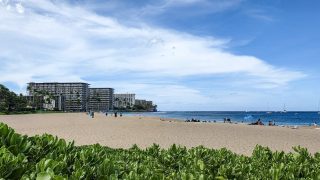
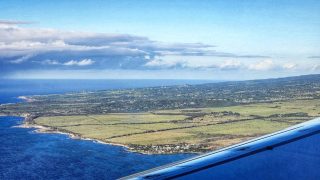


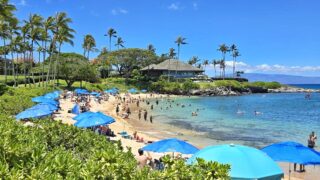
Kahikili (Airport) Beach is one of the best on the island. Was it accessible when the airport was active?
Yes the beach was accessible. The area was sparse, surrounded by sugar cane before Honokawai was developed. There are a few things mentioned in the comments that reflect a simpler time. The airstrip was practical when most flew to HNL or ITO then took a “small plane” to the outer island of their choice. That added some mystique, lost with today’s direct mainland flights. Now a first-time visitor to Maui drives through the big box store corridor and past the shelter structures. I worked at a rent a car desk at the airstrip and met more than a few celebrities. The windsock lounge was a neat place to talk story and have a beverage. There was no rushing to the plane or your hotel. Kenai Helicopters offered tours and charters from the Kaanapali airstrip which accounts for some of the flights per day in the last years of the airstrip. In the 70’s we flew Royal Hawaiian to Hana. On one flight the pilot agreed to extend miles past the airport so we could take aerial photos of our home.
Another lost part of this was that the Kaanapali Landing strip area was to be a regional park. The small facilities we see today as Airport Park were phase I to get it all started and the rest of the park development to follow. The land north of Airport Park proper that is today also park like was acquired in a strange deal by a non-profit so that the regional park was not developed and Westin and Honua Kai could be developed ending the regional park deal. Lots of money and not very transparent deals that have been forgotten today.
Personally, I think Puunene would have been a better choice/compromise, but the Navy field was the ‘cheapest’ option for the county, with a viable runway/infrastructure already in place. With today’s jets and their capacity, having a major airport at Kaanapali would have been a mistake. Think loud jet noise, exhauset, traffic, etc., from jets while lounging on the beach. Nah! Wouldn’t work! So, as ‘inconvenient’ as Kahului is, it is, in the long run (no pun here!) the best location choice.
Just enjoy the scenery on the drive, stop complaining, and be grateful you can vacation on Maui!
Airport?
I can remember the days when there was a seaport in West Maui that had multiple convenient daily round-trip ferries to Lanai right from Lahaina…
Thanks BOH for this article that brings back wonderful memories of the Kaanapali Beach Airport. We flew in and out of it many times in the 1970s and early 1980s. Royal Hawaiian Airlines flew a fleet of twin Cessna aircraft to HNL multiple times everyday. Also daily flights to Kalaupapa, Molokai. The Windsock Lounge on the second floor of the A-frame terminal was something straight out of the movies, and with great drinks and conversations. Loved every minute of it!
Aloha to all.
Guys,
We are frequent visitors to lovely Maui…..
Why in the world are there soo many abandoned cars?
Every trip we see 20-30 of them alongside the roads…
Are there no junk-yards in Maui? It sure seems the police
could trace the registration numbers back and make these people pay for the cost of removing the derelict vehicles.
In our opinion, it is surely one of the biggest black-eyes on this beautiful island.
Much of it can be traced back to the Jones Act. All shipping must travel via US owned, US built, US crewed and US maintained vessels. I’m a big advocate for the act when it comes to the mainland coastal travel, but it makes no sense for Hawaii as nearly the entire transit is in international waters. That act makes shipping so expensive in Hawaii, and there is a bunch of friction when it comes to international trade.
Add in a complete lack of mass transit in many places, making the most of islands car dependent.
The result is it is so expensive to bring a car, and so expensive to remove one. So those on the economic margins buy barely running cars. When those cars die, they can’t afford to dispose of them properly.
Add in a dysfunctional government and you see what happens.
Yes, the drive to West Maui feels a bit long after a long flight. When we took our first trips to Maui we always stayed on the west side, but I never resented the drive. The scenery is pretty damn spectacular. That said, we now stay in N. Kihei, and that drive is only about 15 minutes!
A South Maui airport seems like it would make a lot of sense – not all of the tourists want to hit Costco and Walmart on the way to their hotel, do they?
Look at the land between Puunene and Waikapu, bordered by the Kuihelani Highway (380) and Maui Veterans Highway (311). It’s convenient to Kihei and Wailea and at least gets rid of the drive through Kahului for those headed to West Maui. 380 feeds right into the road to West Maui.
It’s interesting to see the the old Puunene runway still exists, but based on the Google Maps view I’m guessing it is a drag strip now.
Check out the Elvis movie Blue Hawaii. In one scene he lands at the Kaanapali airport.
So appropriate that in that movie, Elvis flew from an airport that no longer exists to a resort that no longer exists (Cocoa Palms).
maybe time to think about reopening it – bring back the West Maui Experience of days gone by?
The old airport is gone, and now resorts. So that can’t be rebuilt. What could happen is the new airport could be expanded. But locals don’t want that, so it won’t happen.
It would be a good thing if it did happen though. Limit it to daytime operations, so no freight. Having a functional second airport would be good. Crashes, earthquakes or tsunamis could shut down OGG. Having the second airfield would be good from a recovery standpoint.
That’ll never happen because it makes too much sense.
We loved the Kaanapali Airport. When I was a kid we would regularly take Royal Hawaiian Air from, and back to, Ohau when visiting. You were able to get helicopter charters to go to Haleakala and charter Royal Hawaiian Air to take trips to Hana.