
Earlier this year, we reported on the aging runway that handles nearly every mainland flight arriving on Maui. What caught our attention back then was that the runway was already more than 80 years old and had been repeatedly resurfaced over its lifetime.
New planning documents released by the Hawaii Department of Transportation reveal a much deeper history than we previously knew about. According to the state’s own records, Kahului Airport’s primary runway has undergone 11 resurfacing and repair projects since it was originally built in World War II.
Hawaii is now examining solutions that go far beyond yet another overlay or repair project. The discussion has shifted from how many more repairs the runway can take to what will replace it.
The runway every Maui visitor relies on.
Runway 2-20 is not just Kahului Airport’s main runway. At 6,998 feet long, it’s the only runway at the airport capable of handling the planes that connect Maui with the rest of Hawaii and the mainland. The airport’s shorter Runway 5-23 handles commuter and general aviation traffic, but it cannot simply take over as Maui’s primary runway. That leaves Hawaii facing a challenge that affects residents, visitors, cargo shipments, and Maui’s economy.
The runway’s history started with construction by the U.S. Navy in 1942. After that, it’s been resurfaced, overlaid, milled, repaired, and patched, with state planning documents reflecting projects in 1953, 1969, 1972, 1981, 1992, 1995, 2000, 2008, 2011, 2023, and again in 2025, when repairs addressed outer cracks caused by water. What began as an 11-inch-thick runway has gradually become a layered asphalt system roughly 18 inches thick following decades of maintenance. State planners now say complete reconstruction is ultimately required.
Why Hawaii says shutting OGG’s runway down isn’t an option.
One detail in the planning documents helps explain why the project has become so complicated. HDOT says that closing Runway 2-20 for several months during reconstruction would create “unacceptable impacts to the island of Maui’s economy.” Because the runway serves as Maui’s primary connection for passengers, cargo movement, and many essential functions, simply shutting it down and rebuilding it is not considered a feasible option.
The focus isn’t just rebuilding the runway any longer. The challenge is rebuilding it while keeping Maui connected.
The bigger story isn’t another repair.
The most interesting part of the planning study isn’t the runway’s condition but what Hawaii is considering. One draft alternative would create a temporary parallel runway that could be used while the existing runway is reconstructed. That approach would allow jet operations to continue without shutting down Maui’s primary runway.
Three other draft alternatives go considerably further. Those concepts include constructing a permanent new parallel runway south of the existing runway while Runway 2-20 is rebuilt. Under those alternatives, Runway 5-23 would eventually be closed. Some versions would also require additional infrastructure changes, including roadway modifications, property acquisition, a landside access tunnel, and changes involving current Hana Highway access areas.
The goal here isn’t to expand Maui’s passenger flight capacity. The proposed runway remains about the same length as today’s primary runway. Instead, the focus is on replacing an aging airfield system while maintaining operations and creating a longer-lasting solution. Under the state’s reconstruction concepts, the current layered asphalt runway would ultimately be replaced by a massive 28.5-inch-thick concrete runway designed for a much longer service life.
What happens next.
Despite the scope of these ideas, nothing has been finalized. No alternatives have been approved, no construction schedule has been announced, and no final budget has been established. Before any reconstruction can proceed, the project must still undergo additional planning, environmental review, permitting, and design work. The runway reconstruction itself thus remains years away.
Today, Hawaii’s HDOT signaled it is ready to move to the next phase, confirming it will present its preferred direction at an upcoming public meeting. The next major step comes on June 25, when HDOT plans to present its preferred draft development concept and an updated project schedule at a public meeting in Kahului. That presentation should offer the clearest indication to date of how Hawaii intends to address Maui’s runway for the first time at this massive level.
For travelers, there will be no immediate impact. In the long term, however, this has clearly moved beyond the next patch job for OGG. The question now is whether Hawaii should continue extending the life of its existing runway system or commit to the much larger undertaking of building an additional parallel runway and the supporting infrastructure that would come with it. This is going to be a massive project, no matter which way it goes.
What do you think? Should Hawaii continue repairing Maui’s existing runway, or is it finally time to build a parallel runway system designed to carry the island into the next generation?
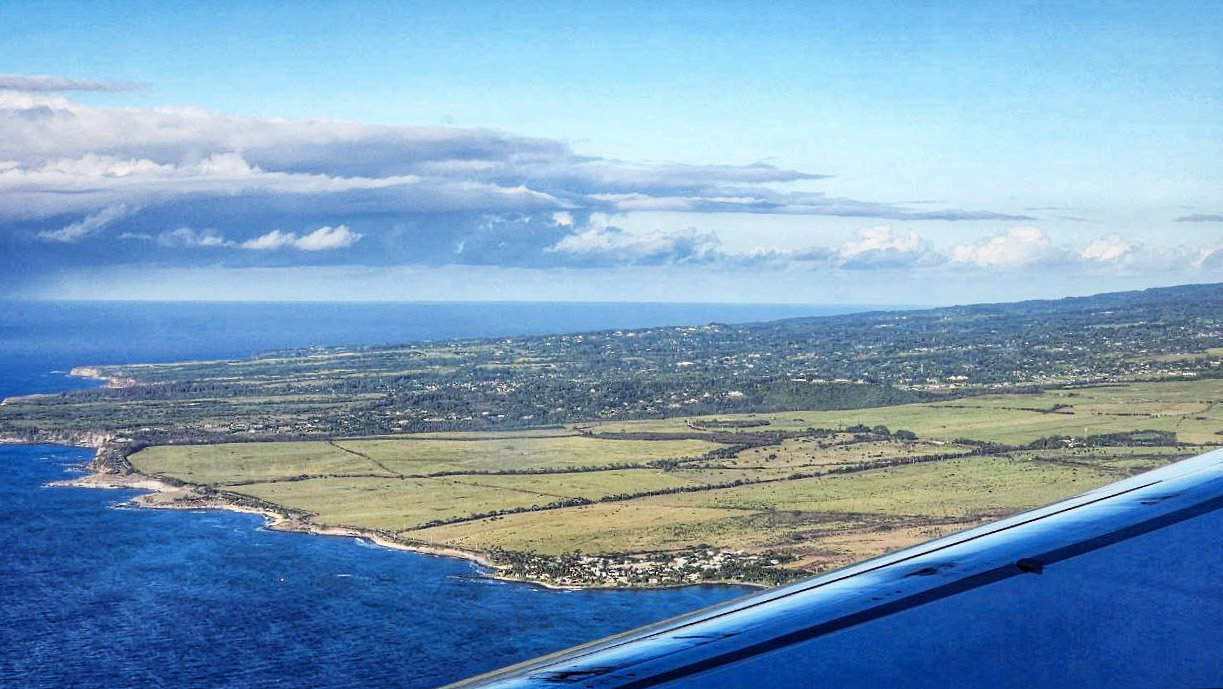
Lead Photo: © Beat of Hawaii flying over Maui.
Get Breaking Hawaii Travel News



I say they should build a New Parallel Runway. Even though it would impact major infrasturcture. Because the life blood of Maui’s economy and people’s lives depend on air traffic bringing daily necessitates. What if a major earthquake or hurricane was to disable the only one runway they have. How would that leave the residents of Maui?
That is a real problem. Can they extend the shorter runway so the main one can be fixed?
Worst yet is Kona. There is no second runway.
When the Kona airport was built the State cut the second runway in the project. It’s time for Kona to get a second runway before it’s to late.
While negotiating with the military over land leases maybe they could build it or pay for most of it? As long as it’s atleast 8K feet long to handle most jets and military aircraft.
The Governor and State need to wake up now!
Jay, totally agree. It’s typical “crisis management” with State & County “government”, instead of proactive actually doing anything. First they “study” to death everything, then the next year review that study, do another study, then add another EIS, then review and litigate that. On & on.
The infrastructure Has got to be taken care of or the islands are moved back to the 19th century, or further. What looks to be a solvable problem, gets worse the more it Is taken for granted that the runways will always be there. They will not. Anything neglected tends to get worse the more it is neglected, one thing always leads to another issue, and before you know it you are suddenly left with nothing. Why are the so called leaders allowing this to continue? They have got to get the lead out and get these points taken care of by Not pushing it to the back burner. This needs flames on it so it can be seen and felt.
Where is the Governor? This should be priority #1. Dr. Josh Green, step up and do something about this, it is the right thing to do.
All the airports in the Hawaiian islands areimportant!
Just shut it down for a year. I’m a tourist who loves Maui but I can wait. Besides, I keep hearing Maui doesn’t want tourists. Let’s give them a year or so break. Anyone who works at building a new parallel runway should qualify for hazard pay. No way I’d want anyone I love out there working on either new or repair on old runway as planes come and go.
If they continue to do temporary fixes that’s what we’ll get something temporary. Time to do what’s needed to have a serviceable runway for decades not years. It’s going to be costly. It’s going to inconvenient. It’s going to take time.
Bit if it isn’t done this time when?
For additional context, San Diego only has one runway. I have always wondered how they perform any maintenance, no matter how minor!
And what do they do when they need a complete replacement?
I think Maui, all islands need to get their act together.
What’s with all the constant planning, reports, votes, permits and just talking about important decisions that need to be made Now!
For ALL the visitors paying taxes and fees up the whahozza get it together and get it done.
The whining and complaining is getting old.
Rae, I totally agree. But watching, the last 44 years, “getting stuff done” in the islands … I could write a book.
Build a second, parallel runway. I can act to replace the commuter shorter runway and allow accomadation of both commuter/private aircraft and commercial aircraft, and also act as a relief runway in case one or the other should be blocked by a disabled aircraft for some reason. The existing large runway is less that a foot thick (originally)???! Another reason to replace it! I’m amazed it can handle the heavy commercial traffic that it does. Plan for the future!
Since money will no doubt be in short supply the answer is simple. Charge every non-resident airplane passenger $100 to land and $50 to take off. Problem silved
Maui residents were very unwise, to say the least, to severely protest, and to block runway expansion, decades ago. I had moved to Maui in 1999, and got to witness all that opposition, first-hand. Amazing that both Kona & Hilo had very long runways, which Maui had the land dedicated for many years ago, but that expansion was blocked. As if, they thought, this would limit tourism, 2+ decades ago. How did that work out? Instead they are left with an old, and short runway. Not safe. Not wise.
they never should have built the airport where it is. After the war It should have been built down near the Kihei baseyard. would have been great, Tourist would have just drove straight from airport to lahaina, Kihei and wailuku and Kahului without any problem and would have saved millions of gallons of gas by now.
Guess the Navy didn’t think of that when they built it. Of course ‘tourism’ wasn’t then, what it is today. And the aircraft that were using that field weighed a fraction of the jets using it now.
John B., totally agree. Originally, that was the plan, many decades ago: to build the Maui Airport much closer to Kihei. Long time kama’aina residents say that it was local politics: those in political power at the time were not enamoured, to say the least, with the residents of the affluent ocean-side area of Spreckelsville, near the current airport location, and thought that the fly-over noise would be political payback for them. So the story goes.
Perhaps 5-23 traffic can be diverted to the main runway temporarily. Then 5-23 can be rebuilt to the new required standards for a main runway. The “old existing 2-20” in its present condition probably could become the commuter runway once the new one is built.
Pay me now or pay me later!
No matter I think the cost will continue to rise as time goes on. Might as well just build a permanent second runway so going forward is always an option for repairing one or the other. Keeping the second runway open would be my thought for now.
This has been seriously neglected for decades. I’d rather see the state planning this now than waiting for some emergency closure down the road. That runway is one of the most important pieces of infrastructure on the entire island.
I can’t even imagine how long this is going to take, what a mess it will create given Hawaii’s DOT, and what the cost will end up at.
I wonder if the FAA has threatened HDOT with fines. This whole mess is indicative of a third world country. An additional runway should have been built long ago when tourism on Maui increased substantially. But, this is how Hawaii operates. No need to hurry, we can wait.
Please build the new runway. Do it once and do it right.
That’s exactly what should be done. The new runway is the only realistic answer long-term. However, given the record of incompetence of government and government agencies in the state of Hawaii, it sadly probably will not be done right!