

You would think this would be the easiest time ever to see Kilauea erupt. After all, the volcano has now produced more lava-fountaining episodes than any Hawaiian eruption ever recorded, surpassing Puu Oo’s previous record of 47 with fifty separate episodes. If there were ever a time to plan a Hawaii vacation around seeing live lava, surely this would be it. And so we thought, and so we tried. But here is what we learned. You can reserve your flights, hotel, rental car, and vacation days. You cannot reserve an eruption.
Now we think the opposite may be true. When we recently booked Volcano House months ahead and were happy to find a slot, we knew we were taking a chance. We could not even get crater-view rooms as we’d wanted, settling instead for a single two-queen room facing the parking lot because that was all that remained. Like so many visitors, we kept hoping our timing would finally line up with the volcano’s. But it never did. We left with a much better understanding of something that visitors ask us all the time. The volcano keeps its own carefully guarded schedule, and no amount of planning can move it onto yours.
Yesterday, Kilauea entered the record books with the 7-hour Episode 50. That milestone only reinforces what we learned during our own stay. The most lava-fountaining episodes Hawaii has ever documented in a single eruption are still something most visitors will not see, even when they carefully build a vacation around it.
The record is real. So is the challenge.
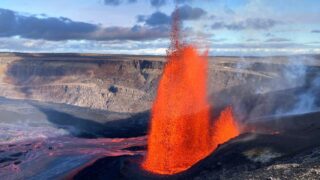
Episode 50 began about 10:10 a.m. on June 27 and ended at 5:10 p.m. after seven hours. During the peak of the eruption, lava fountains rose to roughly 1,000 feet before gradually easing throughout the afternoon. Fresh lava now covers more than half the floor of Halemaumau, while the eruption has officially surpassed Puu Oo’s 47 lava-fountaining episodes to become the most ever recorded during a single Hawaiian eruption.
It is an extraordinary milestone, but it also highlights something visitors rarely think about until they experience it themselves. Almost nobody planning a Hawaii vacation happened to be standing at the overlook during those seven hours. Most people who wanted to see it were still at home, or arriving the following day or week, or had already visited several days before when nothing was happening.
Talking with other visitors at Volcano House when we were there in December was the single story we all shared. The record now clearly belongs to Hawaii’s volcano. But it does not make the timing any easier for anyone trying to fit an eruption into a vacation planned months in advance.

Your vacation follows one schedule while Kilauea follows another.
Episode 49 occurred on June 14. Episode 50 followed about 13 days later and lasted only 7 hours. That simple comparison explains why visitors so often miss precisely what they came to see.
Now compare that with the way most Hawaii vacations actually come together. Airfare is often booked months before departure. Volcano House reservations can disappear even sooner. Many families coordinate work calendars and school schedules far in advance. By the time visitors arrive at Hawaii Volcanoes National Park, almost every part of the trip has already been locked into place.
Kilauea, on the other hand, just doesn’t work that way. Kilauea has become predictable, just not vacation predictable if you know what we mean. Scientists have narrowed the window for the next eruption to several days as the summit reinflates. That is extraordinarily useful if you already live on the Big Island or have plans to be there. It does almost nothing for someone whose vacation was planned six months ago, even when it lands close, as it did for us.
We finally realized we were asking the wrong question.
Looking back, we realized we had unconsciously turned the eruption into the destination. And it’s hard not to. Every walk to the overlook became another check to see whether today might finally be the day. Every update from the Hawaiian Volcano Observatory felt like another clue that perhaps our luck was about to change. We had spent months planning the trip, so it was only natural to hope the volcano would cooperate. And we gave it several days to do so. But to no avail.
Instead, we spent our stay looking across a steaming and glowing caldera that never erupted. At first, that felt disappointing because our expectations had drifted toward the belief that we might just get to see lava after all the planning that had gone into the trip. Once we accepted that our plans and the volcano’s weren’t aligned, we started paying attention to everything that was happening instead of just the one thing that was not.
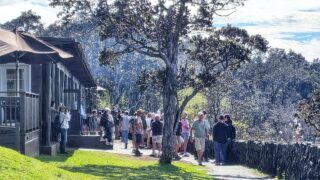
We were standing at one of the world’s most active volcanoes, watching a landscape that continues changing whether lava is visible or not. Steam drifted continuously across Halemaumau. And at night, the glow was unmistakable. Fresh lava from earlier episodes continued to reshape the crater floor in real time. Every overlook revealed evidence that the summit is still actively evolving. We stopped feeling as though we had missed the experience and started appreciating the one we were actually having. In a word, it was incredible.
The volcano still rewards the right expectations.
Over the years, we have noticed that the happiest visitors are rarely the ones chasing a guaranteed anything, including a volcanic eruption. They arrive here at Volcanoes National Park understanding that live lava is a distant possibility rather than the price of admission. They come for the place itself, and the place delivers whether or not the vents are running.
They drive Crater Rim Drive early, before the tour buses fill the pullouts, when the overlooks are nearly empty, and the sheer scale of Kaluapele finally registers, a caldera far wider and deeper than any photo prepares you for. They walk the closed stretches of old Crater Rim Drive with cinder crunching underfoot and steam drifting up from the ground on both sides. They hike down through rainforest and tall ferns into Kilauea Iki and out across its floor, a crater that was a churning lava lake in 1959 and now feels like crossing the surface of the moon. On clear nights, even with nothing fountaining, they watch for the glow that can rise off Halemaumau when lava sits close to the surface.
If lava fountains appear, the day becomes unforgettable. If they do not, they still leave having experienced one of the most remarkable places anywhere in the islands.
Ironically, Episode 50 may be the best reminder yet of why that approach makes sense. Kilauea has never produced this many lava-fountaining episodes during a single eruption, yet the basic challenge for visitors has not changed at all, even with 50 opportunities. Vacations and volcanoes still operate on a completely different schedule, and no record changes that reality.
As we write this, the eruption is paused again, with the summit expected to continue reinflating toward another episode. Are we dreaming of trying again? You bet we are. But even during the eruption with the most lava-fountaining episodes Hawaii has ever recorded, timing a vacation to coincide with these brief episodes remains remarkably difficult.
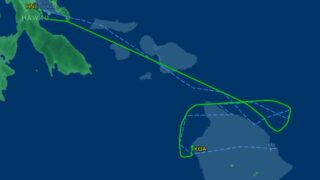
We still hope to be standing at the overlook when another spectacular episode begins. We just no longer build an entire Big Island trip around the assumption that it will happen, even though, for us, starting on Kauai, the volcano is barely an island away.
After our own Volcano House stay, and now after watching Kilauea rewrite the record books entirely, that feels like the most honest advice we can offer anyone planning to visit.
What’s been your experience at Hawaii Volcanoes National Park? Did you leave satisfied or disappointed?
Photo Credits: © Beat of Hawaii at Kilauea in December, 2025.
By Rob and Jeff, Beat of Hawaii.
Some of the most meaningful parts of Hawaii are the ones visitors walk right past without knowing they are there. We’ve spent nearly 20 years finding them firsthand for BOH as full-time Hawaii residents reporting on travel, culture, and island life, and telling you what they mean for your trip. Join us →
Get Breaking Hawaii Travel News

My husband and I live in Kona so it would be possible for us to drive when alerted that an episode has started, but anyone in the world can watch the live feed on YouTube (we’ve done this many times) and it’s spectacular! You can sign up for notifications through USGS.gov. Several years ago before all the episodes began. We were at the crater on a clear evening and The scars of the Milky Way above the glowing. Caldera was a site that would take your breath away!
Well, I live on the Big Island, just a few miles south of Kona. I have attempted to go to a number of eruptions. It is normally a 2 hour trip but on these eruption days, 3-4 hours is not unusual. And if one can get to HVNP in time, the traffic can be terrible. One must be driving by the park when the eruption begins and pull in quickly (yes, this happened to a friend on episode 49!) I have tried to go on several occasions and either the traffic was awful or Mme Pele decided she has had enough for one day and suddenly quits after 6-8 hours, before I can complete the journey. So, even if one lives on the Big Island, there is only a slim chance of seeing the fountain in person. I am a long-time subscriber and sure do enjoy BOH! Thank you!
Hi William.
Thank you! Other BI residents have told us the same thing and even suggested biking into the park as one of only sure ways they have been able to see eruptions.
Aloha.
Drew808 said it best, trying to time your visit to an eruption is a Fool’s errand. Amen to that! We visited Hawaii volcanoes National Park a number of times over the years, and have never seen an eruption. We still feel very blessed to have been able to stay at the Volcano House a number of times, breathe in the unique Big Island fresh air at the park, experience the clear sky at night, and the volcanic steam in the morning. Our last visit was ten years ago, but earlier visits in the 1960s and 1970s were by far the best as the crowds and traffic were much more manageable than today. We hope to make a two day visit from Kauai when at our timeshare next year.
It’s a spectacular experience no matter whether Pele shows up or not.
I live in Hawaii 5 months a year. Last year we woke early for us, saw it was erupting, and hopped in a car for the drive from Kona. It was pouring rain most of the way, and stopped just in time for us to make the long walk. We had an amazing show, and the fountaining stopped off the minute we left the park. Totally lucked out.
It was cool for us because we were in college when the big eruption happened in 1983, and made it a goal to sometime have enough money to be able to fly to Hawaii to see an eruption. Little did we imagine that 22 years later we would own a house on the island. Or that 21 more years would pass before we saw the volcano erupt in person.
In 1990 my girlfriend and I visited Volcanoes National Park for the first time. Kilauea was erupting so we went as close to the flowing lava as we could. It was an unforgettable sight as we watched the lava flowing across the road. There were barricades to keep the curious from getting too close to the action. There was a man with a civil defense arm band who was on the other side of the barricade. As we exchanged pleasantries, he asked if we would like to come over to his side of the barricade and step on the cooled crust. Of course we readily agreed, and as we looked down through the crust, we watched the lava flowing only inches under our feet. After a very few minutes, our sneakers were getting uncomfortably hot, so we stepped off and got on the other side of the barricade. As I look back to marvel at our experience, I can’t help but think how foolish we were. It was a once in a lifetime experience, but never again.
Yep, we’ve experienced it.
In 2023, we watched eruption after eruption in the weeks before our visit. They were not the fountains like now, but still there. Then two weeks before we traveled, the last one went off.
Then last summer we were on Maui when one went off. Three weeks later one went off when we were on Molokai. The whole time we wondered if we should have done a day trip… But getting the timing right is difficult.
Someday… I figure it will involve going at least for two weeks when she’s active to have a decent chance.
Here’s what I would suggest to visitors. Keep an eye on the USGS YouTube channel. Once you see it sputtering. Head up to the park. It’s about a 2 hour drive from Kona and about one hour from the Hilo side. The eruptions usually last 6-10 hours before it ends. So you have some time to get there before it ends if you leave right away. Of course this requires you’re not in the middle of something else.
I travel to my home in Kona 5-6 times a year. I’ve been able to catch the volcano almost every time I go by using this method. If you happen to be a vet. Book the night in the Kilauea Military camp. Way cheaper than volcano House and located in the park also.
Volcanoes National Park is spectacular, whether or not Tūtū Pele decides to make herself seen. Trying to time the visit with an eruption is a fool’s errand. Better to come with no expectations and be pleasantly surprised than get your hopes up and leave disappointed.
Oh that fickle Pele…she has her own timeline.