
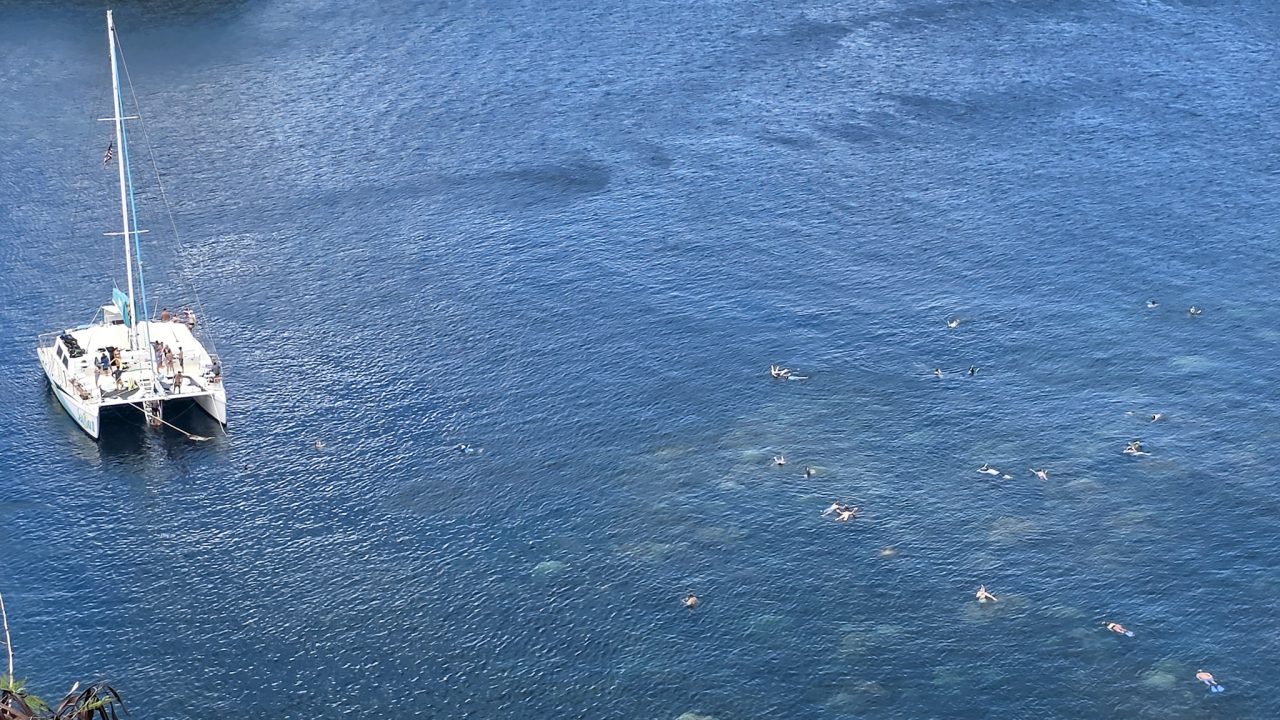
We went to Honolua Bay on West Maui and couldn’t believe just how crowded it was. Cars were wedged along the road, there was virtually nowhere left to park, and people kept arriving and heading down the trail toward a place with almost no infrastructure for the numbers trying to use it.
For us, the scene was immediately reminiscent of Haena State Park and Ke’e Beach on Kauai before that changed starting in 2019. We remember when people simply drove to the end of the road, hunted for someone else to leave, and somewhere to leave the car before walking in. That was until the sheer volume finally forced Hawaii to try something very different.
Honolua may now be headed in much the same direction. Maui’s newly finalized 2026-2028 visitor management plan identifies the bay as one of the island’s top-priority problem areas. The proposal being advanced there could eventually replace today’s informal roadside access with off-site parking, shuttles, timed reservations, and above all, far fewer visitors.
When we first wrote about the proposed changes at Honolua Bay in March, they were still part of a broader statewide planning draft. Five months later, the Maui plan is now final, while a separate effort to protect the remaining privately held land around the bay is also moving forward with state and county funding.
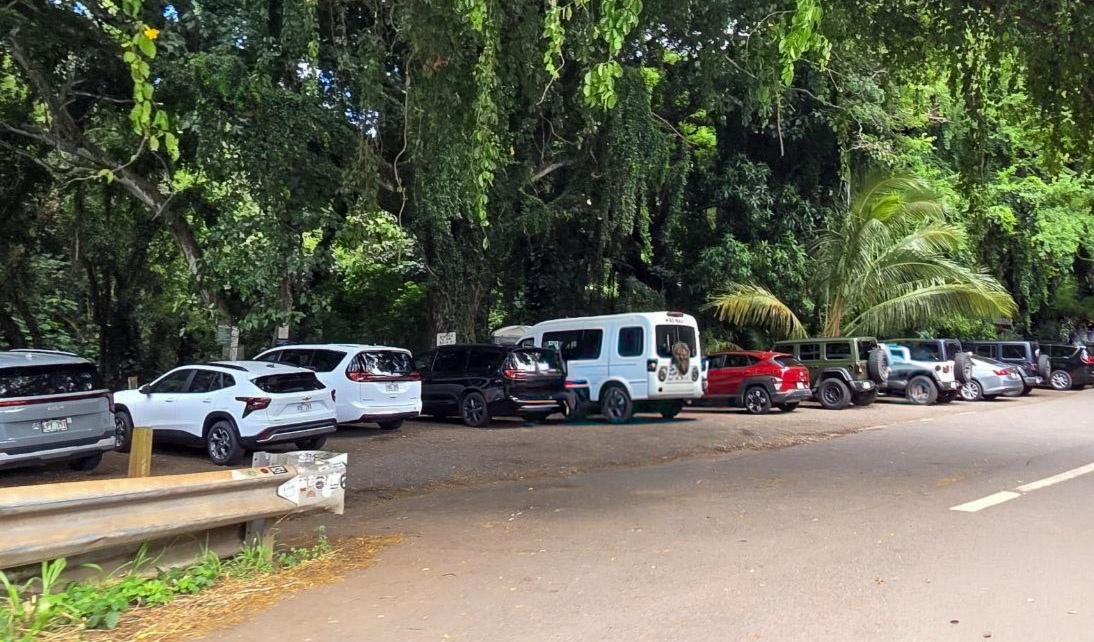
Up to 1,600 people can arrive at Honolua daily.
Trust for Public Land’s Honolua Bay conservation project says Honolua can see up to 1,600 people on peak days, including visitors arriving over land and hundreds more brought into the bay on multiple commercial boats. Save Honolua Coalition has put the busy summer land-based count at about 1,200 people a day.
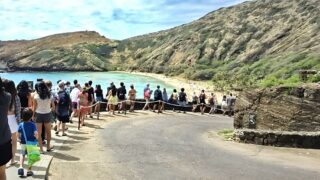
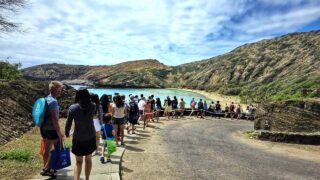
Seeing Honolua today, those numbers weren’t at all difficult to believe. The mismatch is striking because this isn’t a conventional beach park with a large paved lot, restrooms, and other facilities built around heavy visitation. People mostly pull off along the highway, find whatever legal parking remains, and walk through the valley to the rocky shoreline.
The crowd wasn’t coming only from the road. This morning, we saw three very large snorkeling catamarans from the same company in Honolua Bay at the same time, adding another visible layer of visitors to what we were already seeing on land.
The area everyone is coming to is one part of what is being protected. Honolua contains cultural and archaeological resources, including ancestral burials, while the water has been part of the Honolua-Mokuleia Marine Life Conservation District for nearly fifty years, since 1978.
That combination of intense use and very little visitor infrastructure has persisted for the decades that we have been going there. Today, it felt to us as though the place had simply exceeded what its current form could reasonably continue to handle.
The proposed change would be huge.
Save Honolua Coalition wants to reduce land-based visitation by roughly two-thirds, to about 400 people a day, using an off-site parking area, shuttle transportation, and timed reservations. Most of the roadside parking visitors depend on now would disappear, while plans discussed publicly would retain about 14 safe roadside spaces for local access and create a pickup and drop-off area near the trail.
Visitors wouldn’t simply step off a shuttle and walk to the water. The proposal includes paid stewards and a cultural corridor through the valley, with orientation about Honolua’s history and ecology before people reach the shoreline. That is reminiscent of our experience at Hanauma Bay on Oahu, where visitors receive an orientation before heading down to the water.
Planning for the trail itself could involve ground-penetrating radar and consultation with lineal descendants because of known burials and other culturally sensitive areas there. At the bay itself, additional stewardship would focus on the marine environment, and the proposal contemplates that stewards would also provide orientation to people arriving on commercial snorkel boats.
Less clear is how the eventual limits will apply to those boat arrivals. Reducing land access to about 400 people would, in itself, be a dramatic change, but the three catamarans we saw together this morning were a reminder that a substantial part of Honolua’s visitor load can arrive without driving or parking there.
We’ve already seen what this can do at Haena.
Before the current system was implemented, Haena State Park and Ke’e Beach had thousands of visitors a day. Cars overwhelmed the end of Kauai’s North Shore road, illegal and improvised parking spread well beyond the park, and many residents had stopped trying to go there entirely.
After the 2018 floods, Haena reopened in 2019 under an entirely different model. Nonresident visitors then started needing advance reservations, daily admission became capped at 900, parking became tightly controlled, and shuttles began carrying some of the people who previously arrived in rental cars.
It worked inside the state park, but we’ve also watched what happened outside it. As we reported in Kauai Fixed One Beach, Broke The One Down The Road. Now It’s Repeating, some of the demand moved to nearby Haena Beach Park and Tunnels Beach, creating a set of new parking and access problems just down the highway.
That’s useful information for Honolua’s planning because controlling access won’t eliminate the people who want to snorkel while visiting West Maui. It may protect the bay and make the experience there far more manageable, while also creating new pressure at other spots.
Honolua has already seen intervention once.
Save Honolua Coalition was formed in 2007 during a fight over development around Honolua and Lipoa Point. After years of advocacy, Hawaii purchased more than 244 acres from Maui Land & Pineapple in 2014, protecting a large swath of the landscape from being developed.
That conservation victory preserved Honolua from one aspect of pressure, but it didn’t result in a visitor-management system for the bay. Some of the land remained protected, while more and more people continued to come to snorkel and enjoy the bay.
There’s another aspect to the land puzzle ahead. Trust for Public Land is working with the Save Honolua Coalition to acquire approximately 17.8 additional acres of privately held land along the south side of Honolua, with support from more than $2 million awarded through the state’s Legacy Land Conservation Program and additional Maui County funding.
If that acquisition is completed, the south-bank property is intended to transition to community stewardship through the Save Honolua Coalition. Combined with the state-owned land on the other side, this could finally make it possible to manage Honolua as a single interconnected cultural and environmental landscape rather than simply the famous bay where everyone does their own thing.
What is being protected goes well beyond snorkeling.
Honolua Bay occupies an unusual place in modern Hawaiian history. On May 1, 1976, Hōkūleʻa departed from the bay on its maiden voyage to Tahiti, helping revive traditional Polynesian voyaging and becoming one of the defining events of the Hawaiian cultural renaissance.
The ecological story is less celebratory, however. Historical surveys once measured coral cover at around 40% in parts of Honolua, while the Save Honolua Coalition now says it is below 8% after decades of losses from sediment, runoff, and other reef issues.
Water-quality monitoring adds another concern. Surfrider Foundation reported that one-third of its Honolua samples in 2024 exceeded Hawaii’s recreational standard for enterococcus, indicating possible fecal contamination and associated health risks.
Honolua sits below a watershed where rain, sediment, nutrients, and other land-based inputs easily flow toward the ocean, making the water-quality problem more complicated than what is visible during a snorkeling visit.
Two boat groundings showed how vulnerable the bay remains.
In February 2023, the 94-foot yacht Nakoa grounded near Honolua and damaged at least 19,434 square feet of coral and live-rock in the habitat. More than 100 coral colonies were damaged before the yacht could be removed, and the vessel later sank in deep water while being towed away.
Then less than two years later, the 65-foot catamaran Hula Girl grounded inside the conservation district in January 2025 and remained on the rocky shoreline for about six weeks. It was finally pulled free in March, temporarily repaired, and towed to Oahu for repairs. The state later found damage to 36 coral colonies and 48 square meters of live rock, much of which occurred during the difficult salvage operation.
Those were serious events, while the daily pressures at Honolua are less dramatic, albeit far more persistent. Cars compete for a limited supply of roadside spaces, and visitors traverse sensitive land to reach the shore, all within the bay where the reef has already undergone enormous change.
For now, Honolua still works the way it always has.
No reservation is required for Honolua today, and there are no shuttle buses for visitors to take. If you arrive and find legal roadside parking, you can still walk down much as people have for decades.
Hawaii hasn’t announced when that transformation will happen, and years of planning at Honolua are a good reason not to assume it will happen quickly, although it could. What has changed is that the Maui plan is now final, the south-bank acquisition is moving forward, and the proposed visitor system is specific enough and with enough precedent that we know what a future visit is likely to look like.
For those who know Honolua, we’d like to hear whether what we saw today has become typical of your own experiences. And if you’ve experienced Kauai’s Haena State Park and Kee both before and after reservations, would you want to see Honolua go the same way?
Photos of Honolua Bay – © Beat of Hawaii.
By Rob and Jeff, Beat of Hawaii.
Some of the most meaningful parts of Hawaii are the ones visitors walk right past without knowing they are there. We’ve spent nearly 20 years finding them firsthand for BOH as full-time Hawaii residents reporting on travel, culture, and island life, and telling you what they mean for your trip. Join us →
Get Breaking Hawaii Travel News

We have stopped at Honolua in January, for several years including last year, and there were no crowds and ample places to park. It is hard for us, from our experiences, to think about reservation systems for this place. Perhaps a seasonal system could be set up for the busy times and the quieter times left alone.
What about kicking out the squatters who attempt to intimidate many who visit and pollute the area they purport to be protecting?
I am fine with reservations as long as the same rules apply to All patrons.
The Kauai system is rigged to allow locals unlimited free visits paid for by tourists. Shuttles make it almost impossible for families with small children or the elderly to visit because of the extra amount of baggage needed for kids and the less able.
The boats do more damage daily than beach visitors do in a year.
We tend to go off season and though there are always lots of cars it doesn’t seem overly crowded. We stay in Napili and a drive to Honolua is based on the weather. Timed entry could mean a cloudy, choppy snorkel trip and waste of an afternoon. I understand the idea it just makes it harder to be spontaneous.
Yes it has been over crowed for a decade. We stopped going there because of parking!! and the number of snorkel cats
More people more congestion a reality everywhere