
Staying at Volcano House only makes sense once you accept the trade you are making. You are not here for comfort, polish, or quiet, and anyone expecting that will be disappointed quickly. You stay here because sleeping inside Hawaii Volcanoes National Park changes how the place feels before the crowds arrive and after they leave, and that access is the entire point.
When the park closed during the most recent eruption, guests staying at Volcano House were still permitted to remain inside the park, underscoring just how different the access is here.
That tradeoff starts the moment you book, whether you realize it or not. Room choice matters here more than almost anywhere else we have stayed, because it determines whether the compromises feel justified or merely tolerated.
We did not get the room we wanted. We booked what was available, which meant a standard two-queen room facing the parking lot instead of the crater. We tried to upgrade, but nothing opened, which quickly became the first real lesson of Volcano House. If you want the view that makes this place worth the compromises, you have to book far earlier than feels reasonable.
Without that view, you are paying for proximity, not the experience most people imagine when they picture staying here. That distinction shapes how everything else lands once you arrive.

The room is adequate.
Once you accept that the room is not the reason you are here, it becomes easier to evaluate it honestly. This is a place to sleep, regroup, and head back into the park, not somewhere designed for lingering or retreat.
Our room ran $285 per night for a standard two-queen layout with a parking lot view. A kamaʻāina discount was supposed to apply but never did, which is worth flagging for local readers. We did not push the issue once it became clear it was not being applied.
The room itself was small, plain, and serviceable. There is no air conditioning, which was not an issue at this elevation in December, and the heat worked well at night. The bed and the bathroom were fine, and everything functioned as it should.
What stood out more than the room, however, was the noise. The main public areas were loud throughout the day and well into the evening, and that sound carried into the room. Conversations, movement, and the constant churn of visitors never really stopped. It did not feel like staying in a hotel so much as staying inside a facility that never truly powers down.

Volcano House has become the park’s front desk.
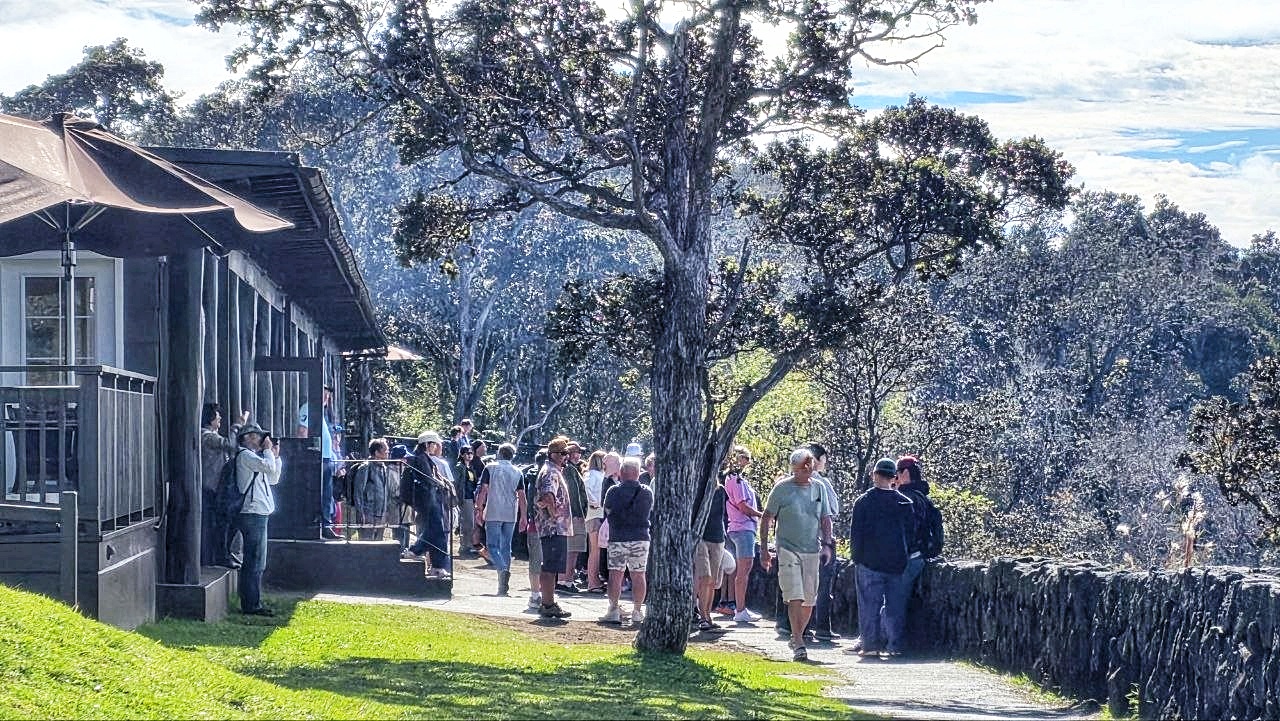
With the visitor center under construction, Volcano House has effectively become the welcome center for much of the park. From roughly 9 am until the restaurants closed at night, the building stayed busy almost continuously.
Visitors flowed through all day, asking questions, looking for maps, lining up for food, browsing the two gift shops, and using the lobby as a staging area. The hotel desk doubled as a Q&A counter for the entire park, fielding questions unrelated to overnight guests.
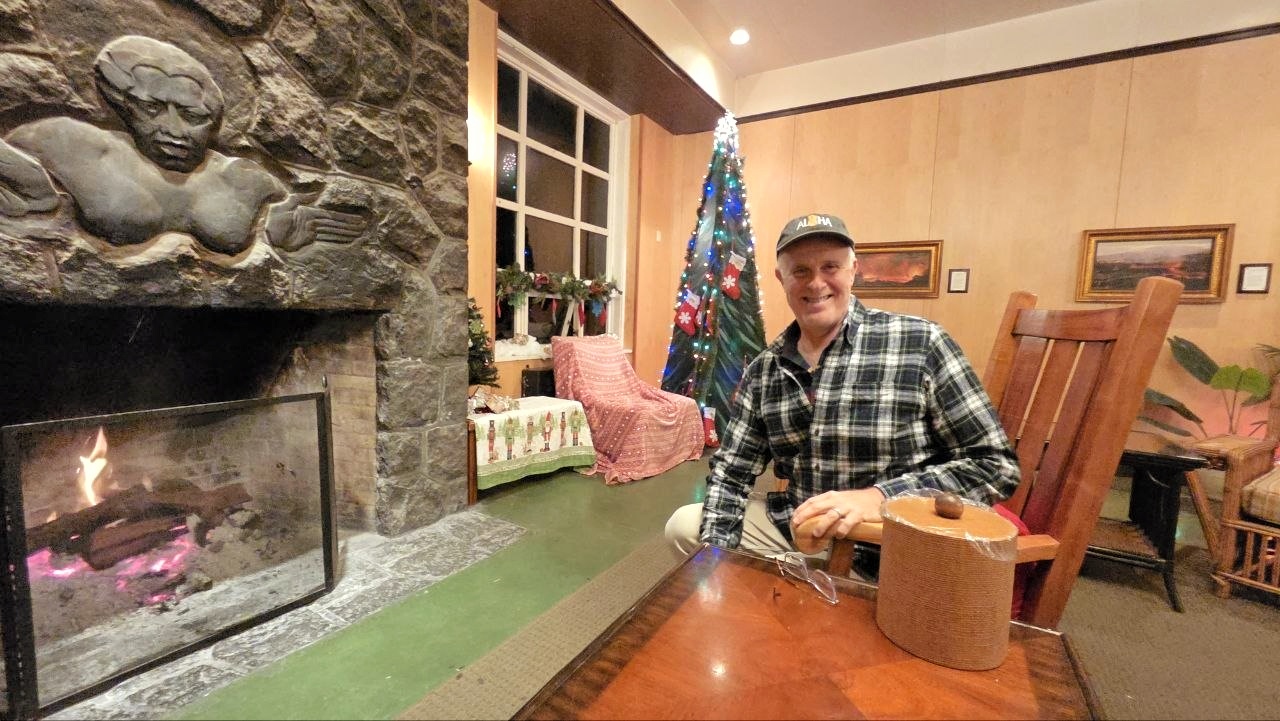
That setup leaves overnight guests without a protected space of their own. There is no common area or lounge reserved for guests, and no quiet place to sit once the building fills. The first real chance we had to sit by the fire without a steady stream of foot traffic came only after the restaurants closed.
Staff offered a welcome drink and daily cookies, which was a nice gesture in theory. In practice, those cookies were kept behind the hotel desk because there was nowhere else to put them. Even small touches felt constrained by the lack of separation between guests and the general public.
The result is an institutional feeling that is hard to ignore. Volcano House does not feel like a lodge organized around its guests. It feels like an operational hub that also rents rooms at night.
The crater-facing wing is the whole calculation.
Walking the property made something else immediately clear. The crater-facing wing is where Volcano House changes from tolerable to compelling. Those rooms are positioned for the view first, not convenience or foot traffic, and they are the ones that justify staying here instead of elsewhere in Volcano Village.
From those rooms, the caldera becomes part of the stay rather than something you drive to and away from. If we were booking again, this would be the only section we would target, because without that view, the logic for staying here weakens considerably. We would also opt for a lanai room in the separate wing.
Why we skipped the restaurants.
Volcano House has on-site dining, and we gave it a fair look. We reviewed the menus, watched what was coming out of the kitchen, and paid attention to how people seemed to be experiencing their meals. Between the pricing, the reviews, and what we observed, we decided to skip it.
That decision was easy and regret-free. The dining felt like something people defaulted into because they were already there, not because it was especially appealing.
The workaround that actually works.
Instead, we drove five minutes across the highway into Volcano Village and ate at Kilauea Lodge. Reservations were required, the atmosphere was calmer, and the experience felt intentional rather than crowded. Food was excellent, and our table by the fireplace was ideal. We also returned to Volcano Village the next day for lunch at Cafe Ono, which has a plant-based menu and is also highly recommended.
If you are staying at Volcano House, both places are where you should plan to eat. It removes one more layer of friction from the stay and gives the evening a clearer break from the park crowds.
There were two grocery stores in Volcano Village that were more like 7-Eleven with limited options. It’s best to shop for any groceries you need before you arrive. Hilo is the closest, at 40 minutes away.
Parking for hotel guests is still a gamble.
The parking chaos at Hawaii Volcanoes National Park has already been covered, but it plays out differently when you are staying at Volcano House. As a hotel guest, you do not get dedicated parking, and you are competing with day visitors for the same limited spaces.
When the closest lots filled, our fallback was the Kūkamāhuākea, or Steam Vents, parking area. Sometimes that worked easily, and other times it was full. This was about a mile walk each way to and from Volcano House.
One night, we parked there and walked back late afternoon. That walk turned into one of the unexpected highlights of the stay, with far fewer people around and space to slow down. What started as an inconvenience became a quiet moment that would not have happened otherwise.
The real value is timing, not comfort.
Staying inside the park gives you one advantage that day visitors do not get. You can bookend the crowds, and that changes how the park feels.
Early mornings are quiet and accessible, and after dark the volume drops noticeably. Being present for those hours is the real value of staying here, not the room or the amenities.
What the 2027 concession renewal could mean.
Volcano House’s concession contract comes up for renewal in 2027. Across the national park system, recent renewals have often come with sharply higher franchise fees, sometimes jumping from single digits into the 20% range. When that happens, higher nightly rates tend to follow quietly and permanently.
There is no guarantee that today’s pricing will remain the same a few years from now. If staying inside the park has been on your list, that adds a layer of urgency that is easy to overlook.
The honest bottom line.
Volcano House is the only lodging inside Hawaii Volcanoes National Park, and that location is irreplaceable. The rooms are just okay, the restaurants are skippable, and the lack of guest-only space can make the stay feel surprisingly institutional.
You stay here for access and timing, not comfort. If you book the right room and know what trade you are making, the stay can be worthwhile. If you do not, the compromises are hard to ignore.
Photo Credits: © Beat of Hawaii at Volcano House, December 2025. As always, to give you an unbiased report, we paid full price and the management was not aware of our stay.
Get Breaking Hawaii Travel News

We live here and go to the volcano house quite often for lunch. The lunch menu overall isn’t bad, the food is decent, but we definitely have seen the prices increase and the portions decrease post Covid.
I’ve thought about staying at volcano house just for a staycation but everything you mentioned. The article is absolutely true. I think Kilauea military camp is a better choice for a local stay.
The parking situation for guests is beyond ridiculous.
Thanks for your update on the Volcano House.
We have stayed there several times over the years, but the most recent time was more than 10 years ago. We opted for the more expensive crater view, and it was enjoyable.
We have always eaten at the Volcano House Restaurant and found the food was adequate. However, all of this has been before the dramatic increase in visitors due to recent volcanic activity. I do remember making reservations months in advance for our last visit. Appreciate your comments and recommendations, and we will keep them in mind when we plan our next visit in the next couple of years.
Mahalo Nui
Agree that there is better food to be had in Volcano Village (including the newish Lanikai Brewing), but the primary appeal of The Rim restaurant – like the hotel – is its proximity to the crater. Having a meal with that view, without being required to be a hotel guest, was worth the tradeoff in food quality – which wasn’t terrible by any means.
My wife and I stayed at Volcano House in October 2023 (off-season) for 2 nights in a Deluxe Crater View room on the 2nd floor. We reserved the room 10 months ahead of time. It was very expensive but they did offer a significant AAA member discount.
The room was “rustic” but it fulfilled its mission and we did get a good night’s sleep both nights. Two nights made sense since otherwise we would have had little time to do anything in the park itself since we had to catch a flight to Maui when we checked out.
The Visitor Center was open at the time we visited and as such, the Volcano House didn’t have the feel of Grand Central Station. Hopefully the calm returns when the Visitor Center reopens.
The restaurant was quite adequate (reservations were necessary). It wasn’t gourmet or inexpensive, but it was convenient.
Volcano House is not in the same league as other National Park lodgings (such as The Ahwahnee at Yosemite) , but it is better than many.
We would go back!
I think people expect a lodge experience like Yosemite or Yellowstone. This is not that, is very different and your review made that pretty clear.
Honestly surprised you skipped the restaurant. We had one good meal and one terrible one. Sounds like you you might have made the smarter call eating elsewhere.
The description of it feeling old and institutional is true.
Much of this is why we chose Volcano Village instead. Same area, way less chaos, and we drove in early and late just like you suggest. On the other hand, we would have been locked out during the latest episode, so there are definitely tradeoffs.
When we stayed there we loved waking up early and walking outside before the buses arrived. That part alone made it worth it for us, even with the compromises.
Being able to stay put while everyone else had to leave sounds surreal and a great reason to stay there, even as basic as it is otherwise..
We found the same thing to be true about the noise and lack of guest space. Every glossy review skips that part and that is more significant than you think. Overall for a night or two it’s worth being right there.
We stayed there years ago and this still rings true. The location is everything, but it never felt like a hotel in the normal sense. More like you were renting a bed inside the park. But it worked.