
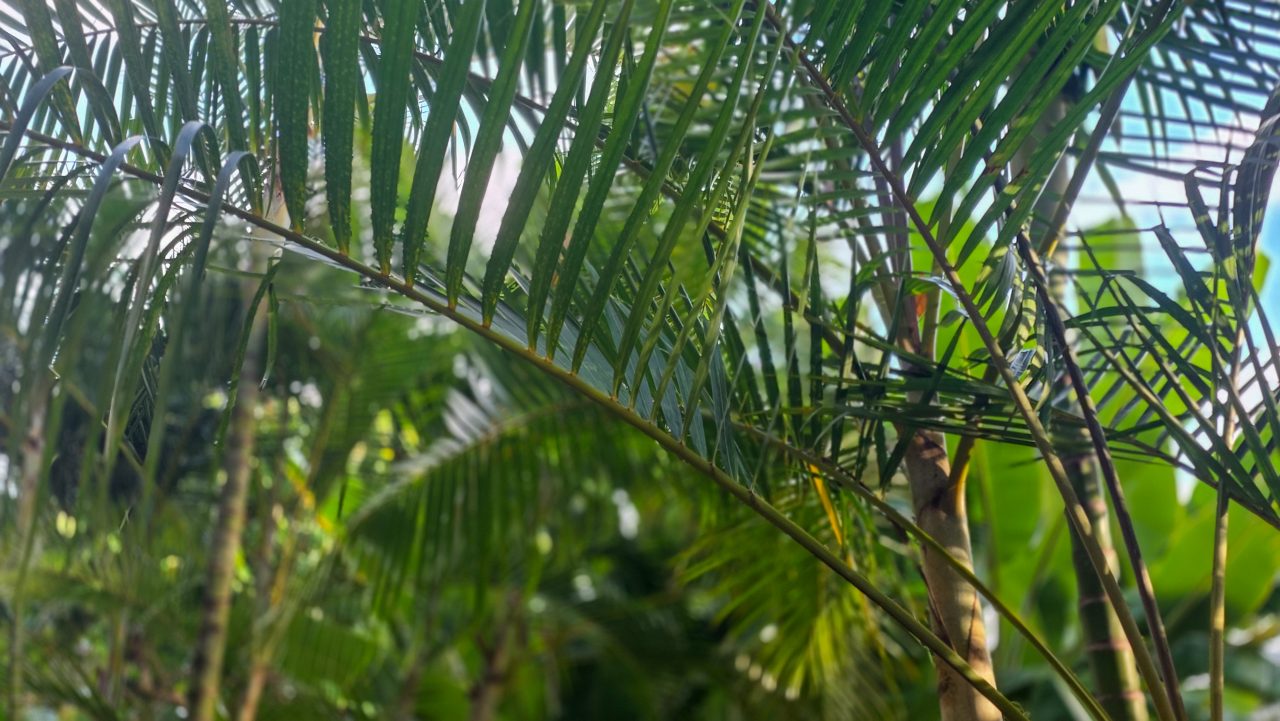
Most Hawaii visitors never think twice about brushing past the tropical plants lining a resort walkway or trail. We don’t either. Most of the time, that is exactly the right instinct, but this summer, one tiny insect hiding on those leaves reminds us that paradise occasionally comes with a small catch.
If you have ever felt a sudden burning, splinter-like sting after brushing against a palm or ti plant, you may have met Hawaii’s stinging nettle caterpillar. The invasive insect is flaring up again this summer, with state officials responding to increased activity on windward Oahu and reports of its presence on Maui. Most visitors will never encounter one, but those who do tend to remember it. Part of what makes it so baffling is that the caterpillar drops off the leaf the instant you brush it, so most people never see what got them.

Why this tiny caterpillar can hurt.
The stinging nettle caterpillar, Darna pallivitta (also written Oxyplax pallivitta), is the larval stage of an invasive moth from Southeast Asia. According to the Hawaii Invasive Species Council, its rows of tiny venomous spines act much like fiberglass, and when they break against your skin, they release a histamine-based irritant that causes an immediate, strong burning sensation.
The pain is often followed by swelling and raised welts that can last for several days. For some people, an itchy rash can linger for weeks, and while most reactions are localized, anyone with a known sensitivity or who develops difficulty breathing should seek prompt medical attention.
Where you’re most likely to encounter it.
This is not a deep-jungle insect. It often lives on exactly the kinds of plants visitors can walk past every day, including the landscaping around hotels, condos, parks, and trailheads.
State agriculture officials and University of Hawaii researchers say the caterpillars feed on more than 45 plant species. Among their favorites are areca and rhapis palms, ti plants, grasses, lilies, and other tropical ornamentals commonly used in Hawaii landscaping.
That means they can occasionally be found along resort pathways, condo gardens, public parks, residential yards, botanical gardens, and trail entrances. They are often on the undersides of leaves, where they are surprisingly difficult to spot unless you are looking carefully.
The caterpillars themselves are only about an inch long. They are pale white to gray, with a darker stripe running down the back, and are covered in rows of fine spines, making them easy to miss from a distance.
We walk past these plants constantly without giving them a second thought, and that is still how we’ll approach them. The goal is not to avoid Hawaii’s beautiful landscaping, but to resist grabbing handfuls of foliage or brushing carelessly through dense plants when a clear path is available.
Why we’re hearing about them now.
Summer is when stinging nettle caterpillar populations typically peak, which happens to coincide with Hawaii’s busy travel season. This week’s attention is on windward Oahu, where the Hawaii Department of Agriculture and Biosecurity has been responding to increased activity in Waimanalo.
State officials reported that technicians have been releasing a tiny stingless parasitic wasp that naturally attacks the caterpillar. About 150 wasps are released at each site, with roughly 1,500 released over the past four months in response to requests from 10 communities.
The wasp, Aroplectrus dimerus, was approved for field release in Hawaii in 2010 after years of research. It is host-specific and has become the state’s primary biological control after multiple pesticides and lure traps proved far less effective.
The caterpillar was first discovered in Hawaii at a nursery on the Big Island in 2001, and it is now established there, as well as on Oahu, Kauai, and Maui. A peer-reviewed evaluation estimated its horticultural and nursery impact at $84.3 million in 2018, which helps explain why the state has treated it as far more than a backyard nuisance.
What to do if you find one or get stung.
The first rule is simple: don’t touch it. If you notice a caterpillar matching the description on a palm, ti plant, or other ornamental, give it space and avoid brushing against the leaf.
There is no reason to panic or avoid the area, but there is every reason to leave the insect alone. That is especially true for children, who may be more likely to touch a strange-looking caterpillar before anyone realizes what it is.
If you are stung, the Hawaii Department of Agriculture advises washing the affected area immediately with soap and water to remove any remaining residue. Apply ice to help reduce swelling, and consult a physician if further treatment becomes needed.
Anyone who has difficulty breathing or is stung in the eyes should, of course, seek prompt medical attention. Residents and visitors who believe they have found the caterpillar can also report sightings to the state’s Pest Hotline at 643-PEST (643-7378).
We have walked past these same plants for decades and been stung by anything only rarely, which is about the right thing to keep in mind. Know what the caterpillar looks like, give it room should you spot one, and the foliage around your Hawaii vacation stays part of why you came, rather than something to avoid.
Have you ever been stung by anything hiding in Hawaii’s foliage? Tell us what happened and where you were in the comments.
By Rob and Jeff, Beat of Hawaii.
Some of the most meaningful parts of Hawaii are the ones visitors walk right past without knowing they are there. We’ve spent nearly 20 years finding them firsthand for BOH as full-time Hawaii residents reporting on travel, culture, and island life, and telling you what they mean for your trip. Join us →
Get Breaking Hawaii Travel News





Would like to return back to Maui, but it seems like theirs always some negative issues for tourists, sometimes they are caused by them, don’t blame the locals for their reactions, but with the prices of hotels an restaurant it makes me think twice, beautiful State I’m trying to make it work.Parks are closing charging too much. Seem to me like they don’t want us to come back.
Readers that want to see videos of the stinging caterpillars can just Google the videos from KHON2 and Hawaii News Now from four days ago.