
Five coconut rhinoceros beetles were found in Maui detection traps this month, and while state officials say the island does not have an established infestation, the discovery is another reminder that one of Hawaii’s most destructive invasive pests continues appearing in places where authorities are trying to keep it from gaining a foothold.
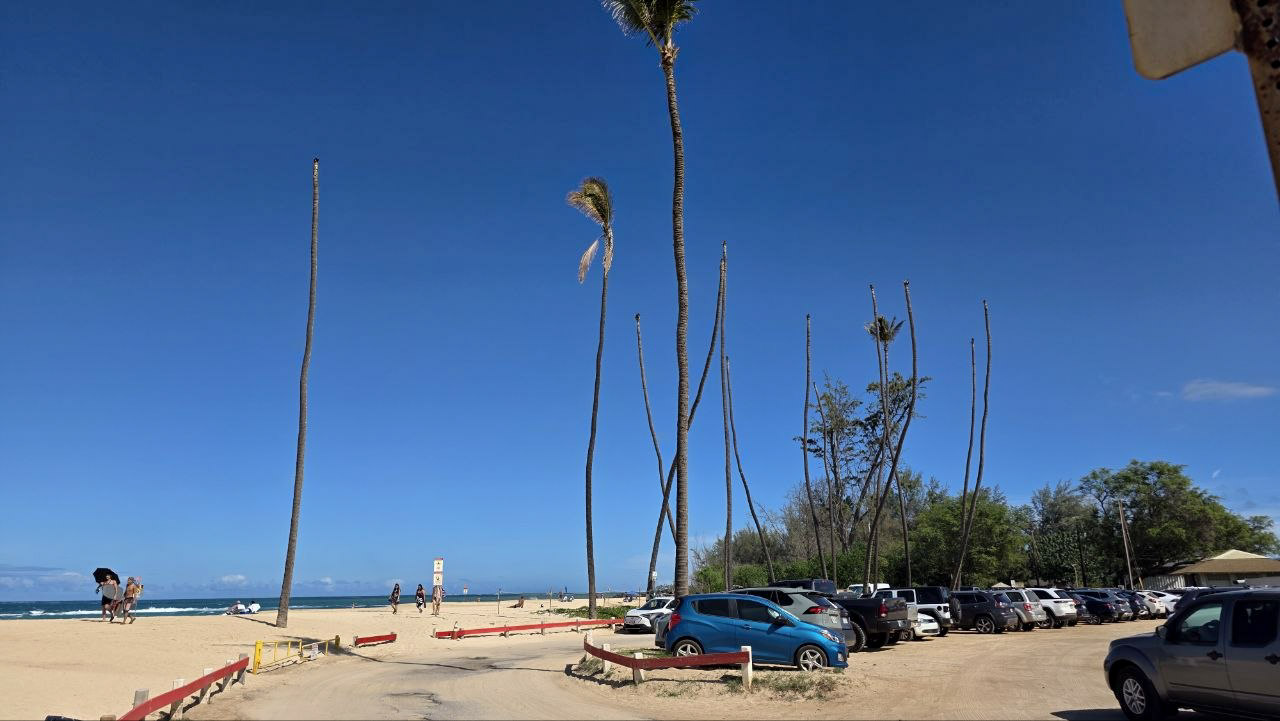
When we were at Baldwin Beach on Maui last year, lifeguards pointed toward the line of palms and told us they believed coconut rhinoceros beetles might already be part of the problem there. Whether that ultimately proves true or not, the conversation stayed with us because it reflected something visitors rarely think about. The palm-lined Hawaii that appears in vacation photos and postcards can feel permanent, yet many of those trees already face pressure from erosion, storms, disease, development, and invasive species.
That concern feels less theoretical following the state’s latest announcement. The Hawaii Department of Agriculture and Biosecurity reported that three dead adult female beetles were collected from two traps in Waikapu on June 4, with two additional dead beetles found during follow-up inspections on June 8. The discoveries came two months after a dead beetle was detected at Kahului Airport.
The concern was already surfacing at Baldwin.
At Baldwin Beach, palms have been disappearing for years as erosion continues to reshape parts of the shoreline. County officials have attributed those losses primarily to coastal erosion and saltwater impacts, and we have not seen evidence linking coconut rhinoceros beetles to the trees lost there. What stood out to us, however, was that the possibility was already part of the conversation among people who spend every day on that beach.
That distinction matters because the latest Maui detections are not being treated as evidence that palms are suddenly dying across the island. Instead, they are reminders that a pest capable of causing significant damage elsewhere in Hawaii continues appearing on an island where officials have so far prevented it from becoming established.
Why dead beetles still matter.
One of the more important details in the state’s announcement is that all of the recently detected beetles were dead. Officials also emphasized that no live adult beetles or larvae have been found on Maui since the detection at Kahului Airport in April.
At first glance, that might sound reassuring enough to end the story. The challenge is that coconut rhinoceros beetles do not always reveal themselves immediately. According to the state, adult beetles bore into palms to feed, and it can take months for visible damage to appear on palm fronds. By the time the characteristic signs show up, the insects may have been present for quite some time.
That delayed timeline helps explain why even dead beetles trigger intensive surveys of nearby green waste piles, compost sites, decaying coconut material, and surrounding palms. Officials are trying to determine whether the beetles originated from a nearby source or arrived via the movement of materials that could harbor the pest.
Maui is not where the infestation story began.
While Maui has not yet developed an established population of coconut rhinoceros beetle, the insect has already become established elsewhere in Hawaii. State officials have spent years battling the pest after it first appeared on Oahu, and it has since been confirmed on Kauai and Hawaii Island as well.
Maui’s history with the beetle has been different. Prior detections in 2023 involved larvae found in a dead palm and a dead adult beetle discovered in bagged soil products. The airport detection in April and the new Waikapu findings continue a pattern of isolated discoveries that have triggered aggressive response efforts before a breeding population could take hold.
That is why state officials continue treating every Maui detection seriously. The goal remains preventing Maui from joining the list of islands where the beetle has become permanently established.
What we are being asked to watch for.
State officials are asking residents and landowners to watch for V-shaped cuts in palm fronds, one of the most recognizable signs of coconut rhinoceros beetle feeding activity. They are also urging caution when purchasing, transporting, or using mulch, compost, soil products, and green waste materials that could potentially harbor the pest.
Suspected damage, larvae, or beetle activity can be reported through the state’s pest reporting system, allowing inspectors to investigate before a localized problem becomes something much larger.
For visitors, the latest Maui detections are unlikely to change anything they see on their next trip. What they do highlight is that many of Hawaii’s most recognizable landscapes face pressures that are not always immediately visible. The palms lining beaches, parks, and resorts may look timeless, but protecting them increasingly depends on catching problems long before the damage becomes obvious.
When you think about Hawaii 10 or 20 years from now, what changes to the islands concern you most?
Photo Credit: © Beat of Hawaii at Baldwin Beach, December 2025.
Get Breaking Hawaii Travel News



Is it illegal to plant coconut palms in Hawaii??
Google says that the trees grow up to 4 feet a year and produce coconuts in about 7 years.
Seriously, I am asking why not do something instead of giving up?
A dozen or more mature Coconut palm trees lining the beach in front of Lahaina Shores Beach Resort survived the tragic fires of 2023.
Like the iconic Banyon Tree these trees are carefully watched to assure their health.
Sounds like all precious coconut palms in Hawaii should receive special “endangered species”
protection.
I cannot imagine a Hawaii without the tall, stately coconut palms. Those towering palms are symbolic of Hawaii. I would hate to see them disappear from CRB activity. I wish they would develop a treatment that destroys them.
I see the Wailua Golf Course palms on Kauai have been hit hard. How will the east side of Kauai keep its distinction as the “Royal Coconut Coast” without them? It saddens me to see the damage everywhere.
A very interesting and informative article to read was published in the Hana Hou magazine last December. If you Google ‘The Future of Niu, Derek Ferrar’ you will read that it is not just the beetles that are killing the coco palms but also the drastic trimming and removal of fruit. I hope there is still time to save this majestic piece of nature.
My concern is the lack of information provided by Dept of Ag to Maui residents when a CRB is found, dead or alive. The incident with CRB on Maui found in a bag of soil, Dept of Ag refused to disclose the name of the business. We buy soil for our yard and we surely would have appreciated being informed if we potential had the same bagged soil, we would immediately have returned it. This whole CRB issue and the fall-out lies with Dept of Ag, for their slow response when CRB first surfaced on O’ahu.
Baldwin connection is unclear. Erosion there has been eating away at that beach and its palm trees for years. Not sure if some of it comes back to the beetle or not.
I had never heard of coconut rhinoceros beetles until a few years ago. Now they seem to be turning up everywhere and bio security related to them is an issue throughout the South Pacific.
I know the palms at Baldwin from how they were years ago and there are definitely fewer than there used to be and the ones there just aren’t healthy. Whether this beetle is part of that or not, I don’t know.