
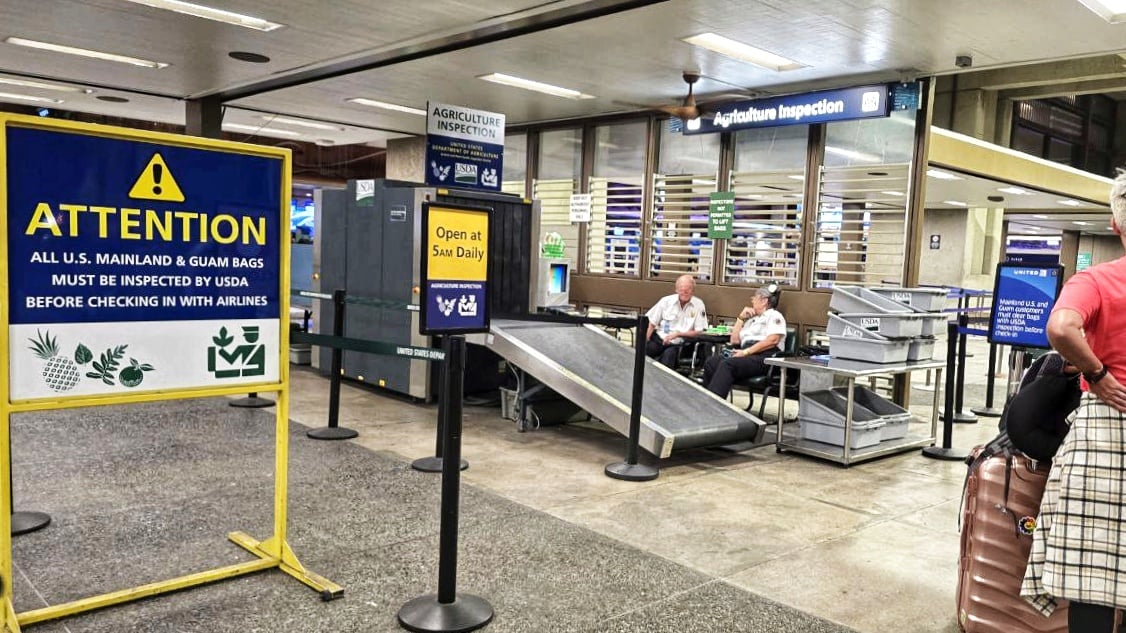
A BOH reader named Dick asked a simple question this week: can you take prepared meals home from Hawaii? The answer surprised some commenters. Flying to Hawaii is entirely the honor system. Flying from Hawaii is the opposite and every checked bag gets x-rayed by the USDA before you can even check in.
After decades of island flights, we’ve filled out more of those agriculture forms than we can count. But not once has anyone checked our bags arriving in Hawaii from the U.S. mainland. International arrivals in Hawaii go through federal customs, which is a different system entirely. The state depends on honesty to protect itself, while the mainland enforces it to protect everyone else.
To Hawaii: 100% the honor system.
Every visitor flying to the islands completes the Plants and Animals Declaration Form from the Hawaii Department of Agriculture. These days, that’s available digitally, thanks to a pilot program called Akamai Arrival. Rob has used it a lot including recently before a flight from LA to Honolulu and said it was quick and painless. It’s the state’s first step toward making the process more digital, but for now at least, it’s still all on the honor system.
The question is short: are you bringing any plants, produce, animals, or soil? But what happens next is even shorter. Nothing. You hand the form to a flight attendant during the flight and before walking off the plane, and head for the beach.
There’s no inspection, no scanner, no agent waiting at baggage claim. You could walk in with a mango in your backpack and no one would know, unless you admit it. That’s the system. It works because most people care enough to follow it.
Hawaii’s system depends on traveler integrity. The state doesn’t have the resources to inspect every bag, so it relies on people concerned enough to be truthful. You’re legally responsible for what you declare, but it’s still all trust.
This approach exists because the risk is real. Hawaii’s delicate ecosystem evolved in isolation. A single insect or seed can cause permanent damage. Little fire ants, coqui frogs, and coffee berry borers all arrived from elsewhere and forever changed the islands in not good ways.
Still, day to day, enforcement is almost invisible. Most travelers never hear from the Department of Agriculture unless they declare something unusual. It’s a quiet system built on faith in Hawaii visitors’.
From Hawaii: 100% inspection.
The tone changes completely when you fly home. Every airport in Hawaii has a USDA agricultural inspection station — you’ve probably seen the lines near check-in countless times. You can’t check your bags until they’ve passed through the x-ray scanner, and inspectors will open anything that looks suspicious. The inspectors are federal employees, not state, and they’re serious about keeping pests and plant diseases from reaching the mainland.
This time, you can’t simply walk through. Every checked bag goes through the scanner. If it contains unapproved fruit, plants, or flowers, it will be opened. Inspectors confiscate anything prohibited, and your airline won’t take the bag until it’s cleared.
Carry-ons are also subject to inspection, though it’s handled differently. You’ll usually pass through a USDA checkpoint near your gate, or sometimes at the entrance to Terminal 1 in Honolulu, depending on staffing and flight volume. Just know it’s there and that your hand luggage will also be scanned before boarding.
Fresh pineapples don’t actually require certification tags from the airport shops. Those boxed pineapples with yellow USDA stickers you see near the gates may move through inspection faster, but the tags aren’t mandatory. If you bought fruit from a roadside stand or a store, it may still go through as long as it passes inspection, but it’s not guaranteed.
Other items that sometimes get stopped include plants with soil or anything in shells that could germinate. Leis are almost always fine, though a few made with certain seed pods or plant materials may need inspection. Prepared foods like poke, deli meals, and fresh fish are allowed.
So to answer Dick’s question directly: yes, prepared meals are usually fine. If it’s cooked, sealed, and doesn’t contain whole fresh produce, you can pack it in checked or carry-on bags. It’s the whole fresh stuff that gets stopped. We’ve never had a cut up fruit or vegetable salad stopped or inspected in hundreds of flights.
What you can bring to Hawaii.
Sealed, commercially packaged food is fine. Coffee, nuts, snacks, canned or frozen items all pass without issue. Alcohol follows normal TSA rules, which means bottles go in checked bags only. Medications are allowed if they’re in original containers, and prescriptions should be available for controlled substances.
Normal travel items are all fine. What you can’t bring are agricultural products: fresh fruit, vegetables, soil, or live plants.
Pets are tightly regulated. Dogs and cats can arrive under Hawaii’s “5 Day Or Less” quarantine program if they meet strict pre-arrival requirements, but if they don’t they may face up to 120 days in quarantine. Non-domestic animals and many hybrids require special approval. (For information on other animals, birds, reptiles, rodents etc., contact HDOA’s Animal Quarantine Branch.)
What you can bring from Hawaii.
Commercially packaged foods including macadamia nuts, coffee, and chocolates are all cleared automatically. Fresh pineapples, as mentioned above, in addition to coconuts, are also allowed to leave Hawaii without any special certification. Prepared meals in sealed containers, frozen poi, and packaged cookies are fine.
What won’t make it through are other fresh fruits, potted plants, or any soil-based items. Seeds and nuts that could sprout are often confiscated too. And while shells and sand sometimes slip through, taking sand, rocks or coral may be both illegal and disrespectful.
Why the system makes sense.
It’s easy to think Hawaii’s rules are inconsistent, but they come from two slightly different purposes. The state is trying to keep invasive species out. The federal government is trying to keep them from spreading to crops and forests across the continental U.S., where a single invasive pest could cost billions in agricultural damage.
Hawaii can’t inspect everyone arriving, so it relies on domestic travelers’ integrity. The federal government has the resources to inspect everyone leaving, so it does just that.
It’s a strange two-way dance between trust and enforcement, and it says something about both sides. Hawaii asks visitors to help protect what makes the islands unique. The mainland demands proof before letting anything go.
What this means for travelers.
When flying to Hawaii, fill out the agriculture form either digitally or on paper. Don’t bring plants, produce, or soil. Other food is fine, and you probably never see an inspector.
When flying from Hawaii, expect the USDA line in BOH’s photo at HNL above. Every checked bag must be scanned. Certified pineapples and packaged snacks are fine. Fresh whole produce and some other items will be taken.
The Beat of Hawaii perspective.
After decades of seeing this system from both sides, we’ve come to appreciate the irony. Hawaii depends on trust. The mainland depends on compliance. It works, mostly because travelers care about keeping the islands safe.
We’d bet most of you have a story, whether about the fruit, the flowers, or the souvenir that almost didn’t make it home. Have you ever had something taken at a Hawaii airport, or brought something you weren’t sure about? We have, and we’d love to hear your story.
Get Breaking Hawaii Travel News



I’ve seen the Border inspections on You Tube done by Australia. They have people arriving for all sorts of reasons and many from South East Asia, Canada, New Zealand, UK and the US. They are so strict, not allowing any food items, drugs, plants, etc. They go by the agriculture and. Drug declaration form in many languages. Apparently, many people from Asia never check off the “Yes” column and therefore are bringing in illegal foods, plants, that could cause agricultural problems or selling drugs in Australia. I was amazed at the number of drugs that are hidden cleverly in luggage, shoes, bodies, etc. It seems many people get away with bringing illegal items into Hawaii. Yes, we’ve made it easy for the visitors to fill out the agriculture form, but that does not protect our Aina. That really bothers me.
Aloha from Daniel K Inouye International AirPort. Mahalo for your informative article concerning Agriculture Inspection for outbound domestic travelers. I am a USDA Inspector and encounter many passengers on a daily basis unknowingly bringing fresh fruit or vegetables. Many don’t understand why we confiscate their contraband. Some become argumentative and confrontational, but it is our job to make sure Hawaii’s pests or diseases stay here. On another note, some cut fruits are allowed provided it is for personal consumption and under 12 ounces. Cut mangoes or papaya will be confiscated. Mahalo, your friendly USDA Inspector
Tomato seeds, Cucumber seeds, Hamburger bun seeds, salad poppy seed dressing, zuchinni seeds, all from fast food restaurants after inspection stations. California has agriculture inspection stations along highways just after entering the state so people don’t wreck their orange, lemon, olive, and grape crops. The more Hawaii depends on California tourism the more stringent the inspections will become. Does that mean fast food establishments at the Hawaii airports don’t apply? Can’t seeds in food containers still sprout after hitting some landfill in California?
Hawaii inspections inspect for agriculture stuff before you get to the food courts etc. But what about the hamburger with lettuce, tomato,pickles, and or tofu burger bought at Burger King just before boarding an airline? Prove the vegetables in any food court or any chinese restaurant are really cooked well enough to pass inspection requirements. Who knows a ant in the salad or roach or just some egg manifestation. Covered or not it’s still there.
You state in the items you can bring in to Hawai’i that “Medications are allowed if they’re in original containers” !!
I have a 14 day medicine plastic unit I use for my medications on a daily basis. I fly different places with the US and internationally, never has anyone said oh, you can’t bring that in because each pill is not in a prescription bottle!
So what is the rule? Do I now need to take all the different prescriptions that I take and put them back in to prescription bottles (and that will be a trick as I throw the prescription bottles out once emptied but my 14 day supply has all those pills in it) to be allowed to land in Hawai’i??
Guessing if Yes too bad, I’ll have to try to get a appt with my Dr. to now get all new prescriptions sent to me (even though I’m not due for a refill for another 90 days) just to have prescription bottles for all of them.
This makes me wonder about coming to Hawai’i. Maybe go somewhere else for vacation.
This is the guidance anytime you are travelling anywhere – not specific to Hawaii. How else are they to ensure that you are not carrying drugs not prescribed to you? This is a precautionary thing. I am sure they are not going to haggle with some senior citizen travelling with their daily pills just for fun. But the rules are the rules – so if anything were to come up, they would be right to confiscate.
I live in Hawaii and travel internationally with my prescription pills and supplements in small travel containers, with no problem. No problem leaving, no problem when returning. I do carry the prescription sticker for my one medication that comes in individual dose sealed packets of powder, but have never been asked about it. It has been a long time since I traveled to Australia, though, so, if they are as strict as they were many years ago, I might be carrying bigger bottles…
Confiscate. Send back to some retailer and confiscate again. An endless system that enables Hawaii to charge multiple customers for the same item when nobody ever obtains the item. Laughable just Laughable. Hawaii IMO is just turning into one big circus act.
I think you misread. It is the feds who are confiscating, not the State of Hawaii. Items that are confiscated are disposed of.
Other non-US locations have much more strict incoming agricultural enforcement than Hawaii! Flying into New Zealand, I was shocked to have my Peking Royal Jelly medicinal vials confiscated. (It’s a natural product created by Queen bees.) Fortunately, this was something that New Zealand also produces, and I quickly found a honey farm to replace my supplies.
Years ago I was bringing Hawaiian jam back to Sacramento and it was called a liquid and had to be thrown away. I have learned my lesson,
One word on this logic. Dumb. Why? Because if I leave Utah with a bag full of bugs and land in California, I can unleash the same crop disaster they’re trying to prevent with Hawai’i. But wait, inbound you’re ok to wreck Hawai’i but outbound from Hawai’i creates some sort of panic to the mainland that already exists just potentially a state or two, or three away. Again, dumb. Oh and scanning outbound when heading to neighbor island? Why.
There is no scanning when island hopping. Just flights bound for the mainland.
The different islands have different invasive species and a bit different economies (economic plants – hort/ag)
Was bringing my Auntie fresh cherry tomatoes from my garden, declared them. On landing had to go find the inspection station and then an agent. We discussed where I got them, shared a couple and off I went. Going home I had 20 pounds of poi in my carryon. I laughed looked like bricks of c4. Went through inspection without even opening my bag. The people behind me however had a beautiful papaya…so we ate it then and there. I also bring from my Auntie homemade mango chutney in freezer bags…just can’t have the seed.
Actually you can also bring turmeric, ginger and taro to the mainland, as long as it is super clean, no soil.
Flying out of Kona, the checked bags are x-rayed after being checked. Until about two years ago, you went through the ag inspection before the airline baggage check but that has changed. You head straight to baggage check and the rest is done behind the scenes.
There was a lady in front of us who insisted that she wasn’t bringing fish. It was sushi; not fish. The poor guy at the station tried to explain it several times to her. We finally switched lines.
So, your reporting left out important elements that could help readers know their responsibility. While it is an honor system inbound to HI, it is also a legal requirement to complete the declaration. Failing to do so can be considered a misdemeanor violation, and they do have roving canine patrols that sniff around in baggage claim for flights arriving from US Mainland.
My aunt & uncle got stopped bringing in oranges & grapefruit from their trees from Florida. My husband waltzed through HNL with a cooler full of fresh, live Maine lobsters & softshell crabs. Go figure.
It drives me crazy that I have to wait in line at 3 separate inspection stations on my way to the mainland. You’d think there’d be a more efficient system.
Dangerous pests rarely if ever come from passenger luggage. They come in freight containers or inter-island barges. That said, passenger bags are a huge point of entry for illegal and dangerous drugs like meth and fentanyl. For those reasons alone, bags should be screened on arrival. Catching organic matter would be a secondary benefit.
I almost always taken avocado through TSA when traveling from the Lihue to the mainland, then mash it up into guacamole before going through agricultural inspection. It creates a nice snack for the flight and has always passed inspection.
First explanation I’ve heard in 35 years of flying in and out!
So TSA says you can bring apples to Hawaii. I had a bag of apples from Costco, which I declared. Hawaii confiscated them upon arrival which I thought was wrong based on what I read. Are you saying the state has a different set of rules as to what can come in? If so, where do we find that list?
Thanks!
TSA and Agriculture Inspections are totally separate and different. TSA rules are universal no matter what state you are flying into/out of. Ag inspections and rules are specific to into/out of Hawaii. TSA doesn’t care if you fly with apples. Ag inspectors may!
A little late to the party, but the first time I ever came to the islands I was diligent about not bringing anything in that wouldn’t be allowed. I was shocked that there was no inspections like you’d find in Australia or New Zealand. Before I left I picked up 2 papayas from a roadside stand to bring home. I was directed through the USDA checkpoint at KOA with no explanation or clue as to what the heck was going on. The inspector was very rude and condescending when she took my fruit, especially because I questioned what exactly this was about as I had never considered the fact that bringing things back to the mainland wouldn’t be allowed, particularly as my flight was direct to Alaska in the dead of winter and no insect would survive the second they opened the cargo hatch. Inspecting all bags arriving to the tiny unique ecosystems that is each of the Hawaiian islands makes perfect sense and it’s a joke that this is not done, and that it is instead done the other way.