
Most first-time Hawaii visitors do not know there is another airport checkpoint waiting before the flight home. No one may have thought about what was in their luggage and carry-on bags at the airport. But leaving Hawaii is where a surprise inspection happens: here’s what gets taken, what sails through, and why so many new-to-Hawaii travelers only learn the rule in line.
A reader named Justin did everything right before his first trip to Hawaii. He checked what he could bring, avoided anything questionable, and figured Hawaii would inspect him on arrival the way, say, Australia or New Zealand do.
It went the other way. He filled out a Hawaii arrival document, but no one checked anything when he landed. On departure at Kona, he had no idea the inspection was even part of leaving Hawaii.
“The first time I ever came to the islands I was diligent about not bringing anything in… I was shocked there were no inspections like you’d find in Australia or New Zealand. Before I left I picked up two papayas from a roadside stand… I was directed through the USDA checkpoint at KOA with no explanation. The inspector was rude and condescending when she took my fruit.” — Justin.
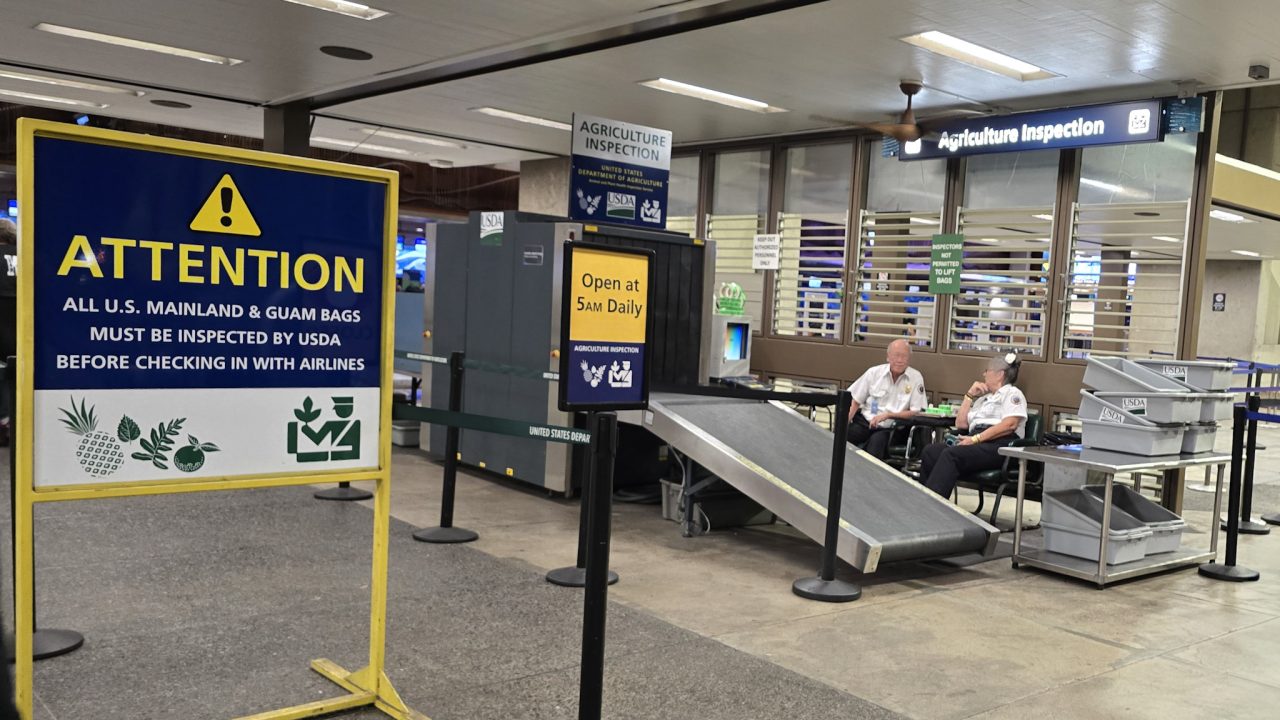
We covered the full system last fall in “Why Hawaii Trusts You Coming In But Checks Everything Going Out.” The comments then showed us something a rules explainer cannot. Even longtime travelers often do not know where TSA security ends, where Hawaii’s own agriculture check on arrival fits in, where the federal USDA inspection on the way out takes over, and why the only checkpoint they really notice is that last one, which comes after the vacation is already over.
Arriving felt like nothing, and that is the trap.
For many first-time visitors, the odd part starts before the plane even lands. They are told Hawaii has strict agricultural rules, and that part is true. The islands are vulnerable to pests, plant diseases, seeds, insects, soil, and all the other small things that can turn into very large problems once they get loose here in Hawaii.
So visitors can expect a visible inspection upon arrival. They think someone will check bags, ask questions, or at least make the process feel serious. Instead, most domestic arrivals from the mainland complete the agriculture declaration, get off the plane, collect luggage, and start vacationing.
That does not mean the agriculture form is optional. It is a legal declaration, and false information can carry consequences. Inspectors are also, at least in theory, present in baggage claim areas for declared agricultural items, so travelers who disclose something can be sent for review.
So on paper, Hawaii has rules. In practice, most arrivals are self-reported, which is where visitors get confused. If you were worried enough to check what you packed before the trip, walking in with no inspection at all feels less like being trusted and more like nobody is guarding the entry point.
The line on the way home is where this gets real.
Leaving Hawaii feels nothing like arriving. The USDA station is real, and for most visitors, it is their first direct contact with agricultural enforcement during the whole trip. Checked bags get screened before being deposited with the airline. Then carry-on bags get checked, prohibited items get flagged, and fruit or flowers bought casually can disappear at the airport.
That is what happened to Justin. He bought two papayas before flying home from Kona and had no idea they would be a problem. His flight was direct to Alaska in winter, and the idea that a tropical pest would survive the cargo hold and the cold seemed absurd to him.
Travelers’ logic and federal logic are not the same thing. The rules do not change based on whether the destination feels cold enough, or whether the passenger thinks the fruit is harmless. They are well-established and built around what can and cannot travel from Hawaii to the mainland.
A reader who said he’s an inspector at HNL told us what actually gets taken.
One comment came from a reader named Keoni, who said he works as a USDA inspector at Honolulu. We cannot verify that, so we are treating him as a reader who told us what he sees rather than as an official source. Either way, what he described sounded exactly like what travelers run into at the airport every day.
Keoni said he encounters passengers daily who unknowingly bring fresh fruit or vegetables to the checkpoint. Many do not understand why the items are being taken, and some even become argumentative. Anyone who has stood near those stations has probably seen some version of that discussion unfold.
Most visitors do not learn exactly how this works until it impacts them. You buy fruit legally in Hawaii, pack it with care, and figure you are fine. One catch is that where you bought it can determine whether it travels or is confiscated, and the USDA airport line is usually where it first gets sorted out.
The rule that surprises people most is the one about cut fruit.
Keoni also raised a question about cut fruit, saying some cut fruit may be allowed for personal consumption in about 12 ounces, while cut mango or papaya would still be taken. We do not find the 12-ounce rule anywhere in the USDA guidance, which works item by item rather than by weight, so treat it as one person’s reading and not official policy. From personal experience, we’ve regularly carried cut fruit salads and have never had them questioned by USDA. What it does show is how quickly this turns into a case-by-case guessing game, as seen in travelers asking real questions.
Fresh whole fruit is easy to understand, even when visitors do not like the answer. Papayas, mangoes, and many other fresh items are exactly the kind of thing people should assume may not travel home with them from Hawaii. The more confusing situations involve prepared food, cut fruit, salads, poke, poi, and leftovers that do not seem to fit neatly into the rules.
That confusion ran through the whole comment thread. One reader declared Costco apples on arrival, had them taken anyway, and asked flat out where the inbound prohibited list even lives. Another wrote about traveling with poi. Someone else mentioned mango chutney without the seed, while another said he turns avocado into guacamole before inspection.
None of those readers were gaming anything. They were trying to understand a system they only half get. They know TSA has its rules about food and liquids. They do not know agriculture has a separate set, and that the two do not care about the same things.
So a jar of jam or liquid guacamole may become a TSA liquid problem, while a papaya becomes a USDA problem. To the traveler, it is all just food in a bag getting inspected. To the airport, it can be security and agriculture, and even potentially customs or airline policy, depending on the item and the specifics of travel.
Coming in is not as wide open as the law says.
Several readers pushed back on the idea that Hawaii simply trusts everyone arriving, and they were right. The law is stronger than the experience feels. Domestic travelers are required to complete the agriculture declaration, and inspectors are available for items that are declared or flagged.
The rules exist. They just do not look like what visitors picture when they imagine a fragile island protecting itself. There is no universal domestic baggage x-ray line on arrival, unlike what travelers see before leaving Hawaii for the mainland.
That is what Justin reacted to. He expected the fragile island ecosystem to be protected on the way in, not mainly policed on the way out. He had already done the careful thing before arrival, then watched the serious inspection happen only when he was trying to leave.
It is why readers kept bringing up Australia and New Zealand. For years, those places have trained travelers to expect a visible inspection. We have been through plenty of those ourselves, with food sometimes confiscated but more often just checked, and inspectors even carefully cleaning the soil off our shoes. Hawaii runs it the other way, with a legal declaration on arrival and a far more visible federal inspection on departure.
Why so many visitors say the whole thing is backward.
The strongest reaction was not about papayas at all. It was about whether the whole pattern makes sense. One reader called the inbound-honor, outbound-enforcement setup dumb, and that one word speaks for more people than would put it that bluntly.
Another reader argued that dangerous pests rarely arrive in passenger luggage and are more likely to arrive via freight, cargo containers, nursery stock, or interisland movement. He said bags should be screened on arrival for other reasons too, including illegal drugs, with agricultural material as a secondary benefit.
That argument is not going away, because both sides are pointing to something. Hawaii’s ecosystem is fragile, so visitors expect to see “the gate” at entry. The mainland has agricultural interests to protect too, so the federal departure screening exists for good reason.
Readers also corrected another common misunderstanding that appeared in the comments. There is no routine agricultural inspection when simply island hopping. The outbound USDA process is tied to flights leaving Hawaii for the mainland, not to a normal Honolulu-to-Lihue or Maui-to-Kona flight. The only exception is flying Southwest interisland through Honolulu. This is because their flights do not use the interisland terminal, so USDA inspection rules apply.
What to pack and what not to leave so you’re not the one holding up the line.
The safest Hawaii food souvenirs are obviously the boring ones. Packaged coffee, macadamia nuts, chocolates, cookies, sealed snacks, and the like move create no drama. If it looks packaged to travel, it will.
Fresh produce is different. If you buy fruit from a stand, market, farm, or grocery store on your last day, do not assume it can go home just because it was easy to buy. Check the USDA rules yourself before packing it, and do not wait until the airport line to find out whether your item is allowed.
Prepared food is still something you have to think about. A sealed meal, a packaged snack, frozen poi, or cooked food is usually fine, while fresh fruit, seeds, plant material, or anything with soil can turn into trouble. Flowers are 50/50. Many will get through on careful inspection while others will not.
The best advice is the simplest. Eat the mangoes and papayas in Hawaii, buy coffee to take home, and do not count on USDA airport staff to turn a confusing rule into a pleasant conversation you’ll want to remember.
What surprised you most on your first flight home from Hawaii, and did anyone warn you about the inspection before you got to the airport?
Get Breaking Hawaii Travel News




We renewed out marriage vows on Maui and wanted to send some stuff back home via USPS. Amongst the items we sent were some Aloha shirts, trinkets from Hilo Hatti and our Leis which were made with Mock Orange parts… We sent that package as normal and when we arrived home, we opened the package and found that it had been opened and inspected and the keys were removed… Oh well…
I completely disagree with your statement that the law is stronger than the experience feels. It feels ridiculous, and it is ridiculous. The in-bound agricultural declaration is simply not enforced. I live in Hawaii and fly back and forth to the mainland about once every other month. I have not completed the declaration in many years. That being said, I do not bring in any item that is prohibited.
Several times, I have been waiting for my Hawaii-bound flight to take off and heard a flight attendant urge people to complete the declaration, stating that the plane will not be allowed to leave the gate until everyone has completed it. That is a flat-out lie, and it amazes me every time I hear the announcement.
I was most mad about a store bought apple- with sticker from Washington- and a sealed container or cherry tomatoes, both taken from me. Both have already passed USDA inspection to get to Hawaii. I’m diabetic, very, very little of the food available in airports is diabetic friendly.
Then to have the person seated next to me have a “snacklebox” with cherry tomatoes in it that was waved through? So mad.
“The outbound USDA process is tied to flights leaving Hawaii for the mainland, not to a normal Honolulu-to-Lihue or Maui-to-Kona flight.”
Not quite correct. I once flew to Maui from Honolulu out of Hawaiian Airlines (at that time) ‘overseas’ terminal. We were flying on a bigger plane that I’m guessing doesn’t fit at their neighbor islands gates at HNL.
We were subject to USDA inspections because we were using that particular terminals and USDA is stationed there.
The USDA is always a joke. When I was going back to college of course I was taking fireworks back to school after vacation.
Luckily I had a few firecrackers in my coat pocket that was never searched. Ah, youth.
Another time I was departing to the mainland and they had this ugly handmade sign….that read “yes, again”. People were being searched twice. I just got an ugly stare when I asked about this ridiculous process. That was normal.
1. They are federal employees. 2. They work at HNL.
There ya go.folks! (at least they have better signs now).
Aloha.
Also illogical – travellers to Canada don’t get screened. Vancouver is biologically adjacent to USA.
My biggest surprise traveling back and forth often from the mainland is the fact that frozen sugar cane juice is not allowed to be in checked bags leaving Hawaii. I’ve freeze-packed many items that are allowed, so I was a little confused and surprised to find Sugarcane juice on the restricted list – even frozen. The other item I found to be odd was a semi-portable near infrared light therapy sauna made of cloth and wood. It shipped from Michigan to Kauai and when taking it back to the mainland, the USDA questioned the unopened boxes and wood that was inside. All the wood was finished quality. I’ve brought back bamboo poles to use to hang artwork purchased in Hawaii with no issues, but an unopened box shipped from Michigan is suspect. They finally allowed it, but not prior to questioning why I would being doing so.
Taking plants from Hawaii all depends on how it is packed at the “in airport” inspection. A potted plant can’t go through and will be taken, but if you take it out of the pot, roll it tightly in paper, it will pass through without issue or question. Other than the pot the plant is in, there is no difference. I wouldn’t do this with a large plant, but a plant that is one quart or smaller will go through. So where is the real inspection and rules as to what is and what isn’t allowed and consistent education and enforcement?
The agriculture checkpoints are odd. You’re required by law to fill out the form on line before arriving in Hawaii. There is no verification as to whether you filled it out or not, there is no inspection of luggage or carry-on luggage for plants, fruit, vegetables, etc. So it is basically a joke. The inspection process for leaving Hawaii is only limitedly better. You have to have “checked” luggage scanned before giving it to the agents at the counter. Your carry on luggage is checked at a secondary screening that comes after the TSA check and be your gate. That inspection site is useless and inconsistent. On one trip our forgotten banana when through, on another trip the banana was tossed by the agent. What is confusing is pineapple is OK regardless of whether you by it at the airport, or from a farmers market or fruit stand. So what is and what isn’t needs to be more clearly defined and given to people upon arrival.
Mainland in Canadian friends love our Hawaiian coffee. Buy whole bean because ground coffee can be confiscated if it exceeds the volume of a 12 ounce can of Coke, the maximum amount of “powder” you can bring in a carry-on bag. And then there’s the whole pineapples you can buy in a box at the airport can you bring a pineapple from a family farm? I don’t know.
Interesting on the terminal designations. As someone who’s traveled the most through Lihue and Kona, that’s a surprise. There are no “inter-island” terminals, just specific gates that they do inspections or not based on the next departure.
Yup, I learned my lesson many years ago when packing store bought sealed salsa bottles in my carry-on. It was very disappointing to watch them take the 2 bottles away from me. They didn’t even look at me just took them and moved on. My last thought was, I hope they give them to someone in need.
I’m surprised you didn’t mention that pineapples are the only fruit that can be taken without question.
At least on Alaska and Hawaiian, for any flight leaving Hawaii – you may ship one box of properly packed box of pineapples for FREE!
No Titanium status needed…lol
(Does not apply to code share flights)
Costco seems to offer the lowest prices for pineapples as compared to Dole and The Pineapple Store, etc.
My husband and I have been to Hawaii a few times and followed all the rules and on our 50th wedding anniversary, coming home the TSA took our colored sand heart which mixed my children’s sand and ours together, unsealed and opened it and messed it all up so you could not even see the sand design. He did not explain or apologize and was very rude and ignored me when I asked him not to shake it up. I was very upset. So if u have a sand art don’t expect to bring it home as sand art.