
Two visitors were rescued from the Waipoo Falls Trail just this week. On Sunday, Kauai Fire Department crews short-hauled a 47-year-old California woman with a leg injury to nearby Porter’s Landing Zone after she could not hike out. On Wednesday, they were back on the same trail for a 53-year-old visitor with an ankle injury, lifted out by aerial rescue vest and flown to the NASA landing zone, then on to the Waimea Canyon Baseball Park landing zone for transfer to AMR medics. Both calls came in late morning, only days apart.
We were sorry to read both, but not shocked. Waipoo Falls is one of our favorite hikes on Kauai, and it is also one where we have too often watched people fall, including friends.
This is not new. We wrote last summer about the run of rescues on the Waipoo Falls Trail and the growing fight over who should pay when they pile up.
This is not a warning to stay away from Waipoo Falls and in fact we take people out there with us who are visiting. It is, however, a guide to doing one of Kauai’s most rewarding hikes without becoming the next person who needs help getting out.
Before the trail, there is the road.
Anyone planning to visit Waimea Canyon and Kokee this summer needs to know that Waimea Canyon Drive is not operating normally. HDOT says the road is closed between Maule Road and Kokee Road on weekdays from 8 a.m. to 11:30 p.m. for full-depth reconstruction and resurfacing.
The closure began June 22 and is anticipated to continue through August 17, weather permitting. The road is open at night, on weekends, and on holidays, but on weekdays, the detour to reach Kokee State Park is Kokee Road through Kekaha.
We covered the winter phase of this same road project in January, when Waimea Canyon Drive closures first started reshaping how visitors reached the canyon.
The detour works, but it is not always effortless. HDOT’s weekly roadwork notices also list single-lane work on Kokee Road near Huakai Road, so the alternate route may experience its own delays and alternating traffic.
For visitors, the practical advice is simple. Go on a weekend for the classic Waimea Canyon Drive experience, or get up early enough to be past the closure by 8 a.m. on a weekday. Otherwise, use Kokee Road and build in extra time before you even think about the trail.
Why Waipoo Falls fools people.
Waipoo Falls does not announce itself as a serious hike on Kauai. It is famous, scenic, relatively approachable, and close to one of the island’s most photographed areas.
That combination is exactly how people get caught. The trail offers canyon views, red dirt, open sky, and the sense that you are doing something big without committing to an all-day backcountry hike.
The distance here isn’t the problem. The footing is.
People arrive wearing shoes that were fine for walking around Hanalei or through a resort, only to find themselves stepping across rocks, uneven dirt, and exposed ground. We’ve seen plenty of flip-flops and even women wearing high heels. Waipoo does not get difficult everywhere, which is why the difficult places often surprise people.
The first two trouble spots are at the beginning and the halfway mark.
To reach the trailhead after milepost 14, you’ll walk down a dirt road to the trailhead, which is a mile away. If you have a 4-wheel drive, you can ride down and park. Another option is to hike down to the trailhead from the Puu Hinahina lookout.
The first place we watch people struggle is at the beginning of the trail. There’s a steep elevation drop, and because of the shade cover, this part of the trail is often muddy. I once hiked in the rain, and my foot was sliding in the mud with each step down. It’s best to hike during dry weather. Once you get through that first part, it gets better and easier.
But then you reach another elevation drop and have to navigate around boulders. This is the second place we see people struggle. It arrives before many hikers are fully paying attention, which is part of what makes it so good at finding the wrong shoes, the wrong step, or the person moving too quickly.
This is not where most visitors expect trouble. Some hikers move too casually over the rock that asks for more care.
The section is not technical in a mountaineering sense. It simply breaks the rhythm of an easy path and forces you to place your feet deliberately. A smooth resort sneaker, a worn sole, or a quick sideways step can turn a pretty morning into an ankle or knee problem before the hike has really begun.
After rain, the same stretch changes fast. Rock and red dirt that felt manageable when dry can become slick enough that one careless plant is all it takes. This is where we slow down, even if everyone else is still rushing forward.
As you near the end, the trail rises again, and then you emerge on a plateau in the middle of the canyon. It’s spectacular. We usually stop there. To continue down has risks, and we’ve seen people fall. It’s the third spot to watch for.
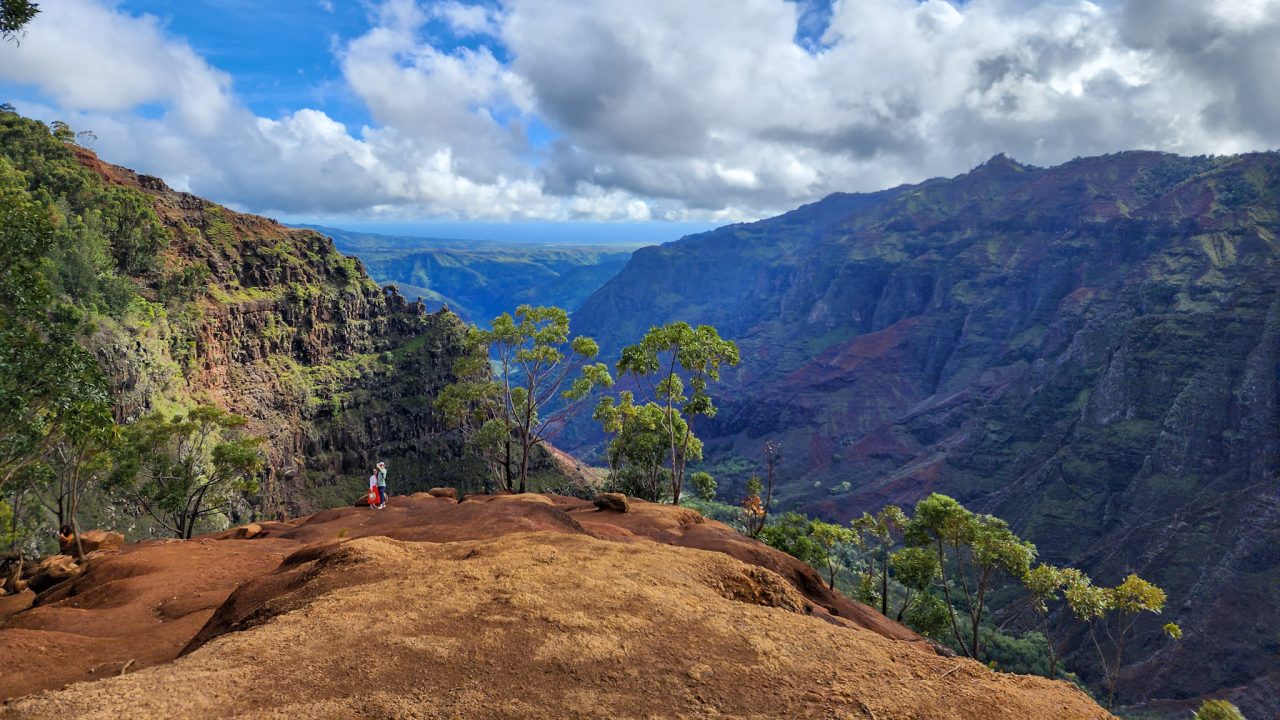
The third trouble spot is our lead photo.
This is hiking down from the top of the plateau to the waterfall. It does not look like the obvious danger zone. By then, hikers have settled into the trail, the views are opening up, and the end feels close enough that attention starts drifting toward photos, conversation, and the payoff.
But the footing there can be loose, the ground can tilt, and the exposure changes the consequence of a slip. A stumble that might be annoying on a flat forest path feels different when there is an open canyon around you.
People relax there at exactly the wrong time. They are no longer at the beginning, so they are not mentally bracing for the trail to catch them off guard. They are not quite at the end, either, so they start walking like the hard part is already over.
Those who make it will view the first of two tiers of Waipoo. It begins as a small waterfall, 25 feet high, with a swimming area. The second tier is the 800-foot Waipoo Falls, Kauai’s tallest waterfall. You’ll stand above it but will be unable to see it from your vantage point.
How to hike it and walk out safely.
We are not telling anyone to skip Waipoo Falls. We would not write this if we did not love the trail, and we would still send the right visitor there on the right day.
Start with real shoes. That means tread, grip, and support, not flat-bottomed sneakers with polished soles, not sandals, and not anything you would hesitate to get dirty.
If it has rained recently, assume the rocky start and exposed canyon section will be worse than they look. Kauai’s red dirt and wet rock have a way of turning casual footing into a problem before you realize the trail has changed.
Slow down twice on purpose. Slow down near the beginning, where the boulder section interrupts the easy rhythm, and slow down again near the end, where the canyon exposure can make a small slip more serious.
Keep your phone away while your feet decide where to land. Waimea Canyon is beautiful enough to make everyone reach for a photo, but the best photo is not worth taking while you are stepping across uneven rock or loose dirt.
Turn around if conditions are bad. The waterfall will still be there another day, and people who live here learn to save a trail for better footing rather than force it on the wrong morning.
Waipoo Falls is still worth doing. It is one of those Kauai hikes that gives back far more than its distance suggests, and on the right day, with the right shoes and the right pace, it can be unforgettable in the best way.
Just do not let the beauty fool you into treating it like a sidewalk. This trail has three places where people get hurt, and knowing them before you go may be the difference between walking back to the car and leaving under a helicopter.
Have you hiked Waipoo Falls? Did the muddy start, the boulder scramble, or the steep drop to the falls feel sketchy to you? Tell us in the comments.
Lead Photo Credit: © Beat of Hawaii at Waipoo Falls Trail on Kauai.
By Rob and Jeff, Beat of Hawaii.
Some of the most meaningful parts of Hawaii are the ones visitors walk right past without knowing they are there. We’ve spent nearly 20 years finding them firsthand for BOH as full-time Hawaii residents reporting on travel, culture, and island life, and telling you what they mean for your trip. Join us →
Get Breaking Hawaii Travel News




The trail is slippery whether wet or dry! We went yesterday as we are staying in a cabin in the State Park. If it’s wet, it’s muddy and slippery. If it’s dry, especially from the plateau to the falls, the dry, loose red dirt is very slippery. Coming out, we past hikers in flip flops and many small children! Love it, but be forewarned!