
Flying Food Group, which currently provides inflight meals for Hawaiian Airlines at Los Angeles International Airport, is facing a new Cal/OSHA complaint alleging mold, vermin and other unsanitary conditions in its food-handling areas. We’ll get to a bit of the specifics below, but the short version is enough to make an old Hawaii flight habit feel timely once again.
We’ve been bringing our own food on Hawaii flights for nearly a decade. Not because we thought airline meals were dangerous, and not because of anything that happened this week, but because years of flying back and forth across the Pacific taught us not to depend on airline catering for the meal, timing, or quality we actually wanted.
Years ago, we stopped depending on Hawaii airline meals.
Longtime Beat of Hawaii readers may remember that our habit of bringing food aboard predates this controversy by years. We were already writing about living well at 30,000 feet nearly a decade ago, then later about how to skip the mystery meat and eat gourmet on Hawaii flights by bringing something aboard that we would actually look forward to eating.
We’ve also explained why we pack our own food on every Hawaii flight now. The habit developed gradually through years of Hawaii flying, good meals mixed with entirely forgettable ones, uneven service and the occasional catering debacle.
We have had airline meals to Hawaii that were fresh, thoughtful and genuinely enjoyable. But we’ve had plenty more that were oddly portioned, mistimed or simply not what we wanted after several hours in the air.
Then there are failures that have nothing to do with taste. In October 2025, we wrote about a United Polaris flight from Papeete to San Francisco where, as passengers, we went through the first three hours without any expected food service.
Point is, once you are over the Pacific, there is no backup food around the corner. And on a longer Hawaii flight of five, six or even ten hours, we would rather not make hunger dependent on which version of airline catering shows up that day.
Flying Food Group put airline catering back in the dismal spotlight.
Flying Food Group currently caters Hawaiian Airlines at LAX, the only U.S. carrier among 15 airlines the union says it serves there, alongside international carriers such as Air France, Lufthansa and ANA. The relationship dates back to at least 2010 and continues today under the combined Alaska-Hawaiian operation.
A 16-page complaint filed August 5 with California’s Division of Occupational Safety and Health names two of Flying Food Group’s LAX-area facilities, not confirmed as the specific site preparing Hawaiian’s meals.
The most striking account comes from the worker who says she found decomposing food, mold and apparent maggots and flies inside an airline dish cart and was told to wash the dishes because they were needed for another flight.
The catering facilities had already drawn Cal/OSHA scrutiny before the most recent complaint, including prior citations this year with proposed penalties totaling $74,000. Cal/OSHA polices workplace safety rather than passenger food safety, so those citations do not establish that unsafe food reached an aircraft.
For us, the significance is much simpler. Airline catering is a complicated chain that passengers rarely see, and once the aircraft door closes, whatever was loaded is what you have. And as they say, you are what you eat.
We would rather control the meal ourselves.
Our approach is straightforward: bring food that travels well, that we actually want to eat and that will still be appealing several hours after leaving home or the hotel.
Good sandwiches, wraps, salads packed to travel, fresh fruit (never whole leaving Hawaii), nuts and snacks can all work. We have also brought genuinely excellent food aboard rather than treating the airport concourse as the last opportunity to grab whatever happens to be available.
There are practical limits. Liquids still have to comply with TSA, highly perishable foods need proper handling, and nobody seated nearby will thank you for bringing something that announces itself from three rows away.
The payoff is control. You decide what to eat, how much to bring and when to eat it, while a delayed meal service, missing catering cart or disappointing menu becomes far less consequential.
If the airline meal turns out to be great, enjoy it. If not, you already have something you chose yourself.
Nearly 10 years of doing it this way.
Our earliest articles on eating better aboard Hawaii flights were written years before the current Flying Food Group complaint. Since then, self-catering has gone from something we experimented with to one of the routines we now take for granted.
That progression also fits with what we recently described in After Hundreds Of Hawaii Flights, Here Is What We Do Differently. Years of frequent Hawaii flying have made us increasingly selective about which parts of the trip we leave to chance.
Food is one of the easiest parts to control. That was true long before this week’s headlines, and the latest airline catering controversy gave us no reason to hand that control back to the airline.
We’re curious how you handle food on Hawaii flights. Do you rely on the airline meal, bring your own, grab something at the airport—or skip eating altogether? Tell us what works best for you and why.
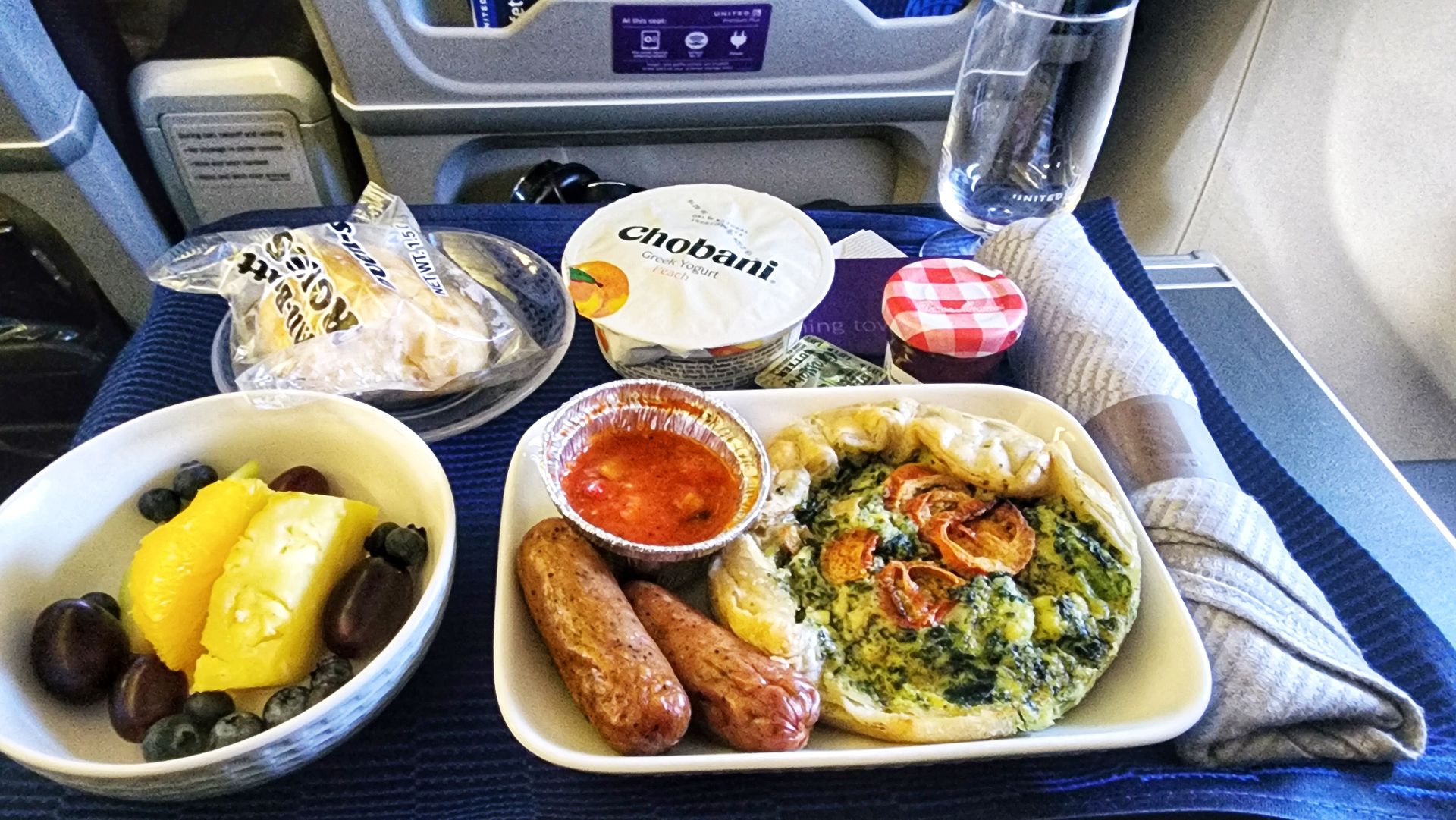
Lead Photo Credit: © Beat of Hawaii – United Airlines Premium Economy Meal.
By Rob and Jeff, Beat of Hawaii.
Some of the most meaningful parts of Hawaii are the ones visitors walk right past without knowing they are there. We’ve spent nearly 20 years finding them firsthand for BOH as full-time Hawaii residents reporting on travel, culture, and island life, and telling you what they mean for your trip. Join us →
Get Breaking Hawaii Travel News


We are like you two. We cater our flights, whether to Hawaii or Japan or Europe, wherever we go. Normally you can look up what each airline will serve on a flight, but we’ve been burned too many times (and we don’t fly That much) where “catering messed up and we don’t have your selection.” So we pack our own, from the appetizers to the fruit sides to the main dish and a little dessert. We even bring table (or tray) clothes to make it civilized. Only drawback is that we never can pack a hot (or even warm) meal because of the lag time from home to first service. If we are in a hurry we will order favorites at the airport (not fast food) and are happy to enjoy that, as well. If they serve a great meal (hardly ever) we save what we brought and eat it before landing. We always use the utensils they provide – one less thing we have to pack. Caveat: Leave room in the carry-on for your dining treats.
why we can’t have better food options at HNL! when I fly HNL-SFO the have better food at SFO and on the Alaskawaiiamerican planes than anything at HNL its really pathetic. No vision
It’s not a question of trust. Its a couple different questions.
1. stomach ?
2.digestion ?
3. next bm ?
That said . I brought home something, Hawaiian / Alaskan whatever, served me a few months ago.
One sniff, both cat and dog ran for cover.
What a terrible waste of food, labor, and money.
I’ve been flying to Hawaii from LAX for over 20 years. The food was okay in the beginning , never enough to eat, but it definitely got worse when they switched to the “Hot pocket” meals. Since the flights are early, I try to pick up McDonalds outside of the airport before my flight. Sometimes, I’ll go to a local donut shop and get something similar. I also eat the Hawaiian Airlines now provided sausage breakfast sandwich. A few times I did get a chance at a sit down restaurant before 9/11 and when my flight was later. But I definitely pass on the “Hot pocket” meal, so I make sure to pick up a Bento before I get on the plane.
Airport food isn’t much better. Mass produced and on shelves where it’s touched, coughed on, and a long way from fresh. I do some jerky or beef sticks, nuts, fruit if I can wash it.
If I eat airline food I go for hot hoping it’s a little more safe. The vegetarian is actually better than non vegetarian.
Historically, a Canadian airline that rhymes with best bet have provided around 9 pretzels in a little foil bag when we pay around $900 USD for a return ticket to Kahalui from Edmonton. Free soft drinks or water are also available. 7.5 hour flight with a layover in Vancouver.
Recently flew Hawaiian first class going to Kauai and cattle section home from Maui. Going over I was not impressed with the selection of breakfast entrees. It appears that the airline was/is trying to be “trendy” with Asian-Pacific cuisine when all I wanted was a basic breakfast. On top of that, I have a green/red pepper allergy that the airline does not allow for. After checking on-line, calling the airline and finally selecting a quiche that was supposedly pepper free, at cruising altitude I found out that it was not pepper free after all. I was ready to go go hungry but the flight attendant was helpful in making something else work.
Coming home, was taken care of by bringing my own snacks and sandwich.
The best part of flying has come down to being lucky enough for the sardine can to get a gate upon arrival, a ground crew to bring out the tunnel and then hopefully, your very own bags, then flea the airport ASAP.
.
We always bring our own nuts, granola bar, sandwiches – whatever suits us at the time. Always bring from home. We used to wait to see “what” was served but as a general rule we ended up eating the packaged cookie provided and of course whatever beverage was provided but our own food ended up being much better and envied by those around us. We’ve been asked — where did you get that? Never depend on airline food. Always freeze a bottle of water the night before to take along because a frozen bottle of water can be taken thru TSA without issue. Besides .. I’m told Hawaiian Airlines will now be charging for meals you can order pre-flight. Not paying more than I already have to for food barely tolerable. Yuck
Family return from summer vacation in Wisconsin Milwaukee Denver Honolulu Hilo. The Trojan effort with a six and eight year-old, seated in the ex-plus 4 seat middle row of the 757 misery craft. The kids meal was unrecognizable; a slice of marble rye smeared with fake butter, a pan of gooey maybe pasta, 3 pieces of lettuce and champagne vinaigrette. Repulsive. The flight attendants and Purser were shocked, a conversation on bended knee took place next to my seat, apologies etc. and 5000 miles compensation as if that’s a good thing. We received two snack boxes. Fir 8 hours the children consumed sugar and junk, long past slightly better bits we over-paid for in the United Denver Lounge. The photo of the “slop” as my grandson described it, resides in the cloud of travel infamy. All agreed the pilots would never feed this to their own child.
I’ve never understood why many people put so much emphasis on being served meals or what type of media they’ll have onboard, if it’s a wide-body or single aisle plane (you’re stuck in your seat so what does it matter). I look at flying as simply a way to get to my destination. I want to arrive safely and at the best price, period. I believe the fun starts when you get there. I’ve always felt this way and that’s why when the airlines began cutting back on everything it didn’t affect me much (other than the seats shrinking).
Didn’t affect you much? The prices went up and you were served less. You didn’t care? That, to me, takes the cake (to maintain the food theme).
Aloha -I have picked up food on the concourse along with nuts and that worked. I thought I’d have a problem with tsa bringing food from home. Getting ready for a trip soon – mahalo