

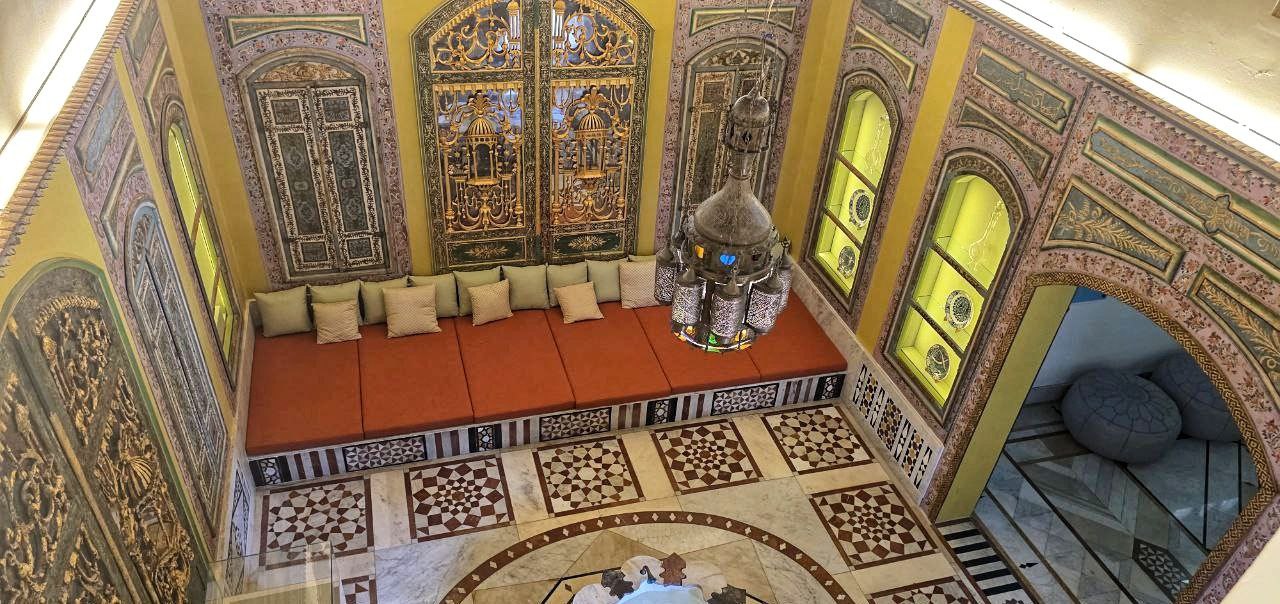
We finally made it back to Shangri La in Honolulu. This is the former home of billionaire heiress Doris Duke, now a public museum of Islamic art, architecture, and design. It sits oceanfront in Kahala, tucked below Diamond Head, and is unlike anything else in Hawaii. It had been nearly 20 years since our last visit, not long after it first opened to the public. The setting remains stunning, but our experience this time was nothing like what we remembered.
The house is still there. The art is still extraordinary. But Doris Duke—the person who built it, lived in it, and gave it meaning—is no longer part of the experience.
What Shangri La was like when it first opened to the public.
In the early 2000s, the tour was led by a docent who was well-versed in Doris Duke’s story. The experience was not just about Islamic art or design. It was about a woman, Doris Duke, with global obsessions, eccentric taste, and enough money to build anything she could imagine, who decided to create this.
The docent shared stories about guests who had visited, how the art was acquired, and what Doris was passionate about. She showed us the interplay between the architecture and the ocean, between Duke’s travels and what she recreated in Honolulu. It felt personal and intimate. The art was fascinating, but the life behind it was what made it memorable.
What it’s like now.
As with past visits, the process begins at the Honolulu Museum of Art. You check in there and board a shuttle bus to Shangri La. The system is designed to limit traffic in the residential neighborhood and continues to run smoothly. Tickets are released four times yearly and sell quickly.
Upon arrival at the house, we received a brief group introduction in the foyer. After that, we were on our own for 90 minutes instead of being guided. There were three docents on the property to answer questions, and each one gave a 15-minute talk for those interested.
It is quieter. It is more open. And it is noticeably emptier in one particular way: Doris Duke is no longer part of the story. Her living room furniture, for example, which had been there before, has been removed. The only part of Doris Duke’s story was a small area in the primary bedroom with photos of her.
They told us why Doris Duke’s story is no longer the focal point.
We asked directly why the narrative had changed. The response was that the Doris Duke Foundation made a decision some years ago to remove personal interpretation from the tour. The reason, we were told, is that she was a very private person, and the foundation felt the experience should reflect that.
That decision has consequences. Today, visitors can see world-class Islamic art in a dramatic oceanfront setting, but with minimal context on how or why it arrived there. None of the art is labeled, so you have no idea what you are seeing.
You walk through a home designed by a tobacco heiress, filled with treasures from the Middle East, India, and North Africa, without being given a single personal anecdote about who lived there or what drove her to collect it.
Why billionaire Doris Duke mattered.
Doris Duke did not just build Shangri La. She lived in it, shaped it, and filled it with people and stories no one today would expect. She inherited a tobacco fortune at the age of 12 and spent her life doing things women of her era were not supposed to do. Duke traveled alone, collected obsessively, surfed, funded jazz musicians, and rejected most social norms.
She began building Shangri La in 1936 after honeymooning through the Middle East and Asia. Duke fell in love with Islamic art and architecture, and rather than bringing back souvenirs, she brought back entire rooms. Her advisors helped her commission hand-carved ceilings, Moroccan tilework, fountains, and textiles from across the Islamic world. The house became her private sanctuary and creative experiment, part museum and part personal retreat.
It was not quiet. Guests included Jackie Kennedy, Elvis Presley, Imelda Marcos, Andy Warhol, and jazz legends like Joe Castro. She surfed with Duke Kahanamoku and reportedly kept a surfboard rack in the backyard. A private chef prepared elaborate meals. Jazz was played live. Rooms were rearranged often. Everything was curated, except the story of her own life, which she preferred to keep private.
There were scandals. She had one daughter who died in infancy. In 1988, at age 75, she adopted a 35‑year‑old woman, Chandi Heffner, whom she believed was the reincarnation of her newborn child. That adoption and subsequent disinheritance led to lawsuits and a legal settlement. Her fortune was enormous. Her motives were not always clear. But Shangri La reflected who she was: brilliant, complex, reclusive, and bold.
Today, none of this is mentioned at the site. Unless you already know it, you would never know it. Today, none of this is mentioned at the site. If you don’t arrive already knowing her story, you won’t learn it there. And without Doris Duke, the house feels like it is missing its reason for existing. Visitors still see the tile, the ocean, the architecture, but they will not know the woman who brought it all together. She is the part we keep thinking about.
What visitors miss now.
Without Doris Duke’s story, Shangri La becomes a gorgeous shell. You can admire the craftsmanship, the views, and the rare objects, but it is difficult to grasp why they are here or what they meant to the person who lived among them.
The Islamic art is important. However, stripped of its personal context, it becomes a catalog of pieces rather than a living collection. The connection between the house, the woman, and the setting is what made it unique.
What you should do before you go.
We still recommend visiting. Shangri La remains one of the most visually spectacular and visitable properties in Hawaii, and the collection is unmatched. But if you want the experience to feel whole, do your homework first.
Watch the Amazon Prime miniseries about Doris Duke or the video below on YouTube. Research her online. Doris Duke was more than a collector. She was the reason this house exists.
If you go in prepared, the experience is still remarkable. But if you go expecting to learn who built it and why, you may walk out with more questions than answers.
Details: Tours are available on Thursdays, Fridays, and Saturdays at 9:00 am, 11:00 am, 1:00 pm, and 3:00 pm. Reservations are required, and tours depart from the Honolulu Museum of Art, where you will catch the shuttle (no exceptions). Tickets are released quarterly on the first Wednesday of September, December, March, and June at 10 am HST. They sell out quickly.
Get Breaking Hawaii Travel News






I assume from the description that the short film is also no longer shown at the museum prior to taking the shuttle to the house. I visited Shangri La about a year after it first opened and found it fascinating and beautiful. The history and the characters and the story of Doris Duke were what made the tour meaningful. One of her servants was still alive and gave a little talk. It’s a shame that any reference to Doris has been removed. She was in some ways controversial, but that only adds to the mystique and the yearning to learn more about her history and the house. Erasing her diminishes the whole point. Sad.
I’ve been to Shangri La many times and took many friends there who loved it. Your description is only partially correct. I think it depends who the docents are at the moment. Most of them are quite knowledgeable about Doris Duke’s life and art pieces in the house, when, why and how she did it, people who were part of her life etc. Some tend to disclose more information than the others, but if you chat with them a bit more they are happy to answer questions. Alright the format has changed over the years you can still learn most of what you’ve heard years ago, either during those few dedicated talks about some of the most important art pieces or in personal one-on-one interactions.
I agree with you that to exclude Doris Duke from the museum does visitors a real disservice. I recently toured it for the second time. I wandered around and admired the beautiful rooms, but I kept wanting to know More – more about the artwork, and more about the architecture. I found the lack of explanatory signage odd. Isn’t the point of a museum to learn?
This makes me sad. I am happy that I toured it 2 different times in the past and was introduced to Doris Duke’s legacy. My previous visits inspired me to read a biography about her fascinating life. The tours were extremely informative about both the art and her history. Very little education will happen just wandering around the home on your own. I’ve always wanted to get back for a 3rd visit, but now don’t feel the urgency with the changes you’ve described. Thank you for informing your readers.
We’ve been coming to Honolulu every year since 2007 except 2008 when condo tower we bought a time share in was being built. Sometimes we come twice a year. I always wanted to see Shangri La and I finally booked tickets (in 2022) for our 2023 visit. It was more impressive than I imagined and the docents were wonderful explaining all the art and how & when Doris bought the items and furnished her stunning home. It made me realize that this was a real home for her. Without that type of information, it would have still been interesting, but nearly as much as it was for us learning about Doris Duke and her life and the items in her home.
We just moved to Honolulu last year and absolutely love it. But, we were absolutely terrified during the tsunami warnings. Just not sure what to expect kept hearing the sirens 🚨 and announcements, but didn’t know to what extent damage would be done. I guess there is not much anyone can do about the wrath of Mother Nature and, next time, we will have a better understanding of the protocols. I am just glad it was not as bad as they had anticipated because to lose the beauty on this island would be detrimental to all. Mahalo Nui Hao.
You must not be very familiar with the history of natural disasters in Hawai’i, otherwise you’d know that this kind of panic is typically mostly unjustified. The odds of a devastating tsunami are lower than the odds of a devastating hurricane and both are fairly low. Everything you experienced is mostly a result of an “abundance of caution” approach and although prudent, no reason for so much fear. Better safe than sorry, for sure. Now you can relax and enjoy your new home while getting used to living with these alerts. After all, people here need some excitement once in a while 🙂
Sad that the foundation turned a ‘living biography’ into a mere ‘display case’. You were fortunate in your early experience to receive more of ‘the whole story’, that put the home and it’s aret more into context. Today, it’s ‘a nice, handsome museum of art’.
Makes me think of the Hearst Castle in California, located on the coast. Created by the wealthy publisher, William Randolph Hearst. An amazing place to visit, now a National Historic Landmark. It’s been about 15 years since I was there but it was ‘out of this world’ beautiful and once again a collection of rooms, buildings and many artifacts collected up throughout Europe shipped to and then rebuild in California. Guides linked it all with stories about the owner and famous guests. I still vividly remember it. It didn’t just happen, it was created by an very unusual person in a similar way to your Doris Duke and that is so much of the story. Thanks for the information!
I went to Shangri La in May when I was in Oahu. I knew nothing about it or her before I went there other than she rich. Recently I have read 2 books on Doris Duke wanting to find out more about her since not much was talked about her when I was there. Shangri La is beautiful and I am so glad I went to see it and it means more now that I know about her and her life.
What a shame, without the background of Doris Duke, the house is as you said, just some persons’ crazy house. I remember my Mom telling me stories about the house and all the goings on there, and no it was not quiet. I’m afraid, the foundation has made a mistake. They would be better off offering recorded headsets, one for those that just want architecture, and one for those that want the details about the house and all about Doris Duke.
Thank you so much for this article. Your perspective on Doris Duke as an inspired woman of her time has such a note of caring and appreciation. I agree with you that the “tour” of Shangri-la has paled in comparison to what it was, just a few years ago. I’ve been there many times and I really miss their guided tours where the docents gave us so much context for all the great art and architectural design. (The last time I had a full guided tour with a docent was right before the pandemic and I was hoping that they would return to full immersion once things got back to normal… apparently not because I’ve been there since then and it was as you described, docents available for questions only) Since they’ve adopted this self guided model, I do wish they would post more information within the rooms themselves. The small pamphlet they provide is minimal. It’s such a beautiful place. Still worthy of a visit…But what a shame that new visitors are now missing so much.
As always, your writing is superb. Your take on this is greatly appreciated. I saw the CBS Sunday morning piece a few years ago and thought it was fascinating. So glad to know I need to prepare myself if I get to go there. The thing I love about history is the stories – the why, the how and mostly the people. So sad they took the person out of it. Thanks so much!