
At $1,000 a night in Hawaii, you’re not just buying a room. You’re paying for the pools, restaurants, grounds, spa, views, atmosphere, and everything else that made you choose that resort in the first place.
But what happens when you arrive to find that part of it is under construction? We’ve had that happen to us twice, and several Hawaii resorts are selling expensive stays during significant work in 2026. What caught our attention this time wasn’t just the construction. It was how differently guests could be told about it depending on where they looked and bought.
We’ve checked in without knowing what was coming.
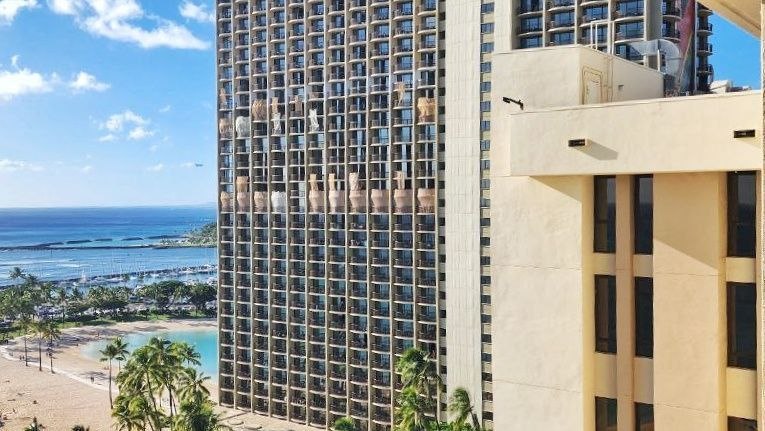
At Hilton Hawaiian Village, we once booked an ocean-view corner room in Rainbow Tower and arrived to find renovation underway both above and below us. The jackhammering became so loud that we couldn’t hear the front desk when we called from our room.
We hadn’t been warned when we booked or during digital check-in. Hilton later acknowledged that we should have been told, but by then we were already living with the work.
This June, we ran into construction again at Outrigger Kauai Beach Resort following its $25 million transformation. We were staying in one of the renovated Signature rooms when nearby jackhammering started, without any warning we’d seen at booking or check-in.
Both stays left us wondering how much information a guest should receive before paying thousands of dollars for a resort experience that may be different by the time they arrive.
A $6,000 Maui stay comes with a construction notice.
Four Seasons Resort Maui at Wailea is refreshing selected accommodations in 2026. Its own booking notice says guests may notice intermittent daytime noise in some areas, lists the renovation dates as July 1 through December 15, and notes that select guestrooms are affected.
We checked September rates and found one date around $800, while most of the dates we looked at started at $1,000 or more. We’re headed to Maui this week and will spend the final part of our trip in Wailea, giving us a chance to see whether the work is barely noticeable or something guests would want to know about before booking.
At Outrigger Waikiki, two booking sites tell different stories.
Outrigger Waikiki Beach Resort is in the middle of a $100 million transformation. Its booking page says modernization work is underway in select public spaces until fall 2026, as it reassures guests that dining, live music, the pool, and Waikiki Beach access remain unchanged.
The resort lists the fitness facilities, front desk, hallways, lobby, and select guestrooms as impacted. The direct rates we checked started at $385 per night, making the disclosure difference relevant even before getting into the resort’s more expensive room categories.
Marriott shows what a useful warning looks like.
Marriott’s Ko Olina Beach Club tells guests that its Nai’a Pool will be closed from September 7 through December 18 while other pools and amenities remain available. Travelers can decide before booking whether losing a particular pool matters to them.
Marriott’s Kauai Beach Club provides even more detail about its own 2026 pool-deck resurfacing. Guests are told to expect reduced seating, relocated food and beverage outlets, temporary closures of whirlpools and adjoining pool areas, possible noise in common areas and villas, and changes to some accessible routes.
That’s considerably more useful than a generic notice that a resort is being renovated. You know what could affect your stay and can make the call yourself.
The Royal Hawaiian is also renovating ahead of its 100th anniversary in 2027. The resort warns guests of intermittent construction noise on weekdays from 9 a.m. to 5 p.m., while restaurants and resort programming remain open.
It pays to check another site even if you’re booking direct.
We went into this research assuming the hotel’s website would usually provide the best information about work taking place on its property. But that wasn’t consistently true.
Sometimes the direct disclosure was excellent, as we found with Marriott. Elsewhere, a third-party site described the affected facilities more clearly for us than the resort’s own pages.
Before booking an expensive Hawaii resort, we’d now check the hotel’s site and at least one major booking site for construction, renovation, and closure notices. It takes a few minutes and may uncover something you’d rather know before the cancellation clock starts running.
Not every construction notice is a reason to flee.
A closed secondary pool at a resort with several others isn’t the same as jackhammering directly outside an occupied guest room. Painting an unused wing may have no effect at all, while closing the main pool, spa, or restaurant can change the reason someone ever selected the property.
Location and timing can matter as much as the project itself. A renovation far from occupied rooms may fade into the background, while more limited work beside your room can dominate the stay.
Resort fees don’t necessarily disappear with the amenities.
Federal rules that took effect in 2025 require that mandatory lodging fees be included in the total price shown upfront, but that doesn’t mean these resort fees are automatically eliminated when a property amenity is closed.
That makes it worth checking what the fee is supposed to include and if it is still being charged. If something specifically covered by a mandatory fee won’t be available, we’d ask the resort before arrival whether the charge or benefits change during the closure.
What if construction starts after you booked?
This is where visitors to Hawaii have less certainty. Someone can reserve a Hawaii resort months in advance, pass a cancellation deadline, and then learn that an important amenity will be closed or that construction will be underway during the stay.
Hotel policies vary, so we’d contact the property immediately and ask what may be unavailable, how close the work is to occupied rooms, during what hours it will occur, and whether the reservation can be changed or canceled without penalty as a result. We also suggest getting the response in writing, or a name, before deciding what to do.
We’ll see what $1,000-a-night construction looks like on Maui.
When we get to Wailea next week, we’ll take a look at Four Seasons Maui and see if we can compare the online warnings with what a guest might actually encounter. The construction could be largely out of sight and have little effect on a vacation, or it could look very different once on the property.
That’s the kind of information we’d want to have before spending more than $7,000 for a week in Hawaii. After discovering resort construction twice only after we’d checked in, we’d rather find the warning before reaching the front desk.
Have you ever arrived at a Hawaii resort and found construction or closed amenities you weren’t expecting? How much would you need to know before booking?
Lead Photo Credit: © Beat of Hawaii at Hilton Hawaiian Village, December, 2024.
By Rob and Jeff, Beat of Hawaii.
Some of the most meaningful parts of Hawaii are the ones visitors walk right past without knowing they are there. We’ve spent nearly 20 years finding them firsthand for BOH as full-time Hawaii residents reporting on travel, culture, and island life, and telling you what they mean for your trip. Join us →
Get Breaking Hawaii Travel News





booked Outrigger Waikiki Beach resort in Jan (Costco) for 7 21-29…Costco listed lobby and beach access (not fitness center).arrival I upgraded to oceanfront #1427 -$180/night. Room (with the blinds drawn defeating oceanfront benefit) took 15 hours to cool 79 to 73…work out time=discovery time. Directed to Outrigger Paradise- 1/2 of the equipment was broken-return to shower…17 minutes for hot water. Front desk-very polite, sends maintanence up-guy nevers looks at the thermostat or turns on the water-says “I hope the guys renovating didn’t screw something up” (already knew)-manager Rowina comes out-credits the upgrade cost for one night, wants me to move but no oceanfront-city only…I decide to stay-she says credits would continue until issues resolved-different story at checkout-my problem I didn’t move. First time and last time at an Outrigger property. Posted on Tripadvisor and only got lengthy “Gee-sorry we did not meet expectations”
We’re owners at Marriott’s Kauai Beach Club and Waiohai Beach Club. They’re great at the communication, but. We were there for the painting last summer. Lost the use of our Lanai for a day. We were notified weeks in advance and worked around it. Waiohai is also under construction right now. They’re doing villa remodels. They started two weeks ago and finish in May. Even google’s AI is up to speed on the entire schedule.
I booked a September eight day stay at the Andaz Resort in Wailea through Costco on July 6th. On August 4th I received an email from Costco informing me that the three pools at the Andaz were going to be refurbished beginning in September. They included the information that the pools would be closed one at a time and that the pools would be hidden from public view. This was in plenty of time to cancel without penalty if I so desired. I didn’t. This information is on the Andaz website, but I don’t remember getting the same information directly from them. Hats off to Costco!
happened to us at HHV. no notification. no reduction in resort fees. not happy
When you work with a travel advisor (like myself) that specializes in Hawai’i these types of things are brought to your attention right away. I continually talk with my contacts at many resorts across the islands, so I’m aware of construction sometimes before it even starts. That way I can advise my clients accordingly so they can either avoid a resort that has construction/anticipated construction, or at least know what the disruption is going to be to make their choices based on whether it bothers them or not.
We stayed at Kalia Tower at Hilton Hawaiian Village for 10 days in 2025. While we are members of Hilton Grand Vacations Club, we are not owners at Kalia Tower. The tower has both timeshare units and hotel rooms. We have stayed there many times over the years. Since we are not owners there, we did not expect to be given the best room on the property. However, we did not expect to be given the room on a floor directly beneath a renovation!
The resort’s website mentioned nothing about construction nor did our booking confirmation. The noise was awful and rendered the room inhabitable in our opinion. They were jackhammering the unit immediately above ours and tearing out the tile floor.
I went to the front desk, located in the Grand Waikiki Tower, and spoke to management and requested to be moved. I was shocked by the poor attitude of management and their balking at relocating us. It wasn’t until I got upset and agitated that he agreed to reluctantly move us.