
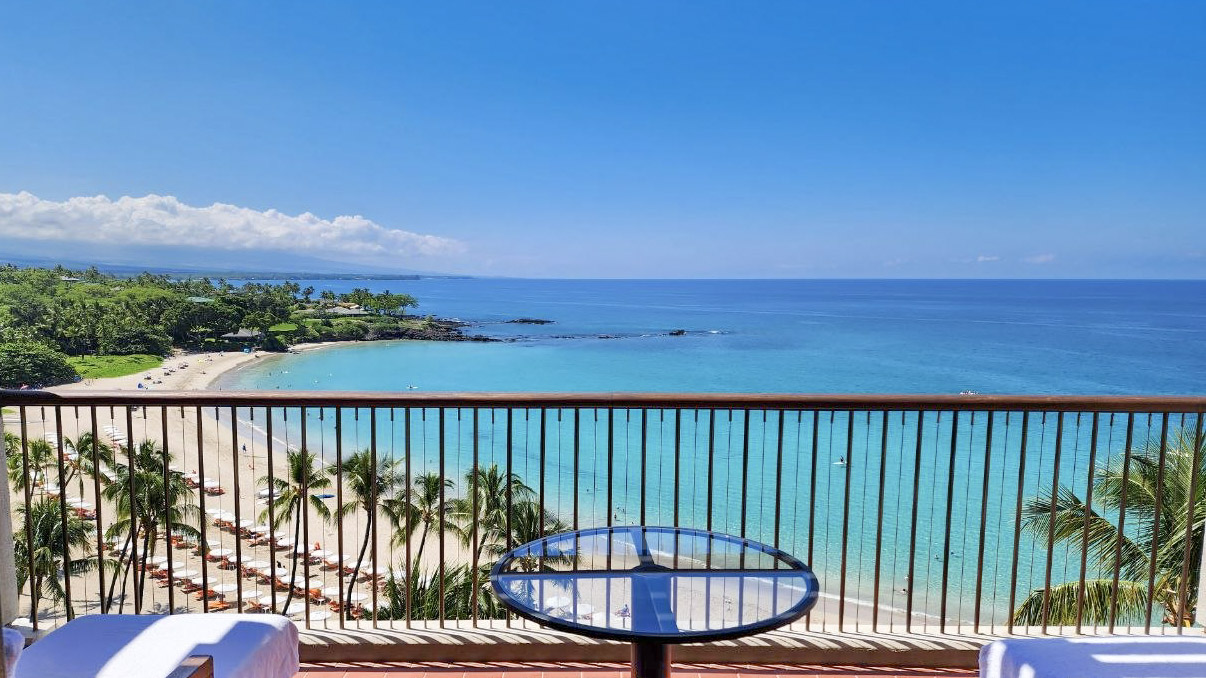
We’ve stayed at Mauna Kea Beach Hotel, and we understand why people keep going back. Its location at Kaunaoa Bay is one of the most beautiful beaches in Hawaii, and staying right there completely changes the experience. You wake up there, swim there, eat there, and once you’re settled in, getting back in the car and driving doesn’t have the same appeal.
That isolation is actually part of what makes Mauna Kea special. But at the same time, it’s part of what makes the cost of eating there even harder to ignore, and why guests start thinking about Costco runs or driving off-property in search of a less expensive meal.
Mauna Kea’s prices get people’s attention.
Food prices have risen sharply over the past couple of years since we last stayed there. Recent examples include a burrito approaching $50, two chicken tacos approaching $40, and a tater tot appetizer nearing $30.
Other travelers who’ve stayed there or elsewhere along the Kohala Coast keep offering the same explanation. Once you’re at the resort, there aren’t many convenient alternatives. We ate recently at Canoe House, which is in a similar situation, further down the coast at the Mauna Lani Resort.
There are places to go along the Kohala coast, of course. They just aren’t outside the front door.

Leaving Mauna Kea takes some effort.
Kawaihae is closest and 7 minutes by car. Waikoloa and Waimea, both in opposite directions, are 20-25 minutes depending on where you’re headed. That sounds easy enough until you’ve spent the afternoon at Kaunaoa Bay, showered, changed, and are trying to decide whether you’d rather have dinner downstairs or get back in the car.
We’ve been there, and the resort’s isolation is actually a part of what you’re paying for. Off-property food isn’t necessarily cheap either, but the difference is nonetheless still substantial.
Island Gourmet Markets in Waikoloa has offered a hamburger and fries for around $16 and a New York steak with two sides for around $25. There are plenty of other takeout options there too, and none of them is inexpensive.
Kawaihae Kitchen has local catch from $14.00. Hawaiian Style Cafe in Waimea offers moderately priced breakfast.
Those aren’t bargain prices. They are simply far below some of the resort numbers being discussed, and reaching them means leaving the property, getting in the car, and giving up some of what you paid to indulge in, in the first place.
Then there’s the Kona Costco run.
This pattern feels familiar because we’ve seen and experienced some version of it for years. Visitors land, pick up the rental car, then stop for water, fruit, breakfast food, snacks, wine, poke, or whatever else they don’t want to buy at resort prices. Maybe it’s Costco, or another chain store.
Costco itself has become a big part of that routine for a lot of Hawaii travelers on all the islands, including guests staying at high-end resorts like Four Seasons, some of the most expensive resorts in the state. The interesting part isn’t that they shop there. It’s that guests paying that much still make the requisite stop.
Refrigerator space has become part of the calculation too, even in rooms that cost $1,000 or more a night. Those can be quite small.
The room can be luxury. Breakfast doesn’t have to be.
Someone may happily spend $1,000 or more a night for the room, the view, the beach, the pool, and the location while still deciding that breakfast, lunch, snacks, and drinks don’t all need to come from the resort. It’s the same instinct behind the $130 daily beach club fee that recently ended one longtime visitor’s Big Island trips altogether: even guests who will pay a premium for the room draw a line somewhere.
We’ve done versions of this ourselves. Breakfast in the room is one of the easiest places to start, with local fruit, yogurt, cereal, coffee, or something picked up the day before. Lunch might be poke or sandwiches, while dinner becomes the meal worth spending on. Or not. None of that feels unusual anymore.
Hawaii resorts seem to know this too.
At 1 Hotel Hanalei Bay, Neighbors is described by the hotel as a cafe and market, with grab-and-go food and order-ahead pickup. Its current menu includes overnight oats and the Garden Isle Parfait for $12, salads starting at $16, and other food that can be picked up without turning every meal into a sit-down restaurant visit.
That doesn’t make it inexpensive by any measure. But it does give guests another choice, and the existence of a market and grab-and-go operation inside a luxury resort is an interesting evolution in itself.
Grand Wailea has taken a similar approach in another form, with room service that includes pizza, local favorites, and shave ice alongside its larger dining options. Fairmont Orchid’s standard guest rooms include refrigerators, making it easy to keep drinks, fruit, yogurt, and other groceries in the room.
Montage Kapalua Bay goes much further. Its residential-style accommodations are built around kitchens, making grocery shopping part of the stay rather than something guests are improvising around.
We don’t remember it always being this way.
Twenty years ago, staying at a luxury Hawaii resort more often meant eating at the resort too. Breakfast there, perhaps included in the rate, lunch by the pool, dinner downstairs, and drinks were simply part of the experience.
That still happens, but we don’t remember the grocery stop being talked about in this level of accommodation, as routinely as it is now. Today, Costco can sound almost like part of the high-end arrival process: pick up the rental car, stop for groceries, then head to the resort.
Maybe higher hotel rates are part of it. We’d suggest that Hawaii travelers have simply become more selective about where they spend once they’re here.
The splurge itself hasn’t disappeared.
People are still willing to spend extraordinary amounts to stay somewhere extraordinary. Mauna Kea proves that every day, and Kaunaoa Bay is still one of those places that can make the expense feel worthwhile. We can totally attest to that.
The same is true at other resorts where people are paying heavily for the setting, service, and location. That doesn’t mean every meal automatically feels worth the price.
So the $1,000 room and the grocery bag, oddly enough, aren’t really at opposite ends anymore. The hotel may be the splurge, while the groceries are simply breakfast.
If you’re paying $1,000 or more a night for a Hawaii hotel, are you still stopping for groceries first? And which meals are actually worth the splurge once you’re there?
Lead Photo Credit: © Beat of Hawaii at Mauna Kea Beach Hotel.
By Rob and Jeff, Beat of Hawaii.
Some of the most meaningful parts of Hawaii are the ones visitors walk right past without knowing they are there. We’ve spent nearly 20 years finding them firsthand for BOH as full-time Hawaii residents reporting on travel, culture, and island life, and telling you what they mean for your trip. Join us →
Get Breaking Hawaii Travel News



So… this is just another “enhancement”. Hotel chains, beholden as they are to their shareholders, will try to squeeze every last penny out of every possible situation, (same as airlines).
The fact that they are paying $1000/night does not mean that they don’t shop cheaper by going to Costco. Often they can afford the $1000/night place Because they shop at Costco. It’s faulty thinking that you get rich and spend rich. It’s also common that people are getting discounts and gifts on these places as well.
Well done guys! Well done.
Yeah, over on Maui where we are it’s always seemed incongruous. People fly in First Class, Grab their Hertz Gold Club Jeep or OJ Bronco, and head straight to Costco before continuing to the top tier weeklong accommodations in Wailea or Ka’annapali.
Maybe they don’t know there’s a perfectly fine Whole Foods just up the beach road?
A Costco run from Four Seasons is an oxymoron. Those who are doing it are likely on a once in a lifetime vacation and spared no expense to get there, or someone who has no business staying at a luxury resort but doesn’t know it.
We used to do the Costco stop before heading to the resort, but now almost all our bookings are with Costco Travel where packages include resort daily food & drink credits.
Last May we stayed at Mauna Kea’s sister property Hapuna Beach on a Costco Travel package that included breakfast buffet and 100 a day resort credit, plus we bring snacks in our carry on.
We ate on property and went next door to Mauna Kea to eat at Copper’s, but for us the only must off property restaurant is Merriman’s in Waimea. We ate there twice, both meals were outstanding.
This October we have a stay booked at Grand Wailea, again thru Costco Travel, loaded with so much food & beverage resort credits that it will easily cover most if not all on property food purchases.
We’re shopping at Costco _Because_ we’re paying $1k a night. Have to economize somewhere.
I grew up on the Big Island. My mom, aunties & myself worked at MKB. It was and always will be a very special place in my heart. The views of the bay are spectacular! The food & beverage dept were outstanding. The quality of food & services offered back then matched the daily fee to stay at MKB.
Of course, that was many years ago before resort fees and higher prices appeared. It’s unfortunate but the wonderful days of my young adulthood has faded into the past.
Today though, the Spirit of Aloha lives on through the people of Hawaii. I left my island home many years ago, but still feel the Aloha whenever return home for a visit or a phone call back home. And yes like many visitors, I tend to stop somewhere to pick up ono kine grinds between the car rental counter and resort that I booked at.
Like the saying goes – There’s no place like home – even if it costs a small fortune to visit 🤙