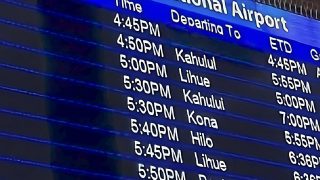
Southwest flew 729 flights between Maui and Kauai over the latest year of federal airline reporting, carrying an average of just 75 passengers on jets with 175 seats. That’s about 100 empty seats on an average flight, while Alaska and Hawaiian were filling most of their seats on the same route. With new reports suggesting Southwest could abandon both Maui-Kauai and Maui-Kona nonstop flights earlier than expected, those passenger numbers help explain why the airline has struggled to compete.
In our July report on Southwest’s Hawaii flight cuts, we documented the planned Maui-Kauai cancellation and a 50% reduction in Honolulu-Maui flights beginning next spring. Now Maui-Kona is also facing a possible early withdrawal, and the latest passenger figures show just how far Southwest has fallen behind Hawaii’s long-time airline.
The empty seats on Maui-Kauai and Maui-Kona.
The latest U.S. Department of Transportation-based passenger data for Maui-Kauai, covering August 2025 through July 2026, show approximately 253,000 passengers traveling in both directions. Southwest carried only 54,612 of them, or about 22% of the market. Its flights averaged 43% full, compared with 70% for Alaska and 72% for Hawaiian.
The Maui-Kona numbers are nearly as revealing. Of approximately 280,000 passengers traveling between those islands, Southwest carried 64,324, or about 23% of the market. Hawaiian carried more than 215,000 passengers, filling approximately 76% of their available seats compared with Southwest’s 50%.
Most of Southwest’s flights used its 175-seat Boeing 737 MAX 8, considerably larger than the 128-seat Boeing 717 still used by Hawaiian. That leaves Southwest with more seats to fill on each departure, yet it has attracted substantially fewer passengers. The figures don’t establish whether any flights were profitable, since fares and operating costs also matter, but regularly operating with so much unused capacity presents an obvious problem. Hawaiian will soon face its own version of this. Alaska-branded 161-seat 737-800s are already flying Honolulu-Maui, and the larger aircraft will begin replacing Hawaiian’s 717 fleet in 2028. Their stronger passenger demand gives them an advantage, but they’ll still have to fill those additional seats or reconsider how frequently they fly some routes.
Another disadvantage is the schedule itself. Southwest generally offered one daily nonstop in each direction on these Maui routes, compared with approximately three daily departures on Alaska and Hawaiian. For residents traveling between islands for work, medical appointments, or family visits, that flexibility can matter more than a modest fare difference. A cheaper ticket doesn’t help much if the only available departure times makes a same-day trip impossible.
Southwest’s low-fare advantage isn’t what it once was.
Southwest’s arrival in Hawaii produced memorable $39 and $49 interisland fares. Hawaiian responded aggressively, sometimes matching those prices, and residents benefited from competition that had been missing for years. We covered how much that changed in Hawaii Just Quietly Lost Its Last Airline Fare Wars.
Southwest can still offer some attractive prices, particularly during promotions, but the assumption that it will automatically be cheaper has ended. When we priced our own Lihue-Maui round trip earlier this year, Southwest wanted $530 for two tickets, while Hawaiian offered the same trip for about $100 less. We described the experience in our firsthand companion fare report.
We had earned Southwest’s promotional Companion Pass, which could have made the trip considerably cheaper, but couldn’t book the companion seat until the pass became active. Rather than gamble on availability, we took Hawaiian’s confirmed seats at the lower price. Our experience was one booking, not a scientific measure of average fares, but Southwest’s advertised Hawaii deals don’t necessarily translate into the best practical choice. Southwest’s broader fare structure and seating policies have changed considerably since 2019, and the straightforward low-fare appeal that originally drew attention to the airline is no longer quite the same.
The reported January 5 withdrawal remains uncertain.
Aviation industry schedule reporting in early November suggests Southwest may end nonstop service between Maui and both Kona and Kauai after January 5, 2027, rather than continuing through March 10 as previously indicated. That would accelerate the withdrawal by more than two months, potentially affecting travelers who already have reservations for early next year.
Southwest has not directly confirmed January 5 as the final operating date, however, and the available schedules conflict with those reports. Published timetables continue showing Southwest Maui-Kona nonstops and Maui-Kauai nonstops beyond January 5, including service into March.
Our November 10 checks of Southwest’s booking system showed fares available through January 5, 2027, for both Maui-Kauai and Maui-Kona, with no flights offered beyond that date. Southwest’s own reservations now confirm the earlier withdrawal from both routes.
Anyone booked on either route during January or up until August (end of the current Southwest booking period) should check the actual flight details with Southwest, particularly whether the original nonstop could still be operating. A replacement itinerary through Honolulu adds considerable time to what was supposed to be a short flight between neighboring islands.
What travelers lose when Southwest leaves.
Once Southwest withdraws, Alaska and Hawaiian will remain the ony large-aircraft nonstop option between Maui and Kauai and between Maui and Kona. Although flights may carry different airline codes, both belong to the same airline group. Mokulele also provides smaller-aircraft service between Maui and Kona, but with a different operating model and far fewer seats.
Southwest hasn’t left either route yet, so we don’t know what fares will look like after it does. But travelers will lose an independent large-jet competitor that once helped push interisland prices down across Hawaii, leaving Alaska and Hawaiian without another large airline matching or undercutting their nonstop fares on these routes. For visitors and residents who depend on these flights, the remaining schedules may still work well, but there will be fewer options when a preferred departure fills up or a fare is unexpectedly high.
Have you recently compared Southwest and Hawaiian fares between Maui and Kauai or Kona? We’re interested in whether Southwest was actually cheaper, and whether its flight times made it a practical choice for your trip or not.
Get Breaking Hawaii Travel News