

The aircraft cabin grew quiet as we approached Aitutaki in The Cook Islands. Everyone was staring out the window as the lagoon came into view, an enormous bowl of turquoise so bright it almost hurt to look at. The motus below looked scattered across the water, each one glowing white against impossible shades of blue and green. It was one of those moments when sound stops and you look. If Hawaii feels familiar now, Aitutaki feels like what Hawaii once was before the rest of us arrived.
When we stepped off the plane, the airport was quiet and simple, just a single open hall with no rush or noise. A man played a ukulele as people collected their bags. It felt calm in a way Honolulu does not anymore. Aitutaki still knows how to pause.
This is part two of our Cook Islands series, a follow-up to our first report from Rarotonga. Our flight from Rarotonga was only 50 minutes, yet it seemed a world away.

The lagoon that defies description.
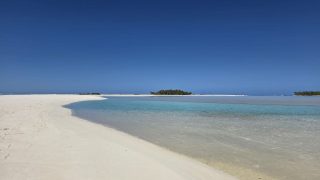
Aitutaki’s lagoon is far bigger than you expect. It covers nearly 30 square miles, wider than the island itself by a factor of five. From almost any shoreline, you can walk straight into warm, shallow water that stays knee-deep for what feels like forever. The colors shift constantly, from pale jade to bright turquoise to a milky blue that looks almost lit from underneath.
There are more than a dozen motus scattered across the lagoon, each one surrounded by sand so white it almost glows. Some motus are no more than a strip of palms and sand, others are large enough to explore on foot. What surprised us most was how much open space there is between them. Even with boats out on the water, the lagoon never feels busy.
We spent three days doing nothing more than floating and watching the light move across the water. People call this the most beautiful lagoon in the world, and it is hard to argue. Hawaii has beaches that are far prettier up close and taller cliffs too, but nothing that matches the scale, calm, and emptiness of this place. It is as if Kaneohe Bay and Hanalei were combined, then stretched out to the horizon and left untouched. It is other-worldly.
Where we stayed: Aitutaki Lagoon Private Island
Our base was Aitutaki Lagoon Private Island Resort, which sits on a small motu just a few minutes by boat from the main island. Only resort guests are allowed on the motu, creating a quiet, adults-only setting that feels separate from the rest of Aitutaki. There are about thirty bungalows, so even at full occupancy, the resort never feels busy.
We chose a Premium Beachfront Bungalow facing away from Aitutaki toward the open lagoon. If we stayed again, we would want to try one of their overwater bungalows (the only ones in The Cook Islands) or a Deluxe Beachfront Bungalow that sits closer to the lagoon.
Our beach chairs were just steps away on the sand, and that is where we spent most of our time looking out over the water. It struck the right balance between privacy and access. Each unit came with bicycles, kayaks, and snorkel gear, and being able to walk from the room directly into the lagoon in under a minute was something we appreciated. The private outdoor shower also fits the setting well.

The resort is a splurge, while it is not truly a luxury property. The setting is what makes it most unique and memorable. Staff were warm and genuine, but things ran on island time. Dinner was excellent with a sunset view, while the included breakfast was hearty but not great in quality compared with Hawaii resorts.
The short boat ride back and forth to the main island became part of the rhythm of the stay. The contrast between the private-island quiet and the everyday pace of Aitutaki is what ultimately made the experience work.
(Note: As always, Beat of Hawaii paid in full, this time for a 4-night stay.)
The supply chain reality that makes Hawaii look connected.
Everything here depends on a supply ship that arrives roughly once every three weeks, assuming weather allows it. When the lagoon is rough or winds shift, the boat can’t dock, and deliveries wait. In some cases, the ship goes to Rarotonga, and another boat then delivers to Aitutaki. We’ve never seen anything quite like it. Stores can run out of the most basic staples, restaurant menus shrink, and what’s available today might not be tomorrow. It’s a reminder of how fragile paradise is when it’s three thousand miles from anywhere.
That scarcity shapes the island’s character. You learn to plan, to accept, to live with less. Hawaii’s outer islands used to have that same resilience before overnight delivery replaced patience.

Our strategy for exploring the world’s most beautiful lagoon.
Most visitors experience the lagoon on the all-day tours from Rarotonga. Those flights arrive midmorning, and the motus fill quickly as the large vaka boats unload for lunch, snorkeling stops, and beach time. It can be a busy scene on those days. We did something completely different.
Instead, on a Sunday, when the day-trips did not operate and the big boats stayed at the dock, we chartered a small boat for the two of us for about five hours. It cost roughly $300 in U.S. dollars, through T’s Tours. That’s a price unheard of both in Hawaii and in French Polynesia, where the same tour would cost four to five times more. It was the best choice we made and one of the most epic days in our Beat of Hawaii world travels. Captain T took us to long stretches of sand where we were the only people on the entire motu, and the lagoon felt as quiet and open as it looks in the photos. So much so it was eerie. If you want to see Aitutaki at its best, this is without question the way to do it.

Driving around Aitutaki.
The island is small, the roads are quiet, and with a population of just under 2,000 people, you rarely see more than a few cars at a time. You drive on the right, but it hardly matters because there is virtually no traffic. You can circle the main coastal road in about 40 minutes, or cut across the island on a few short interior roads.
The land is mostly flat, so biking is a great option too. As you go around, you’ll pass the coral-stone church in Arutanga, the sports field at Vaipae, small family farms, and stretches of shoreline where you can pull over and look straight into the lagoon. There are no billboards, no traffic lights, and no road stress. It is one of the easiest islands on which we have ever driven.
As we drove around, we noticed some buildings in ruins and others that had clearly been rebuilt or were still under repair. In February 2010, the island was struck by Cyclone Pat, a powerful storm that produced wind gusts in excess of 185 km/h (115 mph) and damaged an estimated 60-80% of the island’s homes. The result is that in many villages you’ll see a mix of original homes and newer builds, visibly reflecting the island’s ongoing recovery and resilience.
Avatea Cafe makes perfect fish tacos, and everyone greets you whether you come for food or to shop in their gift store. We also stopped at the so tiny you could miss it Farmers Market at the harbor. Another place we enjoyed for fish was The Boat Shed with its casual Island vibe. There are no chain stores, no neon signs, no crowds. Just families, cats (no dogs on the island), and waves that seem to keep time with the day.
To better understand Aitutaki, we also opted for a 3-hour land tour.
To fully immerse ourselves in Aitutaki’s history and culture, we took a guided 3-hour land tour with Tavai Inventure Tours. We thought we had already seen the island just by driving around, but the tour went well beyond the main road, bumping along back tracks through farmland and forest we would never have found. It included not only the off-road visit to the marae but also stops at small villages, fruit groves, and family lands that revealed what daily life on Aitutaki actually feels like. The guide’s explanations gave context to the places we’d passed before without understanding, and by the time we stood among the ancient stones, the island’s history and its present felt completely connected.

We visited Marae Te Poaki o Rae, the largest and most atmospheric of Aitutaki’s ancient ceremonial sites. Hidden deep in the southern interior, it takes a short walk through dense bush to reach the stone foundations, still partly overgrown and silent except for the wind in the trees. The scale surprised us, revealing massive basalt slabs laid out in a broad rectangular pattern, evidence of gatherings and rituals that predate the first missionaries by centuries. Standing there, it felt closer to a Hawaiian heiau than anything else we’ve seen in the Cook Islands, but wilder and untouched. The sense of continuity was unmistakable on an island remembering itself long before visitors arrived.
The parts that don’t work, and maybe shouldn’t.
Groceries are beyond limited, and what’s on the shelves is imported from New Zealand and is very expensive. You might find one brand of cereal, one kind of milk, and no vegetables at all. When local produce is available, it is scooped up fast. Wi-Fi (Vodafone is the only network in Cooks) works for email, but not much else. U.S. phones won’t connect unless you buy a local SIM. And when the sun sets, everything stops. The island goes quiet in a way that feels almost sacred.
But that’s the point. The lack of choice, the slowness, the empty horizon, all of it strips travel back to something simpler.

What Aitutaki says about Hawaii.
It’s tempting to call Aitutaki “Hawaii 50 years ago,” but it’s not. Aitutaki never had a Waikiki to lose. It’s stayed small by accident, not strategy. Geography, isolation, and that three-week supply ship are what keep it human-sized. And maybe that’s what Hawaii forgot, that limits can, in fact, be gifts.
Here, the absence of abundance is what holds everything together. Limited flights mean fewer crowds. Limited infrastructure means no overbuilding. Limited everything keeps expectations real. What’s left is space, warmth, and people who say “welcome” like they mean it.
When we told a cafe owner we lived on Kauai, she smiled and said, “We look up to Hawaii. You’ve made it.” We smiled back, thinking how many in Hawaii would trade places with her in a second.

Our takeaway.
We left Aitutaki with salt still on our skin and a few mosquito bites that didn’t seem to matter. The lagoon’s light stayed in our eyes for days and weeks after. The island is small, slow, and limited in all the right ways, full of what Hawaii keeps trying to rebuild through slogans about sustainability and authenticity.
We wouldn’t tell anyone to rush here. Aitutaki doesn’t need a rush. But for travelers who remember what Hawaii once felt like, when warmth came naturally and quiet was easy, it’s worth the extra flight and time.
Have you been to Aitutaki or another Pacific island that still feels untouched? What did it make you remember most about Hawaii?
Get Breaking Hawaii Travel News



Shhhhh
Wife and I went to Cooks 10-12 years ago – Raro for about 10 days and Aitutaki four nights. We rented a little 1 bdrm / 1 bath cottage on Aitutaki. Within a day we think everyone on island knew us – at least they all called us by our first name as we drove / walked by. It was at least 50% more laid back then than what you describe – certainly no resorts. Groceries? You quickly learn to get what you can. At that time I had booked our plane stuff to include flight to Aitutaki from Raro as part of a full itinerary – found out we got very lucky as our flight to there was almost nothing compared to cost of if I hadn’t done it that way. Good thing we had local currency as no credit cards accepted then. Hawaii been going since ‘72 and have a home on BI we go to frequently. Cooks and Hawaii and French Polynesia not similar unless you turn clock way back. We loved the Cooks but it is a definite gear down. The lagoon is magnificent – I selfishly want them to never “get discovered.”
Excellent article, beautifully written and very informative in every way. I’m ready to go, however, I’m afraid that at 77 I’ve probably timed out on the possibility due to the typical elder arthritic mobility issues. Mahalo Nui Aloha, BOH
🤟🤟🤟
Very nice, well-written article on Aitutaki. Heart-felt.
I went to Rarotonga last year and did a day trip to Aitutaki. It was stunning, the clams were gigantic, and they had these fascinating burrowing crabs. No dogs on Aitutaki; interesting story on that. Everyone was friendly and genuinely warm. Café Koru had tasty treats!
Back on Rarotonga, I met a guy playing ukulele at the Maire Nui Garden café from Napili! We laughed we were practically neighbors. I enjoyed the slow pace and being a solo traveler, I was adopted by most everyone I met on tours or just the local bus. Lots of Kiwis and Aussies.
Groceries were scarce, but what I did try was fun and interesting. I would go back in a heartbeat, and I am already planning a visit for next year. A feeling of peace and relaxation I have n
In college, over 23 years ago, at the Local Hobby I purchased a panoramic beach photo of an idyllic beach scene. A small, dog head shaped spit of land, some turquoise water and then more landed with a palm tree growing almost sideways out of it. No name or location given, I still have the picture and wondered where the phot was taken.Fast forward 20 plus years and we’ve just come back from Aitutaki. I am brushing my teeth and happen to look at that old panoramic on the wall. I grab my wife and my phone, and we realize I had taken a phot of that exact spot from the panoramic. I had accidentally found it: One Foot Island. Man, I love that place. It is beyond words.
I began visiting Hawaii when I was a boy in the early 60’s. I have owned a second residence on Kauai for 14 years, so I have seen the change. I am still a scuba diver (even at age 76) and also love to fly fish. Four of us visited the Cook Islands several years ago, staying on Roratonga for several weeks and Aitutaki for a week. You are right. While Roratonga did remind me of Kauai back in the 60’s, Aitutaki is a different world. I loved them both, and if I were 15 years younger, and my wife would agree, I would sell my condo on Kauai and buy or rent on Roratonga for months each year. Diving was fantastic and far cheaper than Kauai, and I caught the largest bone fish I’ve ever seen in the Aitutaki lagoon. The only thing keeping these islands so perfect is the fact they are tough to get to, and it least up until your article, nobody knows much about them.
“and it least up until your article, nobody knows much about them.”….. I thought the same thing and even Googled them…..
We just returned from a seven night cruise around the Society Islands (Tahiti, Bora Bora, Moorea, etc.).
The ship was a smaller 330 passenger, 200 crew member all inclusive tour.
It was small enough to get in close to the various motus ( islands ).
However, it was large enough to provide all the creature comforts of the larger cruise ships. Wonderful buffet breakfasts featuring fresh baked French pastries and fresh fruits, etc. I’ve never felt so “pampered” on vacation in my life.
As opposed to the Cook Islands you describe, this trip lacked nothing desired by the average traveller.
Tenders took passengers ashore at each motu on the itinerary for various onshore activities.
Your experience was quite different. And I suppose it was similar to what Hawaii looked like before the millions of visitors trampled it over.
I’ve been wanting to go here since I first heard about it years ago and I still do. Sounds fascinating and entirely unique. Not sure I’m up to the two flights from the West Coast though and wish there were still flights from LA.
We live in the Midwest and found the easiest way is to just fly to HNL the day before and spend the night before going on to RAR. There’s only one flight per week anyway.
It is technically possible to fly to HNL from our home airport and arrive in time to connect to RAR, but in today’s travel environment there’s no way I would chance missing the RAR flight.
We literally returned 1 week ago from our 2nd trip to The Cook Islands. We spent the majority of our week there on Aitutaki at The Pacific Resort Aitutaki. It is our paradise and are already in the process of booking our 3rd trip.
I would note that I was surprised to be able to use my AT&T phone to call via Wi-Fi to the US due to an issue that I had to address before returning to HNL and it worked great.
Kia Orana, BOH!