
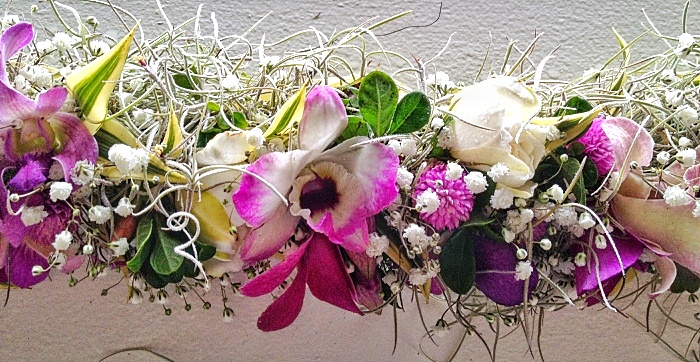
Lei have always been more than flowers. They are a greeting, a promise, and a feeling that marks the start of being here. For many visitors and residents, that moment is unforgettable. What is less obvious, and fast becoming a fault line, is the origin of the flowers and what that means for authenticity.
From local fields to a global supply chain.
A generation ago, you could count on many lei being made with blossoms grown nearby. Farmers’ markets had multiple flower vendors selling plumeria, ginger, heliconia, tuberose, and more. That picture has changed.
Today, nearly 90 percent of flowers used for lei-making are imported, as reported by Hawaii Public Radio. Often, orchids from Thailand and pikake are increasingly from Indonesia. Those imports now fill the gap left by the decline in local production.
The University of Hawaii’s agriculture program has said the decreasing supply of local flowers is having a drastic impact on the lei industry statewide, which is why it launched a new plumeria collection to help rebuild supply over time.
In parallel, the Lei Poinaʻole Project, a nonprofit initiative, is organizing support for growers and makers while raising awareness that the industry is at risk if local cultivation continues to wither. Those efforts will not flip the 90 percent import figure on their own, but they offer a path back to a more regional supply, flower by flower, farm by farm.
Local farms are still in the picture.
Even as imports now dominate, flower farms continue to operate on every island. On Oahu, nurseries in Waimanalo and Wahiawa still grow plumeria, orchids, and ginger used for lei. The Big Island has long produced dendrobium orchids and anthuriums in Hilo’s cooler climate. Kauai has growers cultivating heliconia and plumeria, while Maui farms continue raising tuberose, protea, and orchid varieties.
These farms do not come close to supplying statewide demand, but they remain essential to schools, hula halau, and local celebrations where the call for fresh, homegrown flowers is still strong.
The authenticity question.
Here is the big question our readers raised and we could not ignore: can lei remain a Hawaii tradition when most flowers no longer come from Hawaii?
While most of the flowers are flown in from abroad, nearly all of the stringing and crafting still takes place in Hawaii. Families, small shops, and lei stands continue the tradition of hand-tying each bloom, often overnight, so that visitors and residents are greeted with fresh lei the next morning.
Even when the petals come from Thailand or South America, the act of making the lei — the hours of stringing, the designs chosen, the hands that tie them — remains rooted in Hawaii. That process keeps the custom alive, even as its materials have shifted.
Traditions evolve, and imported flowers do not automatically negate meaning. Families still greet each other, ceremonies pause for lei exchange, and visitors still smell that first whiff of plumeria or tuberose. It is more about whether the lei tradition can keep its roots while relying on a global supply chain for its petals.
Why did the local supply collapse?
There is no single culprit. Land is expensive. Labor is tight. Weather shocks and pests add risk. Global producers can grow and ship orchids on a scale and at a cost that small Hawaiian farms cannot match.
Over decades, as sugar and pineapple gave way to other uses, so did many specialty farms. The numbers show a broader slide. The Hawaii Department of Agriculture reports that the floriculture industry was valued at $47.1 million in 2022, but then fell to $43.9 million in 2023, representing a 7% drop.
That headline masks the composition shifts within the category, with foliage and potted flowering plants declining and cut flowers and orchids stabilizing or growing modestly, often with imported inputs filling the gaps.
Airports are where many people first encounter lei stands.
Some stands operate on month-to-month permits and face high rents, staffing costs, and uneven supply. Agricultural inspection rules allow many fresh lei to travel if they meet specific restrictions on plant parts and species. Those rules exist to protect Hawaii and mainland agriculture from pests and diseases, which is another reason logistics for local growers are complicated.
Prices, perception, and the cost of meaning.
When supply is scarce and rents rise, prices tend to follow. Readers have strong memories of ten-dollar airport lei decades ago and now see prices that can be multiples of that. Cost alone does not end a tradition, but it changes behavior.
Some visitors skip buying lei on arrival and opt for a single purchase later in the trip or a kukui nut lei that lasts longer. Others continue to buy courageously because the experience feels incomplete without it.
Either way, the perception that lei culture is slipping out of reach fuels a broader concern we hear daily about Hawaii becoming more expensive while delivering less. That is not on the lei stands. It is about the fragile ecosystem that supports them.
A path that keeps the ritual real.
Three practical steps could help keep the ritual grounded in Hawaii while respecting the realities of supply and cost.
- First, align public efforts with private energy. If UH’s plumeria work produces hardier, productive varieties and propagation know-how, fast-track those to willing growers with micro-grants and simple permitting.
- Second, stabilize the on-airport presence. If month-to-month uncertainty and high rents drive lei stands out, the state risks losing a cultural touchpoint that sets the tone for a visit. Reasonable rent, multi-year terms, and clear operating rules would trade short-term revenue for long-term brand value.
- Third, communicate honestly about the origin. Vendors should not have to hide that orchids are imported. If a lei is locally grown, make that label visible and let buyers choose. When people understand what they are buying and why, trust grows in tandem with sales.
What we will watch next.
We are tracking the next HDOA floriculture update to see whether 2024 and 2025 bring stabilization or more decline. We are also watching for milestones from UH’s plumeria program and any expansion of local growers tied to Lei Poinaʻole. If those move, that is news, not nostalgia. And it would give lei stands and makers a fighting chance to keep more of the tradition in the place where it was made.
Where you come in.
If you are arriving soon, consider buying a lei on arrival and another later in the trip. Ask where the flowers came from. If a stand offers locally grown options, try one and tell us what you found.
If you live here and have a plumeria tree, consider sharing cuttings with a local school or community group that makes lei for graduations and ceremonies. Small acts add up. The goal is not to police what counts as a lei. It is to keep the ritual connected to the islands in a way that people can feel.
What do you think? Can lei remain a Hawaii tradition if most flowers are imported, or does the meaning fade if the petals do not grow here?
Photo Credit: Beat of Hawaii.
Get Breaking Hawaii Travel News
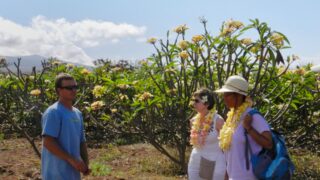

I believe if the islanders and locals know this is happening, we will step up and start planting. Trying to legislate this will be another expensive failure. It’s already too late for a bureaucratic committee to figure it out. One idea is for the farms to offer paid entrance to tourists. No doubt people coming from the mainland would love to stroll through a gorgeous farm full of fragrant flowers. Of course they wouldn’t be allowed to pick any. If the farms were laid out more as a botanical garden with paths. I believe tourist would flock to this.
Perhaps there can be some legislation where someone such as Zuckerberg or Oprah purchase a multitude of acreage, there can be a mandate to allow for such farming on said property on their dime . Kind of a use tax for grabing land, while maintaining the Hawaiian culture.
How sad, Hawaii is even running out of flowers… My childhood was dominated with the scent of Plumeria everywhere. My Father reminisced once that in 1942, when he was arriving to Oahu onboard a Navy transport with his marine battalion, that you could actually “smell the flowers before you could even see the island”. That the ocean was littered with floating flowers and green boughs for miles out. How things have changed.
Best Regards
I’m flying in on Tuesday and will definitely buy some lei!
Lei giving is really what the magic is all about. As a local, I would not buy a Lei for myself. It’s just not what it’s all about. If I need one for my job, then ok. But, every other instance it should be gifted. And it doesn’t matter where the flowers are from. Who cares where a pikake strand or double strung Tuberose is from. They are fragrant and magnificent. Other cultures wear Lei, but not like Hawaii. We are unique in our use of Lei.
Great article. For readers who havenʻt been to the Honolulu Airport lei stands recently – there are plenty of $10 lei, both plumeria and mixed plumeria and orchids/other flowers. I donʻt know if those prices have to go up when our local plumeria season is over but for now, itʻs great.
Hopefully places like littleplumeriafarms.com/ will carry on the tradition of providing local flowers.
I shudder to think of how many invasive species could be coming in from all of the imports. On a recent flight to the mainland, the Ag inspectors confiscated my unopened sealed bag of Shishito peppers I had purchased at Costco. The peppers had originated from the mainland, but ironically could not go back.
Many years ago when I was teaching in Hawaii my students would make leis from local garden greenery and flowers they found in their yards etc. these leis I truly treasured when honored with the gift of one. It does not always have to be plumeria or tuberose blossoms to make a lovely lei. Hawaii is blessed with so much colorful yet humble foliage and flowers. Hope the lei makers and farmers can keep up the unique culture that truly represents Hawaii. Hotels used to offer lei making classes for guests led by wonderful tutus who shared their talents. Hope that is still happening.