
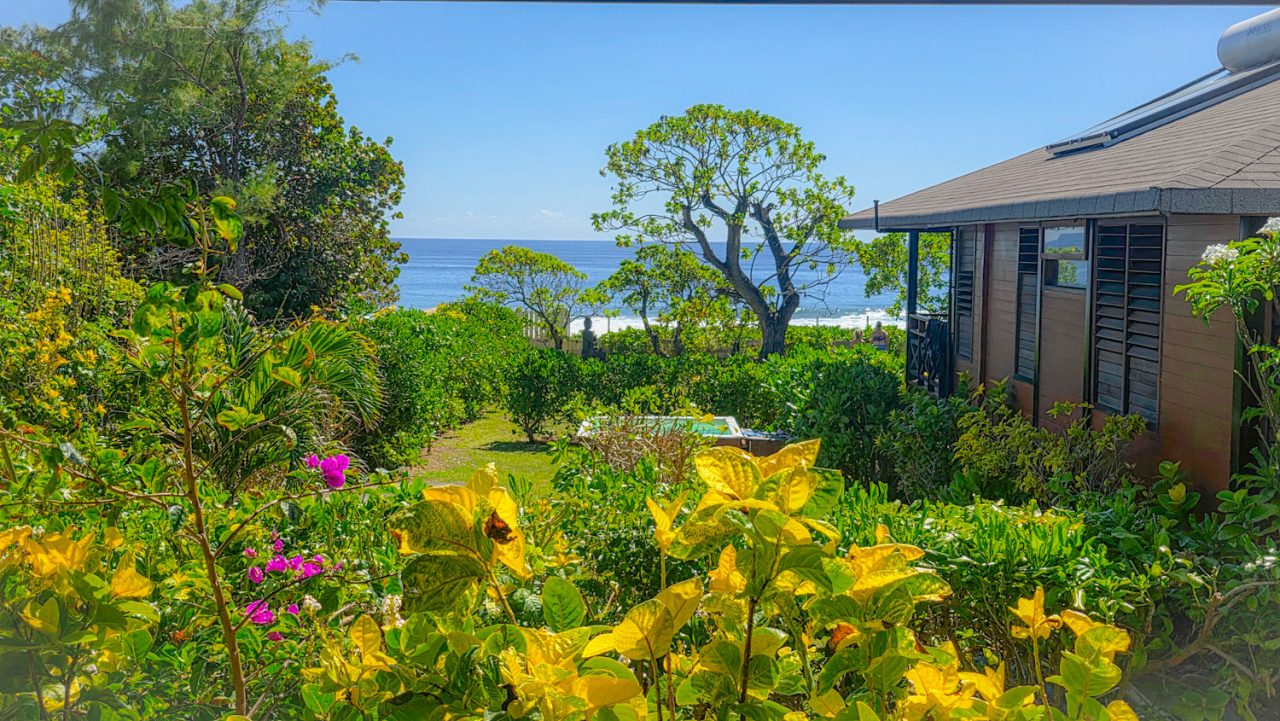
With tropical storm Nolo currently threatening Hawaii, travelers with thousands of dollars already committed to upcoming trips are once again being put in a tough spot. What happens if getting here no longer seems prudent, but the accommodation you’ve paid for is open and waiting for you?
We faced that decision ourselves just last month. Our reporting trip from Kauai to Maui was supposed to begin on a Sunday, but Alaska Airlines canceled our flight late the night before due to Hurricane Lala. Sunday became Monday, and with conditions still uncertain after what had just happened, leaving the next day, if it was even going to happen, still didn’t seem right to us. Monday eventually became Thursday, and we went to Maui.
Then our two Maui accommodation reservations went in completely different directions. Our directly booked Kaanapali hotel worked with us and changed the reservation even though it clearly didn’t have to since we were outside its stated change window. Our Hana vacation rental, on the other hand, held to its cancellation terms, and we ate the entire loss.
The loss we incurred was relatively small compared with the family whose Hawaii vacation rental kept roughly $12,000 while their airline gave them credit. Vrbo returned about $800 in its own booking fee, but the much larger rental payment stayed with the host because Vrbo had not determined that its extraordinary-event protection applied. That story drew a range of comments and a sharp debate over who should bear that kind of loss.
A disrupted trip and an unavailable accommodation aren’t the same thing.
Plenty can go wrong with a Hawaii trip without making the accommodation itself unavailable. Our own experience shows that distinction, and it’s easy to miss until you’re the one losing the money.
Where you booked can make a huge difference. Airbnb and Vrbo have platform-wide policies that can override an individual property’s cancellation terms when a large-scale disruption meets specific requirements, while directly booked hotels and vacation rentals have their own cancellation terms attached to individual reservations. Airbnb specifically excludes non-binding government travel advisories and flight cancellations affecting the guest’s ability to reach the rental. Vrbo likewise decides whether an event qualifies before its extraordinary protection replaces the property’s normal cancellation terms.
That conflict became especially clear following Hurricane Lowell, when Kauai officials advised visitors not to come while the island recovered. Some travelers with prepaid accommodations faced a very different financial reality: their lodging was available, and not coming could mean losing what they’d already paid. The rental itself hadn’t necessarily been affected even though the trip around it clearly had.
Where you book can change who carries the risk.
We book Hawaii accommodations in different ways, including hotels, vacation rentals, Airbnb, Vrbo, and directly with property managers. What we ourselves hadn’t focused on enough was how differently those reservations can behave when circumstances change after the normal cancellation deadline.
The direct-booking agreements we reviewed showed just how far those differences actually go. Some specifically provide no refund when the accommodation remains habitable, but flights are canceled, roads close, utilities are disrupted, or beaches and parks become inaccessible. Others give the property manager discretion to determine whether an accommodation is actually unusable, offer different dates, or substitute another property.
Our experiences also don’t suggest hotels are more flexible than vacation rentals or vice versa. Our directly booked hotel worked with us while our vacation rental held to its cancellation terms. Another hotel, rental, or rate could easily have produced the opposite result.
The contract isn’t always the final answer.
The response to our original $12,000 article showed another part of this that no comparison of written policies captures. Some owners choose to refund money even when they aren’t required to.
One Hawaii Island vacation-rental owner told us that when his guests canceled during the same event involved in that earlier story, he instructed his management company to refund them in full. Another owner argued that guests can insure against cancellation while an owner can’t insure against a traveler changing plans after the property has been taken off the market. A third reader came back to the agreement itself: both sides knew the cancellation terms when the reservation was made.
We still compare the property and price wherever we’re booking, but now we’d also look more closely at what happens after the normal refund deadline. A cheaper rate can now look very different when one reservation offers more subsequent flexibility than another.
If your Hawaii accommodation is open and waiting for you, but circumstances outside your control make taking the trip unreasonable, exactly who should take the loss? You because the property is available and you agreed to the cancellation terms, or the owner because you reasonably can’t use what you paid for? And if this has happened to you in Hawaii, we’d especially like to hear how it turned out.
Photo Credit: © Beat of Hawaii.
By Rob and Jeff, Beat of Hawaii.
Some of the most meaningful parts of Hawaii are the ones visitors walk right past without knowing they are there. We’ve spent nearly 20 years finding them firsthand for BOH as full-time Hawaii residents reporting on travel, culture, and island life, and telling you what they mean for your trip. Join us →
Get Breaking Hawaii Travel News





I am a small vacation property owner and I will say this:
I have No ability to insure the guest fees if they cancel. Only they can buy insurance to cover the loss. And some insurance which cover hurricanes, will not cover if the accommodation is not affected.
Thats why there is CFAR, Cancel for any reason – I just don’t want to come or something happens that is not covered – like a hurricane. like covid.
It usually covers 60-70% and as a small business owner, I would be happy to meet the guest part way and do a 30-40% refund, at least they tried to cover the cost of what could happen.
Instead I hear, I didn’t get insurance because I never thought I would need it.
I ask you – do you insure your car? because I never intend to get into an accident, but I get insurance anyway.
I’m so weary of being the bad guy whenever guests choose to ‘self insure’ and then aren’t happy when bad things happen
Travel is a risky business and not just for Hawaii. Most trips are wonderful, but I canceled a summer trip to hike the Washington mountains because of thick smoke from sudden distant fires. Hotel and car rental would not refund. I also cancelled a trip to Colorado last winter because there was no snow. Hotel and pre-paid lift tickets were not refunded. Not the hotels’ or companies’ fault so accepted personal responsibility for the agreements I made.
That said, I’ve considered canceling other trips in the past for weather and decided to go anyways and ended up having incredible times.
Our family of 8 came in February just before a storm so our plane landed. I have been to Maui 18 times and this was the worst experience ever.
Not only did we have terrible weather, no power and couldn’t swim in the ocean, but a pool that had been out of service for a week before we got there and a management company that lied about it and said it was from the storm. So we were stuck without anything to do. We purposefully picked this place 9 months earlier for the pool amenities for children and an elderly person. It took me almost a month to get one night reimbursement from VRBO from a 25,000 trip. I won’t use VRBO anymore or that management company and don’t know if we will ever be comfortable coming back..
Too much risk, too much $$ and too many still complaining about the money the Islands make from vacationing visitors.
VRBO Needs To Do Better!!!!
Trip insurance is a must for us. If we are leaving the lower 48, we get trip insurance with the “cancel for any reason” addition. Between the insurance and my credit card, we are covered. Sure, both the card and trip insurance are a little extra, but the benefits for us are worth it.
And that’s where people cheap out shopping for the lowest price insurance that covers nothing.
I guess IMO my best thought is don’t throw down anything that you can’t afford to loose. Even insurance companies have so many loopholes, rules, and limitations on what they will cover. What from if they do cover they give you monthly payments and only cover maybe 60% of what you are really out.
I remember a story where BOH claimed 7 hundred including receipts and only received something like 480 dollars back. And there again I think insurance also costs you 5 percent of your trip value so do the math. Ya figure if they only collect 5% then how many claims can they really afford to pay out? At 1:20 wouldn’t even be a break even point in which they have to pay business expenses and wages.
It seems to me that every time I’ve arranged travel there’s a box you have to check that basically says you’ve read and understood the terms and conditions as it relates to canceling a booked stay before you can make payment and finalize your booking.
So it would make sense to do so I mean actually read and understand the terms for cancellation before checking that box and handling your credit over for payment.
If you’re not comfortable or don’t understand the cancellation terms I’d suggest not booking travel any of condo booking sites mentioned in the article or comments here.
We encourage all of our quests to buy insurance and some do and the insurance covers the loss if the customers plane flight gets canceled but no one going to refund money for bad weather a few days before checking in. People rent condos because it’s keeper than hotels, has more bedrooms to accommodate more people and have cooking facilities to save on the of meals. We require full payment 60 days before arrivals and the money is not refundable but push people to get the insurance.
This last hurricane the grazed maui did some damage in Kihei but Lahaina was untouched with had beautiful weather.
Trip insurance would be one of the answers, but only CFAR, which is way more expensive and not always available for every trip. Regarding short-term rentals, I think part of the cost of doing business is not always having a paid rental ever week, and reimbursing someone when things like hurricanes come up. Unlike what one commenter said, while the unit itself may be ready and undamaged, there’s more to it. People are renting an experience, or they would be renting some awful and cheap unit 10 miles from the beach just to have a place to sleep. Most people want more. Plus, Hawaii is different – no way to get there than flights (can’t really count cruises), so airport issues are a huge problem. If you can’t afford to reimburse someone in these hurricane situations, you really shouldn’t be hosting a short-term rental.
CFAR is not ‘way more expensive’. Regular insurance about 7% and CFAR is an additional 2-3%.
Two days after Lowell we sought to cancel. Owner said place wasn’t damaged, had electricity, and the roads were open so they didn’t have to refund.
Same travelers, same circumstances, two completely different outcomes. I don’t know that either business was wrong in your situation, but I would certainly remember which one worked with me the next time I booked.
Government officials telling visitors not to come as happened on Kauai, I think that changes things. I would have a hard time keeping someone’s entire payment while also knowing local officials were asking them to stay away. Maybe a credit toward another stay would be the fairest compromise.
Everyone keeps saying travel insurance, but that isn’t necessarily the answer. We had insurance deny a claim because the reason we decided not to travel wasn’t one of their covered reasons. Buying insurance and having coverage for what actually happened are two very different things although I appreciate the owner/manager hopes to shift the responsibility.
As a vacation rental owner I struggle with this. If I refund someone three days before arrival, there is almost no chance I’m going to replace that reservation. Why should the entire loss shift to me when my unit is open and exactly as promised?
So, the renter’s flight(s) has been canceled by the airline, local flooding in the vicinity of your rental makes it impractical to reach it, downed powerlines between the airport and your rental, but your rental is ‘ready to be occupied’. What would be the ‘right’ thing for the owner to do???
But it isn’t exactly as promised – that’s the whole point. And I agree with what Dennis D. said, who spells out the specific ways in which your unit isn’t exactly as promised. And you probably couldn’t rent out the unit to anyone else anyway because of the overall bad situation. I think the right thing to do is to either give a complete refund or offer them a week to use within a year. You’re probably gaining a repeat customer if you do that, as well as top level referrals to their friends (assuming your unit is great). Also, how many times is something like this going to happen over 5-10 years or however long you’ve owned your unit? Probably pretty rare. It’s the cost of doing business. And being a good person.
Why is it always on the small business condo owner to take FULL responsibility? We have no ability to insure their trip – they do.
Why are we the bad guys because they decided to ‘self insure’?
This happened to us on Maui too. The owner was very nice about it but said the condo was available and therefore the cancellation policy applied. I wasn’t happy about losing the money, but I could understand his side too.
My friend and I recently cancelled our Kauai trip because of Hurricane Lowell. The airline gave us travel credits for our non-refundable tickets, the excursions we had reserved and paid in advance gave us full refunds, VRBO refunded its booking fee, but the condo owner would not even consider a refund or rescheduling. We offered to reschedule to stay after the first of the year, and their calendar was clearly wide open beyond late January. We even said that we would pay the price difference because the rental rates were higher. Still no exceptions. At this point I’m not really sure if it was the condo owner who made the decision or the on-island rental agent. Since we’ve been staying at the same complex annually for 25+ years and even used to own the rental unit we had booked, this experience left a bad taste. We will still continue to stay at the same complex in the future because we love it there. However, we never stay at any condo that uses this same rental agent.
The traveler is responsible to get travel insurance! It is your money and time and we all know how costly a trip to Hawaii is. As a former vacation rental owner, I understand why owners refuse to refund. Everyone must read and understand cancelation policies. I also have a 90 year old mother and a 73 year old husband, things can change on a dime these days. I repeat insure your trip!
We took out rental insurance through our Timeshare insurance company!
The bottom line is “our insurance will not cover unless the Timeshare is completely shut down! “
Very disappointing when you have insurance and you can’t use it!
The governor and mayor of Kauai were both asking us to stay away, many roads were in bad shape, and the property itself had tons of damage, but it was open so it’s go or lose money
Not all insurance is worth buying
not true – know your insurance options.
I have a rental with VRBO. They are currently suspending my account because my customer wanted to cancel due to the pending hurricane.
She couldn’t do it on the VRBO website because she couldn’t find the place to do it, so she emailed me and asked for help.
So they are penalizing me for doing the cancellation and preventing me from income for 7 days…! They will keep the booking fees as well. I am appealing as I still have the email from her requesting the cancelation.
Another customer cancelled and they said because my resort was not damaged, it didn’t qualify for the waiver of fees as well. Even though roads were blocked and power lines down.
I wish I could book direct with them as I did back in the early 2000’s before Expedia bought them!!
They have No Aloha!
If you look me at the Whaler on Kaanapali Beach, I have email addresses of the VRBO execs. You are wasting your time calling. I helped my 80 year old guest cancel the reservation and they did the same to me, including taking away my Premier Host status. The execs took care of it.
How do we look you up and the get VRBO execs email addresses? I am not clear how to do this. Thank you.
I rent through VRBO, and when I had to cancel someone because she couldn’t figure out how to do it, all I had to do was call and show them the messages from the guest, and they deleted my “penalty.” Make sure you get this stuff in writing; don’t handle anything with the guest by phone so you have proof.
In my experience VRBO is very fair when dealing with hosts. If one representative doesn’t give you the answer you want, call back! You may even get someone who speaks good English.
I can’t speak for others really. But we had come to Hawaii for 20 years, bought a ‘winter house’ on the Big Island, and ultimately because of the seriously poor health system availability….that was ‘it’… But as I read (we left in 2023) BOH.. I’m surprised that all the friction, money drain, inefficiencies, and plain government dysfunctionalities has not stopped the flood of tourists. I realize the land itself is beautiful, and since we had a house in Waimea, we could enjoy that without so much friction every day…..but at some point, the various difficulties become staggering…. at least for us. The tensions between demographic groups…well, you could ignore that, or at some point, it gets grinding. Obviously people like us are in a small minority, but I wanted to express my view here. With this story: just one more set of potential and real aggravating friction. And, BTW: Food at Kona Airport? A case in point…years and decades go by…..
I think the media over hypes the hurricanes. Especially West Maui. They lump all the islands together on their media reports. The big island and Kauai are areas that get impacted the most.
It has been over 150 years since West Maui experienced one.
If you look at the history, these tropical storms were in August and September.
Direct hits by hurricane-strength storms are extremely rare in West Maui and Maui County overall, though the region occasionally experiences impacts from passing tropical storms and depressions.
Historical Storms Impacting West Maui
August 9, 1871 (The Kohala Cyclone): A estimated Category 3 hurricane struck Maui and the Big Island, causing severe, tornado-like damage. It remains the last known hurricane-intensity system to directly impact the island.
August 1983 (Tropical Depression Raymond): Passed near the islands, bringing heavy weathe
Airbnb offers insurance for a reasonably low cost, which covers events you can’t control. It only covers the accommodation portion of your trip costs (not airline delays or cancellations). The only time you can buy that insurance is at the time of booking, and I advise all of my Hawaii Airbnb guests to opt for the coverage. That insurance also covers claims for damages caused by a guest to a host’s property.
I’d like to point out, since this post is about the recent hurricanes, that the Airbnb coverage does Not cover cancellations due to hurricanes/tropical weather in Hawaii during the months of hurricane season. That coverage would not be helpful here.