
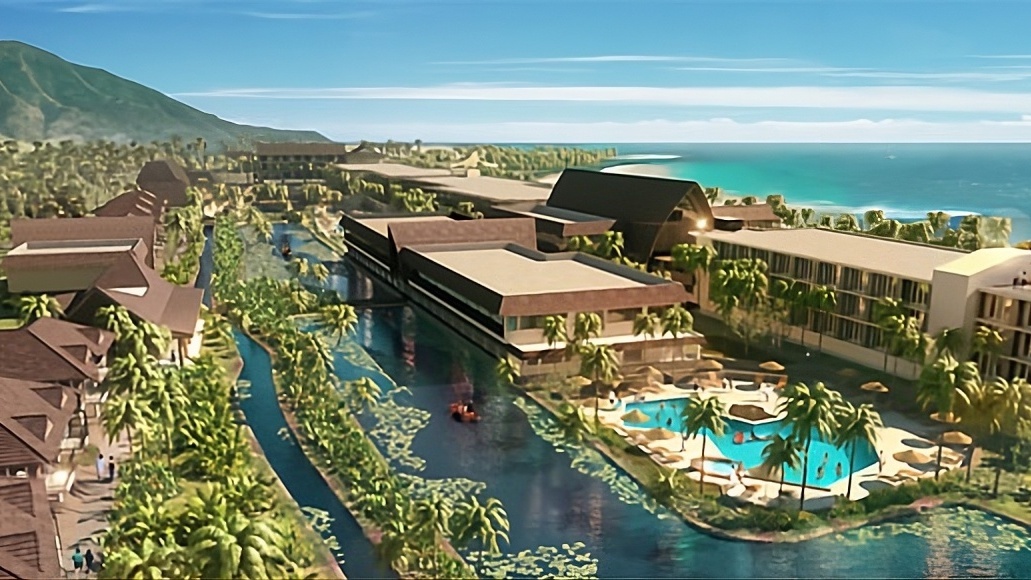
Anyone driving on Kuhio Highway past Wailua Bay on Kauai already knows why this story never ends. You look over at Coco Palms and try to make sense of what you see and what has been promised for years, and it never lines up. The old concrete shells are gone, but that’s it, and the site doesn’t look like a resort build closing in on an opening. For something once planned as a $400 million redevelopment targeting 2026, the absence of any visible construction above ground stands out immediately.
This time, three separate things are happening at once. First, the developer has walked away from 2026 and is now pointing to 2028. Second, the county permit record for this site is a tangle of expired, stalled, and unissued filings going back to 2006. And third, a Kauai mayoral race is now underway in which the candidates’ records on this exact property are no longer just trivia. Any one of those would be a story. Together, they are the reason Coco Palms is back in front of readers this week.
For those of us who have followed this property through hearings, ownership changes, permit fights, and repeated on the ground visits, we see it very differently. It feels like another turn in a cycle Kauai has now watched play out for decades without ever reaching any outcome that would end it, be that a functioning hotel with guests or something else entirely.
What you’re actually seeing at Coco Coco Palms.
From the highway, the most obvious change is what is no longer there. The large concrete buildings that dominated the decayed property for decades have been demolished. That alone was meaningful, coming after so many years. But clearing a site and building a hotel are far from being the same thing.
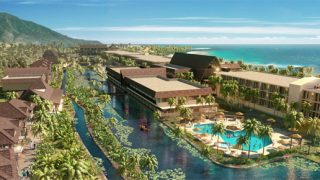
What is missing is momentum. There remain no visible signs of new structures, no framing that signals a project nearing completion, and no other steady progression that would in any way suggest a path toward reopening. For a significant 350-room resort planned across multiple low-rise buildings with cottages, pools, restaurants, and a cultural center, the lack of progress is outstanding.
This story keeps coming back, not driven by press releases, but instead by what people on Kauai see every time they pass that famed stretch of highway.
The 2026 reopening date for Coco Palms is gone.
This latest update comes from Reef Capital Partners. That’s the Utah-based firm behind the redevelopment through Coco Palms Hui. In comments to a recent trade publication, the company acknowledged construction delays and shifted the target opening date to 2028.
The developer’s explanation notes nationwide construction challenges, compounded by the realities of building on Kauai, which have slowed progress. Reef has said approvals were secured years ago, permits were pulled more recently, and work has focused on demolition and selective preservation of historic elements.
What makes this harder to accept is how the project was positioned during its most recent reset. When the Kimpton affiliation was announced, and the redevelopment was framed as a 350-room resort under a recognized brand with a named operator, the conversation shifted. This was no longer a long-term possibility or a speculative rebuild. It was presented as something underway, with structure, backing, and a timeline that finally carried weight.
The 2026 reopening date became part of that framing, and it circulated widely enough that people began to treat it as real rather than aspirational. Now that the date is gone, the replacement does not carry the same confidence.
The current phase under Reef Capital Partners reset expectations again, eventually adding the Kimpton name and a firmer narrative around timing and execution. What has not followed is the kind of visible construction progress that usually backs up that narrative.
Permits are still a fault line.
Permits have been a recurring pressure point in this project for years, and that has not changed. Beat of Hawaii has covered the tension between long-standing permit approvals and the lack of visible progress, including in our earlier look at Coco Palms Kauai Rebuild Starts Now | Unbelievable?, and the broader question of how a project can remain active on paper while almost nothing changes on the ground.
A county source has indicated that some of the building permits tied to earlier plans have expired and will need to be reissued to comply with the current building code. The county’s own permit records tell a similar story. Multiple Coco Palms permits dating back to 2006 remain in plan check or approval status as of today, including permits tied to older ownership entities.
In the 2025 permit record reviewed for this article, the active Coco Palms entries appear to show demolition-related activity rather than hotel construction permits. That adds yet another layer back into a project that has often been optimistically described as ready to move forward.
Legal and compliance issues never fully cleared.
The legal and permit story is a major part of why the project has never moved cleanly from promises to completion. In 2023, the project was hit with a state cease and desist order tied to unpermitted work, followed by a separate dispute over permit revocation that added another layer of instability, raising questions about compliance and oversight. One of the most striking details from that situation involved the removal of nearly 80 coconut palms without a permit, which deepened island skepticism about how the site was being managed.
Two years ago, a state appeals court threw out the earlier foreclosure that put the current ownership structure in place. Ownership eventually reverted to the Coco Palms Hui, and a separate effort to stop work on the property was rejected by a Kauai judge. Nothing has either killed the project or given it the kind of clean legal footing you would expect from a project so old and seemingly so close to opening. So it has kept moving, but through a long series of fights rather than steady progress.
This has never been just a construction story.
Coco Palms sits in Wailua, on Kauai’s Eastside, an area with deep cultural and historical importance. That too has been part of the debate from the beginning. The property is tied to Kauai’s last queen, Deborah Kapule Kekaihaʻakūlou, and occupies land that carries meaning far beyond tourism or redevelopment.
Ground-level opposition to rebuilding it as a hotel has been consistent, well-organized, and focused on different visions for the space’s future.
Now there’s a Kauai election backdrop.
The 2026 mayoral race is underway, with candidates former Mayor Bernard Carvalho and current Council Chair Mel Rapozo. Council Member Felicia Cowden is also in the race, though widely viewed as the long shot among the three.
Coco Palms has not yet become a defining campaign issue, but the candidates’ records on this specific property are not neutral, and voters who care about what happens on that land will be watching closely.
One of the reasons Coco Palms has been able to proceed under older standards is the so-called Iniki Ordinance, a post-1992 hurricane provision that allowed some projects to continue under rules in place at that time. That grandfathering is why the current Coco Palms plan does not have to fully comply with newer requirements, such as shoreline setback rules, that would otherwise apply to a property across from an eroding, fortified coastline.
Both Carvalho and Rapozo have been on the record supporting the extension of that ordinance in ways that benefited Coco Palms redevelopment. Carvalho’s recent campaign fundraising has reportedly included a contribution from an architect with a long history of involvement in efforts to rebuild Coco Palms.
Rapozo, on the other hand, once took a sharper stance. In 2023, he proposed exploring eminent domain to take the property for public use, saying, “I am not going to sit here and watch lie after lie after lie, promise after promise after promise.” The statement drew applause in the council chamber. Yet within weeks, he shut down further public testimony on eminent domain, and the idea faded from the county agenda.
Cowden has been consistent. She has repeatedly opposed the hotel plan in public hearings, mentioning traffic, flooding, hazard mitigation, and sea-level-rise concerns, and has told Beat of Hawaii that she sees a better future for the property as a cultural or wilderness park. Whether that position gains traction in a mayoral race dominated by two better-funded old-time candidates is an open question, but her record on Coco Palms is by far the clearest.
Latest Coco Palms timeline shift.
In some ways, moving this out two more years to 2028 looks like just another two-year delay in a clearly difficult project. On Kauai, however, it feels like one more example of a project that has never crossed the line from concept to certainty.
Oddly, the site keeps evolving just enough to keep the redevelopment story alive, but never enough to bring it to fruition. After 17 years of covering Coco Palms, that is the honest Beat of Hawaii takeaway from this latest change. The property is no longer the untouched, falling-down ruin it once was, but it is also not a clearly advancing resort with a clearly defined path to opening. It sits somewhere in limbo, shaped by its history, legal struggles, and cultural importance as much as by any current construction plan.
The new 2028 date does not feel like firm plans, but rather like just another date in a never-ending story. What is different this time is that Kauai voters are about to have a direct say in what the next chapter could look like. The next mayor will be the one making the decisions that determine whether this story ever ends.
After everything you have seen and heard about Coco Palms over the years, do you still believe this project will open as planned, and should Coco Palms be a front-and-center issue in the 2026 Kauai mayor’s race?
Lead Photo is the 2018 rendition of the new Coco Coco Palms.
Get Breaking Hawaii Travel News

I am a 100% behind Felicia Cowden. She has stayed loyal to the Hawaiians, always tries to look out for their best interests, and a brown paper bag is not going to motivate her decisions. The Gool Ole boy club, we most likely will see another 340 hotel with no parking to accommodate, no sewage treatment plant to manage the 500 toilets and showers, no housing to support the workers, no roads/infrastructure that can accommodate another 500 cars. No overpass bridge to the beach to allow for safe crossing, so more pedestrian accidents are going to happen. The local neighborhoods will be stuck with tourism cars lining their streets because of the lack of available parking at Coco Palms. Not to mention that what little parking they will have will be super expensive to push the cars out along the roads. Hawaiians want tourism, but they want the Aloha. This push for a bigger tax base isn’t balanced or Aloha, and it doesn’t serve the community well.
I use to love the Coco Palms, and staying there. Now Hawaii wants to be it’s own country, and I think we should just let Hawaii do that. Obviously, the people of Hawaii has no need or want of tourists or fellow American’s visiting and enjoying their private Paradise.,
Yes, the Coco Palms issue should indeed be front and center with the election. And if I could vote I’d vote for Cowden. Why? Because it’s more than just about the Coco Palms itself. It’s about the direction the people of Kauai want their island to head in the future. Seems to me there’s a helluva lot of griping about over-tourism yada yada so here is their chance to take a stand and say we don’t need a luxury resort there.
Besides, the reality is that stretch of land is not the place for a luxury resort
Kamehameha Schools demolished the Keauhou Beach Hotel in Kona to create the Kahaluʻu Ma Kai into a 22-acre world-class educational and cultural gathering place. This what should be done throughout Hawaiʻi to educate people about the true cultural value of the land instead of having stupid tourist versions of lūʻau or fire dances.
None of this news is surprising. If, as someone else mentioned, there is a deeper root cause or meaning, I suggest that it is the people of Kauai who are at a conflict with each other as to what they want.
Just as on Oahu with the “stairway to heaven” dilemma, the residents canʻt seem to agree on a course of action. There could be no other reason or excuse for an almost 4 decade delay. I have no personal preference either way as to some sort of completion, but I am hoping with the upcoming election, a clear voice will have the power and conviction to end the limbo of this project. Has anyone ever put the question directly to the people of whether they want development or a park/cultural site?
I’m with Felicia Cowden on this – turn it into a cultural area or a park. Restoring the property to as original state as possible would be respectful to the Queen. The last thing needed is another resort complete with more traffic!
Fines, then fines, and then more fines. After that, foreclose.
Make it a culturally appropriate park.
Yeah… as expected. I believe the last time the story ran here I said basically the same thing.
I’m buying beers for Everyone if this thing is build in the next 10 years.
Kitty and I drove past the Coco Palms on September 9, 1992. It looked like a very nice resort, but we thought it more expensive than we’d ever be able to afford. 33 1/2 years later, it is an eyesore that has existed since 9/11/92. Yes, probably 95% of the property that was badly damaged by Iniki has been removed, but the final 5% is right by the highway and must be a daily reminder to those who experienced that terrible storm of 9/11/92. To us, who left as scheduled on 9/10/92, and returned for a visit every year since 1994, it is just an ugly eyesore on a beautiful island that provides so much beauty and Aloha.
It seems to me that Kauai voters have elected questionable leadership for the past 30 years. This Needs to be addressed seriously.
Gary
There are bigger fish to fry than Coco Palms, which for the most part our elected officials have dealt with respectfully. A visitor isn’t going to have the best knowledge of the ins and outs of local government. Just stay away if you think that is the most important thing for our county to focus on.
The root cause of why a succession of developers continue to hold onto development rights of the site is most likely the perceived value of the “grandfathering” under the “so-called Iniki Ordinance, a post-1992 hurricane provision” mentioned in your article. I suspect developers will never give up until that privilege is revoked. At this point, the sentimental value some potential visitors may have for the history of the site is negligible. Regardless of what one thinks of more development on Kauai, there are better sites available.
If the county government won’t step up then it might be helpful if some of the wealthier folks on Kauai get together and create a donation matching site to fund buying the developer out and preserve the site from commercial development. I don’t know what the matching ratio would have to be to incentivize regular folks to contribute enough, but I’m guessing it would have be more than one to one.
I think they should clear away the hotel remains and leave the site as a Hawaiian historic site. Maybe a park where people could walk and remember the site history, all the way back to before Coco Palms.
Aloha I think the site is better suited now to be a Cultural Park. Restore the habitat and put walkways in to enjoy the flora and fauna. A hotel would clog that corner with traffic on an already clogged busy highway. And the rates for rooms would be very expensive so that only the very high end travellers would stay there. The area is not exactly attractive nearby being rural with local families. The desired areas are South and North Shores for the wealthy tourists to stay.
How do businesses continue to put millions and millions of $ and effort into planning, lobbying, and destruction (so far) for this property, and then delay opening until finally cancelling? Then another company comes behind that one and does the same thing, and the cycle continues?
That doesnt make sense.
With the track record of that redevelopment tried and failed over again, wouldn’t new companies see the futility and the cash dump that property is and run in panic?
Businesses run on “bottom line”. Sounds like there is something deeper. BOH, will you be the reporting org that uncovers the deeper story?
The answer to your question is OPM – Other People’s Money. Developers use a small amount of their money combined with money from investors to do a project. For a project like this they may pay a small amount of up front costs to get a project moving and expect that others will provide the big money to actually make it happen. It is not at all unusual for a developer’s idea and projections to be very optimistic which makes it difficult to attract the investors. I’m guessing that each of the failed attempts to rebuild Coco Palms stalled for the same reason, investors didn’t buy the optimistic projections of the developer. I’m surprised someone actually corralled enough money to actually do the demolition work this time.
All of the objections people have about this project and the reasons why it’s a not a good location for a high end hotel are likely the reason that 2026 completion didn’t happen. They are likely still looking for some OPM to make their dream come true.
Hello! Thank you so much for this update. I have been searching for months for information on the progress (or lack thereof). It is disappointing but not at all surprising.