
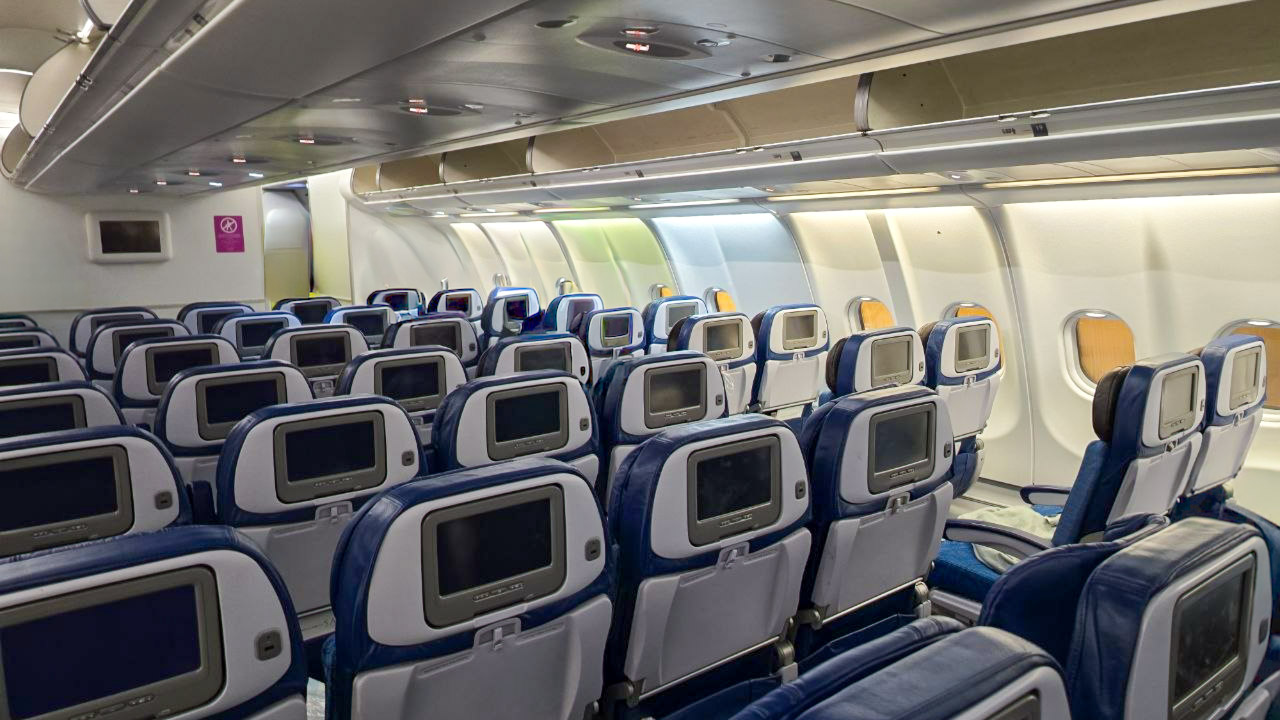
Hawaiian Airlines’ passengers may have helped shape a future where built-in entertainment screens depend on how much you pay. Alaska says what it has been seeing on those Hawaiian flights helped shape a future aircraft where built-in entertainment screens stop at the premium cabins.
On its upcoming Aurora-configured 737 MAX 10s, passengers in Aurora (business) and Premium Reserve (premium economy) will get large 4K screens, while Premium Class (extra legroom) and Main Cabin (economy) passengers will rely on Starlink and their own phones, tablets or laptops.
Alaska told PaxEx.Aero that use of Hawaiian’s A330 seatback entertainment declined on trans-Pacific flights. That’s directly relevant to mainland-Hawaii flying, but the system Alaska appears to have been measuring is one we’ve found dated ourselves, with small screens, an old interface, and no Bluetooth.
Hawaiian’s old screens complicate the conclusion.
When we reviewed Hawaiian’s A330 entertainment system, using our own devices could easily be more appealing than using what was installed in the seat. That makes declining usage harder to interpret than simply concluding passengers no longer care about seatback entertainment. We still do.
They may be losing interest in screens of an aging system that compares poorly with the phone or tablet they already own. We don’t know how large the decline was, which Hawaiian routes were included, how many passengers were measured, or exactly how they calculated usage.
United gives Hawaii travelers a much better example of modern seatback entertainment. Its newer interiors combine high-definition screens with Bluetooth, allowing passengers to use the airline’s system and their own devices together at the same time rather than choosing one or the other.
That is also much closer to what Alaska itself plans to install in the front of its new MAX 10s. Using Hawaiian’s current A330 system as evidence about what passengers want becomes more complicated when the premium product replacing it is vastly better.
The new Alaska MAX 10.
The first 12 seats in the narrow-body will be Aurora lie-flat suites with 19-inch 4K screens. Behind those, 12 Premium Reserve seats will have 38 inches of pitch, greater recline, leg and calf support, and 16-inch 4K OLED screens.
Alaska has practical reasons for ending the installed entertainment there. The aircraft changes from a 1-1 business, then 2-2 Premium Reserve layout to 3-3 seating farther back, creating an engineering issue for the first economy row, while Alaska executives were separately cited as suggesting difficult seat-certification timelines, while there’s the need to get the new product into service without waiting for another seat-development program.
Premium Class (extra legroom) doesn’t get the entertainment either. Those passengers pay for more legroom, but under the MAX 10 plan as we know it, they still get Starlink and use their own devices, just like Main Cabin (economy). That’s familiar for travelers who already fly Alaska’s narrow-bodies or Hawaiian’s A321neo, where seatback screens aren’t part of the experience today.
Hawaiian’s rebuilt A330 is taking a different path.
At roughly the same time these MAX 10s begin arriving, Hawaiian’s rebuilt A330 is scheduled to replace the seatback system Alaska has been measuring. Main Cabin is set to receive new 13-inch 4K OLED screens with Bluetooth, while the higher-paying tiers will get 16-inch or larger displays.
Alaska is making its choices while other U.S. airlines continue reinvesting in seatback entertainment. United never abandoned it, while American has reversed years of relying heavily on passengers’ own devices and committed to putting screens throughout its narrow-body fleet.
BOH readers have already been outspoken and divided on this. When we wrote about seatback screens disappearing from Hawaii flights, some readers said a screen could influence which airline they booked, while others were perfectly happy with their own phones or tablets as long as the Wi-Fi and power worked reliably. And a few others said they don’t care about any of it.
Free Starlink certainly makes the no-seatback required view easier to understand than it was when passengers had to depend on slow or expensive inflight Wi-Fi. It still doesn’t answer whether travelers would use a good modern seatback system differently from Hawaiian’s aging one.
The MAX 10 isn’t a Hawaii plane – yet.
Alaska says at least 25 of the specially configured MAX 10s will begin entering service in 2028 on select transcontinental routes. It hasn’t announced them for Hawaii, so we aren’t turning a highly plausible future assignment into a route plan Alaska hasn’t started.
Yet Hawaii travelers are already part of the evidence Alaska used to decide what goes inside these new planes.
If these MAX 10s eventually appear on mainland-Hawaii routes as we suspect, would free Starlink and your own device be enough, or would a modern built-in screen influence which airline or cabin you choose? Would your answer change after using a newer system like United’s compared with the aging system still found on Hawaiian’s A330 today?
By Rob and Jeff, Beat of Hawaii.
Some of the most meaningful parts of Hawaii are the ones visitors walk right past without knowing they are there. We’ve spent nearly 20 years finding them firsthand for BOH as full-time Hawaii residents reporting on travel, culture, and island life, and telling you what they mean for your trip. Join us →
Get Breaking Hawaii Travel News




Personally, not a fan of seatback screens so happy to hear these will be disappearing from the main cabin. Never liked getting stuck watching someone else’s movie and all those screens were a bit overstimulating for my nervous system. It is easier to avoid your neighbor’s screen when it is on their tray table instead of on every seat in front of your. Thanks for the update!
Aloha~ Price, price, price ~ Time, time, time ~ Loyalty program, loyalty program, loyalty program drive the buying decision. Next time you are on a flight, take a look how many people are actually using a built-in entertainment unit vs their own device, sleeping or reading. The reliability of Starlink and using your own device has shifted that paradigm. One other point, I do not believe that Alaska pulled their research out of a hat, so curious why it is being questioned. I give them solid marks putting together and new airline, as it is a cumbersome task and I speak from experience having been involved in two major mergers. You make not like the outcome, but you get to choose where you spend your dollars so spend them wisely. Cheers
It doesn’t matter to me. We go to Kauai once or twice a year from the Bay Area and typically to Europe once, sometimes twice a year. I have also taken a few hundred flights for business meetings and I have never watched a movie on a flight. I read books when I fly, the last few years on my Kindle. The only thing I ever watch on a flight if there is a seatback screen is the flight data (location, speed, altitude, etc.). We flew to Rome in May, soon after Alaska started their service in the B-787. We enjoyed the flights in the extra legroom coach section and I only had the screen on as noted above. I would like the screens for that purpose.
Thanks I prefer less glass in my face when and where a plane may go down or crash. People that flew 40 years ago never has screens so why would they need them now? Up charge just like they did headphones.
They are forcing people to pay more for comfort and now entertainment. That way is the price difference between economy and premium first class justifiable? Charge double or triple the economy rate just to get a back seat screen. Seriously they made their money in the difference in the seat costs. IMO Hawaii flights offer no value and the desire may only exist in the passengers who spend and money is burning a hole in their pockets. Their IMO are those folk that do brag on how much they spent going to Hawaii as some status symbol or bragging rights thing too.
Why is this a surprise? Since the merger – I can’t find much to celebrate about the new combined airline. Just giving the consumer a ‘good’ reason to fly based on price alone and not on loyalty with the resulting mile credits for future upgrades or ‘free’ flights.
Why not put them in coach as well, and charge a fee for usage. I would pay an extra $10-15 per flight to use them.
I’ve only used the back seat entertainment system when flying international long hauls. A 5 hour flight from the mainland to Hawaii doesn’t qualify. We make that trip repeatedly every year and the only thing we’ve used the back seat entertainment system for was for the flight path information. Otherwise it is a waste, if I want to listen to music, I listen via Bluetooth from my phone to my headphones, or ear jacks. I’ve never watched a movie, too small of a screen, and when not watching a movie, I read from my tablet or Kindle device. I wouldn’t pay extra to have a TV on a flight that wasn’t international.
Coming from the new school of Hawaii travelers (my first visit was in 2021) my flight choice is based on available departure and arrival times and cost. In-flight entertainment and food are secondary and don’t really influence me either way. And since I never experienced the heyday of Hawaii travel that BOH writers and readers long for, I can’t miss or be influenced by losing something I never had.