
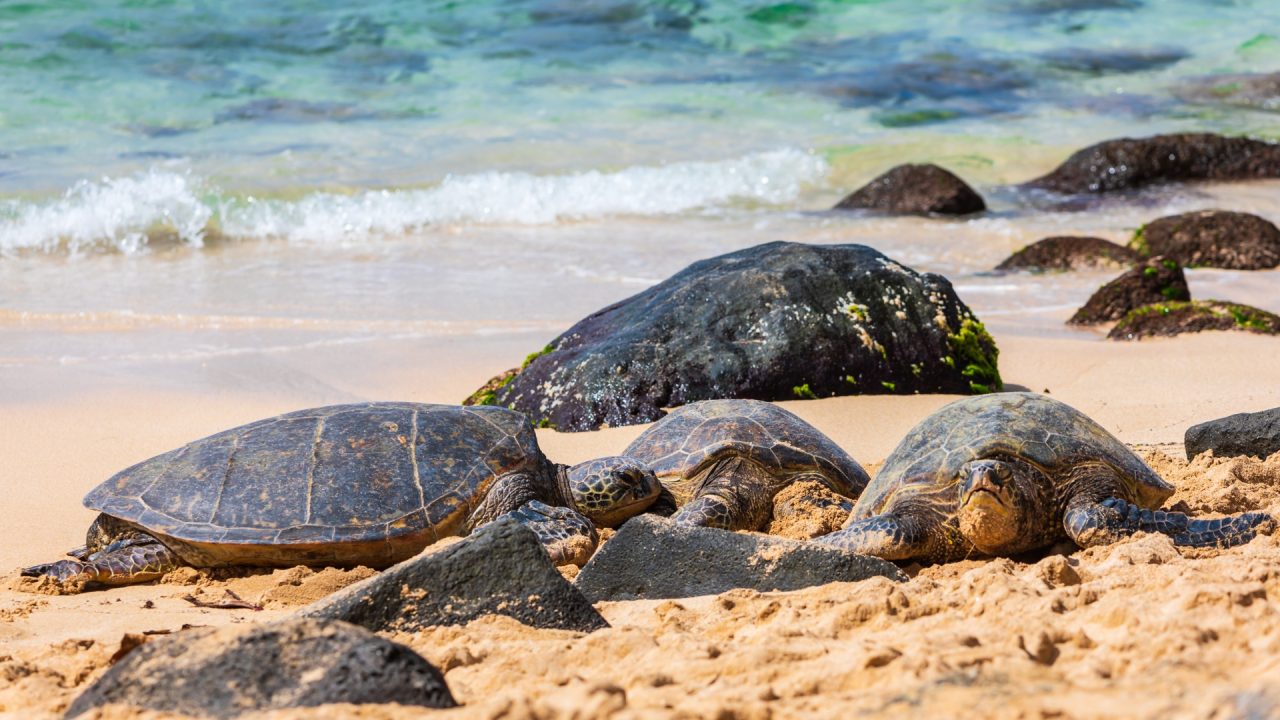
Visitors driving Oahu’s North Shore have always loved Laniakea Beach near Haleiwa. It’s where the traffic suddenly slows, rental cars begin lining the shoulder of the Kamehameha Highway, and another cluster of visitors walks toward the sand, hoping to glimpse sea turtles resting near shore. Some stay just minutes while others linger longer, and some may never have planned to stop at all until they saw the crowd gathering along the road.
That familiar Oahu North Shore event may disappear under a proposal one Oahu lawmaker is now publicly discussing. Resourceful State Rep. Sean Quinlan said this week his goal is to shut down Laniakea Beach Park to non-resident parking and require visitors to pay and ride a shuttle if they want to come to see the turtles.
Quinlan made the comments during a May 10 press interview while discussing traffic and visitor management ideas tied to Oahu’s North Shore. His exact quote was this.
“My goal is to shut down Laniakea Beach Park to non-resident parking, and if visitors want to see turtles, they have to pay us money and ride the shuttle instead of taking their rental car down there and creating traffic.”
For visitors, the quote hits hard while also translating into something practical. One of North Shore Oahu’s best-known roadside stops may eventually stop functioning the way travelers heading toward Waimea Bay, Sunset Beach, or Haleiwa have always known it. Instead, visitors wanting to see the turtles could find themselves parking elsewhere entirely, paying a parking and shuttle fee, and boarding transportation to the area. This is part of the upcoming shift we mentioned when Hawaii’s plan to bring new visitor controls to Oahu’s North Shore first surfaced, and was now spelled out by the lawmaker leading the effort.
That would be very different from the way Laniakea has long worked. There has never been an entry gate, a timed reservation, a transportation requirement, or a formal access structure tied to the experience. Visitors arrived as they did, squeezed into whatever parking they could find, got to the right side of the highway, and hoped turtles were there on that day.
Laniakea has become one of Oahu’s most difficult roadside stops to manage.
Anyone who has driven through Laniakea recently, as we did, understands why the area keeps resurfacing in traffic and access discussions. The parking situation frequently spills onto the highway shoulder, pedestrians cross unpredictably through traffic, and drivers slow suddenly once they realize either that turtles are visible at the beach or that something interesting is happening.
Part of the issue is merely physical limitation, since Laniakea was never designed to absorb the amount of visitor attention it now gets. The beach itself is relatively small, legal parking options remain limited, and the highway corridor leaves very little room to maneuver once vehicles are backing up along the roadside.
Online, in comments and emails, visitors describe the parking as scarce, hectic, and difficult but doable, with most saying the turtles make it worth the effort. Local discussion threads have debated the same fixes for years, including moving parking to the ocean side, adding a pedestrian bridge, or charging a parking fee. None of the visitor sentiment, at least, is asking for a paid shuttle, and residents are split on whether charging would help or just push the same problem somewhere else.
The visitor pattern at Laniakea also differs from that of most traditional beach parks. Most people are not arriving with towels and coolers for a long beach stay. Instead, they are making short stops specifically to see turtles before continuing farther along Oahu’s North Shore. The result is a constant turnover, repeated braking, sudden lane changes, and a steady flow of pedestrians moving back and forth across dangerous Kamehameha Highway.
The state has already been addressing some of those issues through the ongoing Laniakea Beach Improvements and Safety Project, a roughly $19.5 million highway realignment that includes roadway changes, pedestrian improvements, and a new bridge intended to improve safety and traffic flow through the area.
The Department of Transportation realignment near Laniakea has been underway for months, and parking and roadside access in the area are part of that project. First-time visitors often arrive expecting a loose, pull-over-and-watch experience they have read about or seen online, only to find something more managed than they expected. But that’s nothing compared with what’s envisioned.
What Quinlan described goes far beyond any highway improvement project. Rather than managing congestion more safely, the concept would fundamentally change how visitors access Laniakea.
Visitors on Kauai already know how this kind of system works.
Travelers familiar with Kauai’s North Shore immediately recognized similarities between Quinlan’s comments and the visitor-access systems that have been operating for years at Haena State Park. Visitors there now must make advance reservations, have limited parking allocations, and use shuttle transportation from Hanalei rather than simply driving directly into the area whenever they want.
The biggest adjustment many visitors tell us is not the cost itself but the loss of spontaneity once such transportation schedules, reservations, parking limits, and timed entry windows become part of the Hawaii experience. A beach outing now requires planning in ways that didn’t exist before.
Laniakea clearly differs from Haena in several important ways. Oahu’s North Shore is more heavily developed, far more accessible, and directly tied to one of the busiest visitor corridors in Hawaii. Still, Quinlan’s comments suggested that at least some Hawaii officials now see managed transportation as a workable answer for heavily visited beach areas facing unrelenting traffic pressure and overcrowding.
That is the larger shift many visitors are noticing throughout Hawaii.
Visitor and resident discussions increasingly center not on issues of controlling parking or widening roads, but on whether and how visitors can continue accessing certain places independently, whether in rental cars or otherwise.
Kauai’s Haena reservation system shows what that kind of access actually looks like. Nonresident visitors pay $5 per person for park entry plus $10 per vehicle for parking, with reservations required 30 days in advance and no same-day tickets. The North Shore Shuttle from the Waipa Park and Ride costs $40 per adult and $25 per child aged 4 to 15, with park entry included in the shuttle fare. Haena caps daily visitors at 900 and turns away anyone arriving without a reservation, replacing the prior spontaneous drive-out-and-see-it pattern that had defined the area for decades but had become entirely unworkable.
The Haleiwa staging concept reaches beyond turtles.
Quinlan also referenced state budget interest tied to property near Weed Circle at the entrance to Haleiwa. The site has repeatedly surfaced in traffic discussions because it sits at a natural transition point between Haleiwa town and the heavily visited coastline beyond.
The concept being discussed involves visitors parking farther from the beach corridor itself before boarding transportation to the intensely crowded North Shore areas. Quinlan indicated the initial focus would center on Haleiwa and Laniakea before potentially extending farther along the coastline toward Waimea Bay, Sharks Cove, Sunset Beach, and Turtle Bay.
This is all to say that the conversation starts with turtle viewing, then extends far beyond it. Once shuttle infrastructure and staging are in place, the same model can expand into additional beach areas facing similar traffic, parking, and beach strain.
For now, Laniakea remains the clearest first example because visitors understand the problem once they see the area up close. The roadside congestion is hard to miss, the parking pressure is too, and the pedestrian safety issues are concerning. The harder question is whether visitors will embrace the proposed solution.
None of this appears to be happening yet.
The Hawaii Tourism Authority destination management discussions tied to these broader access conversations and the ultimate decisions remain in draft form and are still under review.
Community meetings are still taking place, and some broader implementation discussions remain years away rather than imminent. Some visitors will read Quinlan’s comments and assume Laniakea parking is about to disappear this summer. Nothing currently suggests that this is happening, and honestly, we don’t know how soon this can be implemented. Yet the direction is clear.
Visitors driving Oahu’s iconic North Shore in 2026 should still expect the same basic Laniakea experience they encounter today: roadside parking pressure, periodic traffic crawls, ongoing construction, and crowds gathering whenever turtles are visible near the shore.
Quinlan’s recent comments offered one of the clearest public descriptions yet of where some Hawaii officials want these conversations to end in the long term. Visitors would eventually stop driving there themselves and instead park elsewhere, pay, and take transportation into the area. How widespread this could become remains to be seen.
That changes how people picture the future of the North Shore drive itself. For decades, one of the defining parts of visiting there involved the freedom to stop spontaneously whenever something caught your attention along the way. But that has been loved too much.
Laniakea will now lead the growing debate over whether that style of travel in Hawaii can continue amid mounting visitor pressure, traffic concerns, and infrastructure constraints.
Would you still stop at Laniakea if turtle access eventually required off-site parking and a paid shuttle ride?
Get Breaking Hawaii Travel News


The realignment of Kamehameha Highway with parking on the beach side of the highway should alleviate traffic congestion and help keep tourists from crossing the road…charging tourists to park and pay to be shuttled Diminish es the experience of the north shore experience!You are taxing tourism again!!Where does it end??No tourism means No money for the state!!
Hawai’i gov wants tourists $ at any loss. Grew up as a teen in the 60’s Laniakea back when the Honu population was nearly gone from over fishing. And remember one day paddling out seeing a Honu with a spear all the way through its entire body … not something a teen should ever have to see. Then a few years ago, there were 2 young Asian women taking pics giggling while sitting On Top of a large Honu who had been resting on the beach … and I went instant total mental all over them! Thankfully many of the different kinds of Honu populations have rebounded, due to conservation efforts … but not all as some still endangered.
Anyways, clearly tourism globally has reached a real crisis, due to way too many and some vandalizing wherever they go … just like the recent tourist throwing large rocks at a beloved localMonk Seal on Maui. Some cities like in Italy are now banning where tourists can go and think some are going to limit how many visitors will be allowed into their country.
Will there be …toilets on these shuttle vans? There’s been none at Lani’s all these years and no plans I’ve heard of to install them. Maybe other readers know better?
Let me see, you are going to force non residents to park off site and take a shuttle to see the turtles whether they are there or not. Who is responsible for the unattended parking lot? You can say the State is not responsible for break ins or loss property, but I believe they are if that is the only way to visit that beach area. You have now created another fish pond for those people less inclined to follow society’s rules.
Also how many people per shuttle 25 plus? Talk about overwhelming a beach when you have no control over how many locals are there at the same time.
You hit the nail on the head with this one sentence: “Laniakea was never designed to absorb the amount of visitor attention it now gets”.
This is the problem we have across the entire state. There are simply too many people all in search of the same experience. It’s overwhelming resources and creating traffic jams in places that are not equipped for the volume of visitors.
As a resident of Hawaii, I have no problem with the state regulating with fees and restrictions. While visitors will complain about all the taxes and fees and threaten to stop coming, it’s an empty threat. For every visitor that stops coming, there are 3 more willing to take their place, and that’s the problem in a nutshell.
I understand the need for traffic control, but I would not go. Once again, no spontaneity. Once again, more money out of my pocket. There would also have to be set time limits on how long you can stay. What if you make a reservation and pay a month ahead of time, but there are no turtles that day, or all the turtles have left by the time you get there? It’s not like you can stay for a few hours and enjoy beach-time if they aren’t there, because, like you said, this is most likely a short stop to somewhere else.
If I ever get to afford to come back to the Isles of Aloha, I hope to see a turtle or two lying on a beach or swimming in the water if I am snorkeling, because I decided to stop at that particular time and place, just by chance alone.
good point. last year, in December, no turtles.
An unfortunate, but predictable consequence of overtourism.
This is just one more example of why frequent Hawaii visitors are not considering Hawaii anymore. The complexity of having to manage all these reservation systems on each island, the resort fees, the complexity of hotel and airline fees, take much away from the Aloha experience.
Seriously – what else can we expect? The state’s constant push for more visitors had to run into a limit somewhere. Residents can’t go where they need to go when the only highway is gridlocked. Laniakea, Hana, Hanalei – same story. We need to limit visitor numbers, or Hawaii won’t work for either residents or tourists.
“Laniakea Beach…Park” When did Turtle Beach at Lani’s Surf Break become a Park please?
Dreams come true inv state Hawaii where everything is only another fee, tax and restriction away.
Terrible idea. Does Hawaii want tourists or not? Because we keep getting jerked around.
They don’t want tourist’s at all. Give Hawaii back to the Hawaiians. We don’t do this to them when they come to the mainland.
It took 13 years for the DOT realignment to start at Laniakea, we had been asking for it for at least 13 years, I kept posting on Facebook the map showing that the City actually owned the land that the cows were grazing on, so they had plenty of room to move the road over. I’m hoping that the parking lot on the ocean side will be like The Blow Hole, or Makapu’u Lookout, and will facilitate seeing the turtles from above without the need to go down to the beach to disturb the turtles. It would be easier to see the turtles in the water from an elevated position. But having the parking lot on the ocean side should solve the traffic problem that is caused by people parking on the mauka side and then crossing the road to get to and from their cars. The Shuttle would basically be replacing the service that tour companies used to provide before Honolulu City Council banned tour companies from all of the beaches on the North Shore and East Side (Kailua and Waimanalo).
I think Hawaiian Government needs to stop wanting more money, it’s certainly not helping residents or the tourist industry.
Give Hawaii back, and stop funneling money to them. We don’t charge them non residents fees when they come to the mainland.
“We don’t charge them non residents fees when they come to the mainland.”
Not necessarily true. Colorado, for example, charges non-residents more for state parks and camping than they do for residents. Can’t provide links here, but do a search on “Colorado parks residency requirements”.
Well … it has been successful on Ke’e Beach on the north side of Kaua’i. We don’t go there any more. Being from Arizona I fully understand the challenges of visitors and the impact. It is just unfortunate that it comes down to putting barriers in place to control access … which ultimately limits access.
No kidding. I never go to Ke’e Beach or the Kalalau Trail anymore thanks to these stupid, visitor-unfriendly policies. I wonder who the genius was who decided to make reservations available at midnight HST, which means being awake at 2am or 3am on the west coast to try and snag a parking reservation, which isn’t for a long enough time to hike to Hanakapiai Beach and back.
This is disappointing news. I understand the parking pressures. I’ve been there and had to cross that road with kids in tow. There’s no question it’s frustrating and a little risky. Last time we where there, they had created a little more of a parking lot on the opposite side. That made things better. But the experience is made because it feels like a discovery and a special treasure. Making it a trolley stop at what sounds like exorbitant (not nomimal just to force organization) pricing makes it a tourist trap instead. I hope I can go a few more times before this is implemented.
There are many other sites to see turtles on Oahu. (Google it)
My guess is most tourists are not going to want to take the time and hassle to ride a shuttle. Instead they will google and drive to find other viewing areas. Those areas will become the next “problem area”. Save one area, ruin others. Oahu still has many deserted beaches. That will change. Think Mokuleia.
Mokuleia is usually cloudy and windy
Answering your ending question:
I’m not paying for any of this s___.