
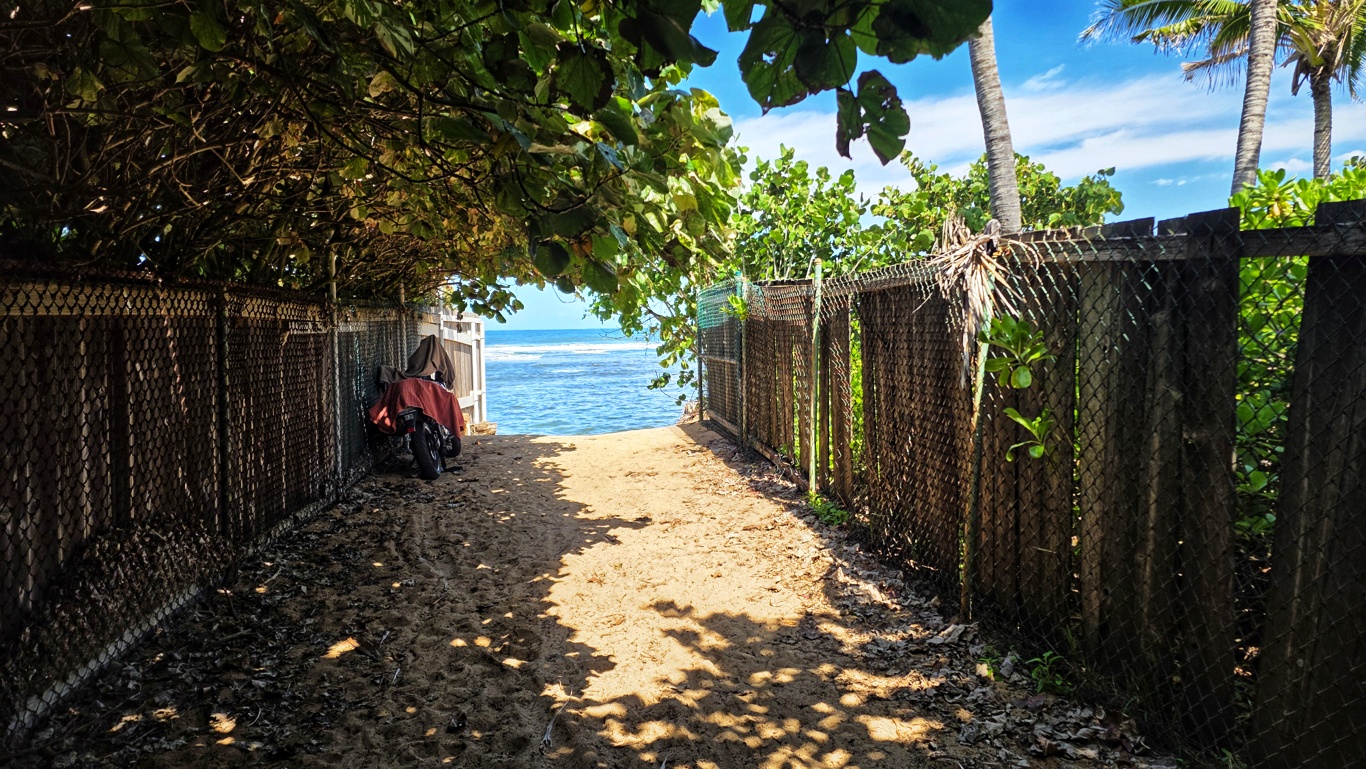
Mokuleia used to be one of those North Shore beaches on Oahu that didn’t require any special planning. You parked, you looked for the familiar opening, and within a minute or two, you were standing on sand with the Waianae Mountains behind you and the ocean straight ahead. It has been like that forever, and people remember it that way, which is why many visitors still arrive expecting a certain experience. We did too.
What visitors run into instead feels like a big change, even though nothing formally announces that access is no longer the same. The beach itself is still as we recalled, and the idea that Hawaii’s beaches are public remains true overall. But the narrow strip in between has become the problem, and public beach access itself is the part most people never think about until it’s suddenly gone missing. It is mostly all houses connected together with no beach access in between.
Visitors heading to Mokulēʻia today are not finding clear access paths.
In its place along Crozier Drive are mostly signs warning about private property, erosion damage that has eaten away what used to be passable, fallen trees blocking informal routes, and a seawall that now cuts off what once felt like a natural approach. All of it combines to create a different experience before anyone ever gets to the beach.

From the road, nothing reveals that access has been compromised. There are no clear signs explaining whether the typical route still works or if alternative beach access exists. People park, walk toward where paths used to be, then stop, unsure whether they are about to trespass or simply missing something obvious, with the beach visible and close yet feeling unreachable.
To visitors, especially those unfamiliar with Oahu’s North Shore, it feels like something’s wrong. This is not about one missing sign or one fallen tree, but about the accumulation of small changes that have taken place over time, each one minor on its own, but together turning a once-familiar beach into something that feels more inaccessible.
Hawaii’s constitution guarantees public access to beaches.
And that guarantee of public access is often quoted as reassurance. At Mokuleia, it rings less true the moment you stand there, wondering how you are supposed to get from the road to the sand. The issue is not whether the beach is public on paper, but whether access exists in practice, given erosion, wall-to-wall private land boundaries, and neglected infrastructure all converging in the same place without coordination or accountability.
Nothing dramatic happened, and there was no closure to speak of. The access simply degraded until it no longer worked. For visitors, the distinction between what’s public but inaccessible and effectively closed doesn’t matter, because the outcome is the same and the experience ends before it begins.
What’s happening at Mokuleia fits a broader pattern across Hawaii, especially on Oahu’s North Shore. Access points that worked for years are becoming harder to find and use due to erosion, development pressure, or basic maintenance that has never kept pace with changing conditions. None of these failures trigger alerts in most travel guides or navigation apps, and they are not obvious when people plan their itineraries, showing up only when someone arrives expecting a simple walk and finds an obstacle course instead.

This is the same problem readers keep describing in Hawaii.
Nothing is clearly closed, but it gets just hard enough that some people give up. It is not a permit system or a reservation requirement, and it isn’t solved by paying a fee or downloading an app. It’s just friction layered on top of friction until access disappears without ever being officially removed, in the Hawaii visitor industry that depends on predictable experiences for those who build their vacation days around beaches.
North Shore beaches still carry an assumption of openness. The beaches are often described as wild, undeveloped, and free, and that image still draws people out there, especially repeat visitors who remember earlier trips. When access is an issue, it feels personal, and visitors assume they missed something, arrived at the wrong spot, or misunderstood directions rather than concluding that the system itself simply broke.
That hesitation keeps most people from asking questions or pushing for clarity. They will simply leave disappointed, adjusting plans on the fly, which is why these access losses can continue for so long without drawing much attention and why, by the time frustration finally shows up in comments, emails, or articles, the damage has often been in place for years.
At Mokuleia, the state is reportedly aware of the situation and looking into it.
This is a phrase that has become familiar to anyone following beach access or infrastructure issues, and usually means a slow process without a clear timeline or interim guidance. For visitors planning trips now or in the coming months, this offers little help, since nothing official is being clearly communicated, and nothing is posted about beach access before people arrive.
The experience on the ground remains trial and error, with confusion and parking constraints doing most of the talking. Whether anyone intended for that to happen almost feels beside the point once you are standing there trying to decide whether to keep trying or to move on.
For Beat of Hawaii readers, this story sits at the intersection of expectation and reality, whether you plan carefully or rely on familiarity built over decades. Access failures like this change how Hawaii feels to experience, not in a dramatic way, but in a cumulative one.
Mokuleia could be addressed with clearer communication and intentional planning, but whether that happens soon or ever remains uncertain. What is clear is that the access people remember is not the same access they will find today, and this keeps coming up with visitors.
If you have been to Mokuleia recently, we want to hear what you encountered, including where you parked, where you walked, and where you stopped, because your comments help make sense of what’s happening while official answers lag behind.
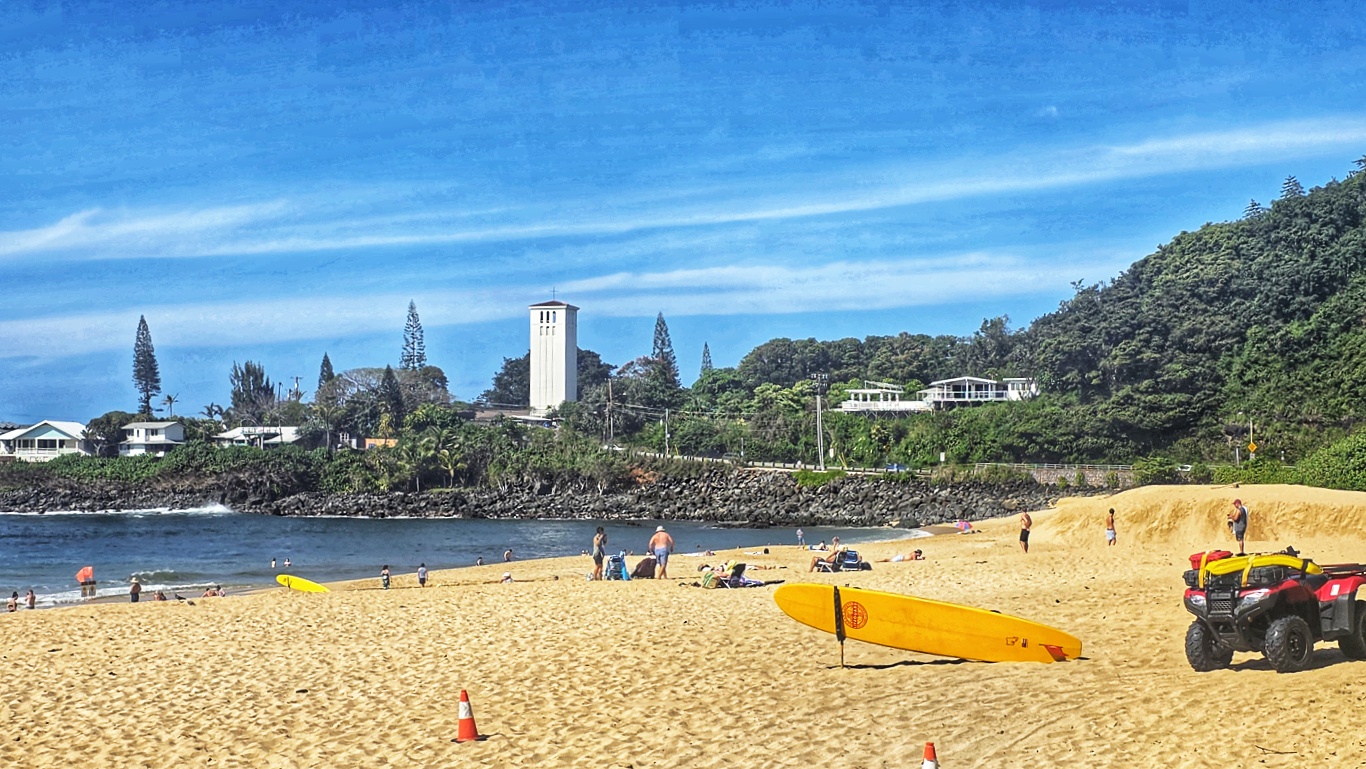
Photo Credits: © Beat of Hawaii on Oahu at Mokuleia Beach.
Get Breaking Hawaii Travel News


From your photo and the caption, access is at 257 A Crozier Drive …… is that correct? If not, where is access?
I haven’t been to this area in a very long time, but we never tried to go to Mokulēʻia Beach that you mentioned by all the houses off of Crozier Drive. We would just drive down Farrington Highway to Mokulēʻia Beach Park. This area had plenty of parking, facilities and the beach was at that time a lot wider. This is located at 8568 Farrington Highway, just 2.7-miles further West.
Aloha e Beat of Hawaii,
Auwe…We appreciate your perspective regarding keeping beaches in Hawai’i open however, as a Mokuleia resident I can attest to the fact that there is a flip side to this perceived open access. We live on a private one-lane road, Crozier Drive, that parallels much of Mokuleia Beach (near the beach access that your story pic was taken). Since the advent of Google Maps and the like, the number of people and cars traversing our private road has increased ten-fold. Along with this traffic comes vehicle-keiki issues, trash, trespassing, illegal parking, people cutting through yards, etc. We are all for beach access however not at the expense of local families and private land owners. There are plenty of nearby beach parks that were actually designed for this use. They provide easy access, parking, and often times showers, such as Ali’i, Kaiaka, ‘Aweoweo, Mokuliea, Polo, Kealia, Makaleha, and Army Beach that provide miles and miles of uncrowded beautiful beaches.
Grew up NS in the 60’s and so know how things have changed dramatically due to more aggressive disrespectful tourists. Even locals attitude has become if they do it, then so will I. So IMO, they need to use the beach parks! But even a few years at Waimea Bay on the N side of the beach by the rocks, I was about to settle in until I realized there were baby diapers and trash that was disgusting! So it’s not easy for beach front owners have to deal with all that.
What is limiting access in Mokuleia? No picture or description.