
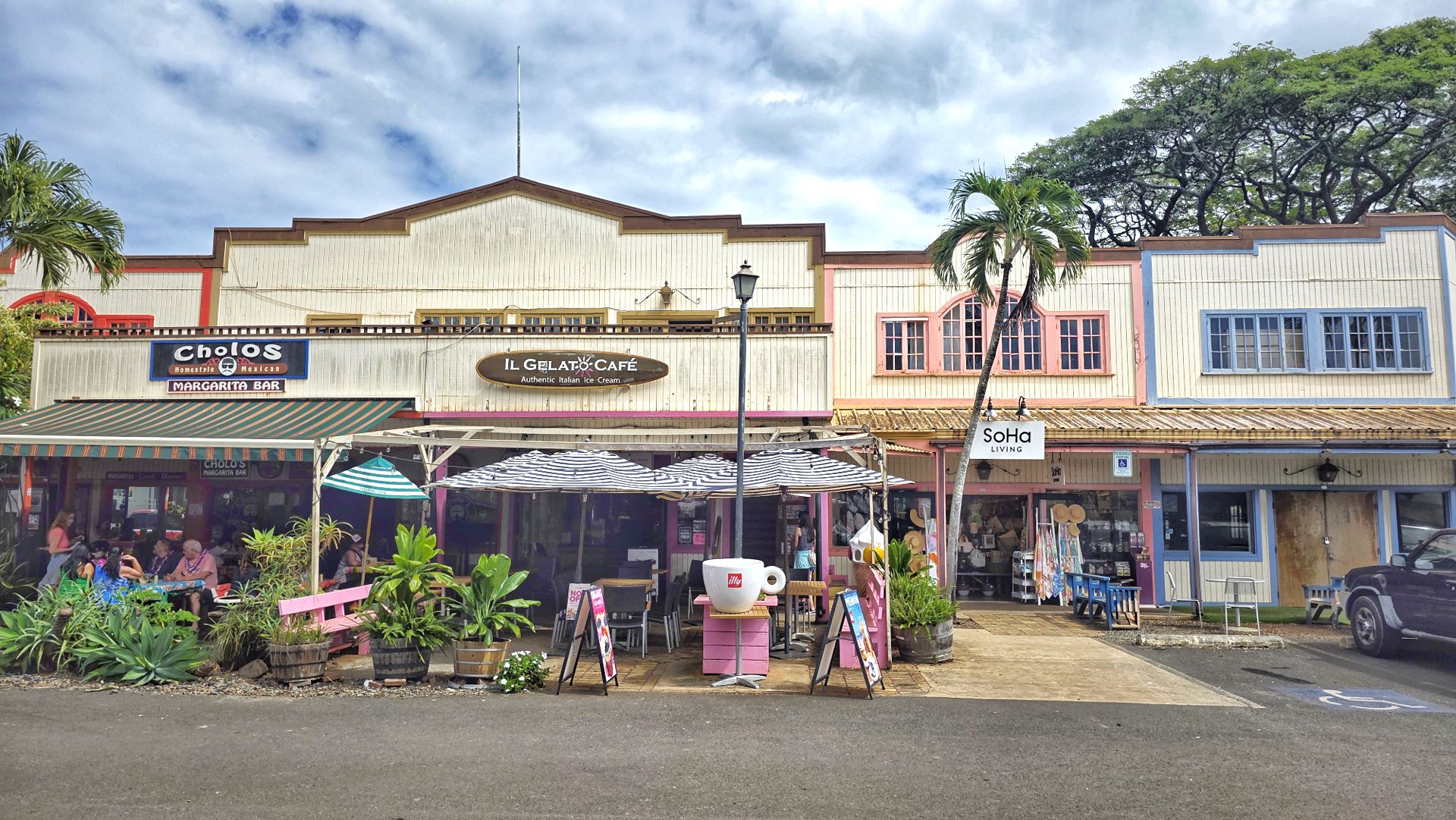
The North Shore Marketplace in Haleiwa has changed hands after a dispute, and that development has larger implications than it might appear. What many visitors experience as a permanent slice of old Hawaii now sits at the center of a ground conflict that could shape what this stretch of Oahu’s North Shore looks like in the years ahead. The disagreement was centered on a ground lease controlled by Kamehameha Schools and the economics beneath the buildings.
What we know right now.
The North Shore Marketplace was built in 1985 by developer Howard Green on land owned by Kamehameha Schools under a long-term ground lease. When that lease came up for renegotiation, the proposed rent increase was steep. As reported earlier this year, Green’s annual ground rent would have jumped from $144,000 to nearly a million dollars, a figure he said would have forced him to raise rents on roughly twenty-five retail tenants.
The terms could not be reconciled and, as a result, Kamehameha Schools is now expected to acquire the marketplace from Green. At this stage, there is no confirmed plan, no announced redevelopment or demolition filings, and no public conversion proposal. KS has said it will not raise tenant rents in the first year and will respect existing tenant leases. The storefronts remain open, the courtyard still functions, but control of the property is shifting, and what that means going forward isn’t clear.
That tension hits at an especially vulnerable moment for Haleiwa. In a March 28 release, the Hawaii Tourism Authority said the vast majority of Haleiwa businesses had reopened after the recent storms, while also noting that recovery continues in parts of Waialua and Mokuleia and asking visitors to respect posted signage and be mindful of what residents and businesses there are still experiencing. HTA and state officials are now encouraging travelers to keep their plans and support local businesses such as Haleiwa Marketplace, as recovery continues.
Why this is bigger than one rent fight.
Visitors have long experienced Haleiwa as preserved and resistant to large-scale development. That image is already rapidly shifting. National brands, including Patagonia (in the Marketplace), Volcom, OluKai, and Rip Curl, all now operate alongside the smaller local shops that defined the town for decades. The North Shore Marketplace still largely looks like plantation-era Hawaii from the outside, but the tenant mix inside has been moving upmarket well before this lease dispute made the economics obvious.
What most people do not see is the land control beneath the center. In Hawaii, land and improvements are frequently separated. Developers build and operate on leased land under long-term agreements that eventually reach renewal. When those renewals arrive, rents can be recalculated at current market value rather than historic terms. If land values have climbed over decades, so can the lease costs required to remain.
Kamehameha Schools owns a majority of the commercial land on Oahu’s North Shore, and the Marketplace is not the only property affected. Ground lease renegotiations across Haleiwa’s commercial district have pushed average rents from roughly $7 to $10 per square foot toward $10 to $14 per square foot, according to the North Shore Chamber of Commerce. The pressure is not isolated to one courtyard. It runs beneath the entire town, and it is already changing the look and feel of Haleiwa.
Honolulu condo owners already know this dynamic well. Entire residential towers have experienced sharp valuation shifts as underlying land leases approach expiration. The buildings looked the same. But the underlying economics changed overnight. The same structural reality applies in Hawaii’s commercial settings.
The buildings at the North Shore Marketplace look stable. The economics underneath may not be.

What this signals about small-town Oahu.
Haleiwa has long defined the rural North Shore for visitors. It is the town you slow down in between surf breaks. The North Shore Marketplace has been part of that vibe for decades. When a lease dispute forces control to shift, it exposes how dependent even iconic small-town spaces are on agreements that eventually reach such inflection points.
There are no confirmed tenant closures tied directly to the Marketplace dispute at this time, and no verified increase in vacancies. What the situation reveals, however, is Hawaii’s vulnerability. With lease economics tightening, long-time tenants face pressure. That pressure tends to produce gradual turnover from mom-and-pop to national, rather than dramatic headlines. A familiar shop disappears. A space sits empty. A huge new store opens, and another operator enters at a different price point. The facade remains the same while the mix shifts dramatically.
Editor’s note from our recent North Shore visit.
When we were in Haleiwa last month, the North Shore Marketplace showed no obvious signs of distress. It was open, functioning, and, at least on the surface, looked more mixed than endangered, with a blend of older shops and far more upscale large tenants. We did not see the kind of dramatic visual evidence that would instantly settle this story on site.
What we are following up on now is the less visible part: whether there have been ownership changes, lease resets, newly posted spaces, or other public records that clarify what the dispute will actually mean below the surface.
Small towns that define Hawaii don’t disappear overnight. They evolve when land agreements reach renewal, and the numbers no longer work. The lease dispute at the North Shore Marketplace is a reminder that even places that feel permanent are ultimately tied to contracts that expire.
If you have walked through that courtyard before, the question is whether it will look and feel the same when you return to Haleiwa.
Photo Credits: © Beat of Hawaii at Haleiwa North Shore Marketplace.
Get Breaking Hawaii Travel News



Kamehameha is selling a lot of land to foreign interest. So Much for holding o. a d taking care of the Aina and the hawaiian people. They are so up in the sky or their nose turned up that they have no connection to preserving Hawaii land. why not help the Hawaiians and build really affordable houses to take care of your people. like you say Ohana. I say all waha.
I guess I’m an outsider but from my perspective living and being here nearly 20 years it seems these ground leases owned by Kam schools have a far reaching destabilizing impact upon residential and commercial property and the affected people’s lives I just don’t understand how Kam Schools doesn’t see how disruptive their actions are to the island economy. But then who am I? I know nothing.
Actually, two specific businesses in that center recently closed as the result of rapid and significant rent increases. Barnfield’s Raging Isle and Coffee Gallery. The owners are both hard-working local North Shore residents who provided valuable services to our local Waialua and Haleiwa communities. The had long time, very committed employees who are an important part of our community. You’d think that Kam Schools would have more compassion for our rural area local small business owners and residents and consider rent and TIA concessions/incentives… But I guess it’s just about the bottom line.
Yet another sad indication of our changing landscape here on the NS.
You should recheck your numbers, and take into account current and past monthly rent thats being collected for these spaces. It might surprise you and then you may adjust your stance on who owns the greed.
I’ve visited Oahu 3 times, and one of my fondest memories is that marketplace, where I visited with a parrot! I always found beautiful momentos there too. It’s distressing to hear it’s character may change.
I have a personal experience with Kamehameha schools and their real estate holdings.
I am the owner of a business on Oahu that employs many locals.
One feature of our business is that we pay a wage high high above our competitors on the island in the interest of helping our employees raise their standard of living. We take a huge cut in our own pay in order to do this.
I am a married man with two young daughters.
Now to the story:
I applied through a property management company in Haleiwa to rent a very basic 2 bedroom home under the ownership of Kamehameha Schools. This was just a run-of-the-mill plantation house/shack for rent behind Banzai Bowls in Haleiwa.
The rent was relatively modest and definitely affordable.
We have a spotless, rental history, excellent credit and references.
My income is about 200 and thousand dollars a year.
Incredibly, Kam schools refused to rent to me stating that my income was not high enough to rent their little shack.
Kam schools = greed
I remember being taught the difference between leasehold and fee-simple ownership shortly after arriving in late 1986. I think the Bishop Estate was the big leasehold property owner and it was noted, with large smiles, that all of the Japanese-owned hotels and other buildings in Waikiki were on leasehold land, and those long term (99 years?) leases were coming due shortly…. I wonder what happened there?
Bishop Estates was the big lease owner but a lawsuit in the 70’s/80’s I believe forced them to allow the owner of the home to acquire the lease and make it fee simple.
So the owner of a leasehold beachfront property purchased around the time of statehood for $35,000, then had the opportunity to buy the land under it for an additional $170,000.
A lot of money back then!
Curious, with all the land and long term rental revenue that Kamehameha Schools collects do rhey have the highest free education system for locals in the US? Do they have free education through community college level and/or 4 year undergrad?
Seems like a good use of revenue. Who audits
Kamehameha Schools and how they spend the revenue they collect?
Good point … Could the good ole mainland corporate greed be infecting Hawaii ? Seems like exorbitant rate increases and where exactly is that $$$ ultimately winding up ? Kinda ironic when I see all the criticism of out of state corporations taking all their profits out of the state !
Is this a similar situation to the Kauai Coffee lease drama ?
This has zero to do with the corporate world this is simply natives taking advantage of all including their own. I bet they have a very poor standard of education in their classes as the students probably do not matter either