
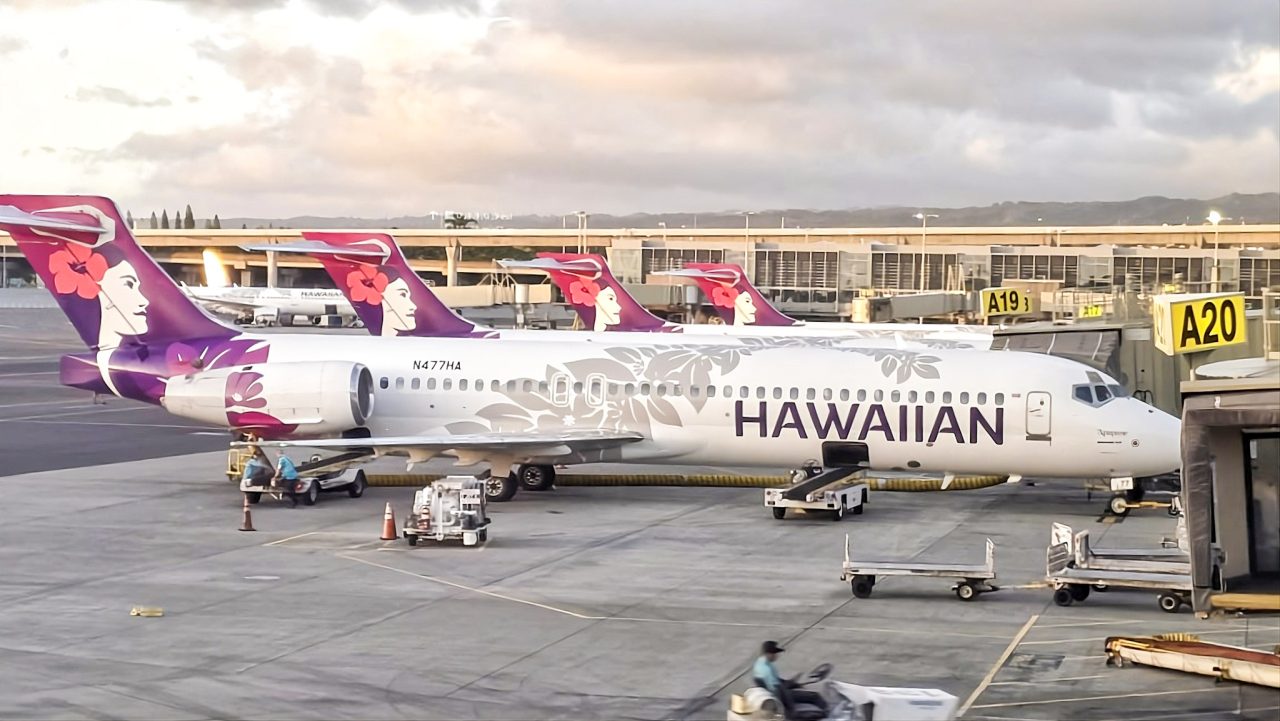
For more than two decades, one Hawaiian Airlines plane has literally defined interisland flying. Residents have relied on it for work, school, medical appointments, and family visits, while visitors have come to recognize its unusual two- and three-seat layout as part of the quintessential Hawaii travel experience.
Now the end of that era is officially in sight. Alaska Airlines announced today that Hawaiian’s Boeing 717 fleet will begin transitioning to Hawaiian-branded Boeing 737-800 aircraft fleet in 2028, answering one of the biggest remaining questions since they purchased the company.
The decision confirms what we warned could happen last month when we reported that dreaded middle seats on Hawaiian’s interisland flights could nearly double. Hawaiian’s next interisland plane will bring free Wi-Fi, more premium seating and a far more modern cabin, but it will also eliminate the two-seat side that many Hawaii travelers have deliberately chosen and enjoyed for all of these years.
Hawaiian Airlines’ Boeing 717 replacement is finally official.
The Boeing 717 has served Hawaii exceptionally well, but the airline could not postpone its replacement decision indefinitely. The aircraft are no longer in production, the fleet continues to age, and Hawaii’s unusually high number of daily takeoffs and landings places demands on the planes that are very different from typical mainland to Hawaii flying.
We explored those pressures when the aging Boeing 717 fleet faced new FAA scrutiny. The planes have remained remarkably dependable, but their age, accumulated flight cycles and long-term parts availability made a successor unavoidable.
Alaska has now selected its existing Boeing 737-800 rather than introducing an entirely new aircraft type. The future fleet will wear Hawaiian branding, be based in Honolulu, and focus on Neighbor Island service. Those are what we have been told. But there are other things that aren’t clear yet.
Once the operational integration of Alaska and Hawaiian is complete, including the crews, the airline says these flights are planned to be flown by Honolulu-based pilots and flight attendants. That is significant because replacing the aircraft had raised a larger question about whether Hawaiian’s interisland operation would remain centered in Hawaii at all.
We asked exactly that when examining whether Hawaiian’s planes could eventually leave Hawaii. Today’s announcement provides a clearer answer than travelers and employees had received until now: the aircraft will change, but Alaska says the Hawaiian brand, Honolulu base and Hawaii crews will remain where they are.
What improves on Hawaiian’s new interisland planes.
The passenger experience will change substantially when the first Hawaiian-branded 737-800s arrive. Alaska says the planes will include fast, free Starlink Wi-Fi, reclining leather Recaro seats, 110V outlets, USB charging and device holders at every seat.
Those features are absent from the current 717 fleet, where the cabin experience remains functional but is increasingly dated. Even on a short interisland flight, reliable Wi-Fi and power may matter to passengers connecting to longer trips, working between islands or trying to use time that previously disappeared between boarding and landing.
Premium seating grows considerably as well. The new aircraft will have twice as many First Class seats as the Boeing 717, increasing from eight to 16, along with more than 30 Premium Class seats offering additional legroom.
That will create more paid seating choices and more upgrade opportunities for Atmos Rewards and Huakai by Hawaiian members. It also brings Alaska’s familiar premium-heavy cabin strategy directly into Hawaiian’s prior interisland operation.
Cargo capacity is another clear improvement. Alaska specifically highlighted more room for surfboards, an everyday issue in Hawaii that can become difficult when smaller aircraft are full of passengers and checked baggage.
The 737-800 will also provide considerably more room overall than the 717. Travelers may find it easier to bring their carry-on bags, although loading and unloading a larger aircraft with more passengers brings potential for a different kind of delay.
The two-across seating of Hawaiian’s 717 is going away.
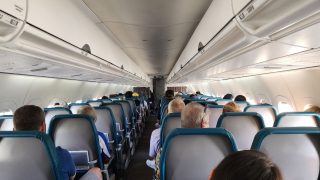
The biggest loss does not appear in Alaska’s list of passenger improvements. Hawaiian’s Boeing 717 has a two-and-three seating configuration, leaving one entire side of the cabin without a middle seat.
Couples could choose two seats together without sharing the row with anyone else. Solo travelers could select that side knowing they would receive either a window or aisle seat, and a parent traveling with a child could occupy the pair without another passenger beside them.
The Boeing 737-800 changes that completely. Its standard three-and-three layout places a middle seat on both sides of every economy row, removing one of the most loved parts of Hawaiian’s interisland experience.
That may sound minor on flights that are mostly less than an hour. For travelers who have flown between the islands for decades, however, the two-seat side was not a minor detail at all.
The current 717 configuration has eight First Class seats and 120 economy seats arranged across 24 rows. With one middle seat in each of those rows, that produces 24 middle seats in the economy cabin.
Alaska has not disclosed the final seat count or complete cabin layout for Hawaiian’s 737-800s. With two middle seats in every three-and-three row, however, the total can approach twice the 717 number even while some cabin space will be devoted to the larger First Class and Premium Class sections.
The tradeoff is already clear even before looking at the final seat map. Travelers gain technology and premium options while losing the one side of the interisland cabin where a middle seat never even existed.
Alaska already owns the planes Hawaiian will get.
The choice of the 737-800 is notable for another reason. Alaska does not need to place a costly new aircraft order and then wait years for deliveries because it already has about sixty of the type in its current fleet.
In practical terms, these aircraft are available within the combined company at no new purchase cost. Alaska can transfer selected 737-800s into the Hawaiian operation, since they will not need all of them, update their interiors, and apply Hawaiian branding without the expense of buying an entirely new fleet for Neighbor Island flying.
The airplanes are not literally free to prepare or operate. Cabin modifications, maintenance, training, and branding will cost real money, but this is still just a fraction of the otherwise expensive path of ordering brand-new Airbus A220S, Embraer E2S, or another specialized aircraft solely to replace Hawaiian’s 717s.
The 737-800 is proven, familiar to Alaska’s maintenance and operating teams, and available without the delivery delays facing many newly ordered airplanes. That makes this an easy decision in most ways.
That possibility has hovered over Hawaiian’s fleet planning since Alaska placed its major Boeing order without including a separate new aircraft for Hawaii interisland. We examined that larger issue when Hawaiian was left out of Alaska’s huge fleet order, making it increasingly clear that aircraft already in Alaska’s Boeing-centered strategy could shape Hawaiian’s future.
Why Alaska says the 737-800 can handle Hawaii flying.
Neighbor Island aircraft live a very different life from planes flying five- or six-hour routes. They may complete numerous takeoffs and landings in a single day, with repeated short climbs, descents and quick turns at airports surrounded by salt air. Hawaiian 717 planes have flown as many as 16 flights in a single day.
Alaska says the 737-800 has the durable airframes and engines needed to withstand those high-cycle operations. The company also says the larger airplane will allow it to maintain capacity while continuing a frequent schedule from morning through evening.
Alaska promises capacity, not necessarily today’s number of flights.
A larger plane can carry the same total number of people with fewer departures, which means schedule frequency remains one of the biggest unanswered questions in the latest announcement.
Hawaiian’s 717 carries 128 passengers, while Alaska’s existing 737-800s carry 161. Even with 16 First Class seats and more than 30 Premium Class seats, the Hawaiian replacement will remain a noticeably larger aircraft.
Alaska has not yet indicated if it plans to reduce interisland frequency. Until the final schedule and cabin layout are released, however, travelers cannot know if the larger planes will just add seats or eventually allow the airline to consolidate some departures.
Hawaiian’s 737 operating pattern not announced.
Another unanswered question is whether these will operate as an exclusively dedicated interisland fleet or to some degree flow between mainland and Neighbor Island routes. Southwest regularly rotates 737s arriving from the mainland through interisland flights before those aircraft continue elsewhere, spreading the demanding short-flight cycles across more time and a broader fleet.
Alaska’s announcement appears different from that model on first take. It described Hawaiian-branded planes based in Honolulu and focused on Neighbor Island service, with Honolulu-based pilots and flight attendants planned to operate them once integration is complete.
That language suggests a dedicated Hawaii fleet, but it does not explicitly lay out the airplanes flying only between the islands. Because the 737-800 can also operate mainland routes and the two airlines now share one operating certificate, Alaska could choose to rotate them through longer flights when various needs make that useful.
Southwest’s flow-through model was a source of frustration, especially early on, due to delays. A plane arriving late from the mainland could then transfer that disruption onto ongoing interisland flights, while a dedicated Honolulu fleet is more insulated from any long-haul delays.
Alaska 737 flights between Honolulu and Maui start first.
Travelers will not need to wait until 2028 to see an Alaska 737 operating between the islands. Beginning this October, one Alaska-branded 737 is planned to supplement the Boeing 717 schedule with three daily round-trips between Honolulu and Kahului.
Those flights will operate from Terminal 1 at Honolulu Airport, where Hawaiian’s interisland operation is already based. The aircraft carries Alaska branding rather than Hawaiian colors for now.
The fall flights appear to serve two purposes. They add near-term capacity before the 717 replacement begins, while also giving Alaska real-world experience operating its larger aircraft repeatedly within Hawaii’s demanding short-haul network.
Hawaiian has used larger aircraft between the islands before, particularly when demand or aircraft positioning required it. We previously looked at why travelers could see Hawaiian’s A321neo flying between the islands.
Hawaiian branding will replace Alaska on this fleet.
Alaska repeated the words “Hawaiian-branded” throughout today’s announcement. That repetition was no accident, especially after months of questions about what Hawaiian Airlines would look like once full operational integration is complete. The answer today is that Hawaiian will remain visible on even more flights, according to Alaska.
What Hawaiian 717 travelers gain and lose in 2028.
There is no question that the 737-800 will deliver a more modern experience. Alaska’s solution is practical and certainly economical. It uses planes the company already owns, avoids adding another aircraft type and gives Hawaiian a clear path beyond a fleet that could not continue indefinitely.
The first feature many travelers notice may not be Starlink or a new Recaro seat. It may be the stranger sitting in the middle seat where Hawaiian’s beloved two-seat side used to be.
What counts more to you on an interisland flight: modern amenities and more premium seats, or keeping the Boeing 717’s two-across seating?
Lead Photo Credit: © Beat of Hawaii.
By Rob and Jeff, Beat of Hawaii.
Some of the most meaningful parts of Hawaii are the ones visitors walk right past without knowing they are there. We’ve spent nearly 20 years finding them firsthand for BOH as full-time Hawaii residents reporting on travel, culture, and island life, and telling you what they mean for your trip. Join us →
Get Breaking Hawaii Travel News



Now someone needs to dig deeper and AsK during the interim of all this transition – which crews specifically will be flying those flights.
There are world ills, but this is not one of them.
Life will go on. Before the 717, Hawaiian flew 737s, Aloha flew 737s and the world was fine.
Alaska is not going to introduce another different aircraft type, and even if they did, the planes won’t be here by 2028.
Could not agree more! A whole lot of ‘sky is falling’. And the B737-800s look great in the HI colors. They are also adding 2 freighters. Whole lot of 737 flying coming our way!
Aloha~ Not sure why everyone is so surprised. AS/HA cannot keep flying an aircraft type that is now 26 years old and why would they go out and bring in another type. Shifting the curret fleet controls expenses and airfares. The 2 seat side conguration is nice to have, but these are short flights and you can still choose the window and middle seat to sit side by side. At least they are going to paint the airplanes and the rendering looks good. I am looking forward to clearly way more overhead bin space and wifi. As for the rest of the article, let’s see how the new operating plan for the islands shakes out as the market dictates before the sky falls. Cheers
It’s within the realm of possibility that 737s could have a select number of rows that do not sell the middle seat, but the three seat section as a two seat, open middle version. In Europe, you may have noticed a strange mini seat in first class that doesn’t accommodate a person but creates space between two passengers in an otherwise coach style seat but gives them more room.
This would be ideal for a parent with one or two children two parents with one child or a couple with that extra space between them. There are many persons of size who fly between the islands this may help them avoid the full cost of a two seat purchase.
Doesn’t really matter what counts more – Wi-Fi or keeping 2 across seating. The 717 is going away after a long, successful life and no amount of hand wringing over a middle seat on a 30 – 45 minute flight is going to change that and is just plain silly. Visitors who are doing inter-island flights for the first time aren’t even going to know there used to be a 717. The average once or twice a year flyer doesn’t know one plane from another.
This is a dumb article. These flights are rarely full and you’re worried about a middle seat for a :20 min hop? You people have first world problems sheeez!
Saw the rendering released by the company. The 737-800 looks great in Hawaiian livery. Better than the 717, actually.
Think we’ll also soon see an announcement that the HA 321NEO is going to be phased out and replaced the 737-MAX10. Seattle has already indicated there aren’t enough 321NEOs in the HA fleet to make it economically viable.
I always pick the two seat side leaving Kauai and the three seat side going to Kauai since that’s the side with the great view.
Especially between Lihue and Kona. I call that flight the “grand tour” as you’ll see every island east of Kauai on the flight.
I don’t think there is going to be anything unique between the Hawaiian branded and Alaska branded aircraft, is there?
I just can’t imagine the dispatchers caring too much about which brand is on the outside. When it comes time to pick the aircraft, they’re going to place the operational needs well above what paint the aircraft has. They already regularly scramble aircraft and crews on every leg, rather than leaving them tied to each other throughout a rotation.
Aircraft don’t get more than basic and emergency service on the islands. They flight for major work on the mainland. Right now, the 717 doesn’t have the range to make the mainland in revenue service. Hawaiian removes the seats, puts in tanks and moves them as a special ferry flight. That’s pretty disruptive. With the 737, they can make money to and from the mainland service. Rotating also makes sense to equalize the extra wear island hopping does.
I was really hoping for either the E195-2 or the A220. The A220 would have retained the 2-3 seating of the 717.
Not a big surprise though, as Alaska is a huge operator of the 737.
Should be a bonus for frequent inter-island travelers. Greater chances of upgrades to first class or the main cabin premium cabin rows.
Kind of a win win especially if one is flying as much inter-island on here as many say they do.
Except…. The 717 has a generous enough seat pitch my 6’2″ frame fits in the regular economy seats. With the Alaska 737, I have to buy premium or play pretzel. I’m confident that the Hawaiian 737 is going to have that tighter seat pitch.
According to the information available so far, the 737 seat pitch may be about the same, but the seat width may be down by about an inch. It all depends how Alaska will configure these. We’ll find out in a few months.
Nice to finally have a definitive answer even though we knew for awhile that Alaska’s 737-800s were the most realistic 717 replacement. Starlink is always a plus even though they’re relatively short flights. Growing up flying Aloha Airlines and their 737s having 3×3 seats doesn’t bother me that much if I happen to get stuck in a middle seat. Again it’s a short flight. Never would sit in the middle on a flight longer than an hour though. Interested to see how flight frequency and turn around time wears on the 737s. That’s probably why Alaska is testing that this fall.
I remember when the DC-9s left and everyone was excited about these new planes. That was a long time ago now. We quickly got used to the 717 as they were a lot quieter and roomier at the time. This will probably be about the same.
Visitors especially probably won’t even know the difference as long as the flights are on time.
This is the only article I’ve read that addressed what passengers actually lose including fewer flights and more middle seats.
The 717 has had an absolutely incredible run. At some point every airplane has to retire, and I’d rather they do it before reliability starts slipping.
As someone who flies between Maui and Oahu monthly or more often, the two-seat side really was the best part of those flights. It made traveling with my husband so much easier, and less stressful. At the same time these planes have been feeling very old.
What counts more to you on an interisland flight? Schedule integrity and reliability. Period. End of discussion. It’s at most a 45 minute flight. Getting worked up over a middle seat is just plain silly on a flight that short.
Right, the bigger question is whether they’ll cut flights. More seats on each plane usually means fewer departures eventually. That’s what I’m worried about since it will make it harder for me to coordinate meetings and appointments. Probably worse for us residents than it will be for visitors. Ugg.
I hadn’t thought about Alaska using already owned planes. That makes the decision make a lot more sense, even if it isn’t as exciting as getting brand-new aircraft. Good move in most ways. The seating, true, less so.
The Starlink WiFi and power are long overdue. If I’m connecting to the mainland, I’d rather have those than just that nice but quirky seating arrangement. Progress isn’t always bad as in this case.
For so many years I’ve always booked the two-seat side without even thinking about it. Funny how you don’t realize you’ll miss something until it’s gone. The Wi-Fi will be nice, but I’m still going to miss that unusual layout.