
We’ve written about our personal go-to three-seat airline trick for years. Now airlines appear ready to sell the same idea back to travelers. For years we’ve been writing that the future of Hawaii flying may not be bigger planes. It may be smaller ones. And something has to happen to make it more tolerable on 5 or more-hour journeys.
Aircraft like the Airbus A321 family and the Boeing 737 MAX family are promoted as the next generation of long-distance flying, capable of connecting cities that might never support a larger widebody aircraft. That’s the reality of flying to Hawaii, and it is becoming more rare to see a widebody used when a narrow-body will do. We’ve followed this evolution closely, from the first discussions about Hawaii route changes to more recent questions about how these planes and the latest variants could reshape nonstop travel from places like Denver, Dallas, Houston, and beyond.
Now the first significant passenger-experience story to emerge from those aircraft families isn’t about a better seat, more legroom, or a new cabin design. Instead, it’s about taking a seat away. The middle one.
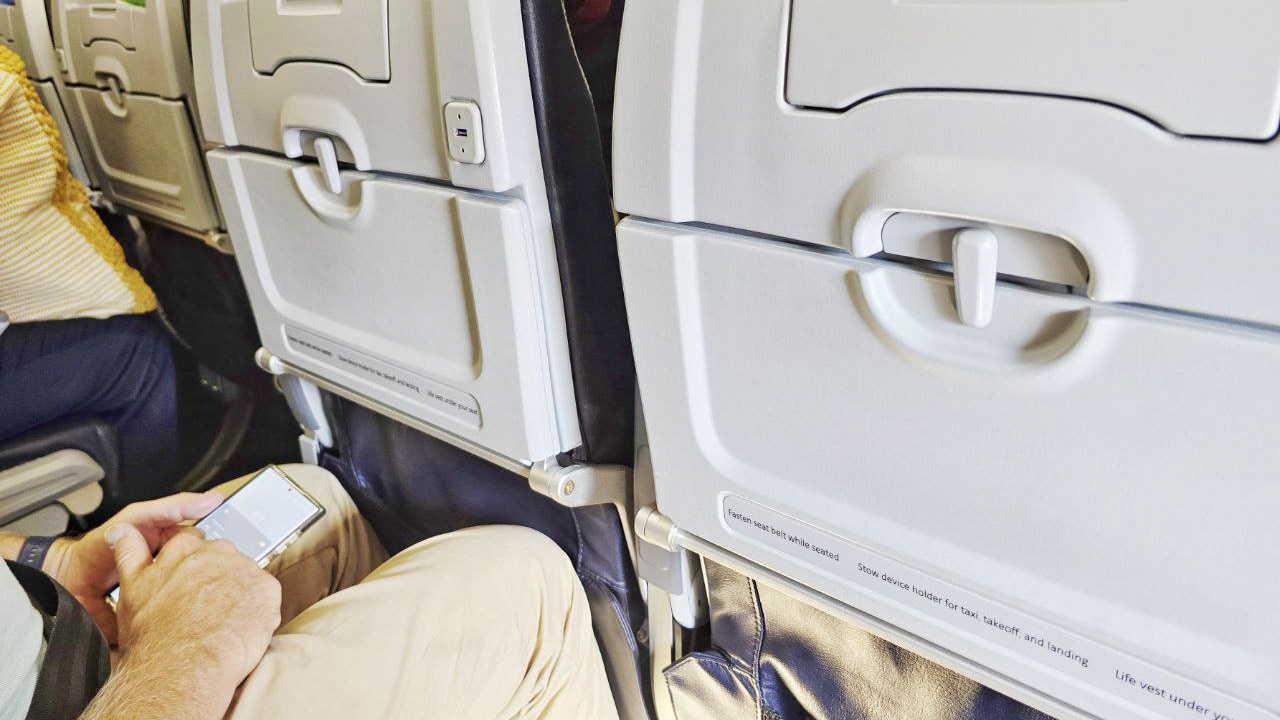
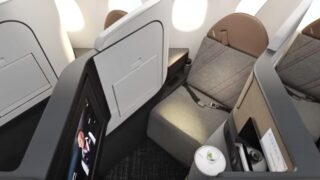
A leaked photo posted online this week showed United exploring a blocked-middle-seat concept on its new Airbus A321XLR. The center seat remains physically present, but a fixed table module covers the cushion, making it unusable. The result is a standard six-seat economy row that functions more like four premium seats in two pairs.
The leak first surfaced in a Reddit post and was later followed by reports from multiple publications before United confirmed it is exploring the concept. United is emphasizing that it is continually testing ideas intended to add value for customers.
The airline has not announced a launch date, route, product name, or pricing structure. It also specifically denied that the concept is planned for its premium transcontinental A321 fleet. Also keep in mind that there are no plans for the XLR to fly to and from Hawaii, at least at this point. But this is a real product nonetheless, and it’s one we’ve experienced elsewhere in the world too.
So what immediately caught our attention wasn’t the seat itself. It was how familiar the idea felt.
We recently flew British Airways from London to Barcelona. The Club Europe seat itself was an ordinary economy seat. The difference was that the middle seat was blocked and unavailable, and had a tray table between the two remaining seats, creating additional personal space. The empty middle wasn’t sold on its own. It was part of the quasi-business-class product.
Then on our flight this week from San Francisco to Kauai, we used a completely different version of the same concept. We bought an extra seat between us and effectively created the very same version of Hawaii quasi-business-class.
Longtime readers know we’ve written about this strategy for years.
Whether travelers call it the three-seat trick, an extra-seat strategy, or simply buying space, the basic idea has always been the same. Instead of paying for a traditional premium cabin, some travelers purchase the empty seat beside them. This is something that is standard procedure for all airlines except Southwest, which hasn’t yet adopted it after only recently going to assigned seating itself.
This development stood out because it is what travelers discovered years ago that appears to be turning into a viable airline product.
The early explanation attached to the leak was that the blocked seat concept was tied to flight-attendant staffing requirements. Some reports suggested the design may have originated as a way to stay below a staffing threshold that would otherwise require additional crew. At first glance, to some at least, the theory seemed plausible.
But clearly that isn’t the real story on its own.
Subsequent reporting indicated that United plans to staff the A321XLR with at least four flight attendants, regardless, due to the aircraft’s Polaris section and associated requirements. If that’s the case, the simple “save a flight attendant” explanation no longer seems to fully capture what’s happening.
Which raises the more interesting question. If this isn’t really about reducing crew, why create the product at all?
United hasn’t answered that question publicly. But what we do know is that airlines have become increasingly adept at separating comfort from the base fare and selling it as an upgrade. Preferred seats, extra-legroom sections, priority boarding, and lounge access all follow that pattern.
An empty middle seat may simply be the next version. In that sense, United wouldn’t be the first airline to head down this path by a long shot.
And this is where the idea gets bigger than a single row.
The tray isn’t bolted on for good. By United’s own description, it can be lifted out and stored under the seat — which means the middle seat never actually disappears. It just gets switched off. That detail matters more than it looks. If a blocked middle can be turned on and off, the cabin stops being a fixed thing.
An airline could decide, almost flight by flight, how many rows to open up and how many to sell as roomier. A packed leisure route in summer fills every seat. A business-heavy day blocks more middles and sells the space. Same airplane, reconfigured on demand, without swapping a single seat.
Taken far enough, the logic points somewhere airlines have eyed for years: one cabin instead of three, segmented as needed. Not a permanent business class with its own seats and galley, but a single economy cabin sliced into tiers by what’s blocked and what isn’t. United isn’t saying that’s the plan. But the hardware quietly makes that future thinkable, and on the plane we’ve spent years calling Hawaii’s narrow-body future, that’s worth watching.
European carriers have been selling blocked-middle business-class seating for decades. More recently, Frontier introduced its UpFront Plus product, allowing travelers to buy extra space through a blocked-middle-seat arrangement.
The difference is where this concept is now showing up. The Airbus A321XLR isn’t just another airplane. It belongs to the same family of aircraft that has been repeatedly promoted as the future of long-distance narrowbody flying. That’s the reason we’ve spent years covering it.
Hawaii presents an interesting contrast.
So for now this is not a Hawaii product. And there is no specific indication that United plans to bring this concept to Hawaii flying. Yet we’d be surprised if this stays unique to United or this new plane. This is a narrow-body evolution worth watching.
The reason is simple. For years, airlines have described aircraft like the A321neo and A321XLR as the future of connecting more cities nonstop over longer distances. If that future arrives, the onboard experience matters just as much as the route map. And further diversification of offerings will help airlines better monetize Hawaii flights.
The first major product innovation associated with this aircraft family isn’t about giving travelers more space. It’s finding a better and more lucrative way to package empty space and sell it back. Either on its own or with other offerings, such as an upgraded meal.
Whether that eventually becomes part of Hawaii-focused narrowbody flying remains completely unknown.
But after years of writing about both the future of narrow-body Hawaii flights and the three-seat trick, it’s hard not to notice that the two stories may finally be converging.
By Rob and Jeff, Beat of Hawaii.
We’ve spent nearly 20 years covering Hawaii from Kauai as full-time residents, reporting firsthand on the travel, the changes, and island life. The shifts that shape Hawaii often happen quietly, long before most visitors notice. We follow them closely and tell you what they mean for your trip. Join us →
Get Breaking Hawaii Travel News


I noticed nothing mentioned about how much the table in the middle might cost? This option might be more than the middle seat costs if you purchased a second seat. IMO this sounds like a way to make a policy of one person per seat reservation rule.
On a recent trip to Seattle I accidentally booked a regular seat. I usually do extra leg room. I had my iPad on the tray table watching a movie while mashed in my seat. The guy in front reclined and trapped my iPad to the point I thought it would break. Luckily the guy next to me said something and he raised his seat enough I could get it out, but not continue to watch a movie. Blocked middle seat does not entice me.
Airbus 330 forever!
Like most people, I don’t enjoy the ever-shrinking seats and legroom. What I hate even more is the lack of seatback monitors. I don’t like watching media on a cell phone screen, and it seems like a small price for airlines to pay, to provide minimal entertainment. I would pay extra for the use of a seatback screen if they were available.
Western Airlines had a similar set up when it first started flying to Hawaii on 720s. The back rest of the center seat had a slightly narrower portion that folded down to become a tray table. The armrests stayed folded up making the two seats a couple of inches wider. I have often wondered why this was not widely used.
I’d far prefer more leg room but blocking the middle seat doesn’t do this and the legroom seems to keep shrinking. Soon you won’t fit if you are taller than 5’6″. FAA needs to look carefully at what seat separation honestly impairs evacuation of real people including the many older fliers rather than just healthy young people.