
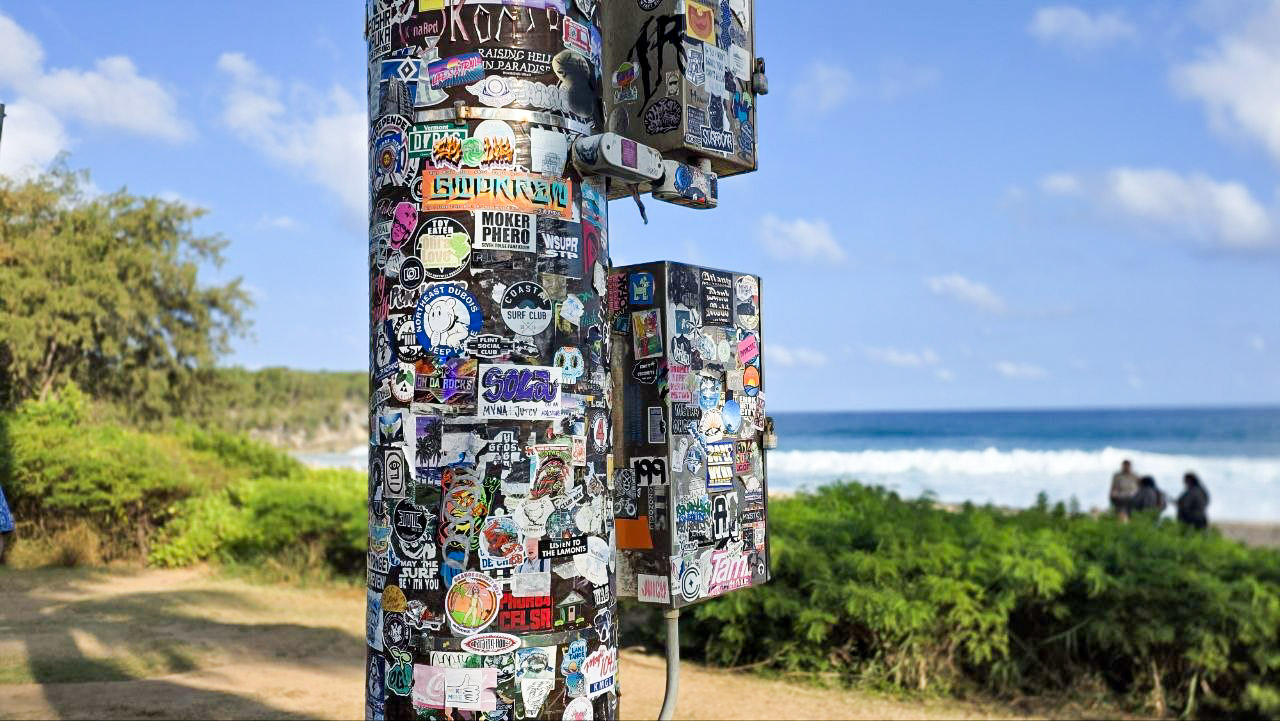
At Shipwreck Beach on Kauai, a tall utility pole and an old metal call box stand near one of the most beautiful coastal scenes in Hawaii. Both are buried under hundreds of stickers, layered so thickly that the original surfaces have nearly disappeared beneath surf-club stickers, brand decals, hand-cut tags, and miscellaneous faded scraps from years before.
Behind them, spectacular turquoise surf breaks across Keoneloa Bay. Open sand stretches toward the water, beachgoers stand near the shoreline, green coastal landscape frames the scene, and the Kauai sky is bright blue above it all. Bolted in front of that natural setting is a chaotic, man-made collage no one seems to own, but everyone now has to look at.
You are standing in front of one of Kauai’s most beautiful beaches, and right in view is a pole no one can agree on. Is this art, or just vandalism? That is the tension in one sentence.
Who actually does this?
One easy version is to blame visitors. Hawaii has plenty of visitor behavior problems, and sticker-covered signs can, at first, look like one more thing outsiders brought here, used here, and left behind for someone else to clean up. And in part, at least, that is true
But that reading is oversimplified. At many of these beach and surf spots, including this one, the stickers are often tied to local surf and board culture rather than to tourists passing through. Some are from people who know the beach and may have been coming to that same point for years.
This is not a locals-versus-visitors story, and it is not a tourist-shaming piece either. The pole at Shipwreck sits within a global sticker culture we’ve personally witnessed from Hawaii to Tahiti to Europe, but it is especially strong in Hawaii’s own beach culture, where belonging, expression, respect, and sharing space often collide in public view.
Once you notice this, you’ll notice it everywhere.
We had just seen this same visual language across Europe before coming home to Kauai and standing in front of it again. In Switzerland and France, stickers covered poles, signs, trail markers, utility boxes, railings, and street corners, from lakeside paths to mountain towns and city neighborhoods.
Once we started noticing them, they became impossible to miss. A scenic overlook would have them. A train station entrance would have them. A trailhead or waterfront sign would have the same layered messaging, part travel mark, part street culture, part anonymous bulletin board.
Hawaii has its own version now at beach accesses, lookouts, trailheads, parking areas, and surf breaks. Some clusters are small and scattered, while others are layered so thickly that they feel less like individual stickers than a growing surface of their own.
It started on a surfboard.
The roots run through surf, skate, and snowboard culture. Riders decorated boards with shop stickers, brand decals, contest marks, crew signs, and personal symbols, and over time the same instinct moved from the board to other places. Before stick-ons, we remember sew-on patches.
That is why a beach pole like the one above can feel like a natural home for it. The sticker is not just decoration. It is a small claim of being here, a way of saying this break, this beach, this moment, this place is mine.
The sticker culture impulse later merged with graffiti slap culture, from blank labels and hand-drawn tags to mass-produced images that have spread around the world. Shepard Fairey’s Andre the Giant and OBEY imagery helped push sticker culture into broader view, and by the early 2000s, slaps were visible across cities and scenes from France and Japan to Brazil, the UK, and beyond.
Portland is often described as a major slap-tag hub, with places like Alberta and Mississippi also known for their dense sticker clusters. But the core impulse is older and simpler than any one city or movement. I was here. I left a mark. I joined the wall.
A thousand years of sacred stickers.
Japan gives this story a deeper meaning. For roughly a thousand years, pilgrims have placed senjafuda, named paper slips written in calligraphy, at Shinto shrines and Buddhist temples to mark a visit. The practice traces back to imperial and pilgrimage traditions and took its familiar paper form during the Edo period.
Across cultures, people have long felt the urge to leave something of themselves behind at meaningful places. In Jerusalem, worshippers place written prayers into the stones of the Western Wall. In Japan, pilgrims left named slips at temples and shrines. The impulse is familiar: to mark presence, memory, gratitude, devotion, or simply the fact that we stood in a place that mattered to us.
The custom was never meant to be just random pasting. Permission was required, and prayer came first. Pilgrims asked at the temple office, paid a small fee, received a stamp, and followed an unwritten code that included not covering someone else’s slip.
That is one interesting part. The same physical act, placing a named slip on a post, gate, pillar, or beam, can be devotion inside a temple gate and yet vandalism on a street sign outside it. In Hawaii, with its deep Japanese heritage and constant debate over how people mark and share place, that is even more fascinating.
Even Japan has had to confront the damage. Modern senjafuda-style stickers are harder to remove than old rice-paste slips, and their inks and adhesives can harm aging wood. Some shrines now restrict or ban them, which brings the ancient practice back to the same practical question that Hawaii faces: what do you do when a mark of presence begins to damage the place it was meant to honor?
Hawaii now wrestles with the same question, particularly at popular viewpoints and trail destinations where sticker-covered signs have become increasingly common.
Why a sticker is worse than spray paint.
A lot of people assume spray paint is the harder problem. With stickers, that is not always true. A standard slap may peel off quickly, but eggshell vinyl was created to do the opposite, breaking into tiny pieces when someone tries to remove it.
That turns cleanup into scraping, solvent, razors, and time. One sticker can take far longer than expected, and a layered sign can become a small excavation job. The material was adopted by writers specifically because cleanup crews cannot just peel it away.
On signs, the issue goes beyond appearance. Stickers can cover directions, warnings, access information, and safety messages. Removing them can tear or dull the reflective coating underneath, leaving a sign harder to read at night even after the stickers are gone.
That is why cities spend real money on this. One mainland city spends about $42,000 a year just cleaning street signs, and broader graffiti and sticker cleanup can run into the millions. What looks like a temporary mark can become expensive, lasting, and harder to undo than it appears.
Bulletin board or defacement.
This is where the split begins. One group looks at a sticker-covered pole and sees surf culture, local identity, community art, and a living bulletin board at the edge of the break. The older layers become part of the appeal, an accidental time capsule of shops, crews, contests, brands, jokes, and people who passed through.
Another group looks at the same pole and sees damage. They see litter stuck to shared public space, visual clutter in front of natural beauty, and another sign that Hawaii’s beaches and trails are being treated as surfaces to use rather than places to respect.
Both readings can be honest. The Shipwreck pole is not beautiful in the same way the beach behind it is beautiful, but it is not meaningless either. It carries a culture and imposes that culture on everyone else who stands there.
That is why the headline question holds. A stickered beach pole can be both a community board and a defacement, depending on where you stand, what you value, and how much of Hawaii’s public landscape you think should be left unmarked.
What Hawaii is starting to do about it.
Honolulu has started testing a response that feels different from the usual Hawaii playbook. Instead of leading with a ban, fine, closure, fee, or reservation system, bright orange signs have appeared asking people to place stickers in designated spots and not above public signage.
Diamond Head is now one of the places experimenting with a different approach. At Koko Crater, in addition to Diamond Head, bright orange signs appeared, asking people to place stickers in designated areas rather than directly over public signage and infrastructure. The message was simple: redirect the behavior rather than ban it outright.
That is the constructive part. Hawaii is often forced into stricter controls once overuse becomes unmanageable, but this approach aims to address the behavior before it causes damage to signs, viewpoints, or public infrastructure beyond easy repair.
Redirect rather than punish. That may not work everywhere, and it may not satisfy people who want the stickers gone completely. But it gives Hawaii another option, living with every sticker or attempting to scrape them all away.
Next time you stand in front of one.
The next time you stand in front of a sticker-covered pole at a beach, trailhead, lookout, or surf break, you may see more than a pile of decals. You may see a global habit, a surf-culture badge, a local mark, travel impulse, time capsule, or a mess someone else will eventually be cleaning up.
At Shipwreck Beach, with the water breaking behind that crowded pole, we found ourselves holding both reactions at once. The stickers felt completely out of place, yet also like they had become part of that very same place.
Hawaii is now making that decision on a spot-by-spot basis. If you had a sticker in your hand at the beach, would you add it to this pole, or leave the space for someone else to decide?
Photo Credit: © Beat of Hawaii at Shipwreck Beach, Kauai.
By Rob and Jeff, Beat of Hawaii.
Some of the most meaningful parts of Hawaii are the ones visitors walk right past without knowing they are there. We’ve spent nearly 20 years finding them firsthand for BOH as full-time Hawaii residents reporting on travel, culture, and island life, and telling you what they mean for your trip. Join us →
Get Breaking Hawaii Travel News






Been visiting Kauai every-other year since Iniki, which makes me a grumpy ol’ haole, But I’m OK with the sticker-decorated utility pole. Your example at Shipwrecks is definitely art. If you want a photo of the beach and don’t like it, step in front of the pole, but I think your pic is unique and more interesting. Lots more wrong with Kauai (and worsening) than man-made graphics festooning a man-made utility pole.
This particular type of defacement of public property is no better than gang members tagging property with their gang symbols. It’s a way of marking their territory and serves as a message to outsiders that they are not welcome.
Trying to paint this as cute or ‘traditional’ is a disservice to the taxpayers who pay to have this type of litter cleaned up.
Please don’t encourage this vandalism.
I completely disagree. When Banksy, Keith Haring, and Basquiat started their “graffiti” careers, they were often condemned. Now their pieces are considered urban art and are worth hundreds of thousands or even millions of dollars. Since the earliest caveman days, humans have painted, chiseled, inked, stacked rocks, tattooed & pierced themselves and left other mementos behind in hopes that future generations would understand their significance. Stonehenge, Machu Picchu and Hawaiian heiau are just examples of the same thing but on a much larger scale. I don’t think anyone would say that Stonehenge is defacing the plains of England! Beauty really is in the eyes of the beholder and someday some of these surf sticker surfaces will be in museums if they’re not already. Relax, enjoy it if you like it, ignore it if you don’t. This art too shall pass.
You’re right on one count: beauty is in the eye of the beholder. Comparing peeling paper stickers littering light poles in public to Stonehenge is quite the stretch, even for graffiti apologists. Apparently beauty standards have greatly degraded over the centuries.
As long as it’s tasteful, I think it’s art. As a musician, I first noticed the “collage stickers” on guitar cases when I did sound at concerts. It should never represent gangs (which brings graffiti wars), but surf clubs and the like is very local.
MJ
P.S. I’ve been quite ill and missed being here. I hope Rob and Jeff are doing well.
Hi MJ.
It’s good to see you back. Sorry to hear you’ve been dealing with illness, and we both hope you’re feeling better soon!
I think you make a fair point about the difference between art and graffiti. Thanks for adding your thoughts to the conversation.
Aloha.
Itʻs 100% surf culture and needs to not be a big deal.