
On a recent Sunday afternoon, after the Kona Storm, Poipu Beach looked like a problem already beyond management. The biggest parking lot was largely flooded. Cars were still trying to get in. Failing that, some spun around, some left, and some cars just stalled out while drivers looked for openings along the streets that were not there. The usable parking lot spaces were gone. Roadside spots were going too. People kept arriving anyway because Poipu is one of the places everyone goes, but now there was nowhere left to put them.
That is Kauai’s visitor problem now. It is not just that beaches get busy. It is that the island has very little extra capacity once anything goes wrong, whether from peak-season tourism, a bad storm, a road backup, a full parking lot, or spillover from another part of the island. When the main lot at Poipu goes underwater, there is no backup system waiting behind it. There is no additional road network to spread out driving and parked cars. And no room to absorb the overflow. Things just jam.
This is also why the usual talk about seasonality does not get very far here anymore. Kauai still has busy weeks and less busy weeks, but the old idea that the island breathes between peaks is getting harder to see on the ground. The pressure now shows up in parking, roads, beaches, small towns, and basic movement from one place to another. Visitors feel it. Residents live with it.
Poipu is one of the key spots that shows the problem fast.
This is not some rare, site-specific mess here either. Poipu is one of the island’s biggest visitor magnets, and its main lot is supposed to handle some of the volume. When even that breaks down, the weakness is tangible. The issue is not only that too many people want the same place at the same time. It is that the island keeps pushing demand into a small number of places, with little margin for failure. If one piece goes down, the rest fills up immediately.
That has become more common on Kauai. A full parking lot does not just mean a full lot. It sends cars back onto roads, into nearby neighborhoods, onto shoulders, and into smaller spaces that were never meant for parking at all. Then those get filled too. The chain reaction starts quickly because there is no slack in the system.
Hanalei reflects the same thing from the island’s other end.
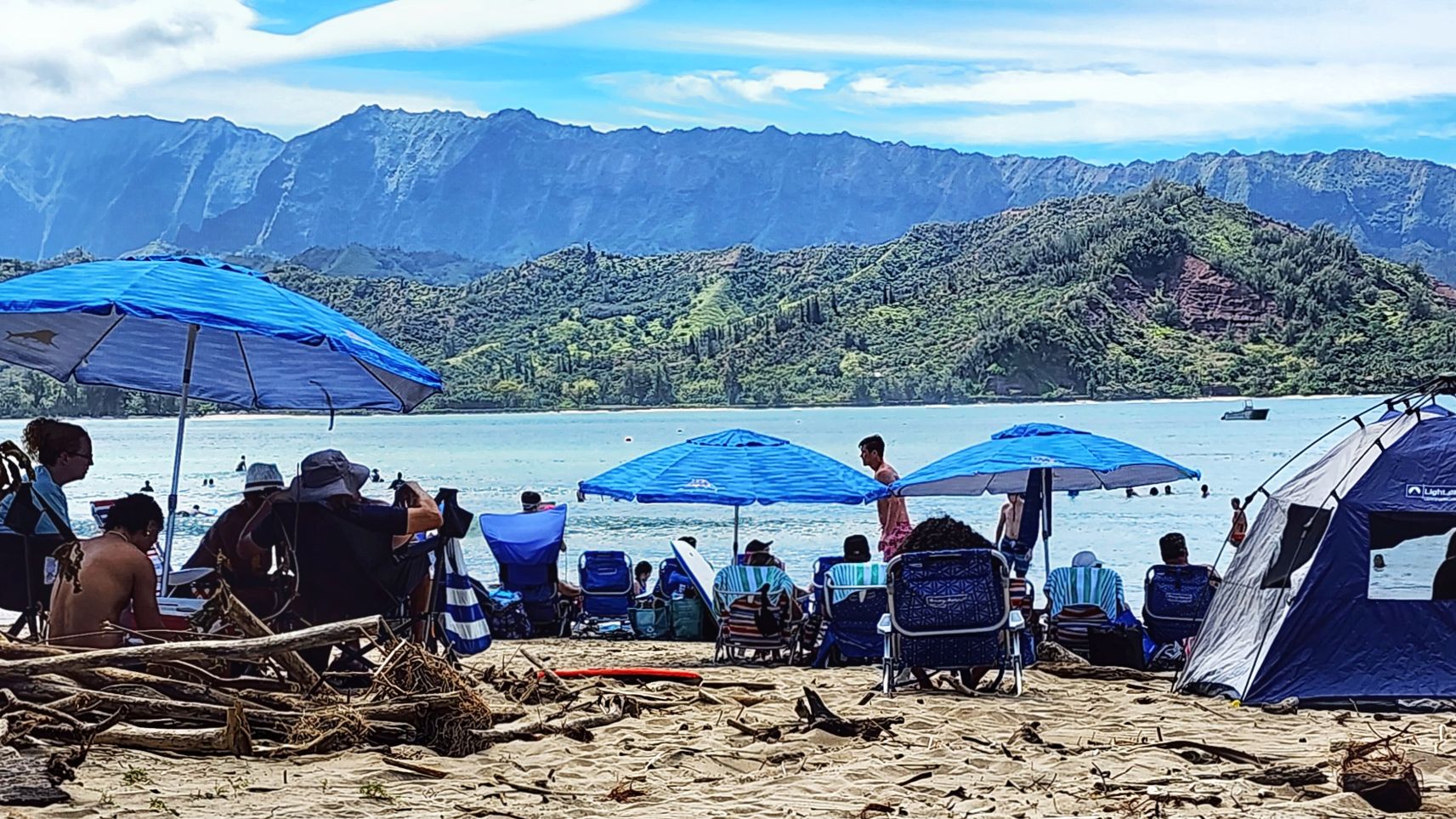
On the North Shore, the same pressure appears slightly different but yields the same result. One local told us that at Christmas, the traffic can run from the pier through downtown Hanalei all the way to the bridge. Anyone who has been there at the wrong time can believe that instantly. It does not take much. A few extra cars, a holiday week, beach traffic, people trying to park near town, and the whole area tightens to the point of being unworkable.
Hanalei is now dealing with more than Hanalei. Black Pot and Hanalei Beach have been absorbing spillover from the reservation system at Haena State Park and the limits at Ke’e. That may reduce pressure at the far end of the road, but it does not solve the larger issue. It just moves the pressure further south. Visitors who cannot get into one place do not disappear. They go somewhere else. On Kauai, somewhere else usually means another place that was already busy before the rules changed.
That dynamic is about to tighten further. The Board of Land and Natural Resources recently voted to bring Haena Beach Park into the existing Haena State Park management system, which would add reservations, fees, and resident set-asides to the last open access point at the end of the North Shore road.
As we reported in Kauai Fixed One Beach, Broke The One Down The Road, community leaders are already warning that controlling Haena Beach Park will push visitors farther down the coast to beaches without lifeguards or facilities. The problem does not disappear. It just moves.
That is why the North Shore problem is not just about one beach, one lot, or one town. It is about volume moving around an already critically constrained part of the island with very few alternatives. Hanalei becomes the release valve, then Hanalei gets overwhelmed, too. Black Pot and Hanalei Beach are not proof that the island has found more room. They are proof that the overflow had to go somewhere.
The numbers are not exploding while the pressure is.
Kauai had about 1.37 million visitors in 2024, and while final numbers aren’t in, 2025 likely was about 3% ahead of that pace. That might sound reassuring, but it is not. The island is dealing with roughly the same scale of visitation and still feeling more pressure in the places that get it first.
Visitor spending has risen by nearly 50% over the same stretch. Kauai is dealing with about the same number of visitors, but with more money in the system and continued pressure in peak seasons. That does not reduce physical strain. If anything, there’s the sense that it intensifies it because higher-spending travel does not create new parking, new roads, or new beach access. The island stays the same size as does the infrastructure.
This is where the tourism planning language starts to sound less theoretical. Kauai’s tourism plans now talk more openly about limits, infrastructure strain, and the need to manage demand within what the island can actually handle. That is a significant shift in tone, even while the practical fixes remain uncertain. The state and county can acknowledge the problem, but acknowledgment does not create space.
Changes at KVB add another important layer to this moment.
Sue Kanoho, who ran the Kauai Visitors Bureau (KVB) for nearly 30 years and built a level of community trust that takes decades to earn, retires at the end of March. Her replacement, Samira Siale, takes the role on April 16. Siale is a Kauai resident, has spent more than a decade working on-island, and currently serves as executive director of the Hawaii Lodging and Tourism Association’s Kauai chapter.
HVCB said she brings a strong track record of building alignment across Kauai’s visitor industry. The job ahead is bigger than one appointment. The island needs her steady leadership, strong local relationships, and a clear understanding that the old growth model is no longer enough.
What Kauai residents and visitors are actually saying.
On our recent piece about Kauai residents and tourism’s impact on daily life, more than 100 readers weighed in. What came back was not the usual split between frustrated locals and defensive visitors. Instead, both groups largely agree on the problem and neither side has an answer.
The loudest thread, with the most engagement, was not about behavior or beach access, but about money. One comment with 56 likes was on the question that kept surfacing in different forms throughout: why does an island economy generating billions in visitor spending every year have deteriorating bathrooms, broken infrastructure, and roads that cannot handle the load? Residents and long-term visitors said the same thing independently. The taxes, fees and spending are all there. But the infrastructure is not.
One commenter said Kauai welcomed roughly 1.37 million visitors in 2007. It welcomed about the same number in 2024. His question was simple: why the panic now? The visitor count held flat but the spending jumped nearly 50 percent even above 2019 levels. But roads did not improve, parking has not expanded, and the limitations did not change. Same island, more pressure, more money flowing through a system that was already at its limit years ago.
The resident voices were not anti-visitors and what came through was exhaustion. One person described watching the island she had known for decades become unrecognizable, not from a single event but from years of accumulation with no correction. Long-term visitors said versions of the same thing. People who had been coming for 30 and 40 years said they were noticing something different, not just crowding but a kind of friction that had not been there before, and that they were not sure they wanted to keep returning into it.
What nobody in 103 comments had was a solution that worked on all sides. Limit visitors and the economy contracts. Keep growing and the island keeps straining. Raise prices and you filter out one kind of visitor while the infrastructure problem stays exactly where it was. The comment section did not resolve anything. Neither has anyone else.
Kauai cannot build its way out.
This is a structural problem. Kauai has one main highway system for road work. It has a protected coastline on three sides. It has towns and neighborhoods that were never built for endless traffic growth. It does not have new bypass roads waiting to be activated. It does not have large new beach parking lots ready to open. In the places where tourism pressure is already greatest, there is little physical room left to expand.
That is why the usual idea that infrastructure will catch up lands flat here. Kauai widened the highway toward the college in Lihue and moved the bottleneck a little further down the road. That is what infrastructure does on this island. It shifts the problem. Shifting cars around is not the same as reducing load, and on Kauai, there are physical limits that planning language does not get around.
Protected land is part of that equation too. A lot of the island’s value lies in exactly what has not been paved over. But it also means the island has, in many cases, chosen not to become a place that can just keep scaling up its visitor infrastructure indefinitely. The tradeoff is now becoming impossible to ignore. You cannot preserve coastlines, constrain roads, protect land, and keep channeling heavy visitor volume into the same places without collision.
This is now the baseline for both visitors and residents.
For visitors, this means a Kauai trip can be more challenging, with traffic jams that last longer than people ever expect. A beach day can become a parking fight, too. A short drive can become a very long backup. A place that looks manageable on social media can be functionally full by the time you arrive. Crowding is no longer an occasional inconvenience that visitors might run into if timing goes badly. It is built into the experience now at many of the island’s most popular places.
For residents, it is more tiring than that. This is not vacation friction. It is daily life getting squeezed by systems that are already maxed out. It means not getting into the car without checking Maps first. The island no longer needs a record tourism period for that to happen. It just needs steady demand, clustering in peaks, weather disruptions, and the same narrow network that everyone is forced to share.
The hardest part is that this does not appear likely to improve on its own. Visitors staying away during bad weather does not fix it. Some off-season, slower weeks don’t fix it. Visitation remaining roughly flat does not fix it if the island is already operating close to its limit in the places people most want to be. That is why the flooded Poipu lot and Hanalei at Christmas are noteworthy. These are not separate stories, but are the same problem showing up on different parts of the island.
Kauai’s beauty keeps pulling more people into a place with very little room left to absorb them. That is the situation now. The island continued to grow as a destination. The island itself did not change.
Have you been to Kauai recently and noticed a change? We’d like to hear about your experience, whether it was on the North Shore, South Shore, or anywhere in between.
Photo Credit: © Beat of Hawaii at Hanalei Bay, Kauai.
Get Breaking Hawaii Travel News



We spent February in Poipu as we have done for many years now. We never felt that beaches or other attractions were overcrowded. What does seem to get overcrowded and create some anxiety is parking at many places on the island, not the attractions themselves. We have noticed over time is the increasing and constant flow of vehicles at all times of the day. You really have to be careful about when you travel. Whenever we get stuck in a long line of slow moving vehicles, we try to remember that we are still on Kauai, the most beautiful place on Earth. We believe the situation can be frustrating, but better parking might keep people from moving from one place to another.
We were fortunate to visit responsibly just as COVID was ending and the mask requirement was lifted in May 2021. There was very little traffic and visitors were few.
We caught a glimpse of what Kauai probably used to be decades ago. We were spellbound with its beauty and peaceful environment. We have not been back since and it saddens me to hear how overcrowded it has become.
Having lived on Kauai for 11 years now what would really help is an actual shuttle system that runs often and efficiently, to take vehicles off the road and improves parking congestion. Designated shuttles north, east and south along with Waimea Canyon. Give people the option of visiting without needing a car, which isn’t possible due to lack of public transportation or other means to easily get around.
Might someone inform us why the A&B sellout to Blackstone, et al venture capitalists consummated Dec 2026 is not a part of the discussion?
Over 2 billion $$ while taking A&B private. 1000’s of acres including water rights, 12 miles shoreline, coffee plantation?? Are we really ready for more high-end development from outsiders? Is anyone considering infrastructure?? Roads, water, sewer, garbage, 1950’s roads and 2026 traffic??
This is a huge play! Please educate us HTA, Mayor, Legislature, and of course the “new” owners???
Thank You
Come on. The State of Hawaii just experienced record-setting and historical rainfall amounts. Yes, the parking lots for Poipu Beach Park were flooded out and parking was a huge problem. Stuff Happens. Even when it’s someone’s vacation. This whole area by Poipu Beach Park is a low area, geographically, and water does accumulate – on roads, in parking lots, and even houses near the waterfront get flooded out. What is the County supposed to do for a mammoth storm that occurs only every few decades?? Stuff happens. You just have to find something else to do if the parking lot is flooded out.
I live in Princeville and the North Shore situation at Christmas was a Gridlock – not an exaggeration.
Been coming to Kauai since 1989 and this is the first time I have left feeling like the island is really in trouble. Not because of any one thing in particular. It just felt full in a way it never has before.
We just got back from Poipu two weeks ago and the parking situation was genuinely shocking. We sat in the car over and over again hoping something would open. It was beyond frustrating.
What if Kauai had an active public bus system with smaller buses only carrying up to 8 people and with a pretty frequent schedule? Because people like you know typical visitor travel patterns, the bus schedule could accommodate that. If the bus system was designed and equipped properly and priced like 50% less than renting a car per day, that could help reduce car traffic. If the infrastructure can’t be improved because of physical limitations, then county saves money so it could spend on a public bus system. While on a much bigger scale, I am thinking about the time that my family stayed near Disneyland Paris, which is right next to the regional train station. We bought a 6-day pass and used it to take a public bus to and from the train station and then took the regional train to and from Paris.
I have stayed in Hanalei during Christmas around 7 different years and I have never seen traffic back up on Weke Road to Aku Road, much less Hanalei town or the bridge. Maybe there was a big rain storm and the bridge was closed, but never a result of tourists. If traffic is backed up on Aku Road, passengers in the cars could just go buy an ice cream cone at Pink’s Ice Cream while they wait.
Aloha! I would be quite interested in the editors thoughts regarding LIH. On a stopver on the way to the mainland in the bad weather, the terminal was overcrowded with passengers and workers.
Of course the inclement weather had a lot to do with the crush of people, but, if LIH is going to accept wide body aircraft and other transpacific planes a terminal enlargement is way overdue.
Kauai is a paradise that I dearly love. I realize residents do not want modernization of the airport. However, if LIH is not remodeled, it will cause more delays and headaches for the visitor industry.
Aloha me ke pumehana!
Kauai is experiencing exactly what Maui has suffered through for a decade or more. Insufficient infrastructure for the population no less the huge amount of visitors. County councils and the state are addicted to the easy revenue. I have lived here over 50 years and feel it has ruined the quality of life immensely.
BOH how can this be when you’ve posted article after article stating long time visitors are done with Hawaii never coming back or Hawaii is no longer affordable, yet Kauai is over crowed?
That’s an easy answer. For every fed up traveler that decides not to return to Hawai’i, there are three new travelers who have never been and are just getting started.