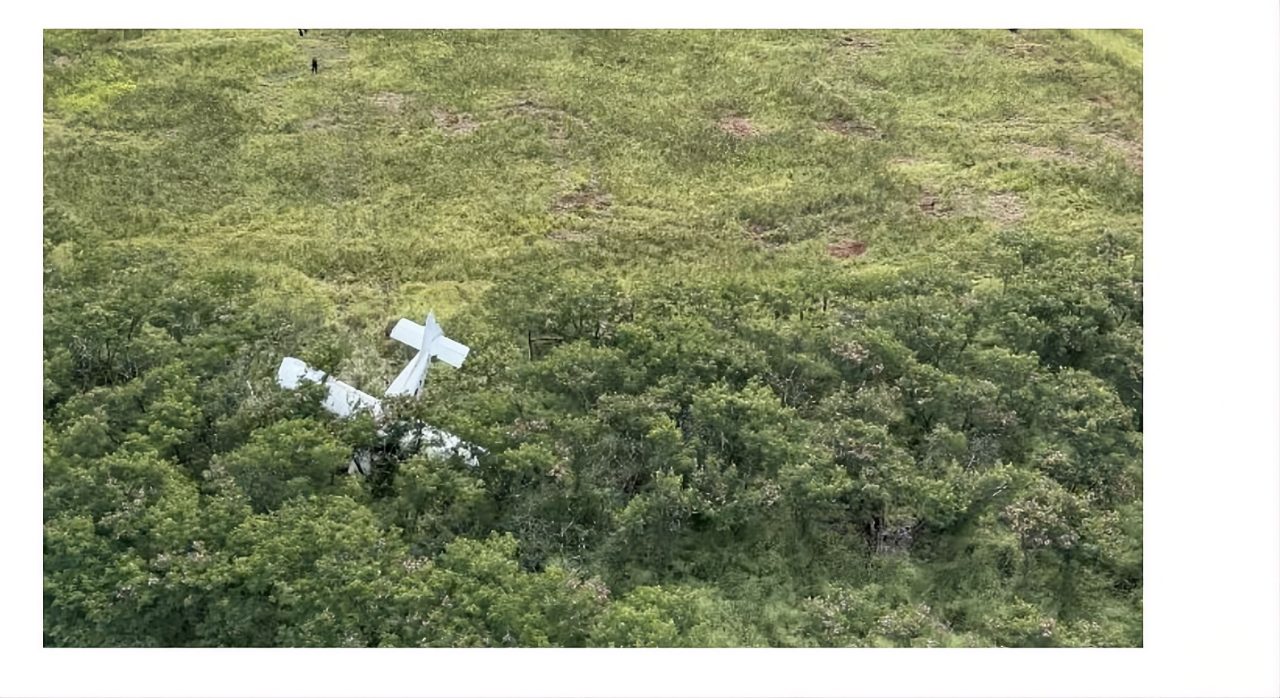
After years of deadly helicopter tour crashes on Kauai, a sightseeing airplane went down Friday morning near Menehune Road in Waimea. All five people aboard survived, although one passenger was hospitalized. The crash comes as visitors have fewer ways to see nearby Waimea Canyon, making sightseeing flights an especially relevant option.
Since Hurricane Lowell, only the first Waimea Canyon lookout has reopened, while the road beyond it, the higher viewpoints, trails, and Kokee remain closed. Some readers have told us they prefer airplane tours because of Hawaii’s helicopter crash history, but Friday’s accident brings that choice into question. Federal accident records don’t establish that fixed-wing sightseeing tours are safer than helicopters.
What happened not far from Waimea Canyon on Friday.
The Kauai Fire Department received a report shortly before 9 a.m. that a single-engine airplane had made an emergency landing. Firefighters found the aircraft on private land in rocky, difficult terrain on the Hanapepe side of the river, where they had to use dirt roads and landowner access to reach the scene.
Kauai Fire Chief Michael Gibson said the pilot heard a popping noise from the engine and tried to find somewhere to land. Gibson said only that the flight appeared to be a tour operation carrying one pilot and four passengers.
The injured passenger was carried out by rescue crews and transported by helicopter to a landing zone before being taken by ambulance to the hospital. Gibson said the aircraft had not caught fire or leaked fuel, and he said he was relieved the pilot and passengers survived an emergency that could have ended very differently.
The FAA is investigating, and it has not confirmed any mechanical failure. The agency’s initial statement did not identify the aircraft registration or operator, and the exact circumstances leading to the emergency landing have not been established.
What N721AV’s flight records show.
We examined Flightradar24 playback for N721AV, the Gippsland GA-8 that flew from Lihue Airport on Friday morning, October 30. It is also known as an Airvan, a high-wing, single-engine aircraft. The aircraft headed southwest along Kauai’s southern coast, passing Poipu before its visible recorded track ended offshore.
The last position shown in our playback was at 8:43 a.m. Hawaii time, shortly before the emergency was reported. The airplane was at 2,400 feet, traveling 121 knots and heading almost due west, with a modest descent of 192 feet per minute. None of those readings, by themselves, indicate an emergency.
FAA registry records show N721AV is a 2007 Gippsland GA-8 registered to Lihue-based Air Ventures Hawaii LLC. While the FAA and Kauai authorities have not yet officially named the operator or tail number, local television footage from the scene and the morning’s flight-tracking records point to the Air Ventures aircraft.
Comparing airplane and helicopter tour safety.
A November 2025 FAA-convened commercial air tour committee report examined National Transportation Safety Board records covering commercial sightseeing operations nationwide from 2008 through 2023. It identified 117 accidents involving airplanes and helicopters, including 27 fatal accidents.
Of those 117 accidents, 60 involved fixed-wing airplanes and 57 involved helicopters. The nearly equal numbers may surprise visitors familiar with Hawaii’s long and sometimes deadly history of helicopter sightseeing accidents, as it did us.
Those figures are merely accident counts, not a comparison of risk. The report calculated an overall commercial air-tour accident rate of 1.79 accidents per 100,000 flight hours, combining both aircraft categories. It also acknowledged serious weaknesses in the underlying flight-hour information, including a response rate of only 37% in the FAA’s voluntary activity survey.
We couldn’t establish any reliable, current Hawaii-specific accident rate comparing fixed-wing sightseeing aircraft with tour helicopters and the two aircraft handle emergencies differently. A fixed-wing airplane can continue gliding after an engine failure, potentially allowing the pilot to reach a suitable landing area if altitude, terrain, and distance permit. A helicopter can descend without engine power using autorotation, but the pilot must respond correctly and quickly, with both sufficient altitude and a place to land.
Neither aircraft has much margin when surrounded by Kauai’s steep ridges, narrow valleys, or open ocean. The same spectacular geography that draws sightseeing flights also limits options when something goes wrong.
Another Kauai airplane accident involving a GA-8 already appears in federal records.
On February 28, 2025, an Air Ventures Hawaii Gippsland GA-8 was involved in a separate accident at Lihue Airport. According to the NTSB’s final accident report, that aircraft, N699AV, had completed an air tour and landed normally before its right main landing gear collapsed while turning from the runway toward parking, causing substantial damage to the airplane. One passenger sustained minor injuries, while the pilot and four other passengers were uninjured.
Investigators determined that a fatigue crack developed in the landing gear and went undetected during maintenance inspections. The NTSB also documented a crack in the opposite landing gear leg and concluded that inadequate maintenance inspection contributed to the accident. The airplane had reportedly undergone a 100-hour inspection just 11 days before the failure.
Air Ventures Hawaii’s website currently describes its safety record as perfect, with no accidents or incidents, although the NTSB’s final report clearly identifies the company as the operator involved in the February 2025 accident. We found no qualification or explanation alongside that claim on the company’s FAQ page.
Kauai’s helicopter history remains difficult to ignore.
We’ve been covering Hawaii helicopter tour safety for many years, including the 2019 Safari Helicopters crash that killed seven people, the July 2024 fatal accident involving an Alii Air Tours helicopter, and the March 2026 crash off the Na Pali Coast that killed three people and injured two others.
Our reporting on why Hawaii helicopter crashes keep happening has examined pilot decisions, maintenance, unexpected, rapid weather changes, aircraft characteristics, and federal oversight. NTSB investigations have identified different causes in different accidents, including dangerous weather and mechanical failures.
The March 2026 disaster was particularly troubling because the company involved had the kind of reputation many travelers relied on when choosing helicopter tours. Airborne Aviation had years of experience with utility flying, emergency response, and rescue work. Three people still died when its helicopter crashed off Kalalau Beach, and the cause remains under investigation.
We’ve also written about the long delay in getting additional aviation weather cameras into Waimea Canyon. Those cameras are intended to give pilots better information about visibility and changing conditions before they enter some of Kauai’s most difficult flying areas.
We know from our own experience how quickly those conditions can change. During one of our own Kauai helicopter tours, clouds moved in so rapidly that our experienced pilot abandoned part of the planned route rather than continue into deteriorating visibility. That decision has stayed with us and has shaped much of our coverage of sightseeing flight safety.
What passengers can check before booking either type of tour.
Hawaii’s sightseeing operators don’t all fly under identical FAA certification requirements. Some shorter commercial air tours operate under Part 91 with an FAA letter of authorization, while others operate under Part 135, which imposes additional certification, pilot training, and operational requirements. Both airplanes and helicopters may operate under these different frameworks.
The Air Ventures airplane involved in the February 2025 landing gear accident was operating a Part 91 sightseeing flight, according to the NTSB. That was a legally recognized category of air-tour operation, but it was not subject to the stricter certification standards applied to a Part 135 air carrier.
Visitors considering either aircraft type can ask the operator which rules govern the flight, how the operator handles pilot training and maintenance, and what circumstances cause a tour to be canceled. Those questions deserve more weight than online reviews describing spectacular scenery, comfortable seating, or a pilot’s entertaining commentary.
We have long encouraged readers to check an operator’s history in federal accident records before booking. Visitors can also ask operators to explain their weather cancellation policies, particularly when a scheduled tour involves the Na Pali Coast or Waimea Canyon.
A canceled flight may be disappointing, especially when it was supposed to be a highlight of a Hawaii vacation. But a company willing to explain why it will not fly under certain conditions offers passengers information that no five-star review can provide.
Would you feel safer touring Kauai by airplane rather than helicopter, or have Hawaii’s air tour accidents made you reconsider flying over the islands altogether?
Lead Photo Credit: County of Kauai.
By Rob and Jeff, Beat of Hawaii.
Some of Hawaii’s most meaningful parts are the ones visitors walk right past without knowing they are there. We’ve spent nearly 20 years finding them firsthand for BOH as full-time Hawaii residents reporting on travel, culture, and island life, and telling you what they mean for your trip. Join us →
Get Breaking Hawaii Travel News