
Maui’s effort to eliminate thousands of vacation rentals has taken another turn. Some of the same coastal condos Maui targeted for conversion to resident housing could now be placed on a county-initiated path toward hotel zoning, allowing vacation rentals to continue.
We found ourselves in South Maui, within minutes of several of the properties under consideration, so we stopped by. The reason they’re getting another look isn’t their popularity with visitors. It’s their location within Maui County’s 3.2-foot Sea Level Rise Exposure Area, which is a state planning map showing land expected to be exposed to coastal erosion, flooding, or wave impacts. That’s now complicated the original thought that every apartment zoned Maui vacation rental was being phased out to make room for permanent housing.
The county may rezone these properties itself.
Bill 9, signed into law last December, phases out transient vacation rentals in apartment-zoned properties beginning January 1, 2029, in West Maui and January 1, 2031, elsewhere in Maui County. We followed what happened next when thousands of Maui vacation rentals that looked doomed were given a possible path to survive.
That came through Bill 88, which created two new hotel districts that qualifying properties could seek to enter. But as we subsequently reported, Maui vacation rentals weren’t automatically saved even by that new zoning. Individual properties generally face their own applications, studies, hearings, and costs to get there.
Resolution 26-129 now before the County Council’s Housing and Land Use Committee approaches this new group of properties differently. It would refer proposed community-plan amendments and zoning changes to the Maui Planning Commission, explicitly for the purpose of allowing continued vacation rental use.
Sea-level rise is now officially driving this new list.
The resolution initially covered eight properties: Island Sands and Maalaea Kai in Maalaea; Kihei Bay Surf and Kihei Bay Vista in Kihei; and Lokelani, Hale Ono Loa, Pikake and Hale Kai I in West Maui. All are within the county’s Sea Level Rise Exposure Area using its 3.2-foot planning threshold for coastal erosion.
The committee has since considered additions, including Makani A Kai, Maalaea Banyans, Kamaole One, Kahana Reef, Nohonani, Makani Sands, Hoyochi Nikko, Noelani, Puunoa Beach Estates, Kihei Resort, Waiohuli Beach Hale, Shores of Maui, Polynesian Shores, Lahaina Roads, Kihei Park Shore and Kaleialoha. The county record includes amendments, Planning and Finance correspondence, and public testimony as the list has evolved.
People already live in some of these condos.
That came through clearly in testimony before the committee. The argument isn’t simply between vacation-rental owners who want to keep renting and Maui residents who want more housing.
At Kihei Bay Vista, a longtime resident and condo association vice president described repeated flooding affecting her family and the difficulty of simply moving elsewhere on Maui. That while other testimony pointed in the opposite direction, citing residents already living at Kihei Bay Vista and neighboring Kihei Bay Surf as evidence that these properties can and do function as homes.
The county isn’t declaring these condos uninhabitable, and placement within the Sea Level Rise Exposure Area doesn’t suggest what might happen to any individual building. It does leave the council deciding whether coastal exposure itself should help determine which properties remain available to visitors after any broader phase-out.
We’re going to look at the South Maui properties.
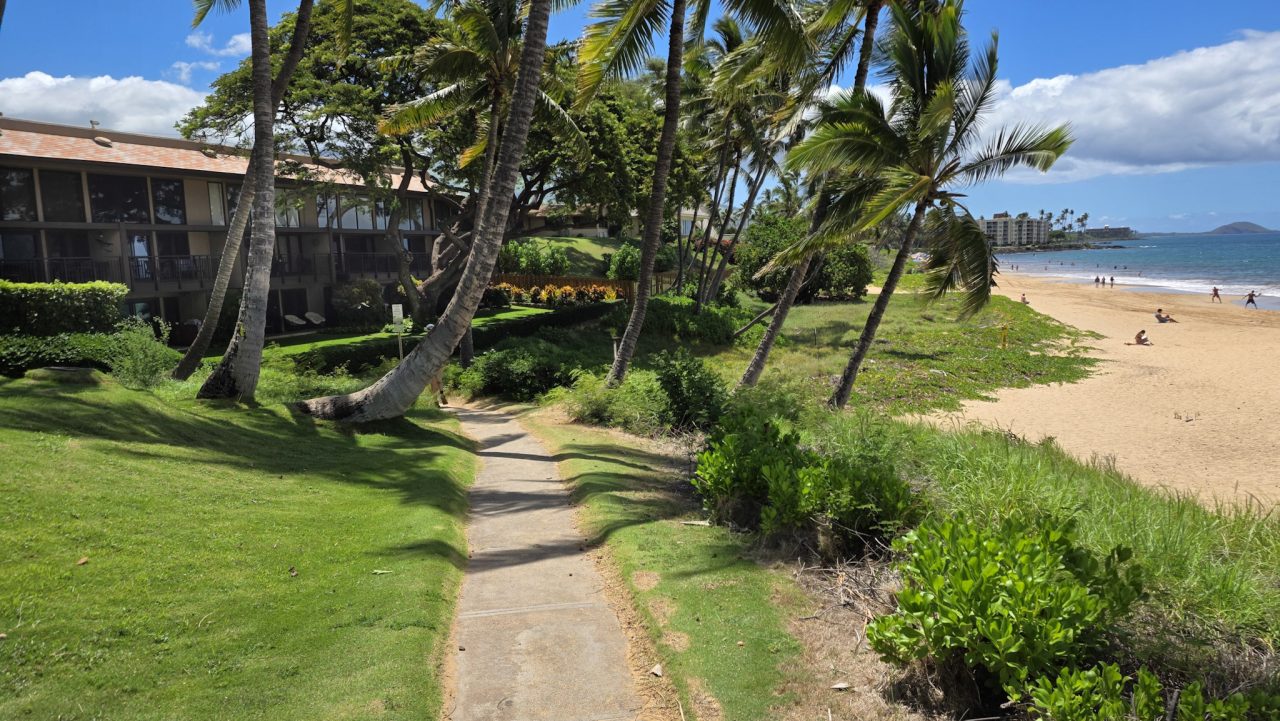
Several are close to us in Wailea, so we headed out to see and photograph some of them while we’re here. We checked their relationship to the shoreline and the surrounding neighborhood rather than drawing conclusions about future flooding based on what we could actually see (above). For visitors who have stayed in these complexes for years, however, the names on this zoning list certainlyh not abstract.
The Maui Planning Commission would still have to consider the proposed changes if the committee sends them forward, and rezoning has not occurred. As of this morning, the county has posted no further action or results. Yesterday’s minutes remain in draft status, and no meeting video is available, so we can’t yet say whether the committee advanced, amended, deferred, or rejected them.
Do you think coastal condos facing rising-sea risks should be allowed to remain vacation rentals rather than being converted to long-term housing?
Lead Photo Credit: © Beat of Hawaii in Kihei.
By Rob and Jeff, Beat of Hawaii.
Some of the most meaningful parts of Hawaii are the ones visitors walk right past without knowing they are there. We’ve spent nearly 20 years finding them firsthand for BOH as full-time Hawaii residents reporting on travel, culture, and island life, and telling you what they mean for your trip. Join us →
Get Breaking Hawaii Travel News




Could you please explain what rising-sea risks have to do with their zoning as vacation rentals? I read this article three times and the logic of this connection isn’t clear at all. Thank you.
I don’t understand the logic of this reprieve. Could someone explain to me please why say that properties threatened by sea rise are suitable for vacation rentals but not for longterm residents?
3.2-ft sea level rise?! That will be a huge number of years before that ever happens
I believe it’s not any either or proposition. Many of these units cost between $800 K and $1.3 million. That’s not a cost most local workers can afford. They are 850 sq ft or less and have maint. fees of over $2000 per month. Our buildings are among those named in the amendments to be added to thoses that face sea level rise issues, that is before the committee. We have a small beach with retaining walls keeping sea level rise at bay. Would the county prefer the sea take the land and buildings in the future? That seems to the the intent.
Yes! This is just a ploy to keep more units as vacation rentals and unavailable as long term rentals. I lived here when these were built- and know as a fact that except for newer complexes already excluded, most were used as residences for local residents: including my mother for the last 20 years of her life!
Absolutely they will remain ST or LT rentals. If they were converted to inventory, I imagine there would be quite the legal controversy if (when) those properties are sold, inundated and later condemned. “You knew when you made these available for purchase they were vulnerable to disaster.” Better to leave them with the current owners and let them be responsible for mitigation costs over the next decade or longer. They should decide to to rent sell, if they can. Everyone will be aware of the risks involved. It will be the owners choice, as it should be. PS. Cant wait for you guys to get to West Maui and the Sands of Kahana slow motion disaster, and further south what money is being used influence the beach from Black Rock to Canoe beach.
I oppose bill 9 but any decision on Maui based on the adopted projected sea level claim is wrong. The sea level projections are based on IPCC, political considerations, not science. We are a third of the way into the sea level rise plan forecast and the rate of sea level rise has not increased, making the plan forecasts impossible to reach. The Maui sea level gauge remains constant for 80 years, and a recent study of sea level gauges around the world refute accelerating sea level rise. I have written to the Governor with a request to adjust public policy accordingly.