

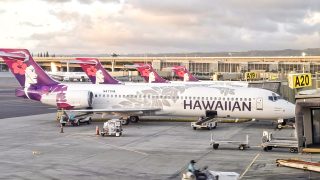
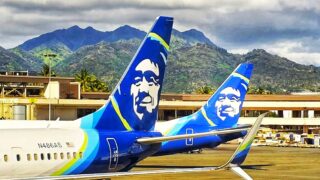
With Alaska Airlines expected to complete its takeover of Hawaiian Airlines soon, one of the biggest unanswered questions is what will replace Hawaiian’s aging Boeing 717 fleet. These workhorse planes have served the islands for a quarter century, but their time is running out. A Hawaiian Airlines pilot recently estimated they have five to six years left, and industry watchers say the decision on a replacement must come soon to avoid a gap in interisland service.
The challenge? There’s no clear successor. While options like the Boeing 737 MAX 7, Airbus A220, and Embraer E195-E2 are all likely under consideration, each comes with trade-offs in efficiency, cost, availability, and the passenger and cargo experiences.

Airbus, Boeing, or Embraer? The fleet debate.
Hawaiian’s interisland Boeing 717s will face a different analysis. Alaska does not operate that quarter-century-old aircraft type, and the few remaining airline operators that fly the 717 are in the process of retiring the plane. A decision will not be far off, while the actual fleet replacement may take several years.
The Airbus A220 stands out for its fuel efficiency, modern design, and comfortable passenger experience. Its size makes it a strong contender for interisland routes, but integrating another Airbus jet into Alaska’s traditionally all-Boeing mainline fleet would require a significant shift.
Alaska previously acquired a fleet of A321neo planes through its Virgin America merger. Those planes were later sold to American Airlines, returning Alaska to an all-Boeing 737 company.
The Boeing 737 MAX 7 is another logical choice for fleet standardization, aligning with Alaska’s existing aircraft. However, it faces ongoing certification and deliverability delays, and its suitability for engine-taxing, high-frequency, short-haul flights is still unclear.
One reader highlighted this concern: “The (Alaska) delay is likely due to waiting for the 737-7, not just economics. They’d be far down the list if they order now, especially since it’s still uncertified.”
Meanwhile, the Embraer E195-E2 could serve as a middle-ground solution. Alaska’s regional subsidiary, Horizon Air, already operates the smaller E175 version, making the transition to the E195-E2 a more seamless option in some ways. Its 2-2 seating and lower operating costs could provide an interesting alternative to the 717’s current role that’s travel friendly in the sense it doesn’t have three-across seating.
Beyond aircraft availability, operational efficiency is another concern. The 717 was built for quick turnarounds, something modern jets struggle with in Hawaii’s high-frequency interisland market where a single aircraft might operate as many as 16 flights in one day.
As one reader noted: “The MAX engines require a longer period to cool down after a flight, which would lead to a drop in the number of interisland flights unless you have extra jets.”
Passenger comfort vs. operational costs.
Beyond efficiency, the aircraft decision will impact passengers. The 717’s unique 2-3 seating configuration has been a strong advantage over the years, offering a slightly roomier feeling experience compared to the 3-3 layout of most modern jets. A shift to the 737 MAX 7 would mean sacrificing this comfort in favor of more dreaded middle seats per flight.
One BOH commenter said, “Passengers have long appreciated the 717’s 2-3 seating, which offers a more spacious feel compared to the tighter 3-3 layout of most modern jets. A shift to the 737 could mean sacrificing this comfort for standardization.”
Meanwhile, some believe maintaining the 717 is a better short-term option, with Hawaiian’s maintenance of them remaining one of its strong suits.
One commercial pilot noted: “We just flew Hawaiian 717’s OGG to KOA and back—all looked good, including the cockpit. As indicated in your article, I spoke to the flight crew, and all seemed happy with the 717. As long as the superior servicing is kept up, the 717 should still be reliable for the next 5 years.”
Alaska Airlines’ upcoming critical decision.
Air travel plays a critical role for Hawaii’s visitors, residents, and economy. The decision on this imminent fleet replacement is more than just an operational issue—it will impact reliability, pricing, and the Hawaii travel experience for years to come.
As the clock ticks on the Boeing 717, all eyes will remain on Alaska Airlines to see how the company balances operational efficiency, passenger comfort, and fleet integration in shaping the future of Hawaii travel.
What do you think? Will Alaska prioritize operational efficiency, passenger comfort, or fleet standardization as it shapes the future of Hawaii travel?
Get Breaking Hawaii Travel News



re-engine… & re-furbish👏❗️
keep ’em flying👍👏❗️
As frequent Flyers from Phoenix AZ to Maui we much prefer a two seat option. In fact if the 737 dash 7 is put in place we would most likely fly nonstop from Phoenix to Maui. We would prefer to fly on Hawaiian to Oahu and then take the shuttle to to Maui however that is because we like the two seat option. We fly a minimum of three to four times a year.
Ya see where Alaska is shrinking HAL routes, credit card merger and points redemption going towards Alaska only. What makes you really think they want to invest in HAL at all? What choice do Hawaiian’s have? You fly what’s available. Comfort really please. IMO quit being so spoiled.
Alaska Airlines invested $1.9 billion to buy Hawaiian so it doesn’t seem likely they’ll be indifferent to it.
But what you can absolutely, positively be sure of is that anything that doesn’t make money will be history. HA has lost over $1 billion since 2019 with no end of that in sight, so nothing is sacred, nothing is beyond the axe.
In my humble opinion the E2 seems like the best solution. The Max 7 is significantly bigger than the 717 and Southwest has been having trouble with interisland on the 737, between engine cool downs and being too large. The E2 also provides the flexibility of two different sizes, so shorter or thinner routes could get the 190 while busier ones get the 195
I just don’t think AS will go for a 20 plane sub fleet that will have to be based in HNL.
I think Southwest issues with inter-island flights may be tied in to it not having had overnight flights on the return. I suspect they flew inter-island flights when they had planes, not when it was a good time to go, and they had poor connectivity between their mainland flights and their inter-island flights.
I think they flew inter-island flights not because they were profitable, but because the alternative would have been to have the planes sit for as much as 12 hours.
AS/HA won’t have that problem.
“The internet” does say the MAX requires a longer cool down time than previous 737’s, but that’s also based on the inbound flight time. As most inter-island flights are short, I doubt this will be an issue. Also, they will be unloading and loading more people and cargo than on the 717’s so the extra time probably would be needed anyway.
They did. And they quickly went out of business, although that was no doubt more about market saturation, that equipment.
But that plane certainly kept them from being meaningfully in the cargo business, even, if the market would have supported it
I think Alaska should go with the E175 like Horizon uses.
People forget that Mokulele Airlines used Republics E175 for inter-island service. The seats are approximately one have inch wider than a Boeing 737 coach seat. The overhead baggage bins are huge and the two by two seating is great.
My wife and I have flowed many times on the 717 and really have enjoyed the aircraft for those short inter island flights. One thing I have enjoyed is right below the overhead storage units is the long railing that’s built in and so useful for seniors and others when you walk the aisle – it’s a railing to use. I have not seen any other aircraft with that type of feature.
I think you’re missing a more obvious choice. The E175 with more flights. Alaska has switched to them in other markets with great success. More flights has resulted in higher customer satisfaction due to increased oyptions on what times you can fly.
So more flights to carry the same number of people per day, flown by crews who aren’t likely to take a 1/3 pay cut because they are 1/3 less productive on every trip?
I agree. And if anything comes along that would work better, Alaska can move them to other routes on the mainland.
This will be a tough call as airplanes like the DC9 (aka 717) are not built as robust. Interisland travel is a lot of cycles for an airplane. 737M7 is probably too big and likely has some restrictions such as engine cooldown. The A220 is the Bombardier C series that Airbus “rescued” and not certain if it would be durable enough to take the short hops day in and day out. Only apparent reasonable option is the Embraer 175E2 that potentially could be used for island hopping and then rotated into Alaska’s mainland regional fleet to finish its life. That being said the 717 while durable, shows its age and is definitely nearing its demise.
I believe that Horizon Airlines will be flying the interisland routes in the future. I read about the scope clause that the Hawaiian pilots have on there contract. Maybe once the pilots contract between Hawaiian pilots and Alaska pilots are combined. An agreement may be made to allow Horizon Airlines to fly the interisland routes and may be able to offer service to Molokai and Lanai. Remember Alaska Air group bought Hawaiian Airlines. There is no Hawaiian Airlines anymore only by brand.
Just speculating.
HNL-OGG and HNL-LIH are both shorter than SEA-PDX. Just think about the beating planes get per flight hour.
This will be a tough call. Hawaiian has lost over a billion dollars since its last profitable year in 2019 with no end in sight. Everything will be on the table.
737’s would be better for cargo, while the EMB-175/195 would be quite a come down from the 717.
The main issue is that the 717’s were substantially overbuilt, which made them ideal for HA’s operation with many more landings and takeoffs than most airlines have.
The A220 would require a substantial increase in maintenance investment to deal with its carbon fiber and I suspect it would be the worst for HA’s heavy usage
I suspect HA will end up with 737’s so it can share maintenance with AS. It wouldn’t too far fetched to see HA ditch their A321’s for 737’s and base them on the mainland for Hawaii service. This would make the 737 for interisland an obvious choice.
I think AS will order some new 737NG-700’s. I understand that is still possible. If boeing can get the planes out it would be a perfect solution.
That would be my thought. They could use them in both fleets with AS replacing their aging 737-700’s.
In what way is the Embraer E195 a “come down”? The E195 is bigger than the 717.
The 717 has a larger cargo door and a wider cross section, giving it an advantage in cargo, something that is especially important to the Hawaii market.
Longer and skinnier, like the Embraer family makes for slower loading and unloading, some that is a disadvantage in the Hawaii market where quick turnaround times are especially important.
I like boeing 717
maybe it’s time to go to Boeing and have build a new boeing 717 aircraft
With extra new planes
Hawaiian airlines already have a new maintenance program for the 717
You must not have much knowledge on airplanes. The Boeing 717 is originally a McDonald Douglas.
Why would Boeing make a plane just for Hawaiian’s needs? When they can just offer a sweet deal of brand new 737’s.
It’ll be A319’s. All max, neo, a220, E2 aircraft have geared turbofans. No go for interisland turns. Plus the 319 is superior to all with cargo capacity. 319’s can be found cheap, same type as 321’s, creating pilot efficiency. Your 3/2 comfort will not be factored in to their decision.
What about the Comac C919 or Yakovlev/Sukhoi Superjet 100/SJ-100 ? … That might shake things up a bit ! … “Pualani” would most certainly be frowning, perched on the tail of those aircraft ! … lol..
Although certainly not preferred, almost anyone could survive those mercifully short intra-island sectors stuck in the dreaded middle seat …
I think the 737 max is a good pick , because Hawaii has small islands with frequent short take off and landing runways not to mention the mountainese terrain with ever changing unpredictable tropical climates . With that said need a good , tough , and reliable aircraft !!
The DC-9 was very similar to the 717 which was an easy transition
in 2001. This time will be more difficult. I favor the Embraer
which Horizon already has in their fleet
The airbus a220-100 seems to be the best option, with its 2-3 seating and similar passenger capacity… I’ve been on them, nice plane… Not sure about the economics with interisland flying.
Really??? “Passenger comfort” on a 50 min. max. interisland flight?
Y’all need to ride the train or subway in Tokyo during rush hour for 20min. Then no matter where you sit on a interisland flight, it would feel like first class!!!
Hawaiian already flies Airbus and has maintainers familiar with the brand. Among the options you present, the 220 seems the best and would further differentiate the Hawaiian and Alaska brands.
I have flown Alaska a lot in the western Us (>1 million real miles). Alaska frequently flies mixes of 737s and E175s on the same routes, depending on time of year or day (and anticipated load factors), pretty effectively-even when they have hourly flights, like between Spokane and Seattle. Wouldn’t be surprised to see a similar mix replace those aging 717s-they have looked their age when I have been on them.
Lived in Hawaii for over 30yrs. flew often with Hawaiian & Aloha. Now retired in Thailand where most of the domestic and regional airlines are using the A320-a very comfortable plane