
We traveled 7,500 miles, then kept bracing for the Barcelona we had been warned about, only to keep failing to find it. We walked the neighborhoods that have become shorthand for peak overtourism around the world, expecting the city that sprayed tourists with water guns and told them to go home.
What we found instead was a place that was perfectly polite, mostly welcoming, and visibly too full. The frustration was real, and the housing crisis behind it was very real, but the idea that every street corner was at war with visitors was simply not true. A city can be totally courteous and still feel overburdened, and Barcelona may be significantly further down the road Hawaii is on than any other single major tourism destination we have ever visited.
We did not come to Barcelona as tourists. We came to explore what advanced overtourism actually looks like up close, because the same pressures are building in Hawaii, and Barcelona is where the rest of the world goes to watch them play out first.
The protest that traveled the world was not quite the city we walked.
Last summer, roughly 2,800 people marched through Barcelona’s tourist districts carrying signs that the city was not for sale, a smaller group spraying visitors with toy water pistols in what organizers later called a spontaneous act, others taping off hotel and cafe entrances, and the footage ran worldwide as the face of tourism backlash.
That was real, and it was also only part of it. But it was significant enough to make us cautious about visiting. Is that the same reaction we sometimes hear from visitors who openly question whether Hawaii even wants them?
We walked the most visited districts, the Gothic Quarter, El Born, La Ramblas, Sagrada Familia, Park Guell, and the waterfront, expecting at least some signs of visible conflict and finding virtually none. Most interactions were friendly; nearly everyone spoke English; shopkeepers and restaurant staff welcomed us; and our private guide from Barcelona Sustainable Tours, Mariona Prats, spoke candidly about the city’s problems while remaining staunchly proud of it. The weight of tourism was everywhere, but it was not taking the form of open confrontation. As Mariona pointed out, the uprising about tourism last summer was confined to a single day, and was blown out of proportion by the media.
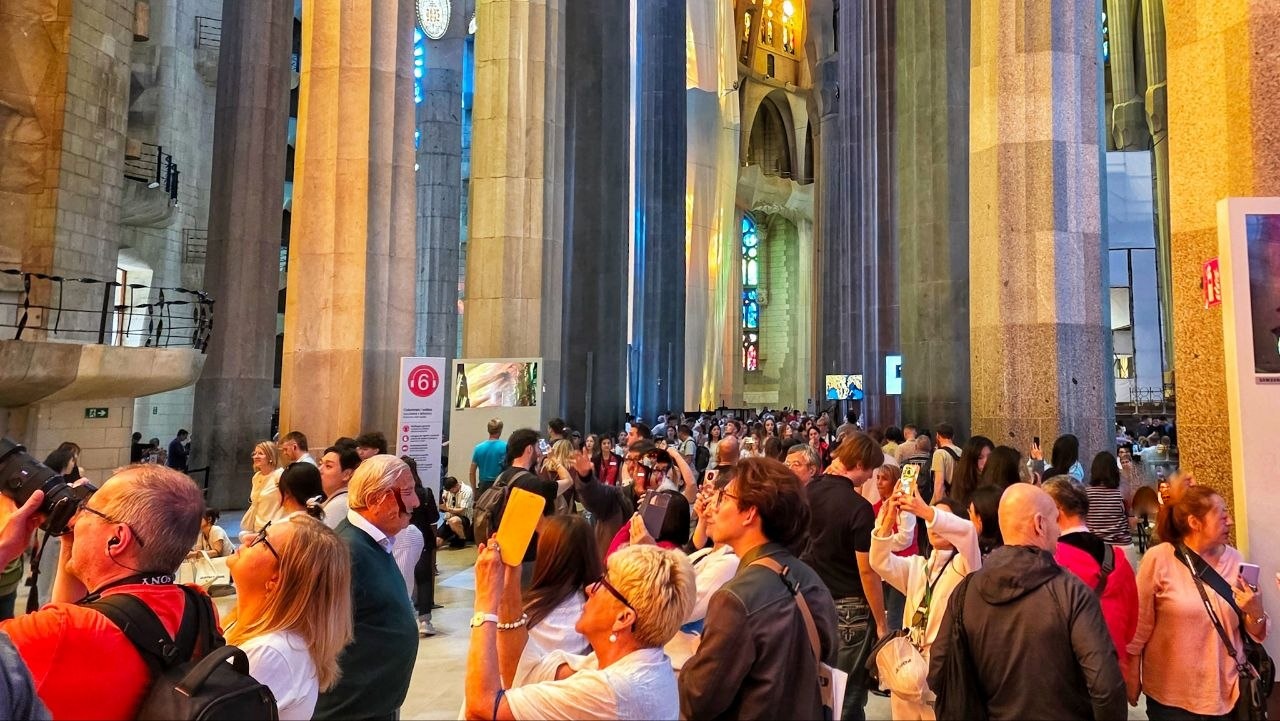
Iconic Sagrada Familia felt overwhelmed in a way few places we have ever visited do; Park Guell was as compressed or more than we’d expected, and La Ramblas often read less like a street than an intense river of people moving between attractions. The city felt too full for comfort rather than in any way hostile.
The anger is about housing, and the numbers behind it are real.
The deeper story is housing. City officials point to rents up roughly 68% over the last decade and home prices up about 38%, with young residents competing for apartments in a region of Spain that draws 25 million visitors a year. Tourism did not cause all the problems, but it has become the most visible symbol of a broader affordability problem, and it came up repeatedly in our conversations. It reminded us so much of being home in Hawaii in these very ways.
Our own Airbnb host explained it plainly without our even asking. He told us he can likely only rent the apartment through 2028, after which he expects the city’s tourist apartment rules to require a complete change. You hear that differently when you are standing in the very apartment in question.
Barcelona is doing something no major tourism destination has tried.
Barcelona has more than 10,000 licensed tourist apartments, and Mayor Jaume Collboni announced in 2024 that none of those licenses will be renewed when they expire in November 2028, a plan Spain’s Constitutional Court upheld in 2025. Other tourism destinations cap and restrict vacation rentals, including Hawaii; Barcelona, however, is planning to eliminate the licensed sector outright and return those units to long-term residents.
Supporters say housing has to come first. Owners and industry groups counter that they invested legally under the old rules and are now losing the use they paid for, and they warn of economic harm and a surge in illegal rentals. The lawsuits and the politics are not entirely finished, but for Hawaii readers this is the closest real-world test yet of ideas that keep entering local island debate.
Barcelona is also moving against cruise ship pressure. The city handled nearly three million cruise passengers in 2024, with many arriving as in-transit day use visitors, and has approved reducing the number of cruise terminals from seven to five. The mayor has said he wants cruise calls pushed toward zero over time, and the per-day cruise passenger levy is set to roughly double.
Visitor taxes climbed while we were there. On April 1, weeks before we landed, the nightly tourist tax rose again to as much as €12 per person at the top hotels, about $14, layered onto the room through a city surcharge that holds into 2027, and we paid it ourselves.
Here is the part that should stop a Hawaii reader cold. That European crackdown everyone reads about is modest next to what we already pay here in Hawaii. Barcelona charges a flat fee per guest, while Hawaii charges a percentage of the room, an 11% state accommodations tax that already folds in the new 0.75% green fee, 3% county on top of that, and the 4.712% general excise too, which lands at close to 19% before a single resort or parking fee is added.
On a $400 resort night, that is roughly $75 in tax, where the same night at a top Barcelona hotel runs the two of us about $28 and does not climb when the room rate does. The city the world looks to as an example of tourism crackdown taxes its visitors nowhere near as hard as Hawaii does.
The markets showed what tourism does to a place over time.
One of the sharpest moments had nothing to do with any landmark. Inside the famous market, Mercat de Santa Caterina, the balance had tipped to either high-end specialty goods or tourist food stalls, with little of the everyday middle left; the ordinary produce and staples a neighborhood actually shops for thinned out to almost nothing. We have watched the same thing in Venice, Florence, Lisbon, and other heavily visited cities, where permanent public markets slowly stop working for residents as vendors who sell everyday food get squeezed by rising costs and prepared food and tourist retail crowd in.
That is another global pattern, not a Barcelona one. Hawaii has no real equivalent to these old urban market halls, and seeing one tip toward visitors hit us harder than any landmark did. The market still works, but it no longer feels built for the people who live around it. We seem to be seeing the same changes coming to Hawaii, for example, at the Saturday market at KCC in Honolulu.
Restaurants told the same story in another way. Around major attractions, the menus and plates began to blur together, each promising the same famous paella to the same rotating crowds. We are largely self-catering, and maybe that makes us even less forgiving, but we found ourselves trusting online restaurant reviews less and less as we walked through areas where everything looked designed for visitors who would be gone by tomorrow.
This is Hawaii, a few exits earlier on the very same road.
Barcelona drew roughly 16 million visitors in 2024, with the broader area drawing over 26 million, and tourism accounts for about 14% of the local economy and supports roughly 126,000 jobs. The city depends on tourism and is straining under it at the very same time, a bind that Hawaii readers will recognize immediately.
Barcelona has moved further into the experiment than Hawaii, and that’s a good thing for Hawaii, at least for now. Barcelona vacation rental restrictions go beyond anything Hawaii has tried; its cruise cuts are more direct, its visitor taxes are climbing, and the familiar timed entry already shapes access to all of the major attractions. Sagrada Familia now admits only pre-booked visitors and draws about five million people a year, while Park Guell is capped, timed, and still packed to capacity day and night.
Venice took a different tourism revision route, launching a day-visitor fee on peak dates in 2024 and expanding it since, while Barcelona is rewriting where visitors can stay at all. Both are circling the same question of how much tourism is enough.
Hawaii is not Barcelona. Geography, land ownership, culture, governance, and the visitor economy are decidedly different. Yet the pattern is recognizable: housing pressure, cruise friction, crowding at famous places, rising fees, access controls, and residents asking whether tourism’s benefits still reach them in ways that justify the daily burden.
Hit-and-run meets Instagram in Barcelona
What stayed with us was not the protest movement but the distance between the water-gun Barcelona of the coverage and the one we actually walked into, where the hostility may have been real at some level but was not visible on every corner. A city does not have to be openly hostile to feel saturated, and this one feels over-saturated.
The rapid-fire hit-and-run tourism was on display everywhere, visitors timed out and costed out, racing packed itineraries between famous stops. Many still value travel above buying things, but the result on the ground is frantic: everyone trying to see the same places, on the same clock, in the same narrow parts of the city.
The Instagram tourism was worse, and harder to watch. People changed outfits inside the Sagrada Familia to pose for different shots, costume after costume, in what is still a working church. We saw it staged everywhere, the same poses at the same backdrops, a city being treated as a bizarre content set rather than a place where people actually live and worship.
The contrast only sharpened after we left, as we knew it would, when the world watched Pope Leo the 14th consecrate the same basilica and crown it the tallest church on earth, the nave full of the faithful for a day in the place we had watched tourists treat as merely a costume set.
That may be the most useful warning for Hawaii.
The danger is not only that residents grow angry or visitors feel unwelcome. It is that a destination keeps functioning, keeps smiling, keeps selling its experience, and still reaches a point where many residents no longer believe more visitors automatically means a better future for them.
Barcelona is one stop. We have been to others; people now say they will choose over Hawaii, and we will keep reporting back on whether the alternative actually delivers, or whether the grass only looks greener from the plane at 30k feet.
You have stood in these same crowds too. Tell us where you have felt a place slide from welcoming to worn, and whether Hawaii is closer to that line than we even want to admit.
Photo Credit: © Beat of Hawaii at Sagrada Familia in Barcelona.
Get Breaking Hawaii Travel News


Am a boomer, grew up North Shore Oahu in a 60’s surfing family who was always looking to outrun tourism & development … declaring Oahu too crowed by 1968 moving onto Australia. Since then, I have traveled lived here and there, now back in HI, Island of Hawai’i, past 26 years. So have experienced and seen so many changes over the past decades. And have concluded that tourism has both improved and ruined so many places.
IMO, the problem is very complex depending on what places. First, it’s always been embarrassing being an American tourist because there have always been plenty of arrogant self-entitled demanding American (and Colonial) tourists … in the past 100 plus years … to trample all over host countries (including the still legal Kingdom of Hawai’i) … disrespectfully.
Then you have all of the deeply corrupt political country leaders whom make sure that every dollar a tourist spends is money laundered to the max … until now, a real breaking point mess.
Am a boomer, grew up North Shore Oahu in a 60’s surfing family who was always looking to outrun tourism & development … declaring Oahu too crowed by 1968 moving onto Australia. Since then, I have traveled lived here and there, now back in HI, Island of Hawai’i, past 26 years. So have experienced and seen so many changes over the past decades. And have concluded that tourism has both improved and ruined so many places.
IMO, the problem is very complex depending on what places. First, it’s always been embarrassing being an American tourist because there have always been plenty of arrogant self-entitled demanding American (and Colonial) tourists … in the past 100 plus years … to trample all over host countries (including the still legal Kingdom of Hawai’i) … disrespectfully.
Then you have all of the deeply corrupt political country leaders whom make sure that every dollar a tourist spends is money laundered to the max … until now, a real breaking point mess.
Excellent article. Engaging and well written.
What wasn’t mentioned was that Americans and Spaniards are very different culturally. Americans will get angry at visitors. Spaniards will disapprove but rarely get mad. Even last year with the squirt gun protest, it all had a light-hearted element to it.
Barcelona is truly overcrowded with tourists. I travel to Europe two to three times a year and have come to avoid the” hotspots.”
And personally I feel sorry for the Instagram tourists. It reminds me of the crowd at the Louvre in front of the Mona. Lisa, not actually looking at the painting but just raising their phone to take an Instagram shot of it. I can do without those folks.
I just returned from 5 weeks I’m Iceland, May 2, June 7, somewhat before summer session. I was also there last September for the month. Similar situation there except that it is concentrated in the Golden Circle near Reykjavik and the famous spots along the south coast, Diamond Beach, Jokulsarlan Glacier,etc. the crowds are manageable in late September and early May, after that, no thank you. But once you leave that small area you can easily escape tourists… At least the annoying ones! If a parking lot is full, I don’t stop.
Last time in Kauai the traffic, especially through Kapaa was horrible. We can no longer afford the hotel fees and the exorbitant rental car rates 😟
This is a fascinating report, and yet I feel it overlooks one aspect of the situation. I visited Barcelona in the late 1970s when it was dark, dank, dirty, unfashionable and all-around pretty shabby. When I re-visited in 2018, it was bright, alluring and very enjoyable. My point is that when tourism grows, for whatever reason, a city’s attractions can get cleaned off, restaurants upgraded, street lighting improved and so on.
I agree that tourism can reach a tipping point, but at the same time it has some benefits. Perhaps in Hawaii the state and counties haven’t reinvested enough in amenities like restrooms at the beaches, etc., but I would like to see a balanced report including also what *has* improved in Hawaii due to its increased tourist dollars. Hospitals? Schools? I don’t know because I only started coming to Hawaii in 2008.
Excellent points! Thank you for your comment.
BOH, how about doing a piece on where all the tourism dollars go? My thoughts are that the islands are cleaner, more well kept, have better services, and in general improve the lives of residents because of the massive budget received from tourism dollars.
Interesting idea. But i suspect you will find that the majority of
1. tourist taxes – (GET, TAT, OTAT on Oahu) are not used well. Hawaii Tourism Authority (HTA), Council for Native Hawaiian Advancement (CNHA) and Hawaii Visitors & Convention Bureau (HVCB) combined receive over 100 mil / year. Look into any of their budgets and you will find waste, inefficiency and cronyism.
2. Tourist spending- international hotels, car rentals, fees for tourist locations, chain restaurants – very little other than low paying jobs stays here.
Hawaii is beautiful and unique. But the use (waste) of tax dollars leaves a lot to be desired.
Barcelona received a huge “glow-up” for the 1992 Olympics, and has never looked back. That certainly wouldn’t work for Hawaii though!
I find the cruise ship people and the instagram people to be the worst. They overwhelm the same few iconic places, while everything else is ignored. That’s why when it comes to tourist taxes I support high “arrival fees”. Charge someone $400 to visit Venice, regardless how much time they spend there. Maybe the same with Hawaii.
In general though, I travel to Europe in the shoulder season, and I don’t go to popular sights. I ride my bike, often through smaller towns and villages. I often go a whole week without seeing/hearing an American.
That’s the “I’ve got mine. You can’t have any” American mentality, sometimes with a gun.
Just prior to the pandemic, Machu Picchu had to install entry gates and introduce timed visits. Post-pandemic, the situation has only grown worse. The Instagram crowd has little to no interest in the history of the Incas. Their only question is where are the best places for photos… and with it come the invariable cringe-worthy poses.
Likewise, Perito Moreno glacier just outside El Calafate, Argentina. Hordes of Instagrammers clog the walkways for the perfect photo to post to their friends.
It seems like the whole world is traveling now. I started exploring the world in the 1970s and have visited more than 100 countries. Back then, world travelers were few. Now nearly everywhere is crowded. Not sure what the answer is, aside from limiting access.
I live in Maui, and we are continually overwhelmed by tourists, in spite of media reports saying that our numbers have plummeted
Definitely true. When I grew up in the 70’s people considered themselves lucky to make one overseas trip in their lifetimes. Now it’s a yearly thing for many. But I still avoid crowds by traveling off-season and as much as possible, off the beaten path. My last trips were Dublin/Paris/Bruges in September, and even New Zealand/Sydney in January (their summer). I didn’t run into crowds.
Instagrammers have no shame. We have seen it everywhere we have traveled. If they are present we swiftly make a u turn and laugh while we are doing so.
Thank you for all the knowledge you deliver. We love all the islands and visit several times a year. We won’t be stopping any time soon.
So if Barcelona removes 10,000 rentals, won’t hotel rates go through the roof? Then only wealthier tourists will come. I am not sure that solves anything except making the visitor mix richer.
I went to Venice last year and it felt beautiful and completely broken at the same time. Barcelona is in the same category. I hope Hawaii does not join that list. Not sure what can be done to prevent such a strange new global tourism trend.
Yes the air quality in Europe bothers me as much as the crowds. Clean air is one thing Hawaii still has that many other more densely populated destinations do not.
The restaurant situation is painfully familiar in Hawaii and Europe now. We have had the same experiences in Waikiki, where everything looked busy and was highly rated, but none of it felt really connected at all. The same in Europe. The large multi national food corporations all have a hand in providing food to restaurants that is easy and cheap. So much for the old days of authentic food.
The Instagram thing is out of control everywhere. I recently watched people pose at Pearl Harbor like it was a fashion shoot.
Interesting that you found people friendly there. That’s also been my experience in Hawaii. The online discussions always sound worse than what actually happens when you’re standing there talking to someone. We will keep coming back to Hawaii!
Yes, the online world and reality are two totally different worlds. I think people are starting to realize that now.
There are a loud few (probably bots) on social media who are writing multi-paragraph diatribes on how awful life in Hawaii is, and how people visiting Hawaii should be ashamed of themselves for “extracting from the ‘āina”.
Instead, the best source for what it’s like to visit Hawaii and what the people are like there is tourists who have already visited multiple times. Invariably they’ve had a wonderful time and the locals have been kind and generous – 180 degrees different from what you read online.
You receive what you give out, in Hawaii and in the rest of the world.
I’ve been going to Barcelona for thirty years and what struck me was not the crowds. The crowds have been horrible there for years. But about restaurants, I used to be able to wander into almost any place and get something memorable. Last few times it felt like most places in tourist areas had basically the same laminated menu and the same paella photo out front.
I am not sure visitors are the only problem either in Hawaii or in Europe. Governments like the tax money and businesses like the travel spending. But then everyone acts shocked when residents push back.
This made me less interested in Barcelona but more interested in how Hawaii can avoid becoming that. Maybe that was your whole point and I want to hear more!
Don’t let anyone give Barcelona a bad rap. I went there in 2024, and didn’t experience any of the frenzy and brokenness described in this article. I think it depends when you go and what you do while you’re there. Early morning visits to the landmarks and traveling during the shoulder seasons will give you a much better experience.
That being said, balance is important. The destinations themselves can manage large influxes with assigned, scheduled appointments to the landmarks, parking fees, things of that nature.
People always say they will go somewhere other than Hawaii because Hawaii is too expensive or too regulated or too whatever. Then they get to Europe and find equal costs, bigger crowds, taxes and fees, housing fights, and even worse tourist fatigue there too.