
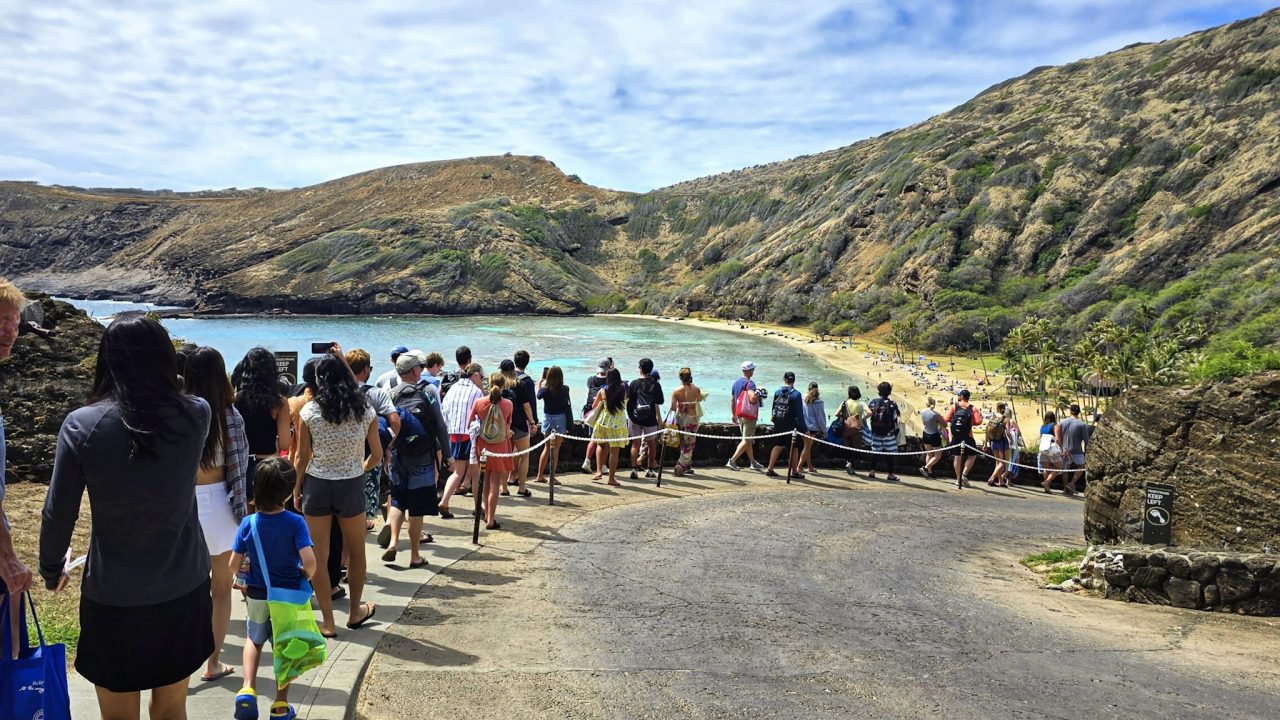
Read our comments long enough, and the question answers itself. Hawaii residents tell us exactly what gets to them about living here, and the first answers come fast and practical. Restrooms locked or missing a door, sidewalks that stop where the danger starts, parking lots full by midmorning, lookouts so overrun people stand in the road for the photo.
Underneath the practical gripes, though, the answers turned and got heavier, and they were strikingly consistent. Most of them pointed straight back at the visitor reading this. Not as the villain, but as the person who moves through all of Hawaii’s issues on vacation and never sees the half of it residents live with on a daily basis.
We read the comments, and the real answer surprised us.
The answers carrying real heat here were not about parking or potholes. They were about cost climbing past what families can carry, neighborhoods filling with people who were not there before, beaches and trails too crowded to enjoy, turtles and seals crowded by visitors who mostly do not know better, and the tax money that pours in while the island shows nothing for it.
Visitors did not build any of that, and most never see it, because a week on vacation does not show you what a mortgage, a property tax bill, and a changing neighborhood do. The point was never that Hawaii wants fewer visitors. It is that most visitors never get shown what residents are actually reacting to.
The island people love is one that its own people can’t afford.
The most persistent answer was not tourism at all. It was cost. Families across Hawaii keep wrestling with housing, groceries, utilities, and insurance bills that would strain any household, and here they hit harder.
It shows up as children moving away, parents wondering whether their kids will ever be able to afford to stay, and friends leaving for the mainland, not because they wanted to, but because the math of living in Hawaii stopped working.
You see the same islands from the paying visitor’s side. A luxury resort costs more per night than some mortgages once did for a month; the rental condo may be worth several million dollars, and the restaurant charges what it charges because visitors will pay it, while residents mostly cannot.
None of that is wrong, but it helps create a strange reality in which the Hawaii you are enjoying feels increasingly out of reach to the very people who live there. The next time a dinner check or a room rate shocks you, it helps to remember that residents are standing in the same line, looking at the very same number, and not leaving in a week to return to something more affordable.
Here both sides end up looking at the same question. You pay more in lodging tax and park fees every year; residents pay more in taxes and everything else, and the island keeps showing everyone the same broken restrooms and unmaintained roads. Where the money goes is the one frustration visitors and residents tend to land hard on together, and it points at the government collecting the money more than at anyone reading this.

The building never stopped, and the islands are paying for it.
Part of what has always set Hawaii apart is the people in it, the families who have had the same places for generations, the small local businesses that hang on, and the sense that a place mostly belongs to the people who built it. Residents watch development chip away at all of it, resort by resort and subdivision by subdivision.
Decades of timeshares, condos, and vacation rentals went up while the roads, parks, and sidewalks around them never grew to match. Each project cleared its approval on the promise it would barely add to the load, but the loads kept adding anyway. The result is a Hawaii built well past what its own infrastructure was ever sized to carry.
What got built changes what you came for too. A coastline fills with units, a town that ran on local shops turns over to whatever serves visitors, and the Hawaii pulling you there keeps thinning into the same thing you could find anywhere.
The line between welcome and harm you can’t see.
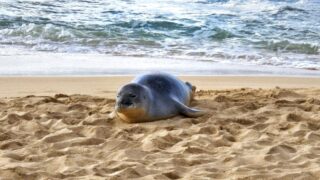
Most visitors arrive in Hawaii wanting to do right by the place, and the trouble is that the line between respect and disruption often remains invisible until someone points it out. Wildlife can look at ease around people while taking on real stress from the attention, and a single photo shot can look harmless until thousands of people chase the same shot in the same spot. This is where a lot of resident frustration actually starts, not out of malice but out of plain unawareness.
The visitor crowding a monk seal is usually not trying to hurt anything; the person stepping past a barrier may assume the rule was written for someone else, and the family walking away from a packed overlook may never picture what that spot absorbs after millions of identical visits.
These are also the easiest of all the grievances to fix. The visitors who slow down, watch, ask, and leave wildlife and places more room almost never end up in the story residents are telling.
The old Hawaii is disappearing while you’re looking for it.
Visitors tell us all the time that they want authentic experiences, and we know exactly what they mean. They want the Hawaii that feels lived-in rather than staged like a luau, where conversations happen on their own, traditions remain visible, and places still belong to the people around them.
The hard part is that authenticity itself has turned into one of Hawaii’s most marketable products. As tourism grows, gathering places become attractions, neighborhoods become visitor destinations, and the corners where people actually met each other change.
A marketplace becomes a development, a longtime hangout becomes something shinier, and a familiar block becomes one more version of somewhere else. Residents register that loss much more than most visitors because they remember what stood there before.
The places we recall most clearly are not the ones that changed, but the ones that vanished outright, and the visitor hunting for old Hawaii has usually arrived after it was already paved over.
Your must-see list is everyone else’s.
Every generation of visitors shows up with a list, the same beaches, the same hikes, the same lookouts, the same drives. This is, after all, a small place. The list is not the problem. The problem is that millions of people are carrying virtually the same one, and it shows across Hawaii.
Spots built for a modest number of visitors now absorb extraordinary demand, roads turn into parking lots, trails into crowded corridors, and viewpoints into waiting lines. Residents feel it differently because those places are part of their everyday lives, and visitors feel it because the reality rarely matches the picture that sold them on the trip.
This is another one of the grievances where both sides want the very same things: less crowding, more access, and better experiences. Often the best of Hawaii is sitting one beach over, one town down the road, or one hour earlier than everyone else thought to ever show up, because the islands have always been much more than just the must-see list.
The visitor Hawaii wants back.
We have come to think that most of this conversation is not really about tourism at all, but about relationships. Hawaii depends on visitors, and visitors love Hawaii.
The tension seems to arise when people move through the islands as consumers rather than guests, or when residents start seeing every visitor as part of a group rather than as a person, and neither side gains anything from that.
The visitors who leave the strongest mark are rarely the ones spending the most or checking off the most stops. They are the ones paying attention, the ones who catch that there is a greater story behind the view, a community behind the beach, and a history behind the place. Hawaii residents tell us exactly what frustrates them, and most of it is not about visitors being bad. It is about what visitors move through without seeing, from crowded beaches and vanishing local places to the cost of living behind the vacation view.
Those visitors tend to leave with a deeper Hawaii experience than the one they came expecting to find, and they are usually the ones residents hope will see again.
So we will leave it with you. If you live in Hawaii, what do you most wish visitors understood? And if you visit, what is the thing about these islands that took you years to finally get?
Photo Credit: © Beat of Hawaii at Hanauma Bay, Oahu.
By Rob and Jeff, Beat of Hawaii.
Some of the most meaningful parts of Hawaii are the ones visitors walk right past without knowing they are there. We’ve spent nearly 20 years finding them firsthand for BOH as full-time Hawaii residents reporting on travel, culture, and island life, and telling you what they mean for your trip. Join us →
Get Breaking Hawaii Travel News


Hawaii now wants more wealthy tourists and less visitors. Wow if this isn’t the formula to raise prices. Less customers means higher prices for local business to make the profits in order to pay the bills. Sorry looks like you’re in a situation where the fortunate or wealthy survive while the less fortunate suffer with the choice of keep on or move on.
The governance of Hawaii is the main culprit here. Over the last 10 years, state revenue has been a little over $25o Billion dollars. Think about that number for a moment – a quarter of a *trillion* dollars. What do we have to show for it? Where has the money gone? for all the crowing about transparency in government, we can only tell that things are continuing to deteriorate. These numbers do not include the county budgets. Truckloads of money have vaporized inside our corrupt government.
Until the people of Hawaii rise up and clean house politically, nothing is going to change. If we continue to do what we’ve always done, we’ll continue to get what we’ve always gotten. Is this what we want?
Excuse me if spent thousands on a vacation to your paradise island. Maybe I should be sorry if I purchased a bottle of water out of an ABC store not thinking a local or resident might be in dire need of a drink. It’s never cheap to live in pristine neighborhoods in the mainland nor is it cheap to live in paradise. If you live in New York expect it to be expensive including utilities as an example. You would think that locals and residents would accept the fact that Hawaii is marketed as a Vacation Destination. Sure expect crowds, bad traffic, delays to work etc. Most visitors with 1 week vacation or can budget for a week don’t have time to slow down and smell the flowers. If I’m some kind of inconvenience or invader then your island isn’t somewhere where I wish to spend any money. You also have to realize the street goes two ways.
Don’t come here then. Hawaii is about much more than money. Overtourism has caused us to be over tourism.
That and the “Spirit of Aloha” that is so touted left the island about the time of Airline Deregulation.
We have owned a STR on the West Side for 7 years now. We spent almost
$200 K renovating the unit, using local contractors and local vendors. Our annual property tax rose from $6000 to almost $17,000 in the past 7 years. We too would like to know how the county and state are using these funds. From a 850 sq ft condo. Multiply that by how many STR condos? We have educational materials in our condo for our renters about interacting on the beaches and with wildlife on the island. We encourage them to use locally owned businesses. We have come to Hawaii for 35 years. We’ve seen the changes, good and bad. But visitors come where they are welcomed. Some of that feeling has diminshed. Our building is over 50 years old. Most on the west side are that age. We aren’t part of the new development, yet we are blamed for it. It’s hard to understand how politicians can believe ocean front property can be affordable to local workers. Decades lack of long range planning is to blame.
Please let me explain. If the local buildings department refused to issue any new building permits for hotels, or such Hawaii wouldn’t be so overpopulated as it is today. They should have limited housing to as as an example no closer than 1 mile inland from any beach. No mobile home permits. Limit or restrict alot of new construction projects. If they did this years ago it would have the natural beauty of 40 years ago. No overtourism, less crowds, and more land. IMO just look at Waikiki. Major retailers like Rolex, Tiffany’s and such. It’s a major downtown city like Portland with palm trees. If the building department quit issuing permits years go Hawaii wouldn’t have this problem. IMO Hawaii is over developed in accomdating huge amounts of tourists that makes it unbearable for the locals and residents. Sorry and you can’t tell me that Hawaii isn’t about the money when there isn’t anything to do that don’t cost you some money at every turn.
Since Hawaii is a state, it would be nearly impossible to control the volume of visitors entering Hawaii. Airline and ships are able to control the capacities but most likely that would never occur. No company wants to lose income from passengers.
Independent attractions, restaurants, and hotels would never compromise profits for controls.
The only real solution is to limit visitor numbers, just like they are starting to do in other overtouristed areas. If we don’t it will just get worse. Hawaii Tourism Authority pretends to care about managing visitor impacts, but they won’t touch limiting visitor numbers. So it will get worse. If you visited before, cherish the memory.
The problems facing Hawaii are hardly unique. You complain about $4/gallon gas–ours is $8/gallon. You or your kids can’t afford the million dollar plus cost of housing. Neither can ours, and they’re also moving away to more affordable areas. But decades of poor governance in Hawaii, plus the woeful lack of foresight and planning does not become my emergency or responsibility when I visit. We visited annually for 30 plus years, and willingly paid the high cost for that privilege. Your article points out all sorts of problems also faced by many other jurisdictions, but is short on concrete suggestions. What exactly are we supposed to do, short of contributing to a donation box at the airport terminal?
No. Not a donation in a box at the airport. 😂
This is a great article highlighting key points of view. I agree, it isn’t the tourists fault things are the way they are. The key thing comes down to greed; placing profits over people. How much land has the government of Hawai`i sold to foreign investors who don’t care about a places culture and traditions. They come in, take what they can and leave when it doesn’t serve their purpose anymore. Hawai`i government is looking at how many local families are being forced to leave and now want them to come back but look at the one’s their recruiting to come back- mostly professional level jobs like doctors and psychiatrists. How about the authentic local who has a regular profession but loves Hawai`i and would love to come home. It comes down again to money. Speaking of money, where does all the taxes go that gets paid by locals? Outside, independent auditors, should be paid to look at and a working plan made for real change involving real accountability.
We love coming to Hawaii. My family has done so since 1979 – almost every year. I’ve been to all the islands (Lani and Molokai included) at least once. Yes, I’ve seen changes… lots of them. Am I upset by the new parking costs at the beaches? Not if the money is going back into maintaining/improving the site. I use it, I pay for it. Sounds reasonable to me. The biggest reason I come back time after time (and now for a month to 6 weeks at a time) is the Ohana feeling and the culture. I can get sun and beaches all over the world but Hawaii is special. The open air farmer’s markets, the eat outside restaurants, the museums, the food, and pop-up shows that showcase what Hawaiian history is all about – Magical! And I love the Hawaiian clothing – unique and special. We leave for Hawaii July 10th. Oahu/Waikiki for 2 weeks. Molokai for 2 weeks. Maui for 2 weeks. I’m so excited to come back to paradise again!
My parents met and were married on Oahu in 1956. Since my father was an airline pilot, we visited the islands almost every other year. I have cousins who live in Hilo. Like the article states….where does all the money go? Perhaps voting differently might just be a start?
I was born and raised in Hawaii but have lived on the mainland since after college, and my family and I have traveled back every couple of years for decades, so I have experienced the islands both as a local and a now-visitor.
For those here responding that this is no different than anywhere that attracts tourists, there is one very key difference that is being overlooked. Hawaii is made up of islands. Residents can’t just move further out and commute to their jobs and livelihoods and live somewhere significantly less expensive, as is at least a possibility in most touristed places. They have to pay the same prices that shock visitors during their vacations, and wages are generally much Lower in Hawaii than they are on the mainland.
Aside from the costs aspect, it’s hard for me to read the callousness of many of these comments saying “so what, I’ll just keep doing what I want with the same sense of entitlement toward the place they claim to love.
Off the track, one most remembered, two girls 7-8 local & inuit, alley yard sale, little bananas and fruit, trip hilite.
I believe there is real friction. But the role played by local / state government cannot be overstated.
While infrastructure on each island is overwhelmed, they scapegoat short term rentals (that keep the highest % of money in local pockets), while permitting lots of new timeshare buildings )that keep the smallest % of money in local pockets).
2080 Kalakaua is now a busy timeshare.
1833 Kalakaua will be operating soon.
A change in policy is greatly needed.
Hawai’i is unfortunately just like any other area that draws tourists. Every summer where I live millions come to visit the national parks in the area (about 8 million between the two, compared to 9.5 million over four islands in Hawai’i). Every year there are complaints and people wishing they would not come. Hawai’i, however, is lucky that this rush of tourism is spread over 12 months of the year and not seasonally as is the case here. The whining gets tiresome as if this admittedly beautiful island chain is unique in the world for the stresses of tourism.
It is very much seasonal. Just because we have beautiful weather year-round doesn’t mean people travel here year-round. Right now it is pretty quiet in West Maui. February is something completely different.
While that’s somewhat true, it goes from an average low of around 675K in September to a high of 925K in July. This is not the same as some of our mountain towns in the West seeing 5 million visitors between Memorial and Labor Day.
Wow; a really thought-provoking article, guys and I think you hit the nail on the head. Coincidentally, an article from Elliott Advocacy also appeared in my inbox today talking about people booking vacations they don’t really want to take, they just want to get away from whatever emotional state their in. I wonder how many trips to Hawaii are rooted in rage-booking behavior? And how much of bad Hawaii visitor behavior might be attributed to visitors who may not be in the most healthy of mindsets?
No. What about what tourist’s want. I IMO don’t like to be referred by people on the street in Hawaii as a walking wallet. IMO Hawaii has this perspective as if the first person don’t get all your money then the next person down the road will. Seriously is this any human way to look at another person? Just to mark them as some walking ATM. The people of Hawaii really need to talk to their building permit department and blame themselves allowing this development situation to go out of hand starting at the elected mayors and state elected officials that really run the show. Scream to them what you want and not some helpless tourist. Tourists never created this problem. It was the deparment that issues the permits and land use permits who really caused the environment change. Sorry visitors aren’t allowed to vote on that.
Why does no one ask where all of the tax money actually goes. I see a lot of dialog about visitors, but i really think that the residents should start to take responsibility for there own state and vote people in that actually know what they are doing.
As an owner of timeshare weeks in Kauai I find this a very interesting question. The county I live in is about the same size geographically and has about the same population.
Yet we survive just fine on less than 1/5 the tax revenue. With So much money going in, how do they manage to squander every bit of it?
Unfortunately, politicians that might have some idea of what they are doing or more in their heads than rocks and vitriol seem less inclined to pander to the right set of voters. Or they don’t pander hard enough. We continue to elect well-meaning ignoramuses fixated on their pet goals without the wisdom to give even a passing thought to unintended consequences.
“One needs to be right before getting righteous.” – Walter Darby Bannard
Locals don’t see you as an ATM but if you feel like an ATM its because the economy of Hawaii is beyond the means of the everyday person which is the point to the story. At the end of a trip you go home to a better economy while the local, from no choice of their own is stuck with the high prices barely able to survive and at times forced to move to another state away from friends and family who are not a days drive away like the mainland. You also lack insight as to how the hawaii government works across islands and things you never voted for come to be. High prices are not driven by the vote of the people, when was the last time you voted for your electric, water, trash or the food at the market to lower its prices. What ever high prices you felt while you were here was a choice you made by visiting, the local however pays the same high prices and no choice to shop or go elsewhere. Rather then take offense try a bit of empathy for what it must be like to live in this economy.
I take issue with your statement that we as tourists go home to a better
economy. Depends on where you live on the Mainland. In Oregon the
economy sucks. Oregon is a state like Hawaii. You get what you
vote for. Same as me. When I’ve had enough, I will move too. Breaks my
heart since I was born here, but the populace keeps voting for the high tax, out of control, corrupt politicians. I wager it’s the same in the State of Hawaii.
When You are forced to move like the Hawaiians you can go to the next state over or under in your case and pack all your stuff in a U haul and take it with you. Hawaiians are forced to take a 5 hour or more flight to a new economy, sell everything they have including their cars as the expense of shipping has doubled and most can’t afford it. It also then becomes an expense and flight they encounter every time they want to see their family or friends. Even if they wanted to stay and scrape by there is no housing to choose from. 2-4 generations living in the same cramped house. It is in this way that Mainland economy’s personal impact differs as the resources and distance to remedies for mainlanders lays much closer to your door where as the Hawaiians lays over the ocean.
Don, did you really read this thoughtful piece that strives so well to present an empathetic view of both perspectives, from the visitor and the resident? I truly don’t understand this reaction.
The theme is familiar, the reality is hard. Gone are the good old days (if there ever were any). Change is unstoppable as long as people remain people. Name a place that’s the same it was 40 years ago, with or without tourism. Hawaii is far from unique in facing this dilemma. Overtourism has stolen the peaceful existence of natives in all corners of the planet: Venice, Paris, Barcelona, Breckenridge, Ketchikan, Kennebunkport, St. Maarten. I’m a perennial tourist, and I’m respectful of the places I visit, as much as is practical. But once you open the door to your special habitat, I’m going to walk through it.
It’s not the visitor’s fault that greedy developers bribed county councils to build more and more and more. We would have hit an equilibrium if visitors were limited by capacity. But more is never enough.
Nowhere is this more evident than on Maui, where vacation rentals have completely overwhelmed and transformed neighborhoods. AirBnB and VRBO didn’t just make it easy to rent out a spare room or a house. It created a death spiral of investors swooping in and buying up property for the sole purpose of passive income. Maui County should have put a halt to it decades ago. At least Hawaii County is moving in the right direction before it too falls to the excesses of Maui.
This doesn’t happen in a vacuum. When county planning boards are made up primarily of realtors, the conflict of interest is astonishing, yet nobody says anything, because all the palms are greased.
Thanks for the interesting article. Non-rhetorical / non-sarcastic question: so what do the lodging / park fees actually fund? If they keep going up each year, with little to nothing to show for it, are they just used to pay government employees’ salaries? What examples exist of the funds providing tangible benefits for the state, locals and visitors? Mahalo.
Kind of my point, someone needs to audit all of the fee income and where it is going. I don’t thin anyone doesn’t appreciate the fact that its expensive to live in Hawaii. But the tourist does not spend your tax dollars, your elected officials do.
Over the last 40 years, my husband and I have visited the Hawaiian Islands at least a dozen times. We went as a couple, as parents with small children, as parents with teenagers, and now as senior citizens. We love everything about Hawaii and have read about and respected the culture. We do not go in tour groups; we follow all the local signage and regulations; and we are willing to pay to preserve everything the islanders want. I only hope that they respect our appreciation of their culture and our visiting.
These problems are no different than many tourist areas. I remember skiing in Whitefosh, MT. Wealthy skiers and fancy homes, yet locals mostly worked at lumber companies and barely got by. I alsonremember innthe midn69’s all the junk cars that were driven in to the jungle and left to rot. Some of these problems are not new or exclusively caused by tourists.
We live in Hawaii 5 or 6 months a year, and what I most wish is that visitors would put away their cellphones and experience what is around them, the sights, sounds and smells. I know that it is their loss when they walk with their phone five inches in front of their face all the time, but it makes me sad to the extent that it dents my own experience sometimes.
Do you think I am exaggerating? I’m not. I walk 5 miles every morning (without a phone) at least one-third of the other walkers or runners (mostly visitors because I recognize the other regulars) are not attuned to what’s around them. And even if a certain stretch seems fairly ordinary, there are still flowering bushes and enormous sheltering trees that they do not have back home.
Mahalo for the article. Is there a quieter weekday time residents recommend for visiting this area respectfully?