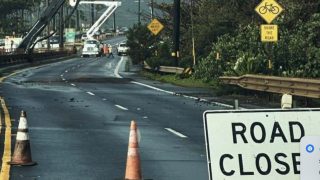
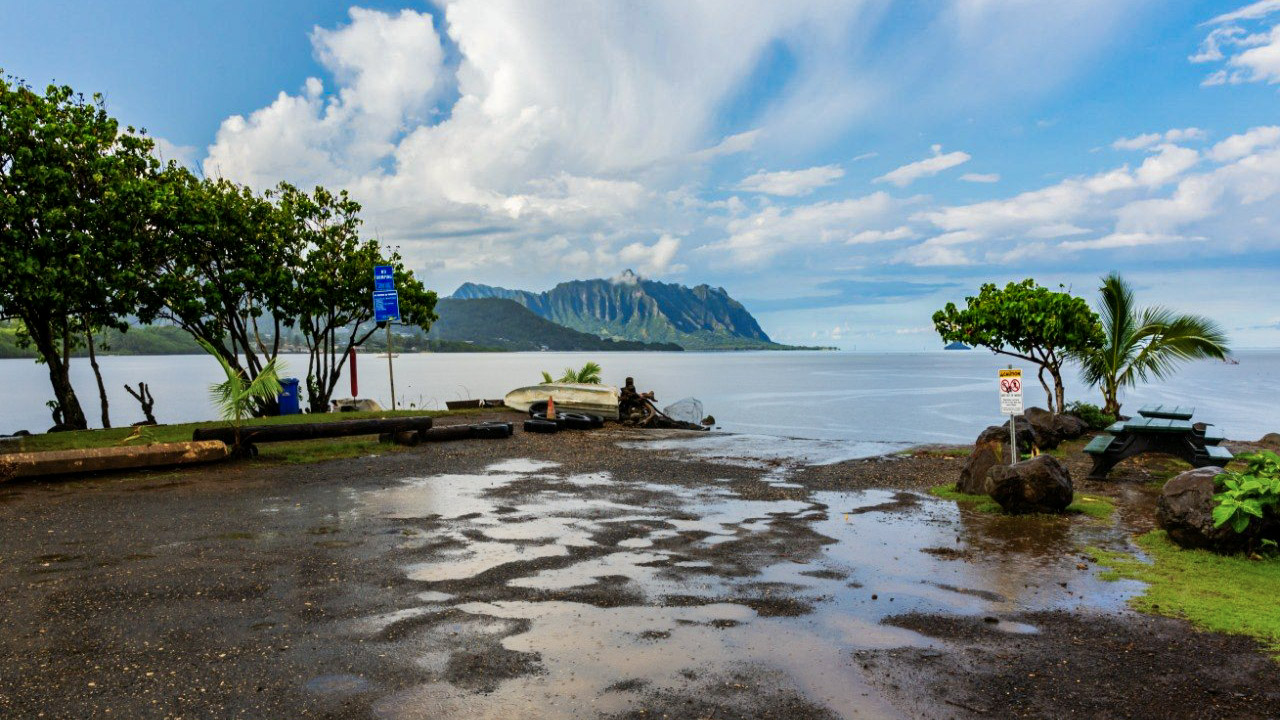
As Hurricane Fausto moved west toward the Central Pacific, visitors started contacting us to ask whether people were canceling upcoming Hawaii vacations or if they should. Here’s what other travelers are saying.
Hawaii visitors who were already on their way, flying within the next few days, or watching the forecast from home on the mainland overwhelmingly said they were still coming. One person wrote that they were already on the plane, while others said they were flying between now and Tuesday and had no intention of changing their vacation plans.
Comments including “Don’t cancel,” “Business as usual,” and “Nothing’s going to stop us” kept appearing. The words varied, but the decision was remarkably consistent.
These travelers were not ignoring Fausto or pretending Hawaii hurricane forecasts cannot change. They had simply reached the point where the existence of a hurricane somewhere east of Hawaii was not, by itself, enough to undo the trip.
Hawaii travelers had already made their decision.
Some of the strongest responses came from people whose vacations were no longer theoretical. Their bags were packed, their flights were hours away, or they were already in the air.
“I’m literally on the plane,” one traveler wrote. Others said they were leaving Sunday, Monday, or Tuesday and continuing to watch the forecast without changing their plans.
That distinction came through repeatedly. People were paying attention, but paying attention was not the same thing as canceling.
Several travelers said they would change activities if conditions required it. They might avoid the ocean, postpone a hike, spend more time at their hotel, or shift plans from one part of an island to another.
What they were not prepared to do was abandon the entire vacation based on a forecast that was still evolving. For most, the decision to come to Hawaii had been made long before Fausto appeared.
These were not casual weekend trips.
Hawaii vacations carry a weight that many other trips do not. Travelers described years of planning, thousands of dollars already committed, limited vacation time, and family schedules that could not simply be moved to another week.
For some, this was a bucket-list trip. For others, it was a return to the islands they had been planning for months or even years.
Flights, accommodations, rental cars, activities, and time away from work had already been arranged. For most, canceling would not mean choosing another sunny weekend later in the summer.
It would mean losing money or scarce vacation days, or waiting another year before everyone could come together to travel here again.
Travelers considering insurance after seeing Fausto should also know that coverage generally cannot be purchased retroactively for a storm that is already a known event. Existing policy terms, airline waivers, and hotel cancellation rules vary, so travelers need to check their own arrangements directly.
As of Sunday morning, no broad Hawaii travel waivers had been issued. That could still change if airlines begin expecting meaningful flight disruptions.
Watching carefully did not mean canceling Hawaii.
The comments did not suggest that visitors believed hurricanes were harmless or that Hawaii weather warnings should be brushed aside. Most described a wait-and-watch approach rather than blind confidence.
They were monitoring forecasts, checking airline information, and preparing to adjust once the actual effects became clearer. Several said they understood that a day at the beach might become a hotel day, or that part of an itinerary might need to be abandoned.
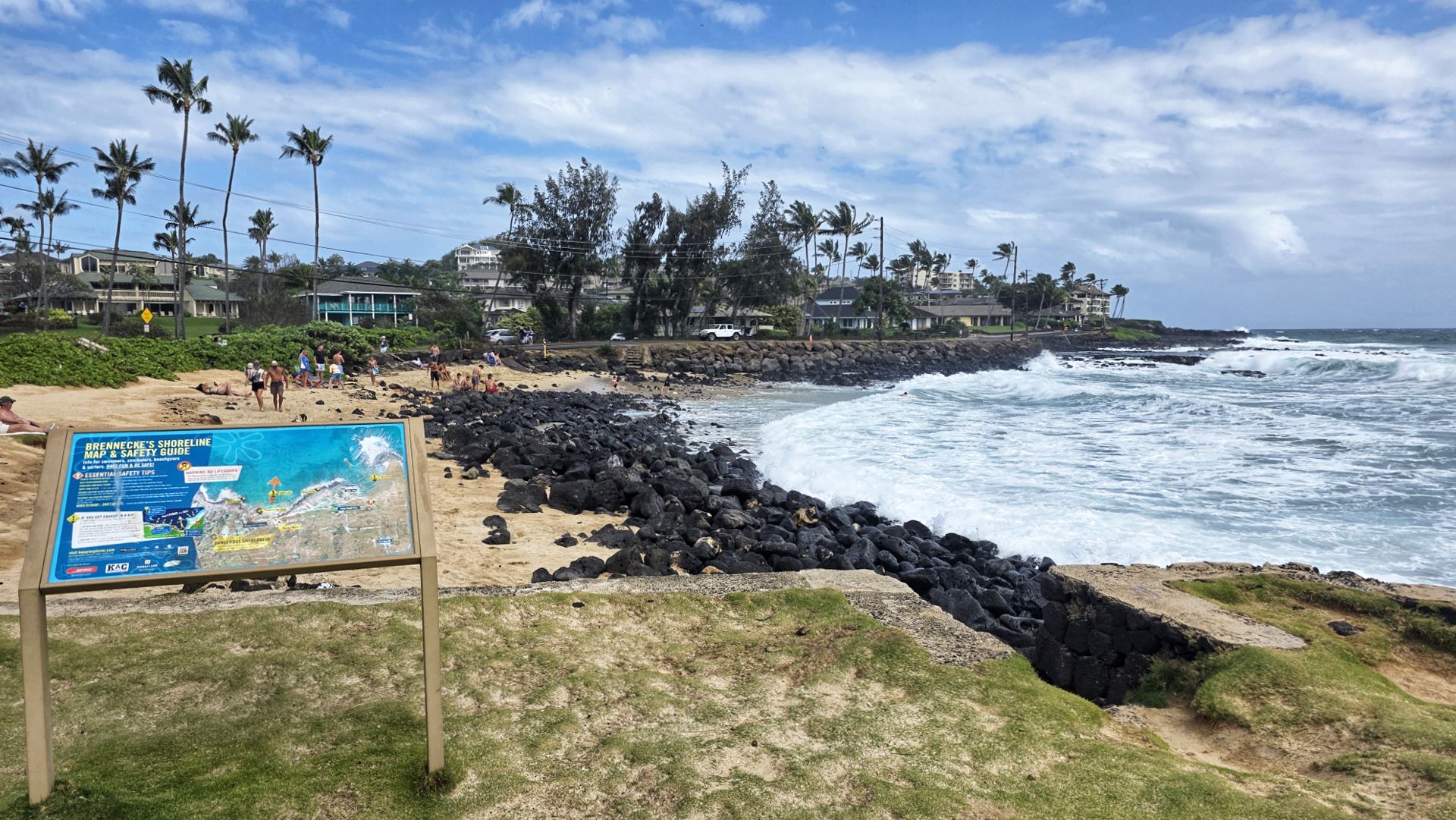
Several comments mentioned that dangerous surf and currents can be a greater immediate concern than the storm center itself, particularly for visitors unfamiliar with Hawaii waters. A storm passing offshore can still produce hazardous conditions along beaches that still appear inviting from the shore.
For many travelers, that was the line between changing plans and canceling the trip. They were willing to give up individual activities without giving up Hawaii.
Hawaii residents offered both welcome and warning.
Many Hawaii residents told visitors to continue with their trips while staying informed and using common sense. Their advice was generally to listen to officials, stay away from dangerous surf, avoid flooded roads, and be prepared to change plans.
Residents suggested visitors continue their trips, but that welcome came with suggestions that travelers should listenm and adjust their plans. Residents have seen people enter rough water, hike during dangerous weather, and drive past barriers because an activity was already on vacation schedules.
Visitors can continue with a trip while recognizing that the people who live here may be preparing for something more than a disrupted beach day.
The forecast could still change.
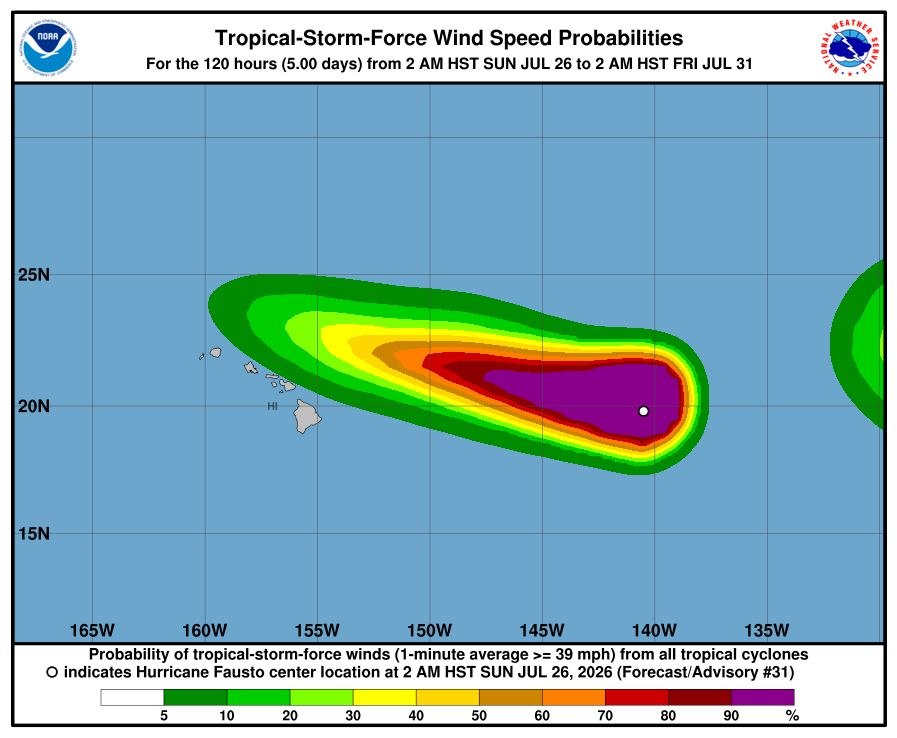
As of the 5 a.m. HST advisory Sunday, July 26, Fausto had weakened to a Category 1 hurricane with sustained winds of 85 mph. The National Weather Service said confidence was high that the center and greatest impacts would pass north of Hawaii, with Fausto expected to weaken to tropical storm strength as it approached the island chain Tuesday and Wednesday.
No tropical storm or hurricane watches or warnings were in effect for the Hawaiian Islands. Forecasters caution that any shift farther south or a slower weakening could still change island-by-island impacts.
The most certain effect was increasingly dangerous surf. A high surf advisory was issued Sunday morning for east-facing shores of Kauai, Oahu, Molokai, Maui, and Hawaii Island, with surf expected to build Monday and potentially reach warning levels Tuesday into early Wednesday.
Heavy rain and stronger winds remained less certain. The National Weather Service said locally heavy rain could develop Tuesday through Wednesday, depending on Fausto’s final track and condition as it neared the state.
Visitors should pay particular attention Tuesday and Wednesday, when rain chances are highest. Driving through flooded roads, entering fast-moving streams, hiking during heavy rain, or swimming near runoff can turn a disappointing weather day into a preventable emergency.
The forecast may continue improving, or it may create localized problems that are not apparent yet. Travelers should follow the Central Pacific Hurricane Center, the National Weather Service in Honolulu, airline guidance, and county emergency information rather than relying on an older forecast or a reassuring comment online.
What we heard from travelers was not that Fausto did not concern them. It was that they had already chosen Hawaii and would change their plans only as much as actual conditions required. For now, they are still coming. They are just watching more carefully.
Have you ever kept a Hawaii trip despite a storm forecast, or decided to cancel one? Tell us what happened and whether you would make the same decision again.
By Rob and Jeff, Beat of Hawaii.
For the latest on Fausto and Hawaii travel, join our free Beat of Hawaii email list.
Get Breaking Hawaii Travel News