
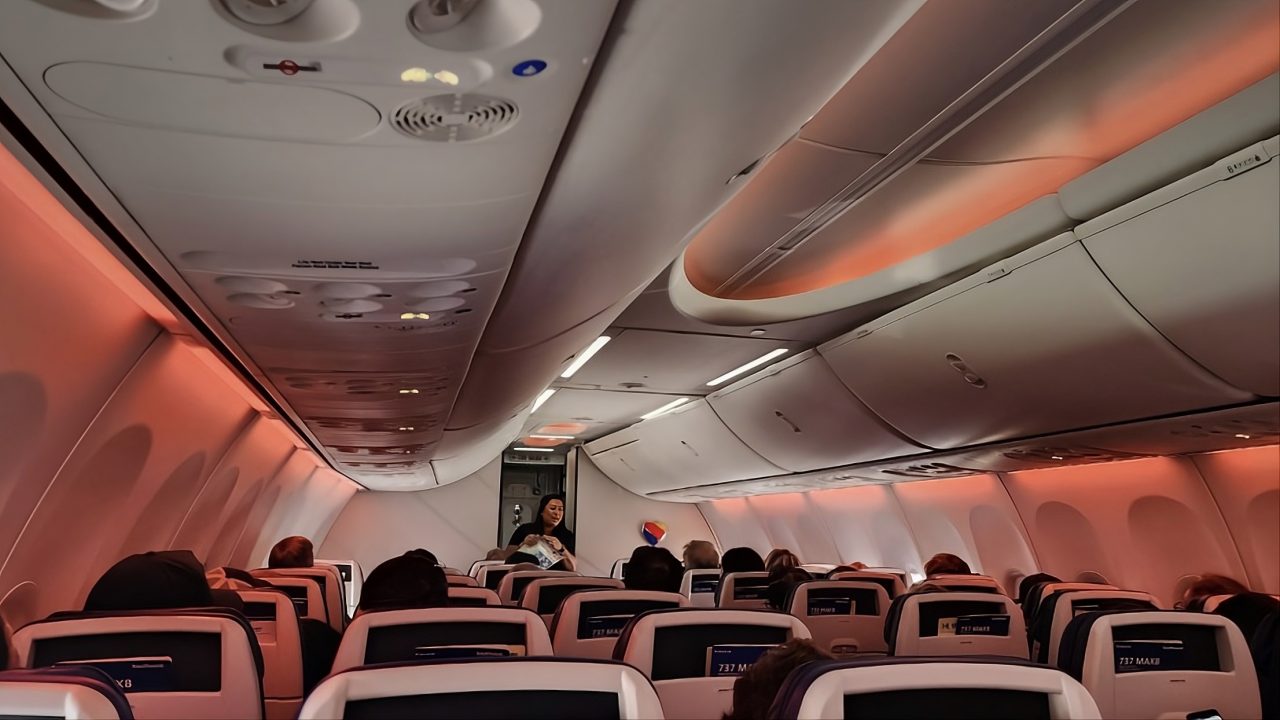
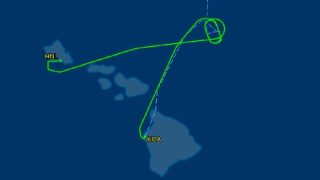
A red-eye flight bound from Maui to Las Vegas left on time Sunday night, climbed and left Hawaii normally, then reversed course over the Pacific about 90 minutes into the flight before finally diverting to Honolulu.
That sequence sounds dramatic, especially when paired with a reported emergency transponder code. Yet based on everything we can confirm so far, it appears to reflect a conservative decision by the flight crew early in an overwater crossing rather than evidence of something significantly wrong aboard the aircraft.
Southwest has not confirmed what prompted the turnback, and no official cause has been released. Until that changes, the more useful story for Hawaii travelers is why an aircraft might turn around early over the Pacific, why it headed for Honolulu instead of simply returning to Maui, and why those decisions can be reassuring rather than alarming.
A Vegas bound red-eye reversed course over the Pacific.
Southwest Flight 139 departed Kahului on Maui Sunday evening, July 5, aboard a Boeing 737 MAX 8, registration N8773Q, bound for Harry Reid International in Las Vegas.
Flight tracking shows the aircraft pushed back on schedule, departed around 8:40 PM HST, and climbed normally onto its usual east-northeast course toward the mainland. About one and a half hours into the crossing, while cruising at 32,000 feet, the aircraft reversed course over open ocean, and the crew reportedly squawked 7700, the international transponder code used to request priority handling from air traffic control. By itself, that code does not identify the type of problem or indicate how serious it may be.
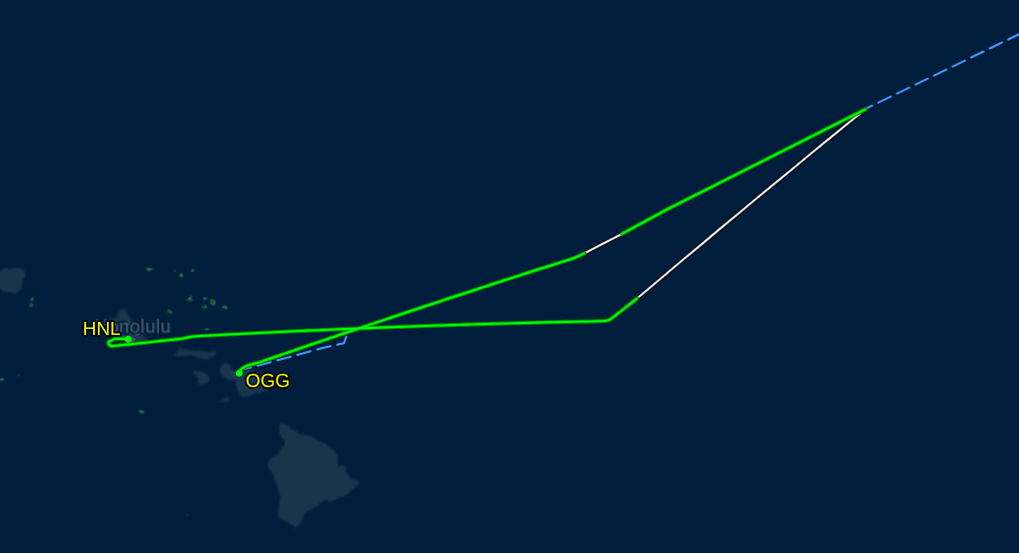
Instead of returning to Kahului, the aircraft diverted to Honolulu, where it landed safely at about 11:48 PM HST after roughly 3 hours 17 minutes in the air. Emergency vehicles were positioned at the airport as a standard precaution, and no injuries were reported among passengers or crew. For everyone aboard, however, the disruption was real because a red-eye that should have arrived in Las Vegas instead returned to a different Hawaii airport at near midnight, leaving travelers facing an unexpected overnight interruption and rebooking.
Here is what the flight tracking data shows. As of this morning, Monday, July 6, the aircraft hasn’t returned to service and has remained at Honolulu following the diversion.
Why the crew turned back instead of pushing on.
Long overwater flights involve a different set of considerations than flights over the continental United States. When a crew identifies something that warrants added caution, they weigh distance to suitable airports, fuel, weather, and the nature of the issue they are evaluating. Early in an ocean crossing, turning back toward Hawaii often offers more and better options than continuing farther from available airports.
None of that reveals what the crew saw Sunday night, but the timing of the turn back places it squarely within the conservative choices crews make when they want the widest range of options while the aircraft is still reasonably close to Hawaii.
Why this diversion ended up at Honolulu and not Maui.
Southwest has not said why Honolulu was chosen over Kahului, so we cannot present that as a confirmed operational decision. Even so, Honolulu offers the widest range of aviation resources in Hawaii, including longer runways, extensive emergency response capabilities, maintenance support, and airline operations, making it the most practical diversion airport in many situations. Diverting to Honolulu does not mean the situation was any worse than a return to Maui would have implied.
What hasn’t been confirmed yet about the cause.
What is unknown for now is the cause, whether mechanical or any other specific reason for the diversion. We’ll await more information and will update this as soon as we learn more.
What an overwater turnback means for your Hawaii flight.
Most Hawaii travelers spend five or six hours over open ocean without thinking much about the planning behind these flights, and this diversion is one such example. Airline crews make conservative decisions when something appears out of the ordinary, particularly early in an overwater crossing. While turning around over the Pacific may sound alarming and is certainly a frustration for passengers, it reflects a crew making deliberately conservative choices, using the flexibility they have early in a trans-Pacific flight before the aircraft gets farther from alternative airports.
When this happens, the immediate result is likely only inconvenience rather than any danger. Your plans may suddenly include a diversion, an overnight delay, a day off work, and a scramble to rebook, instead of arriving on the mainland as scheduled.
Those outcomes are frustrating, even though the procedures are normal. This flight landed safely, no one was hurt, and the reason for the diversion remains unknown for now.
If you were on this flight, please let us know in the comment section.
By Rob and Jeff, Beat of Hawaii.
Some of the most meaningful parts of Hawaii are the ones visitors walk right past without knowing they are there. We’ve spent nearly 20 years finding them firsthand for BOH as full-time Hawaii residents reporting on travel, culture, and island life, and telling you what they mean for your trip. Join us →
Get Breaking Hawaii Travel News
Hmmmmmmm………. Somebody forgot to fill up the tank?
It’s so tremendously reassuring to know the crew called this one beautifully.
BOH reports “What is unknown for now is the cause…”.
Impossible to say with certainty if the crew did the right or wrong things. The crew could have been to blame for the situation.
Blame is such an interesting word to use for this situation….??
The flight crew did Not make the wrong choice. Something was wrong. Perhaps they were overly cautious, something most passengers would prefer instead of pushing on and thinking, “This will probably be ok….I hope” and then that little drop in hydraulic pressure gets bigger and Bigger leaves them with an aircraft very difficult to control a few hours later.
The longest over-water flight distance in the world without a suitable alternate runway is the west coast to Hawaii. That may have been the issue.
Hawaii to the Americas is not even close to the longest flights without an alternate. Hawaii is the most remote location in the world as Hawaii is surrounded by ocean in every direction.
There are commercial flights from Auckland, New Zealand to both Johannesburg, South Africa and Santiago, Chili. One is an 11 hour flight and the other is a 10 hour flight without any alternate as there are no commercial airports in Antarctica. None of those 3 cities are the most remote as one only has to travel a short distance northwards to another airport.
Hawaii is an unavoidable long distance over-water flight no matter how you go. The other three cities are not. That difference leads many to make the mistake of assuming it’s the longest flight without a diversion. There are many travel articles and videos making this claim, but it is incorrect.
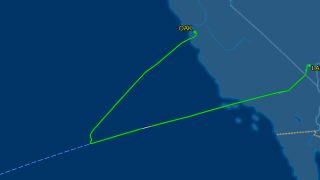
Aloha! We had to turn around from San Francisco to Kona for a medical emergency…a woman’s oxygen wasn’t working properly…we were over half way into the flight.
We didn’t land until after 10:30, but thankfully Costco called the rental car and hotel notifying them of what happened. As we walked into the rental car and our hotel, they had everything ready for us! That’s why we use Costco!
The choice of Honolulu is easy. There is only one runway at OGG. It would be easy for an incident to close the only runway. That very same runway is the preferred way of taking critical care cases over to Honolulu if there are any. A better, bigger fire department, multiple local hospitals and many long runways make it a logical and responsible choice.